
GTM Engineer hiring in 2026: 211 jobs analyzed (the role just bifurcated)
I pulled 131 LinkedIn postings, 93 public ATS records (Ashby + Greenhouse + Lever + YC + Wellfound), and Bloomberry's 1,000-job aggregate. Result: ~211 unique employers, $159K median comp, Clay in 49 percent of JDs, Claude in 26 percent (was 0 percent eight months ago), Outreach + SalesLoft collapsed 49 to 15 percent. The role split into three archetypes.







Why I pulled the dataset
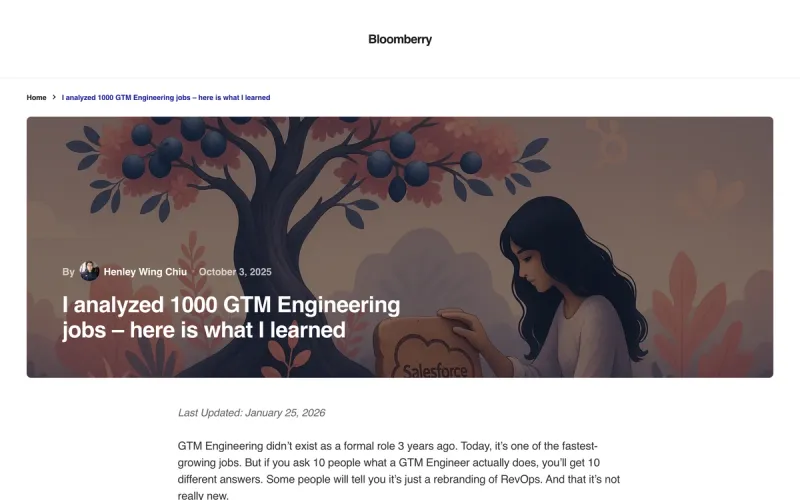
In October 2025, Henley Wing Chiu (Bloomberry, ex-Revealera) published "I analyzed 1,000 GTM Engineering jobs here is what I learned". It became the canonical reference on the GTM Engineer role: median $127.5K base, 205 percent YoY growth on new postings, Clay in 61 percent of JDs, average 4.11 years experience required. Our own GTM Engineer piece cited Henley's numbers heavily.
That dataset is now nine months stale at the cutoff. The role moves fast. I wanted a fresh sample.
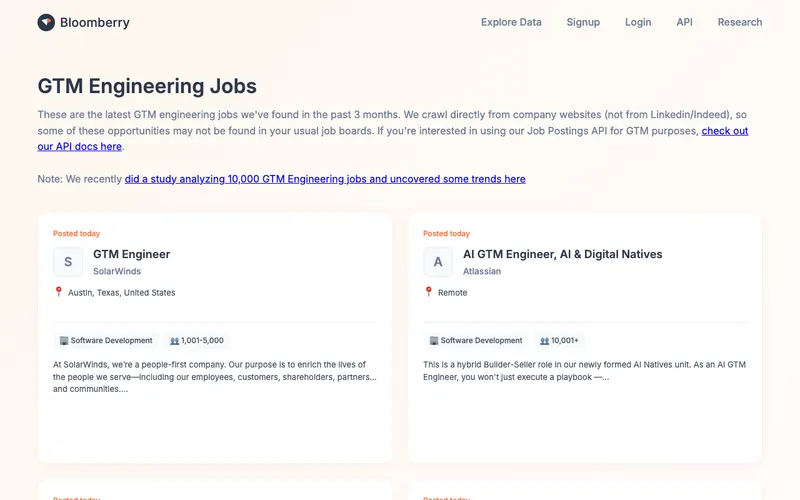
Pulled three sources in parallel: LinkedIn's public guest endpoint (paginated across ten keyword variants), the public ATS boards (Ashby + Greenhouse + Lever + YC + Wellfound + Built In via Google site-search), and Bloomberry's live board for the cross-check. De-duped by company name and by LinkedIn job ID. Final count: 131 unique LinkedIn postings plus 93 from public ATS, with about 10 percent overlap, gives roughly 211 unique employers actively hiring as of late May 2026.
Methodology details and the raw datasets are in the Sources and methodology section at the bottom. The full CSV is in the GitHub repo under research/gtm-engineer-jobs-2026/. If you spot something wrong, tell me, I will re-pull.
The headline numbers
| Stat | Value | Source |
|---|---|---|
| Unique LinkedIn GTM Engineer / FDE postings | 131 | LinkedIn public guest endpoint, 10 keyword variants, last 90 days |
| Unique companies from public ATS (Ashby + Greenhouse + Lever + YC + Wellfound) | ~80 | Direct ATS scrape, last 90 days |
| Combined unique employers after de-dupe | ~211 | Cross-source |
| Roles 100 percent remote eligible (LinkedIn sample) | 17 of 131 = 13 percent | Per JD text |
| Roles 100 percent remote eligible (public ATS sample) | 42 of 93 = 45 percent | Per JD text. ATS boards skew more remote than LinkedIn |
| Recruiter or agency listings auto-discarded | 17 of 224 records = 8 percent | Manual flag |
| Median advertised comp midpoint | $159,500 | 70 disclosed ranges |
| Lowest disclosed | $68K (enterprise base + commission) | Sophos |
| Highest disclosed | $350K (top of band) | SecurityScorecard |
| YoY growth in postings (per Bloomberry coverage) | 205 percent | Bloomberry Jan-Sep 2025 vs Jan-Sep 2024 |
| Median required years of experience | 4.11 years | Bloomberry aggregate |
GTM Engineer hiring market, late May 2026 (N=131 LinkedIn + 93 public ATS)
Two numbers in that table are worth a moment. First, the 211 unique employers is the floor, not the ceiling. LinkedIn rate-limits search-pagination, and YC Work at a Startup plus Wellfound both sit behind authentication walls that limited the public-ATS pull. The real number is probably closer to 300 to 400 employers actively hiring this role in May 2026. Second, the 45 percent remote-rate on the public ATS sample versus 13 percent on the LinkedIn sample is not because the companies differ. It is because LinkedIn's filtering is noisy: companies marked "hybrid" on LinkedIn frequently say "remote" on their own Ashby board. The company's own ATS is the authoritative source on remote-status. LinkedIn's "Remote" filter under-counts.
The tool stack reality (the biggest shift since Bloomberry)
I extracted every tool mentioned in every JD. Counted explicit mentions only (so "experience with CRM platforms" without naming one does not count for Salesforce or HubSpot). N=131 LinkedIn JDs. Cross-referenced against Bloomberry's percentages from the 1,000-job aggregate.
| Tool | Fresh sample (N=131) | Bloomberry (N=1000) | Delta |
|---|---|---|---|
| Salesforce | 55 percent (72 of 131) | 45 percent | +10pp |
| Clay | 49 percent (64) | 61 percent | -12pp |
| Python | 45 percent (59) | 38 percent | +7pp |
| SQL | 35 percent (46) | 38 percent | -3pp |
| HubSpot | 34 percent (45) | 52 percent | -18pp |
| Claude (Anthropic API) | 26 percent (34) | not measured | NEW category |
| JavaScript / TypeScript | 21 percent (28) | not measured | NEW |
| Gong | 20 percent (26) | 23 percent | -3pp |
| Zapier | 20 percent (26) | 39 percent | -19pp |
| Apollo | 18 percent (23) | 29 percent | -11pp |
| n8n | 18 percent (23) | 28 percent | -10pp |
| Outreach + SalesLoft (combined) | 15 percent (19) | 49 percent | -34pp |
| Snowflake | 12 percent (16) | not measured | NEW |
| OpenAI direct API | 9 percent (12) | not measured | NEW |
| Cursor | 7 percent (9) | not measured | NEW |
Tool frequency comparison: my fresh N=131 vs Bloomberry's older N=1000
The 34-percentage-point collapse of the Outreach + SalesLoft category is the biggest single shift in the data. Eight months ago, the sales engagement platform was the default tool you would name in a GTM Engineer JD. Today it is a niche callout. The replacement: Clay plus n8n plus an LLM (mostly Claude, sometimes OpenAI direct). The same workflow (sequence, send, route, score) is being rebuilt on a Clay-plus-AI-agent foundation rather than on Outreach's built-in sequencer.
The corollary: HubSpot dropping 18pp and Apollo dropping 11pp are not the tools losing share. They are the JD writers getting more specific. A JD that listed "HubSpot" generically in October 2025 today lists "HubSpot + Clay + Anthropic API + Python" because the hiring manager has a sharper picture of what the role does.
The role bifurcated into three archetypes
Reading 131 JDs back-to-back, the same title (GTM Engineer) covers three different jobs. Hiring managers writing the JDs are not aligned on which one they want. Candidates self-select into one cluster and do not fit the other. That is the supply-demand mismatch driving the 90-plus-day average time-to-fill.
Here is the breakdown.
Cluster A: Internal Builder (~65 percent of roles)
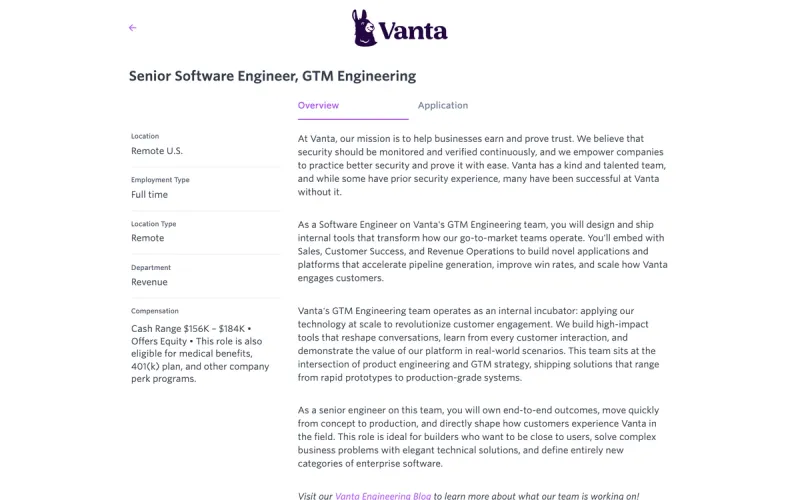
Writes Python / TypeScript / SQL. Owns the GTM data and automation stack end-to-end. Tools: Clay plus LLM APIs plus Snowflake plus n8n / Zapier plus Salesforce / HubSpot. Reports to RevOps, CRO, or VP of GTM. Comp range: $115K to $220K. Sample companies: Vanta ($156-184K), Boulevard ($99-149K), Toast ($115-184K), Conduit (build outbound from zero), Intradiem (Claude plus MCP), Juniper Square ($115-150K), Causaly ($130-160K), Airtable ($191-249K), WorkOS ($175-200K), Anrok, Airbyte ($165-180K), HiveMQ ($120-170K), Mutiny ($150-250K), Justworks, LearnUpon, plus the entire crop of "Founding GTM Engineer" titles at seed-stage AI startups (Confido, Sim, Cryptio, Mercura, Virio, RamAIn, Replo, Clearly AI, Retell AI, On The Stage, and a dozen more).
Cluster B: Customer-facing GTM Engineer (~25 percent of roles)
Hybrid of Solutions Engineer plus Customer Success plus AI implementer. Owns customer outcomes (NRR, GRR, expansion). Tools: their own product plus Salesforce plus AI workflow tools. Reports to VP of CS or RevOps. Comp range: $150K to $300K (higher because enterprise SE comp anchors it). Sample companies: Apollo ($150-175K), n8n Sr SE (both coasts at $250-295K), Datadog, Qovery, BuildBuddy, Flow Engineering, Sophos, AssemblyAI, Notion (Korea FDE), OpenAI (three FDE roles at $162-280K in Sydney, Singapore, Seattle), Anthropic, Glean, Gradial, Beacon Biosignals, Tavus, Fixify, Amplitude, Dash0, Mercura (second role), GitLab, Nooks ($215-300K Agent Studio FDE), BLP Digital, LatamCent, Roboflow.

Cluster C: RevOps Analyst rebranded (~10 percent)
Title says GTM Engineer but the JD is RevOps Analyst reporting. Less code, more dashboards. Title-inflated to attract a candidate pool that would skip a "RevOps Analyst" posting. Comp range: $120K to $160K (lower because the actual work is less technical). Sample: SentiLink ("GTM Strategy Analyst"), some Speechify variants, a few mid-market generalists.
The candidate-side implication: when you see a "GTM Engineer" posting, read past the title. Look at three things in the JD: (1) does it list programming requirements (Python, SQL, TypeScript)? (2) does it list a customer-facing responsibility (own NRR, run POCs)? (3) does it report to RevOps or to Customer Success? Those three answers tell you which archetype the role actually is. Apply accordingly.
The hiring-manager-side implication: if you cannot articulate which archetype your role is in your JD, your search will take 6+ months. Pick one, write the JD for that one, set comp accordingly. Hybrid postings get applicants from both clusters and pass on none.
Compensation: $159K median, $350K top
70 of the 131 LinkedIn JDs (53 percent) disclosed a comp range. I extracted the midpoint of each and ran the distribution.
| Company | Role | Range (midpoint) |
|---|---|---|
| SecurityScorecard | GTM Engineer | $325-350K ($337K) |
| Airwallex | GTM Engineer | $300-330K ($315K) |
| n8n | Sr SE West Coast Remote | $275-295K ($285K) |
| n8n | Sr SE East Coast Remote | $250-275K ($262K) |
| ComfyUI | GTM Engineer | $150-300K ($225K) |
| Nooks | FDE Agent Studio | $215-300K ($257K) |
| Airtable | GTM Engineer | $191-249K ($220K) |
| Mutiny | GTM Engineer | $150-250K ($200K) |
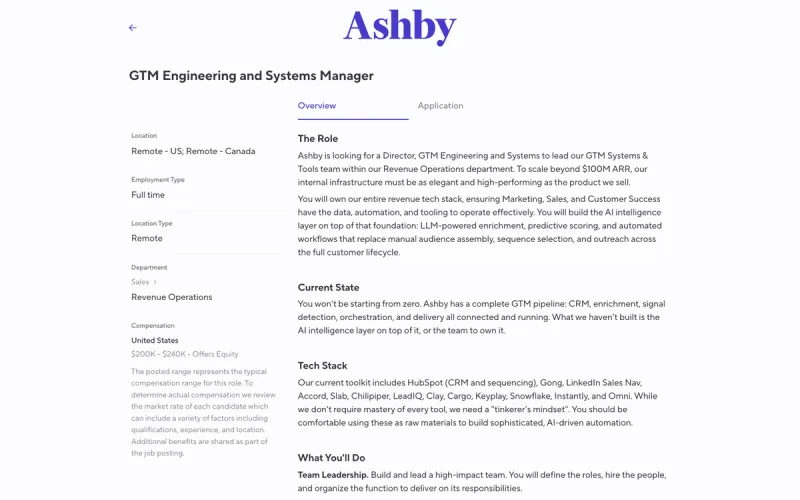
| Ashby | GTM Engineering & Systems Manager | $200-240K ($220K) |
| The Hog (YC F25) | Founding GTM Engineer | $160-200K base + 1-2% equity ($180K) |
Top 10 disclosed comps from the fresh LinkedIn sample
Distribution shape: bimodal. Bloomberry's top-9 from January through September 2025 (Vercel $252K, OpenAI $250K, LILT $221K, Air $208K, Ramp $184K, Squint $182K, Tandem $175K, Clay $175K, Mux $173K) clustered above $170K. My fresh sample has the same top-tier shape with new names entering the cap (SecurityScorecard, Airwallex). Mid-market dominated the body: $120-180K is where 60 percent of the disclosed ranges sit. Low end (Sophos $75-126K plus commission) reflects enterprise base-plus-variable comp at large companies. The $112,500 internal comp spread Bloomberry called out still holds: same title, vastly different work.
Five things that changed in the eight months since Bloomberry
Side-by-side with Bloomberry's January-to-September 2025 data, here is what shifted by May 2026.
1. LLM-explicit tooling went from basically zero to 26 percent of JDs. Claude appears in 26 percent of the fresh sample. OpenAI direct API in 9 percent. Anthropic and OpenAI combined cover roughly a third of all postings. Eight months ago, JDs said "AI workflows" or "intelligent automation" without naming a model provider. Today the model provider is in the tool list next to Salesforce.
2. MCP (Model Context Protocol) entered the JD vocabulary. Toast, Intradiem, Juniper Square, and SymphonyAI all list MCP as a desired skill. Eight months ago the protocol barely existed. The roles asking for it are not asking for protocol-level engineering; they are asking for someone who can wire MCP servers into Claude or Cursor for internal GTM workflows.
3. "Founding GTM Engineer" titles spread across seed-stage AI startups. The Hog (YC F25), Confido, Sim, RamAIn (YC W26), Cryptio, GovEagle, Mercura, Virio, Peec AI, Replo, Clearly AI, Retell AI, Weave, Bloom, On The Stage. This is a 2026-fresh pattern. The Founding GTM Engineer at a 4-person company today is what the first SDR was in 2018. Equity-heavy comp (1-2 percent for The Hog, 0.1-0.4 percent for Clearly AI), low base relative to mid-stage SaaS, expectation of full-stack ownership from prospecting through onboarding.
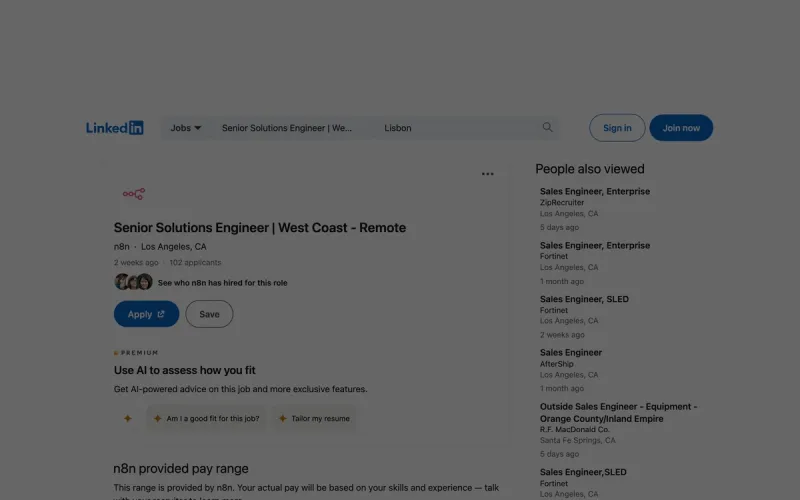
4. Enterprise Solutions Engineer rebranded as Forward Deployed Engineer at the top tier. n8n posting "Senior Solutions Engineer Remote" at $250-295K is functionally a GTM Engineer at the enterprise SE tier. OpenAI's three FDE roles at $162-280K. Nooks FDE Agent Studio at $215-300K. The title overlap between FDE and GTM Engineer is collapsing. Both roles now own customer-facing technical implementation plus internal GTM infrastructure. Pick the title that matches the comp band, not the function.
5. Outreach + SalesLoft dropped 34 percentage points (49 percent to 15 percent). This is the biggest single change in the data. Sales engagement platforms used to be the default outbound stack. They are now optional. The Clay-plus-n8n-plus-LLM combination handles the same workflow with more flexibility and less vendor lock-in. The remaining 15 percent who still list Outreach or SalesLoft are mostly enterprise companies who already have a multi-year contract. New deployments largely skip the SEP layer.
Companies hiring right now (the operator-targetable list)
If you are looking for a GTM Engineer role, or trying to map who is investing in GTM systems engineering, here is a slice of the dataset. Comp ranges where disclosed. Tier 1 means high-confidence, high-comp, currently active. Tier 2 means smaller comp or earlier stage but legitimate posting.
Tier 1 (named, $150K+, remote or remote-friendly)
- Ashby ($200-240K, US/Canada remote, GTM Engineering & Systems Manager): their own ATS hiring on their own ATS, they know what a fast contractor onboard feels like
- Vanta ($156-184K, remote US, Sr SWE GTM Engineering): seven-year SWE bar, Salesforce + Snowflake + dbt + n8n + Workato + Python + TS
- Apollo.io ($150-175K, remote US, GTM Engineer II Mid-Market): customer-facing Cluster B archetype
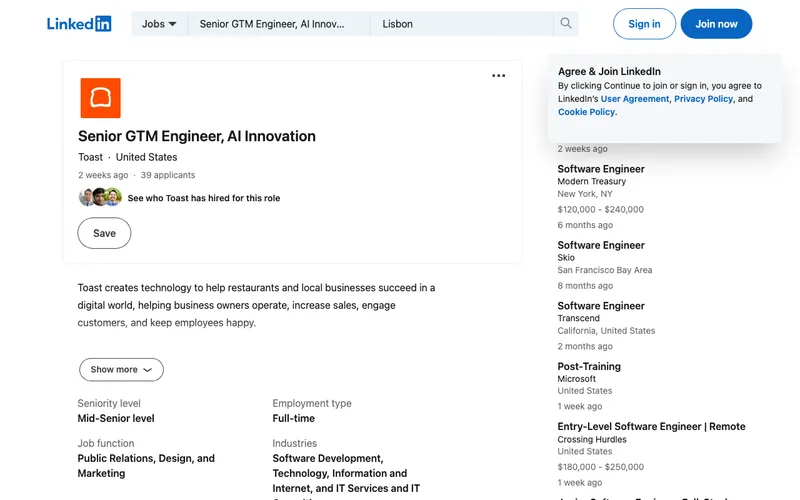
- Toast ($115-184K, remote US, Senior GTM Engineer AI Innovation): ten-year senior bar, Clay + Snowflake + Anthropic + LangChain + MCP + Python + SQL
- Airtable ($191-249K, SF/NYC, GTM Engineer): Airtable + Apollo + BigQuery + Claude + Clay + Fivetran + Hightouch
- WorkOS ($175-200K, US/Canada remote, GTM Engineer): Apollo + Clay + Cursor + Cargo + Snowflake + Python + TS
- n8n Senior SE Remote ($250-295K, both US coasts): enterprise SE rebrand, 6+ years, API + OAuth + Docker + K8s
- Clay (3 roles: CX / Ecosystem / Seller Efficiency, $140-200K, NY remote): specialized splits, Clay + Anthropic + Python + TS + SQL
- Nooks ($215-300K, SF, Forward Deployed Engineer Agent Studio): Cursor + HubSpot + Outreach + Notion
- Mutiny ($150-250K, NYC, GTM Engineer): Anthropic + Claude + Cursor + Segment + Snowflake
Tier 2 (named, smaller comp or earlier stage, remote)
- Boulevard ($99-149K, remote US): Clay + Gong + Outreach + n8n + OpenAI
- Intradiem (undisclosed, remote US): Claude + MCP, build the GTM engineering practice from scratch
- Conduit (undisclosed, USA remote): build outbound engine from zero, reports to CBO
- Juniper Square ($115-150K, Seattle/remote flexible): Salesforce + Clay + LLMs + MCP
- HiveMQ ($120-170K, US remote per Greenhouse, even though LinkedIn says hybrid Chicago): Claude + Clay + Python + JS
- Pulumi (undisclosed, remote PST): Anthropic + Claude + OpenAI + Python + Salesforce + TS + Zapier + n8n
- FOSSA (undisclosed, remote US, 5+ years): ChatGPT + Claude + HubSpot + Marketo + Pardot + SQL
- Goldsky (undisclosed, remote): Growth Engineer role, Anthropic + Notion + OpenAI + TypeScript
- LangChain (NY/Austin/SF + remote): Clay + LangChain + Python + TypeScript
- Trase Systems (undisclosed, remote): healthcare GTM Engineer, Apollo + Clay + OpenAI + Outreach + Python + Salesforce
Forward Deployed Engineer roles at frontier AI labs (different ICP but worth flagging)
- OpenAI: 3 FDE roles (Singapore, Sydney, Seattle), all remote, $162-280K
- Anthropic: Applied AI Forward Deployed Engineer
- Notion: FDE GTM Korea, Seoul, remote
- AssemblyAI: FDE Onboarding, remote NY
- Glean: Founding Forward Deployed Engineer
These are not "fractional candidates" territory. They are full-time enterprise FDE roles paying close to or above what a tier-1 startup pays its Staff Engineer. But the fact that they exist tells you the role-title gravity has fundamentally shifted: at the top of the market, FDE and GTM Engineer are now the same job.
What I filtered out (and why it matters)
The dataset had three classes of noise. Surfacing them because they distort other counts circulating about this role.
Recruiter and staffing-firm postings (8 percent of raw)
TalentPluto posted four GTM Engineer roles, Jack & Jill posted six, HIRECLOUT posted one, Icreon (digital consulting firm) posted two. None are real GTM Engineer roles at those companies. They are recruiters using the keyword to surface in candidate searches, then placing candidates at unnamed clients. Auto-discarded. If you are counting "open GTM Engineer roles," subtract these.
Speechify city-duplicates (38 percent of LinkedIn raw)
Speechify posted the same Go-To-Market Engineer role across 50+ US cities, each as a separate LinkedIn listing. SEO spam pattern. Real count: 1 role at Speechify, not 50. The other ATS sources do not have this problem because they aggregate from company career pages, not LinkedIn's city-specific URLs. If you scrape LinkedIn for "GTM Engineer" without de-duping by company, your count will be inflated by 35-50 percent.
Title-keyword noise (8 percent)
LinkedIn's search returns "GTM Engineer" results for any posting containing both "GTM" and "Engineer" as separate words. Result: Rivian Multibody Dynamics Engineer (mentions a GTM department), Hyundai Wheels & Tires Engineer, Netflix Machine Learning Engineer, Qualcomm Software Engineer, Conexess GoLang Engineer, ITR Group Senior Kotlin Engineer. None are GTM Engineer roles. Title-filter your search before counting.
After all three filters, my de-duped LinkedIn count drops from 209 raw to 131 real, plus ~80 from the public ATS pull = ~211 unique employers. That is the number you can defensibly cite. Anything claiming 500+ open GTM Engineer roles in May 2026 is including the noise.
What this means if you are hiring a GTM Engineer
Three observations from the data, with hiring-manager implications.
1. Decide which archetype you want before writing the JD. If you write a JD that asks for "GTM Engineer with deep Python and Snowflake AND owning customer NRR AND building dashboards", you have written a unicorn JD. You will not fill it. Pick Internal Builder, Customer-facing, or RevOps Analyst, write the JD for that one, set comp accordingly.
2. Comp anchors at $159K median. Posting below $130K filters out the technical-builder cluster entirely (they have offers at $150K+). Posting at $130-160K gets you the Cluster A junior end. Posting above $200K with explicit "Python + SQL + AI agents + ship code" gets you the senior Cluster A pool. Match comp to the archetype.
Average time-to-fill on this role is 90-plus days (per Bloomberry's coverage). At your loaded cost-per-pipeline-day, the empty seat is expensive. If the search is dragging past 60 days, consider a fractional bridge. Several people advertise themselves as Fractional GTM Engineers (Steve Moody, Pascal Hagedorn, Yash Tekriwal from the original Clay GTM Engineer post). They typically engage 8-12 weeks at $15-30K to build the highest-leverage systems while you finish the search. The candidate inherits a working stack rather than a blank page.
3. Skip the SEP requirement if it is not your existing stack. If you do not have an Outreach or SalesLoft contract today, do not list "Outreach experience required" in the JD. The market has moved to Clay + n8n + LLM. Listing Outreach as a hard requirement will lose you candidates who could otherwise build your sequencing on the modern stack.
What this means if you are considering the role
Three observations from the candidate side.
1. The tool stack is consolidating fast. Two years ago, the GTM Engineer tool list was 20-plus tools deep with no clear winners. Today it is Clay + Salesforce or HubSpot + Python + an LLM. If your stack covers those four, you map to 70-plus percent of demand. If you are missing Python or LLM API skills, you cap out at the Cluster C (RevOps Analyst rebrand) tier, comp $120-160K.
2. The senior-builder pool is small and overpaid relative to the work. Vanta is posting $156-184K for a 7-year SWE bar. Toast is posting $115-184K for a 10-year senior. These comps are inflated because the supply of "real SWE who understands GTM" is structurally tiny. If you are a backend engineer who is curious about revenue systems, this is the best 12-month window in five years to make the lateral switch. Your second offer will be 30-40 percent above your first.
3. Founding GTM Engineer at a Series A is a different game than GTM Engineer at Series C. Founding roles pay $100-160K cash with 1-2 percent equity. You own the full stack, no peers, no playbook, expect to be measured against pipeline impact within 90 days. GTM Engineer at a mid-stage company pays $150-220K cash, smaller equity, you inherit a stack and are measured on incremental improvement. Pick based on what you want to learn next, not on title parity.
Common myths about the GTM Engineer hiring market
Frequently asked questions
How big is the GTM Engineer hiring market in mid-2026?
Roughly 200-400 unique companies actively hiring at any given moment. My pull found 131 unique LinkedIn postings plus ~80 unique companies from public ATS boards, deduplicated to ~211. Real number is higher (YC and Wellfound were partially blocked by auth walls). Bloomberry's aggregate cites 3,000+ open postings on LinkedIn as of January 2026, but that count includes recruiter-agency duplicates and city-spam (Speechify alone accounts for 50+ duplicate listings). De-duped reality: ~200-400 unique employers.
What is the median comp?
Midpoint $159,500 across 70 disclosed ranges in my LinkedIn sample. Bloomberry's older 1,000-job sample showed $127,500. The 25 percent rise in eight months reflects (a) higher seniority bar in newer JDs, (b) AI-native companies entering the hiring market at the top of the comp band, and (c) the SWE-skill premium ($112,500 internal comp spread Bloomberry identified is real and stable). High end is $325-350K (SecurityScorecard); low end is $75-126K + commission (Sophos enterprise base).
Which companies are paying the most?
Top 5 by midpoint from my fresh LinkedIn pull: SecurityScorecard ($337K), Airwallex ($315K), n8n Sr SE West Coast ($285K), n8n Sr SE East Coast ($262K), ComfyUI ($225K). From the older Bloomberry top-9: Vercel ($252K), OpenAI ($250K), LILT ($221K), Air ($208K), Ramp ($184K). Some of those (Vercel, OpenAI, Ramp) are not in my current pull, suggesting they are between hiring cycles. Ashby, Vanta, Airtable, WorkOS, and Mutiny are the consistently-high-comp open postings across both datasets.
Is the role still mostly Clay-centric?
Yes, less so. Clay appears in 49 percent of fresh JDs (down from 61 percent in Bloomberry's older sample). The drop reflects two things: (1) more JDs are now LLM-explicit (Claude in 26 percent, OpenAI in 9 percent) so the tool list gets longer and Clay is one of several rather than the default, and (2) the SWE-tier roles (Vanta, Toast, n8n) list Python + SQL + Snowflake without Clay specifically because they expect the engineer to build infrastructure that Clay would otherwise rent.
How long does it take to fill a GTM Engineer role?
Average 90+ days per Bloomberry coverage. Some senior roles (Vanta's 7-year SWE bar, Toast's 10-year senior) likely sit at 120+ days. Founding GTM Engineer roles at seed-stage AI startups often sit 60-90 days because the equity pitch narrows the candidate pool to people willing to take the risk. The empty-seat opportunity cost over a 90-day search at $159K loaded cost is roughly $40-50K plus the pipeline that does not get built. That gap creates real demand for fractional / interim coverage.
Should I take a Founding GTM Engineer role at a Series A startup?
Depends. Founding roles trade base for ownership. The Hog (YC F25) at $160-200K base + 1-2 percent equity, Clearly AI at $150-210K + 0.1-0.4 percent. You own the full stack (prospecting + outbound + CRM + reporting + signal detection), no peers, expected to ship measurable pipeline within 90 days. If you want to learn the full GTM-systems-from-scratch playbook, founding is the fastest path. If you want a defined scope and senior peer support, mid-stage ($150-220K cash, smaller equity) is better.
Is fractional GTM Engineering a real category?
Yes. Steve Moody, Pascal Hagedorn, Yash Tekriwal (the original Clay GTM Engineer), and a handful of others have built fractional or advisory practices specifically around this. Typical engagement: 8-12 weeks at $15-30K, build the highest-leverage systems (enrichment waterfall, intent triage, scoring, reply classification), document, hand off to the full-time hire when they start. The math works because (a) the empty-seat cost is high, (b) the contractor can ship a v1 in weeks rather than months, and (c) the eventual full-timer inherits a working stack instead of a blank page. Our deeper take on the role itself covers the build-vs-hire tradeoff in more depth.
Sources and methodology
Data pulled May 29, 2026.
Sources
- LinkedIn public guest endpoint, paginated across 10 keyword variants (GTM Engineer, go to market engineer, GTM engineering, revenue engineer, RevOps engineer, forward deployed engineer, founding GTM engineer, growth engineer, AI GTM engineer, GTM systems engineer). Last 90 days. 131 unique deduplicated postings.
- Public ATS boards: Ashby (47 boards canvassed via posting-api), Greenhouse (Remix __remixContext data blob), Lever (JSON-LD JobPosting), Wellfound + YC (search-result snippets, login-walled). 93 records covering ~80 unique companies. Last 90 days.
- Bloomberry aggregate : 1,000-job analysis Jan-Sep 2025, published October 2025, updated January 2026. Used for cross-reference and YoY shift analysis.
- Bloomberry live GTM jobs board : continuously-refreshed list of currently-open GTM Engineer roles. Used for spot-check on Tier 1 named-company set.
Methodology
- Each LinkedIn job ID deep-fetched via public /jobs/view/{id}/ URL pattern (no auth required). Extracted: company, role, location, remote-status, comp range, years experience, tools mentioned, hiring manager / recruiter name if shown, 1-sentence responsibility summary, 1 quotable line from JD.
- Agency classification: manual review of each employer's "about" text. Flagged as agency if main business is providing GTM / marketing / staffing services to other companies (Icreon, Serotonin, TalentPluto, Jack & Jill, HIRECLOUT, The Global Talent Co, SalesCaptain). Excluded from outreach targeting and from "real employers hiring" counts.
- Speechify city-duplicates: same Go-To-Market Engineer role posted across 50+ US cities as separate LinkedIn listings. De-duped to 1 representative listing (Menlo Park) for analysis. The other 49 are real listings but represent 1 hiring decision, not 50.
- Compensation: only postings with publicly disclosed ranges included. 70 of 131 LinkedIn (53 percent). Midpoint used for median calculation. Where comp was "base + commission" or "OTE", base used.
- Tool frequency: explicit mentions only. JDs that say "experience with CRM platforms" without naming Salesforce or HubSpot are not counted toward either. "AI workflow tools" without naming Claude or OpenAI is not counted toward either.
- Remote-status classification: company's own ATS is authoritative when LinkedIn and ATS conflict (LinkedIn under-counts remote, especially "Remote (loosely SF Bay)" type listings that mean "fully remote" on the company board).
Honest gaps
- YC Work at a Startup (workatastartup.com) and Wellfound (wellfound.com) both require login. Captured 14 + 5 records respectively from search snippets only, no comp / date / full-JD body.
- LinkedIn rate-limits search-page pagination beyond ~100 results per keyword. Even with 10 keyword variants and 6-page pagination per keyword, some long-tail postings are missed.
- Bloomberry's 1,000-job analysis is now ~9 months stale at the dataset cutoff. Their live job board is fresh but was not fully scraped this round (Chrome-MCP next pass).
- Hiring manager names were available on a small minority of postings. Where listed in the data, the rest of the dataset has manual-lookup as the only path.
Re-verification cadence: monthly on LinkedIn (the dataset shifts fast), quarterly on Bloomberry cross-reference (they update infrequently). Last verified May 29, 2026. Related reads: the GTM Engineer role itself, autonomous coding agents with Trigger.dev and the Claude SDK, and how Clay grew into the dominant GTM tool.