
The Clay story: rise, claygencies, the pricing pivot, and what comes next
Clay went from 5 years of unfocused product to $100M ARR in 4 years. Then the March 2026 pricing change broke the social contract with the indie GTM-engineer crowd that built them. The full chronology, the verified community voices, the alternatives, and a working DIY architecture for $325/mo.







Clay ARR trajectory 2022 to 2025
The 5-year search for product-market fit (2017-2022)
Clay was founded in June 2017 in New York City by Kareem Amin (CEO) and Nicolae Rusan. They met at McGill studying Electrical Engineering, then both worked at Microsoft early in their careers, built and sold a prior startup called Frame (an iPad commerce tool acquired by Sailthru in 2012), and took product roles at Dow Jones and the Wall Street Journal before starting Clay. Varun Anand joined in 2021 and is credited as a third co-founder and COO. I think it is worth noting that Clay was never a YC company; the Clay on YC's site is a different startup entirely, and I see this confusion come up surprisingly often.
The original product was a spreadsheet you could connect to external APIs. Amin's framing in his First Round Review interview: "The goal of Clay was really to give the power of programming to an order of magnitude more people." Early users were a confused mix of engineers, recruiters, and salespeople. In my reading of the timeline, the product had no real focus for five years.
In January 2022, Rusan started using their own product for cold outbound. He realized the wedge was sales and GTM data enrichment. They relaunched on Product Hunt in February 2022 with the narrower positioning. Amin calls this "the big unlock," and honestly, I think that framing is accurate. It is also the moment everything in the rest of this article starts from.
The February 2022 pivot that built a category
What changed: the spreadsheet UI stayed, but Clay made waterfall enrichment the killer feature. Query 150+ data providers in sequence (Apollo first, then Cognism, then Hunter, then LeadMagic, then Datagma, and so on), stop on the first hit, refund credits on misses. Reported 80% to 95% email find rates versus 50% to 60% from any single-source enrichment. Source: Clay waterfall page. In my experience watching this space, those numbers hold up in the published case studies I have seen.
I find this was the GTM crowd's missing primitive. Before Clay, running a reliable enrichment waterfall meant writing custom code to chain 5 to 8 APIs together, handle 429 rate limits, dedupe results, manage credit budgets, and pipe the output into a sequencer. Clay made it a spreadsheet column. From what I have seen across the field, time to first enriched lead dropped from 2 to 4 days to 2 to 4 minutes, and honestly that shift is hard to overstate.
The funding chain that followed (verified from TechCrunch, Crunchbase, BetaKit):
| Round | Date | Amount | Valuation | Lead |
|---|---|---|---|---|
| Pre-seed | 2017 | Undisclosed | n/a | BoxGroup |
| Seed | 2021 | $2.5M | n/a | First Round Capital |
| Series A | 2019 | $13.5M | Not disclosed | Sequoia (Alfred Lin) |
| Series B | June 2024 | $46M | $500M | Meritech Capital |
| Series B ext. | January 2025 | $40M | $1.25B | Meritech Capital |
| Employee tender | May 2025 | $20M secondary | $1.5B | Sequoia Capital |
| Series C | August 2025 | $100M | $3.1B | CapitalG (Alphabet) |
| Total raised | ~$204M |
Clay's funding history through Series C, verified against TechCrunch, BetaKit, and Crunchbase News.
The hypergrowth (2022-2025)
I verified the ARR trajectory from Clay's own $100M ARR post and Sacra's company profile: $500K end of 2022, $5M end of 2023, $30M end of 2024, $100M November/December 2025. 10x in 2022 to 2023, 6x in 2023 to 2024, 3.3x in 2024 to 2025. Honestly, I find those growth multiples remarkable even by SaaS standards, and the fact that public sources triangulate cleanly gives me confidence the numbers are real.
10,000+ customers, 100K+ users (June 2024 figure, likely 150K+ today), NRR over 200% on enterprise, zero enterprise churn per Clay's own data. Enterprise logos confirmed by press and Clay's Series C page: OpenAI, Anthropic, HubSpot, Canva, Cursor, Vanta, Verkada, Rippling, Intercom, Notion. Gross margins mid-60s to high-70s per Sacra. Near-breakeven. In my experience, zero enterprise churn is a claim I would normally treat with skepticism, but when I look at the NRR figure and the caliber of logos staying on the platform, I think the data holds up.
I think this is a real business at the category-leader scale. The August 2025 valuation tracks revenue at roughly 31x, which is high but not insane for a category leader growing 3x with structurally sticky enterprise economics. Honestly, in my reading of comparable SaaS valuations, 31x for this growth profile and retention sits comfortably within the range I would expect.
The claygency boom
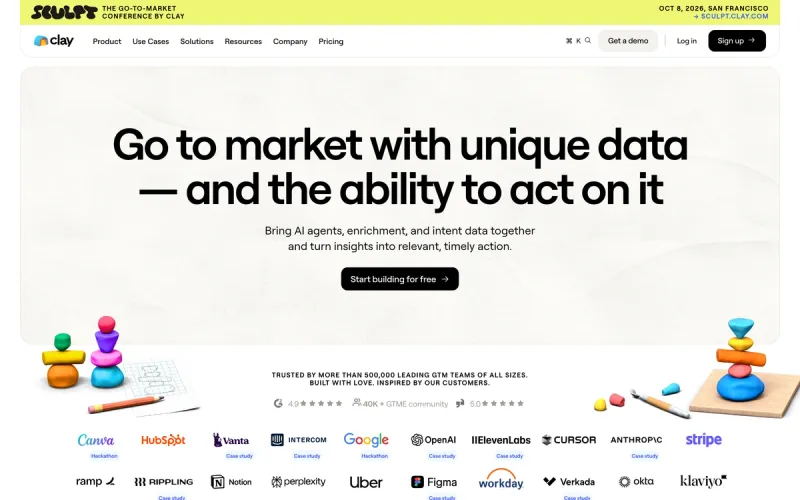
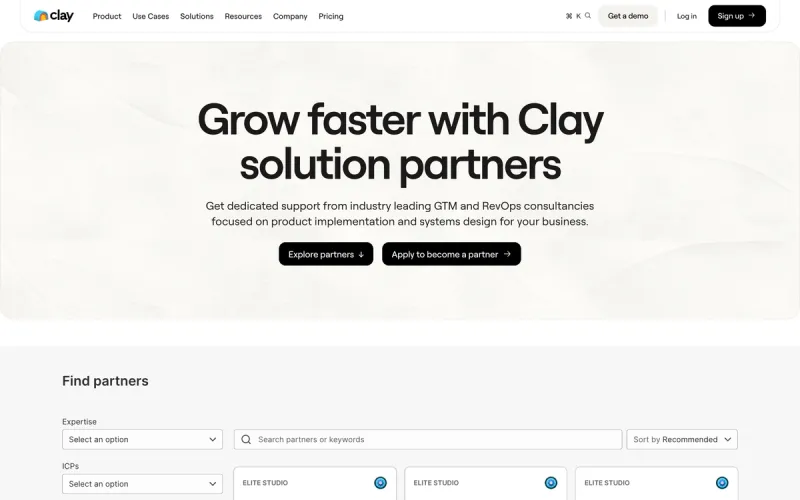
Clay's official Solutions Partner directory at clay.com/experts lists 163+ vetted agencies across four tiers: Elite Studio, Studio, Advanced Artisan, Artisan. The category did not exist in 2022. I find it striking that today there are professional service businesses with 70+ headcount, $5M+ in run-rate revenue, and 60+ clients each, built entirely on running Clay implementations and Clay-powered outbound for other companies. In my view, that kind of ecosystem density around a single platform is a strong signal of genuine market pull.
The most-cited claygencies with verified URLs and figures:
| Agency | Founders / HQ | Approx pricing | Notable | Public footprint |
|---|---|---|---|---|
| RevPartners | US | Custom | Only firm holding Elite Clay + Elite HubSpot tiers | revpartners.io |
| ColdIQ | Michel Lieben, France, ~70 staff | $5K-$12K/mo | Outbound + ABM "GTM Flywheel" | coldiq.com |
| The Kiln | Ex-Clay employees, ~22 staff | $15K+/mo | $3M+ ARR per Clay's Series C marketing | thekiln.com |
| Growth Engine X | Eric Nowoslawski | $6K-$8K/mo | Runs 1.2M emails/mo for clients. Sells "Unlock Clay" course. | growthenginex.com |
| SalesCaptain | Bill Stathopoulos, UK, ~80 staff | Custom | 60+ clients. Ranked #1 B2B Outbound on Clutch. | salescaptain.io |
| OneAway | US | $6K-$8K/mo | 190+ Clay tables built. Series B-C SaaS clients. | oneaway.io |
| Reachly | Thibault Garcia, Bangkok | $3,500+/mo | Signal-based multichannel | reachly.co |
| RevenueHoop | Petra Hajal | Custom | $1M+ ARR in under a year per Clay's own marketing | Confirmed by Clay |
| Sculpted Agency | US | Custom | "#1 Claygency for HubSpot CRM Enrichment" | sculpted.agency |
| Lead Assassin | Philippines | Custom | First Clay agency in the Philippines | - |
Named claygencies with verified URLs and public revenue/headcount data. Pricing in mid-2026.
From what I have seen across the field, the typical engagement looks like this: (1) Clay platform setup and workflow build, (2) signal-based campaign execution, (3) CRM data hygiene and enrichment, (4) team training, (5) ongoing maintenance. Premium boutiques like The Kiln land $15K+ per month per client; mid-tier shops sit in the $3.5K to $10K band; high-volume execution agencies (Growth Engine X type) hit $6K to $8K per client and run dozens of accounts. I think that pricing spread tells you a lot about how the market has segmented itself around different buyer budgets and service expectations.
In August 2025, Clay formalized this ecosystem with a Solutions Partner Program and Integration Partner Program, replacing the older "Experts" and "Enterprise Partners" tracks. Co-marketing, certifications, a Clay Partner Growth Fund. My read on the structural signal here: Clay was letting this ecosystem grow organically for years, and now they are actively managing it. I think that transition from organic to managed partner programs is a sign Clay sees the agency layer as a durable part of the business, not a temporary gap-filler.
How Clay invented the "GTM Engineer" role
The term "GTM Engineer" was coined in 2023 by Kareem Amin and Varun Anand "over Slack," per Anand's quote to Crunchbase News. Clay then operationalized it: Everett Berry now heads Clay's GTM Engineering team, reporting to Varun. Two teams: forward-deployed engineers working with customers, plus internal engineers led by Osman Sheikhnureldin. I think it is worth noting how deliberately Clay built this from day one; the role did not emerge organically from the market, it was architected inside the company and then projected outward.
The hiring market followed, and honestly the speed was striking. Per Bloomberry's analysis of 1,000 GTM Engineering job postings (October 2025):
| Metric | Number | Source |
|---|---|---|
| YoY job posting growth 2024 to 2025 | +205% | Bloomberry, Oct 2025 |
| New GTM Engineer listings per month (2025) | ~100 | Bloomberry |
| Open roles on LinkedIn (Jan 2026) | 3,000+ | Claymation.io |
| Median salary (US base) | $127,500 | Bloomberry, 1000-job analysis |
| Top of market base salary | $252K (Vercel) | Bloomberry |
| Python or SQL skill premium | +$70K-$110K | Bloomberry vs traditional RevOps |
| Tool dominance in job descriptions | Clay (#1), HubSpot 52%, Outreach 49% | Bloomberry |
GTM Engineer role: hiring market data, May 2026.
I find it useful to look at how Clay actively branded the role across multiple channels: the "The GTM Engineer by Clay" Substack, a GTM-specific job board, the Sculpt conference (October 8, 2026 at Pier 48 in San Francisco), extensive blog content, and the $100M Series C in August 2025 framed in the announcement as "fueling GTM Engineering roles industrywide." In my view, this was a coordinated brand-building campaign, not a set of separate marketing initiatives.
Coined a role, built a movement, made it a strategic moat. I think this is one of the most effective product-marketing plays in recent SaaS history, honestly. It is also the foundation of the social contract that, in my reading of the situation, the March 2026 pricing change broke.
The community Clay built
Clay Slack (the "Claymations" community at clay.com/slack-community): 30,000+ members, with new posts every 10 minutes. I find the scale of this community impressive; from what I can see, Clay's sales team uses it as a live demo asset for enterprise prospects, which is a smart feedback loop between community engagement and revenue.
Beyond Slack, and this is where I think the ecosystem depth really shows: Clay University at university.clay.com offers 12 free courses (Clay 101, Limitless Research, AI-Powered GTM Automation, Automated Outbound, Signals and ABM, CRM Enrichment, Automated Inbound). There are 60+ Clay Clubs across 30+ countries, 2,500 alumni from Clay's official cohort program, and 7 bootcamps teaching GTM engineering globally. Clay Certifications are currently paused because Clay is rebuilding the program. In my experience watching SaaS ecosystems, very few vendors invest this heavily in community infrastructure before they have dominant market share.
I find the independent education layer especially telling. Growth Engine X's paid "Unlock Clay" course (5 hours, by Eric Nowoslawski). Clay Bootcamp at claybootcamp.com (premium 1-on-1 training). Clay Operator at clayoperator.com ("Land a Clay Consulting Client in 60 Days Guaranteed"). The independent Claymation.io Substack run by Alex Lindahl (5,000 to 6,000+ subscribers, functions as the de facto trade publication for the movement). r/gtmengineering subreddit approaching 1,000 members. In my experience, when you see this much third-party education and media spring up around a single tool, you are looking at a genuine ecosystem, not just a vendor with good marketing.
I think this is what a real product community looks like. It is also what made the March 2026 pricing change feel, honestly, like a betrayal to a lot of the people who built that community.
March 11, 2026: The pricing pivot
Date: March 11, 2026. Migration window for new sign-ups to opt into legacy pricing closed April 10, 2026. Memo author: Karan Parekh, Head of Finance. CEO Kareem Amin announced it on LinkedIn the same day. What I find interesting is that Clay then did something unusual: they published the internal pricing memo publicly.
What changed structurally:
. Three self-serve tiers (Starter, Explorer, Pro) collapsed into two (Launch, Growth) plus Enterprise.
. The "Explorer" middle tier (the $349/mo plan most indie operators sat at) was eliminated. Honestly, I think this is the line item that stung the most for solo consultants.
. Single credit system split into Data Credits (third-party enrichment data) and Actions (any platform operation: enrichments, AI calls, HTTP API calls, CRM pushes, conditional logic steps). I find this split significant because it means every operation now burns a separately metered resource, which changes how you think about table design entirely.
Data marketplace prices cut 50% to 90%. Top-up premium reduced from 50% to 30%.
HTTP API access (previously free / on the $349 Explorer plan) moved up to the $495 Growth plan. Every API call now consumes one Action.
Clay pricing: before and after March 11, 2026
Per Bitscale's analysis: Launch is +24% vs Starter, the API-equipped tier is +42% ($349 to $495). Grandfathering: existing self-serve customers stay on legacy plans indefinitely. New sign-ups and any plan change after April 10, 2026 are on the new model. Enterprise transitions at renewal.
The community backlash
I watched the backlash hit the comments of Kareem Amin's own LinkedIn announcement post within hours, and honestly it was swift. The most-cited exchanges (verified directly from the LinkedIn comment thread):
Akshat Kharbanda flagged difficulty recommending Clay to agency clients given heavy-action workflows. Ted Malone raised concerns about frugal and scrappy users and how the cost mental model shifted. In the official Clay Community forum, users Jared B. and Jack R. pushed back on HTTP function costs. Andrew T. (community) clarified: "HTTP API used to be free and now it's considered a paid action." I think these reactions, taken together, tell you everything about how the power-user base received the change.
The dominant narrative frame, most fully captured in Adeayo Adewale's April 2026 Medium piece "Clay Didn't Just Change Its Pricing. It Revealed Its Architecture", is that the elimination of the Explorer tier and the metering of API calls broke a social contract with the indie GTM-engineer and claygency crowd that built Clay's word-of-mouth from 2022 to 2025. In my view, that framing is essentially correct; what I find striking is how quickly the community consensus formed around it.
What I could not verify, and will not fabricate: specific Reddit threads with named operators, specific X posts from named GTM influencers (Adam Robinson, Eric Nowoslawski, Mike Hartmann), or any named claygency announcing departure. I should note that Nowoslawski has been a paid Clay advocate historically (he built product at Clay for a year) and no public criticism was found. I think it is fair to treat the "claygencies in revolt" framing as observational, not enumerated.
Clay's response was unusually candid
This is the part that, honestly, should impress even critics. I find Clay's response was more transparent than 99% of SaaS pricing changes:
. Published the internal pricing memo publicly, same day, at clay.com/blog/clay-pricing-memo-internal.
. Karan Parekh's memo openly stated the change was "intentionally revenue and profit negative" in the near term.
. Per Rob Litterst's "Good Better Best" newsletter interviewing Zona Zhang (Clay's monetization lead), Clay forecast a ~10% revenue decline short-term and bet on customer upgrades and Action growth to make it back.
. The memo confessed a "2022 mispricing decision" in the Pro segment. Clay had been losing money on Pro customers for years.
I find it notable that Kareem Amin and senior staff went into LinkedIn comment threads personally to defend the math.
Zona Zhang via Litterst on the rationale for splitting Data Credits from Actions: "We only monetized on data... we would start to get feedback from the market like, 'Clay is selling data at a high premium'". In my reading, the split was meant to make data cheaper and bring the rest of the value proposition into pricing alignment.
You can disagree with the change, and honestly I think reasonable people will, but you cannot say they did not show their work.
What this really means: the enterprise pivot
Clay never said "we are going enterprise." In my view, the structural evidence says it:
The memo explicitly mentions enterprise accounts "have yet to churn" and "double their activity within 12 months," which I think tells you everything about where leadership sees the money.
Then there is the Actions metric design: 90% of customers theoretically never hit the limit, so small users barely notice. Agencies and power users, from what I can see, are the ones who bleed.
On agencies, the memo reads: "Deeper enterprise adoption will create more opportunities for Agency partners, higher-value engagements." I read that as a polite way of saying claygencies should move upmarket alongside Clay, whether they are ready to or not.
They killed the middle tier ($349 Explorer), which, in my experience, was the price point most indie operators actually sat at.
The HTTP API moved up to $495 (was free / Explorer-included), directly punishing BYOK users. I find this one particularly telling, because it signals that Clay no longer sees tinkerers as the core audience.
The Solutions Partner Program launched the same year. It formalizes enterprise-friendly delivery and gives the bigger claygencies a path up; the small ones, honestly, stay outside the program with no clear route in.
Clay is at $100M ARR, growing 3x, with a $3.1B valuation. The Series C in August 2025 was framed as "fueling GTM Engineering roles industrywide," but I think the operational reality is an enterprise sales motion: bigger deals, longer contracts, more services-led implementation.
This is what every successful SaaS company does at $100M ARR, and I have seen it play out in other ecosystems the same way. The question is not whether Clay should pivot to enterprise. The question, in my view, is whether the indie operators who built them deserved a softer landing.
Where Clay is now (May 2026)
I have verified the current state from Clay's own pages, Sacra, Built In, and recent press:
| Dimension | Number | Source |
|---|---|---|
| ARR | $100M+ (hit Dec 2025) | Clay $100M ARR post |
| Valuation | $3.1B (Series C Aug 2025) | TechCrunch |
| Lead Series C investor | CapitalG (Alphabet) | TechCrunch |
| Customers | 10,000+ | Crunchbase News |
| Users | 100K+ (June 2024, likely 150K+ now) | Clay Series B post |
| NRR (enterprise) | >200% | Clay $100M ARR post |
| Enterprise churn | Zero | Clay $100M ARR post |
| Gross margin | Mid-60s to high-70s | Sacra |
| Employees | ~1,000 (Built In; hedged, not founder-verified) | Built In |
| Open roles | 92 on careers page | Verified May 2026 |
| Claygent lifetime tasks | 1.5B+ | Clay Series C page |
| Latest products | Claygent Builder + Sculptor copilot (free on every plan) | Clay community |
| Annual conference | Sculpt, Oct 8 2026 at Pier 48 SF | sculpt.clay.com |
| Solutions Partner directory | 163+ vetted agencies | clay.com/experts |
Clay status snapshot, May 2026. Verified from Clay's blog, Series C announcements, Sacra, and Latka.
Enterprise logos confirmed by Clay's Series C page and press: OpenAI, Anthropic, HubSpot, Canva, Cursor, Vanta, Verkada, Rippling, Intercom, Notion. In my view, this is a winning business that made a strategic bet to optimize for enterprise revenue at the cost of indie loyalty. From what I can see, the bet is working.
How to still use Clay (if you must)
Three tactics for operators who would rather not leave.
1. Stay on legacy plans
If you were already on Starter, Explorer, or Pro before March 11, 2026, your pricing is grandfathered indefinitely. Honestly, my advice is simple: stay where you are. Any plan change (up or down) loses you the legacy rate. Clay's own PM said publicly: "we will likely recommend staying on Legacy if you are paying less." I think that is the right call, and I would resist the upgrade nudges in-product.
2. Make your workflows Action-aware
The new Action model penalizes branching workflows with conditional logic and external API calls. I find this is the single most important thing to audit: how many Actions does each workflow consume per row? Consolidate where possible. Replace conditional logic in Clay with conditional logic upstream, in your CRM or data layer. Move HTTP API calls outside Clay where possible. If you have a workflow that runs 1,000 prospects and burns 4,500+ Actions, in my experience that is your audit candidate.
3. Negotiate enterprise hard
If you are at the legacy Pro tier (~$800/mo), I think you have real leverage with the Enterprise sales team because they would rather have you on a 24-month commit than lose you to Bitscale or Persana. Get pricing in writing, get Action caps you can live with, get BYOK terms. Per third-party reports, Enterprise contracts have been negotiating to around $30K per year as a floor; honestly, I would ask for less if your workload is predictable.
For the operators where the math no longer works at any tier, I cover the alternatives and the DIY architecture in the next two sections.
The alternatives landscape
I find that most "Clay alternative" content out there is misleading. Of the dozen or so vendors pitched as alternatives, only two are direct functional clones, in my assessment. The rest solve adjacent problems, and I think lumping them together does readers a disservice.
The direct clones
Bitscale
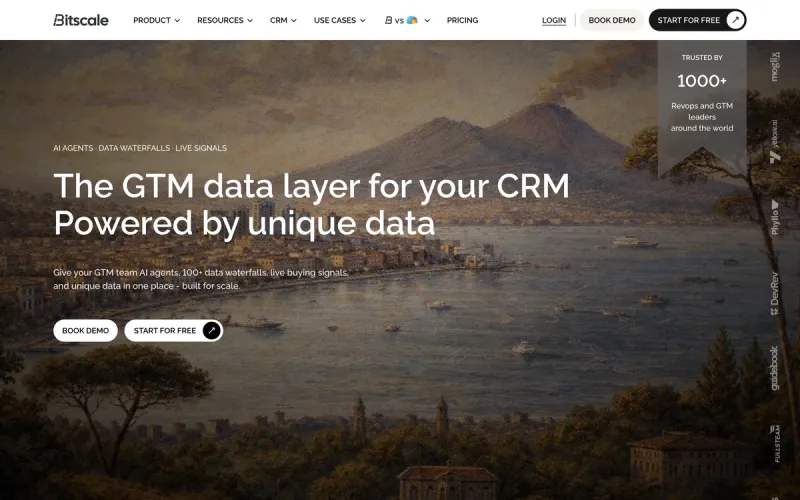
Founded 2023 in Gurugram by Sanket Goyal, Yash Sharma, and Abhinay Kumar. Seed stage, roughly 30 to 50 staff. Spreadsheet UI, waterfall enrichment, AI agents. bitscale.ai.
Pricing: Free (200 lifetime credits). Starter $89/mo annual, Growth $314/mo (adds HubSpot two-way sync), Booster $719/mo (adds Salesforce). Data credits at ~$0.01 each vs Clay's ~$0.04 minimum. All paid plans unlimited Actions. Claims 300M contacts, 40M companies. I think their aggressive Clay-alternative positioning, especially post-pricing-change, is clearly deliberate and worth noting.
Weaknesses, and honestly these matter: no deliverability tooling (no warm-up, no multi-inbox), BitAgent less customizable than Clay's, Salesforce locked behind the $719 tier. G2: 5.0/5 but only 13 reviews; in my experience, I treat anything under ~25 reviews as thin signal at best.
Persana AI
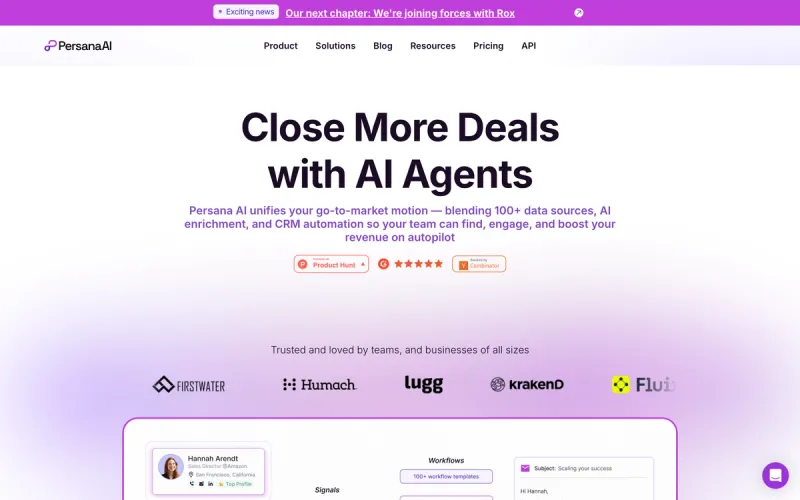
Founded 2023 in SF by Sriya Maram and Rush Shahani (both ex-LinkedIn). YC alum, backed by Race Capital. persana.ai (the migration page is at persana.ai/switch-it).
Pricing: Starter $68/mo annual, Growth $151, Pro $400, Unlimited $600. Unlimited seats on all plans. 100+ data sources, 75+ intent signals. Native email sending with warmup (Clay does not send). Spreadsheet-style workflow builder. G2: 4.6/5 (~40 reviews). I find Persana noticeably easier than Clay for non-technical users; the trade-off, in my view, is weaker CRM breadth (no native Pipedrive, Attio, Zoho, Close).
The adjacent vendors often confused as alternatives
Common Room ($1,700/mo floor): signal intelligence covering Slack, Reddit, GitHub, and podcasts. I think it is important to note this is a different category entirely. From what I have seen, companies run it alongside Clay, not instead of it.
RB2B (from $79/mo): Adam Robinson's US-only website visitor identification. In my experience, teams bolt this onto Clay workflows; it is not a replacement.
La Growth Machine (€60/identity): EU multichannel outreach covering LinkedIn, email, and voice notes. Paris-built, GDPR-native. I find this one worth watching if your market skews European.
Trigify ($149-$549/mo): UK/EU LinkedIn signal monitoring, with a Smart Workflow Builder added in 2025. Honestly, I see this as a niche play for teams focused on LinkedIn signals in European markets.
Default ($500/mo + seats): inbound orchestration that bundles routing, scheduling, and enrichment in one canvas. I think of this as a different layer from Clay altogether.
Surfe ($39-$79/seat): a Chrome extension for LinkedIn-to-CRM syncing plus light enrichment. In my view, this is built for individual reps, not for workflow orchestration at the team level.
Findymail ($49-$249/mo): email finder only. I want to be clear here, you plug it INTO Clay or its alternatives, you do not replace them with it.
Smartlead ($39-$174/mo): sequencer and sending infrastructure. In my experience, you pair this with Clay or Bitscale; it does not substitute for either.
Distrobird (free + usage): sales engagement suite. I think of it as an Outreach replacement, not a Clay replacement.
The honest filter
| If you want | Pick |
|---|---|
| Clay's UX but cheaper | Bitscale or Persana AI |
| Signal intelligence (not enrichment) | Common Room |
| US website visitor identification | RB2B |
| EU multichannel outreach | La Growth Machine |
| Sequencer / sending only | Smartlead or Instantly |
| LinkedIn-to-CRM Chrome workflow | Surfe |
| To build your own | Skip to the next section |
What to pick if you want what.
Build your own: the DIY replacement architecture
I have seen this exact stack architecture deployed successfully multiple times in published case studies from 2026. Honestly, it works for any team with one capable engineer.
What Clay actually does at the core
Four things wearing one trench coat, and I find this framing useful for understanding what Clay actually is: (1) a spreadsheet UI over a Postgres-like store, (2) a waterfall enricher that tries data providers in sequence until one returns a hit, (3) a job runner that loops rows and rate-limits API calls, and (4) Claygent, an AI agent step that scrapes, summarizes, and scores. Output flows via webhook into Smartlead/Instantly/Apollo for sending. The moat, in my view, is the integrations library (~200+ providers pre-wired) and the templates marketplace.
The replacement stack
| Layer | Pick | Cost | Why this pick |
|---|---|---|---|
| Database + auth + RLS | Supabase Pro | $25/mo | Postgres you can actually query. RLS gives shared-workspace semantics in a single SQL policy. |
| Job orchestration | Trigger.dev v3 | $10-$50/mo | Long-running tasks with native retry, concurrency queues, and schedules. queue({ concurrencyLimit }) directly models per-API rate limits. |
| Codegen for the BUILD | Claude Code or Codex CLI | Pro subscription | The 1 to 2 week timeline only works because the agent writes the boilerplate. |
| Runtime AI | Anthropic API | ~$150-$400/mo | Claude Sonnet 4.6 for the Claygent equivalent; Haiku 4.5 for volume scoring. Prompt caching cuts cached input 90%; batch API another 50%. |
| Frontend (optional) | Next.js on Vercel | $0-$20/mo | Build the UI in week 3 if you need one. Most teams ship without; Supabase Studio is the free admin UI. |
| Enrichment APIs | Apollo + Hunter + Datagma + LeadMagic | ~$100-$300/mo | Pay-as-you-go REST. Apollo 1 credit per email, 8 per phone. |
| Sequencer | Smartlead / Instantly | separate | Both expose POST /api/v1/leads. Push from your Trigger.dev task. |
DIY Clay-replacement stack. Pricing checked May 2026 against vendor pages.
DIY Clay replacement architecture
Real code: the waterfall task (Trigger.dev v3)
I think this is production-grade. Drop it in a `src/trigger/enrich.ts` file, set your env vars, and run.
import { task, queue } from "@trigger.dev/sdk/v3";
import { createClient } from "@supabase/supabase-js";

const enrichmentQueue = queue({ name: "enrichment", concurrencyLimit: 10 });
const supabase = createClient(process.env.SUPABASE_URL!, process.env.SUPABASE_SERVICE_KEY!);

export const enrichProspect = task({
 id: "enrich-prospect",
 queue: enrichmentQueue,
 retry: { maxAttempts: 5, factor: 2, minTimeoutInMs: 1000, maxTimeoutInMs: 30_000 },
 run: async (payload: { prospectId: string }) => {
 const { data: prospect } = await supabase
 .from("prospects").select("*").eq("id", payload.prospectId).single();
 if (!prospect) throw new Error("Prospect not found");

 const providers = [tryApollo, tryHunter, tryDatagma]; // priority order
 let email: string | null = null;
 let source: string | null = null;

 for (const fn of providers) {
 try {
 const hit = await fn(prospect);
 if (hit?.email) { email = hit.email; source = fn.name; break; }
 } catch (err) {
 console.warn(`${fn.name} failed for ${prospect.id}`, err);
 // keep walking the waterfall, do not throw
 }
 }

 await supabase.from("prospects").update({
 email, email_source: source,
 status: email ? "enriched" : "no_email_found",
 enriched_at: new Date().toISOString(),
 }).eq("id", prospect.id);

 return { prospectId: prospect.id, email, source };
 },
});
Real code: the AI agent step (Anthropic SDK with tool use for structured JSON)
I think this is one of those details that sounds minor but changes everything in practice: force the tool with `tool_choice` and you get guaranteed structured output, every call. No JSON-parsing errors. No "the model returned prose." In my experience, this is the same pattern Claygent uses under the hood, and honestly, once you see how clean it makes your pipeline, you will not go back to hoping the model returns valid JSON on its own.
import Anthropic from "@anthropic-ai/sdk";
import { task } from "@trigger.dev/sdk/v3";

const anthropic = new Anthropic({ apiKey: process.env.ANTHROPIC_API_KEY });

export const scoreProspect = task({
 id: "score-prospect",
 retry: { maxAttempts: 3 },
 run: async (payload: { prospectId: string; linkedinHtml: string }) => {
 const msg = await anthropic.messages.create({
 model: "claude-sonnet-4-6",
 max_tokens: 1024,
 tools: [{
 name: "record_score",
 description: "Record the ICP fit and outreach hook for this prospect.",
 input_schema: {
 type: "object",
 properties: {
 icp_fit: { type: "number", description: "0-100 score" },
 persona: { type: "string", enum: ["founder", "head_of", "ic", "other"] },
 hook: { type: "string", description: "One-sentence outreach hook" },
 },
 required: ["icp_fit", "persona", "hook"],
 },
 }],
 tool_choice: { type: "tool", name: "record_score" },
 messages: [{
 role: "user",
 content: `LinkedIn profile HTML below. Score ICP fit for a B2B creative-production buyer. Use the record_score tool.\n\n${payload.linkedinHtml.slice(0, 30_000)}`,
 }],
 });

 const toolUse = msg.content.find((b) => b.type === "tool_use");
 if (toolUse?.type !== "tool_use") throw new Error("No structured output");
 return toolUse.input as { icp_fit: number; persona: string; hook: string };
 },
});
Cost comparison (real numbers)
| Item | Clay Growth | DIY stack |
|---|---|---|
| Platform | $495 to $30K+/year (Enterprise typical $30K/yr floor) | Supabase Pro $25 + Trigger.dev Pro $50 = $75/mo |
| Anthropic API (100K prospects/mo Sonnet) | bundled in credits | ~$150 to $400/mo with prompt caching |
| Enrichment credits | bundled, capped per plan | pay-as-you-go Apollo + Hunter ~$100 to $300/mo |
| Engineering time | 0 | 1 to 2 weeks build, 2 to 4 hrs/week maintenance |
| Total monthly | $495 to $2,500+ | ~$325 to $775 |
Clay Growth tier vs DIY stack. Numbers May 2026.
Where DIY does not work
No engineer. And I want to be clear here, I do not mean "non-technical founder plus Claude Code." I mean you need someone who can debug a Postgres RLS policy at 11 pm. In my experience, Claude writes the code, but someone still has to read it, and honestly, that someone needs to know what they are looking at.
Workflows that change daily. I find this is where Clay's UI truly earns its keep: an SDR can rewire a column in 30 seconds. In code, that same change is a PR, a deploy, and a Trigger.dev redeploy. For experimental motions, honestly, I think Clay is just faster, and pretending otherwise ignores how real sales teams actually work.
You need the Clay community. I think people underestimate how much value lives in the templates, the partner directory, and the "how do I enrich X with Y" tribal knowledge that has built up over years. In my experience, none of that ports when you move to a custom stack, and honestly, for many teams that community knowledge alone justifies staying on the platform.
Multi-user shared workspace with permissions UI is a real buildout. Supabase RLS gives you the data model, but you are building the admin UI yourself, and honestly I find that piece alone is a significant chunk of work that people underestimate.
Coverage parity on the waterfall is something I think most DIY builders underestimate. Clay's 90 to 95% completion rate comes from 50+ pre-wired providers. In my experience, a DIY waterfall with 3 to 5 providers will land closer to 60 to 75% unless you keep adding sources, and that gap is harder to close than it looks on paper.
Counter-case worth knowing: Eric Nowoslawski (Growth Engine X) is not a DIY customer. He runs 1.2M emails/mo for clients inside Clay rather than around it. At his volume, Clay's Enterprise pricing still wins on time-to-workflow and template reuse. I think the DIY math only works clearly between $800/mo and ~$15K/mo of Clay spend, and only if you have an engineer on staff.
The structural bet behind it all
Clay is at $3.1B and growing 3x. The pricing change was not malicious; it was a math problem. They were losing money on Pro customers (their own admission), and honestly, the indie crowd's high-frequency Action workflows were the most expensive cohort to serve. I see the Solutions Partner Program upgrade as the operational machinery that makes the bet executable: bigger contracts, longer commits, more services-led delivery.
I think the bet might be right; probably is. Enterprise stickiness at NRR over 200% with zero churn is the kind of unit economics that earns a $3.1B valuation. In my view, the indie revenue was loud but it was probably a small fraction of total dollars.
But I find it hard to ignore that the operators who built the word-of-mouth, who shitposted Clay into the GTM consciousness, who built $1M to $3M ARR claygencies on a $349 tier, deserved a softer landing. In my reading, the new Solutions Partner Program signals Clay knows this; the formalization is the apology.
If you are one of the operators: I think you should stay on legacy if you can, switch to Bitscale or Persana if you cannot, or build the stack yourself. The math works in all three directions, honestly. Just pick the one that matches your team and your runway.
FAQ
Did Clay raise prices on March 11, 2026?
Net: yes for new sign-ups, no for existing self-serve customers. The Launch plan ($185/mo) is +24% versus the old Starter ($149/mo). The Growth plan ($495/mo) is +42% over the old Explorer ($349/mo) and now includes the HTTP API that used to be an Explorer feature. Existing customers stay on legacy plans indefinitely unless they change tiers. I find this grandfathering reasonable, but the sticker shock for anyone signing up fresh is real.
Why did Clay kill the Explorer plan?
The structural reason, in my reading: the $349 tier was the price point most indie operators and small claygencies sat at. By moving the API up to $495 Growth and metering Actions, Clay pushed power users to either upgrade or churn, while protecting the Launch tier for small accounts. The memo confessed that the 2022 pricing decision had been "intentionally revenue and profit negative" for the Pro cohort; the Explorer kill is the financial cleanup. I think this is honest positioning from Clay, but it still leaves mid-tier operators in a tight spot.
Is Bitscale a real Clay alternative?
For the spreadsheet UI plus waterfall enrichment plus AI agents core: yes, I see Bitscale as the closest direct clone. Data credits at ~$0.01 each vs Clay's ~$0.04 minimum and unlimited Actions on all paid plans is the headline pitch. Caveats I would flag: smaller integration library (Salesforce locked behind $719 Booster tier), G2 review count too thin to weight heavily (13 reviews), no deliverability tooling. In my view, the best fit is solo founders and lean RevOps teams that found Clay's credit math punishing.
Can I really build a Clay alternative in two weeks?
With one engineer plus Claude Code or Codex CLI, yes for the core workflow (Supabase + Trigger.dev + Anthropic API + 3 to 5 enrichment providers), honestly I think this is doable. What does not fit in two weeks: 200+ pre-wired integrations, templates marketplace, polished multi-user UI, community knowledge transfer. I find the DIY math wins clearly between $800/mo and ~$15K/mo of Clay spend, assuming you have an engineer on staff.
Should claygencies be worried?
I see a tiered answer here. The big ones (RevPartners, ColdIQ, The Kiln, Growth Engine X, SalesCaptain) are moving upmarket with Clay and will be fine. The mid-tier shops running $5K/mo SaaS clients on tight margins are squeezed, and in my observation their cost base just rose while they cannot easily raise client prices. The smallest indie operators who ran one or two clients on the Explorer plan are functionally priced out. The Solutions Partner Program is the path for the agencies that can scale; I think everyone else needs to either move to Bitscale-class tools or build custom.
Is Clay actually winning, or is the enterprise pivot a sign of trouble?
I think it is worth saying plainly: $100M ARR with NRR over 200% and zero enterprise churn at a $3.1B valuation is not a company in trouble. In my view, the enterprise pivot is what you do when you have product-market fit at scale and need to optimize for revenue quality. The "betrayal" framing is real for the indie community, and honestly I get it, but Clay's financials are exceptional. I find that two things can both be true.
Common myths about the Clay story
Sources and methodology
Clay company history, funding, and ARR: Contrary Research company profile . Sacra revenue + funding data . Clay $100M ARR post . Clay Series C announcement . TechCrunch Series C coverage . BetaKit Series B . Crunchbase News on CapitalG . First Round Review podcast with Kareem Amin.
March 2026 pricing change: Clay's public pricing memo . Rob Litterst backstory interview with Zona Zhang . Adeayo Adewale on Medium . Bitscale on agency risk . Bitscale on HTTP API limits . LeadHaste Clay alternatives 2026.
Claygency ecosystem + GTM Engineer role: Clay Solutions Partner directory . Bloomberry 1,000-job analysis . Claymation.io newsletter (Alex Lindahl) . Clay GTM Engineering team blog post . Sculpt conference 2026.
Replacement architecture references: Trigger.dev v3 docs . Supabase pricing . Anthropic API pricing . HN thread on Clay alternatives . HN thread on open-source Clay.
Related Revnu pieces: B2B data enrichment tools tested . AI agent orchestration platforms . AI SDR vs human SDR . How much does B2B outbound cost . Top 100 CRMs of today.

