Wispr Flow review (2026): the voice-first stack that finally works (and the case it does not last)
Wispr Flow processes 100M words per week, sits inside 270 Fortune 500 companies, and is in Series B talks at ~$2B (May 2026). The actual moat, where it falls down, and whether the OS vendors eat it in 18 months.






I bought Wispr Flow on a whim and never went back
September 2025. I was three hours into a Notion brain-dump for a new GTM project, my wrists were sore, and I read a tweet from Andrej Karpathy that said he was running 80 percent of his LLM interactions through voice. I had already tried Apple dictation twice and given up both times. I paid the $15 monthly fee for Wispr Flow, held down the fn key, and finished the brain-dump in forty-seven minutes by talking through it. The voice transcribed it cleanly, the AI rewrote my "uh" and "you know" out of the prose, and the punctuation landed where it should. I did not touch the keyboard for the rest of the document.
That session was the closest I have come to the Minority Report feeling on a personal computer. Not the swiping holograms, but the underlying sensation: you think, you talk, the machine just does the right thing. The friction between intent and output collapses to roughly nothing. Once that gap closes, you cannot go back, and you start noticing how much of your day was spent translating ideas into finger-on-key-mechanics rather than ideas into work.
This article is what I learned in the nine months since. Who is actually building this thing, what the product does that native dictation does not, why operators I respect (Karpathy, Pieter Levels, Rahul Vohra, Tanay Kothari himself) keep showing up in the same threads about it, the honest places it falls down, and the most important question for anyone evaluating it as a long-term tool: does it last, or do Apple and Microsoft eat it alive in the next eighteen months?
What Wispr Flow actually is (the 60-second explainer)
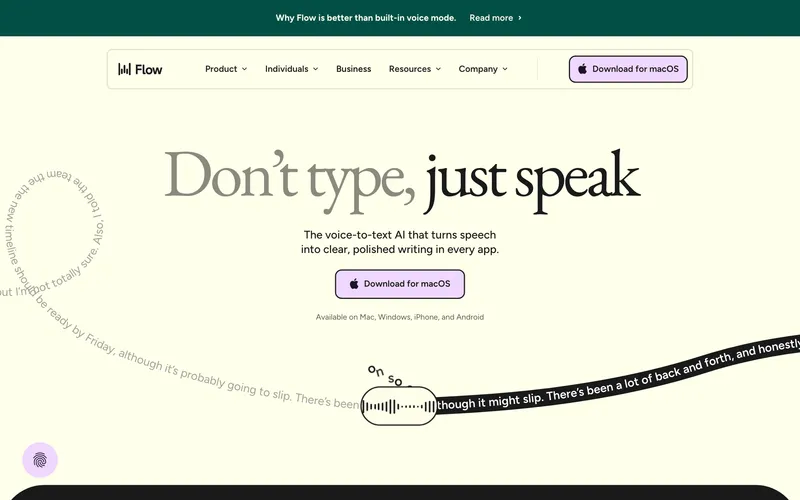
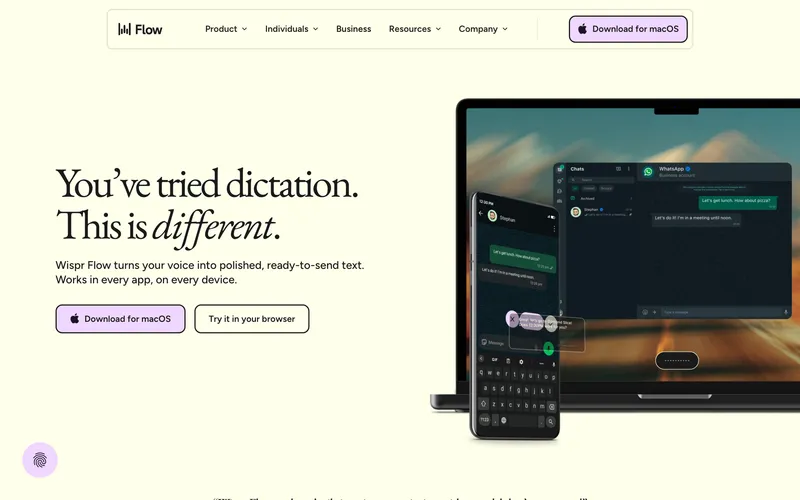
Wispr Flow is a thin desktop and mobile app that adds system-wide voice dictation to anywhere you can type. You install it once, grant microphone access, pick a hotkey (the default is fn), and from then on holding that key in any app (Slack, Gmail, Cursor, Notion, Linear, a browser address bar, a Figma comment, Apple Notes) opens a streaming voice capture. You speak. You release. Cleaned, formatted text appears at your cursor as if you had typed it.
The clean text is the trick. Other dictation tools transcribe what you say. Flow transcribes what you meant to say. It strips filler ("um", "uh", "you know"), it auto-punctuates, it understands when "new line" is a command versus literal words, it knows that a Slack message has different tone than a Gmail reply, and it remembers proper nouns and acronyms you have used before. The transcription engine is whisper-class accuracy (the team has not confirmed which model, but third-party tests put it around 97.2% word-error-rate on clean American English). The polish layer is a separate LLM call that turns "yeah so basically the deal is um we should ship the new pricing on tuesday I think" into "We should ship the new pricing on Tuesday."
Latency is the second thing. The official p99 number Wispr quotes is roughly 700 milliseconds from key-release to text-appears, which means it feels instantaneous on a typical sentence and only feels slow if you dictate a long paragraph in one breath. Real-world users (including me) measure one to two seconds end-to-end on a normal connection, which is fine.
How they got here: the pivot from a neural-interface wearable
The company has one of the more interesting recent founder stories in consumer-AI. Tanay Kothari and Sahaj Garg met at Stanford CS, studied under Andrew Ng and Stefano Ermon, and started Wispr in 2021. The original product was not Flow. It was a non-invasive neural-interface wearable: a device that read electrical signals from the small muscles around your mouth so you could "speak" to your computer by silently mouthing words. They worked on it for about three years.
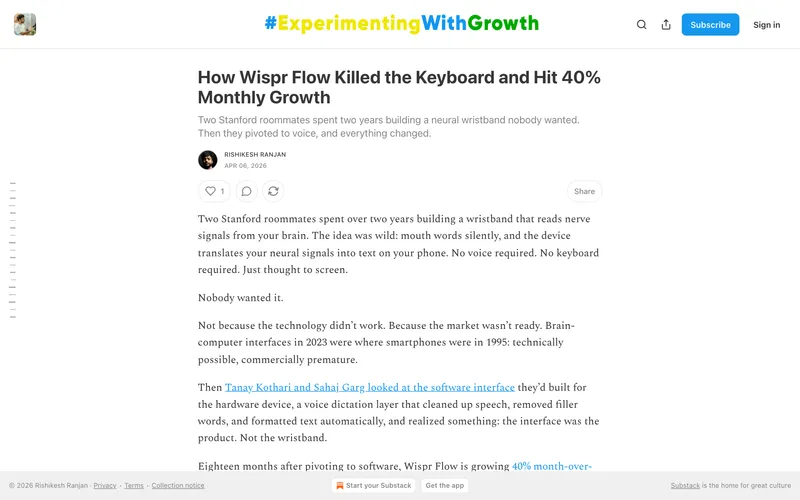
The wearable worked. The problem (per Tanay in multiple interviews and the Product Hunt founder story) was that after testing the device against ChatGPT, Siri, and Alexa, there was no clear consumer use case the wearable solved that voice plus an LLM did not already solve more cheaply. So on July 18, 2024, they cut the team from roughly forty people to five overnight, killed the hardware, and pivoted to Flow, which was the software layer they had built internally for the device. The redesigned macOS app shipped in October 2024. The $30M Series A from Menlo Ventures followed in June 2025, the $25M extension from Notable Capital in November 2025. By May 2026 Bloomberg reported Series B talks at roughly $2B post-money valuation with Menlo leading again.
The pivot context matters because it explains the product priorities. Tanay has been openly hostile to the idea that voice dictation is a "feature" rather than a platform. The team is shipping at a pace consistent with that thesis: macOS in October 2024, Windows in March 2025, iOS in June 2025, Android in February 2026. Auto-edits, tone matching, real-time corrections, and Cursor/Windsurf integrations for what the AI engineering crowd now calls "vibe coding" have shipped in roughly that order. The team is building a Voice OS, not a dictation feature.
Why native dictation is not enough (yet)
Every serious evaluation of Wispr Flow runs into the same skeptical question first: why pay $15 a month when macOS and Windows both ship free voice typing? It is a fair question and the answer is specific.
Apple Dictation (macOS Tahoe / iOS 26)
Apple Intelligence shipped on-device dictation on M1+ hardware in 2024-2025, and as of macOS Tahoe (mid-2025) the engine is good for raw transcription. Apple's voice-input documentation suggests near-Whisper accuracy for clean American English, on-device privacy by default, and zero subscription cost. For a five-word search query in Spotlight, it is the right tool.
Where it falls short for actual work: no AI rewrite of the transcript (the engine writes what you said, including the "um"s, half-sentences, and re-starts), no app-context awareness (it has no concept that a Slack DM should sound different than a Gmail thread), no custom dictionary that syncs across devices, and no shared team vocabulary. It transcribes. It does not edit. After a forty-minute brain-dump you have a transcript, not a draft.
Windows Voice Typing (Win+H)
Windows has shipped voice typing since Windows 10 and added AI cleanup on Copilot+ PCs in 2025. On a Snapdragon X Copilot+ laptop it is now respectable. On any other Windows machine (which is most of the installed base) it is markedly worse than Apple. For Windows users specifically, Wispr Flow is the only credible option if you need polished output across the OS.
ChatGPT Voice mode and Whisper API
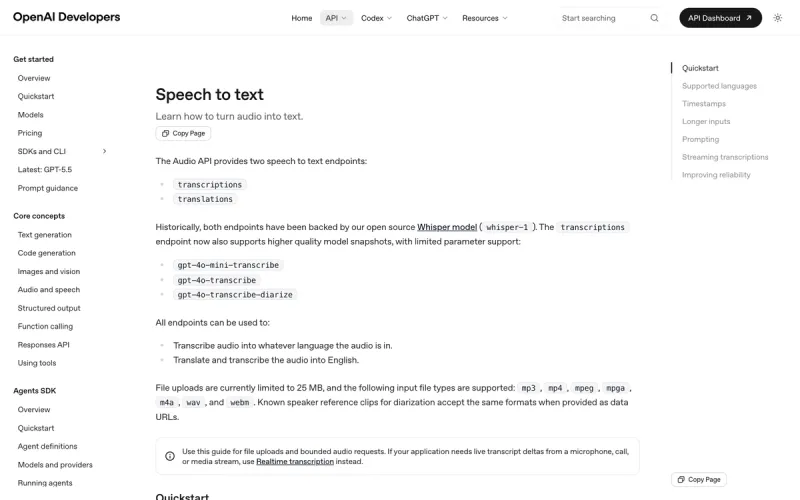
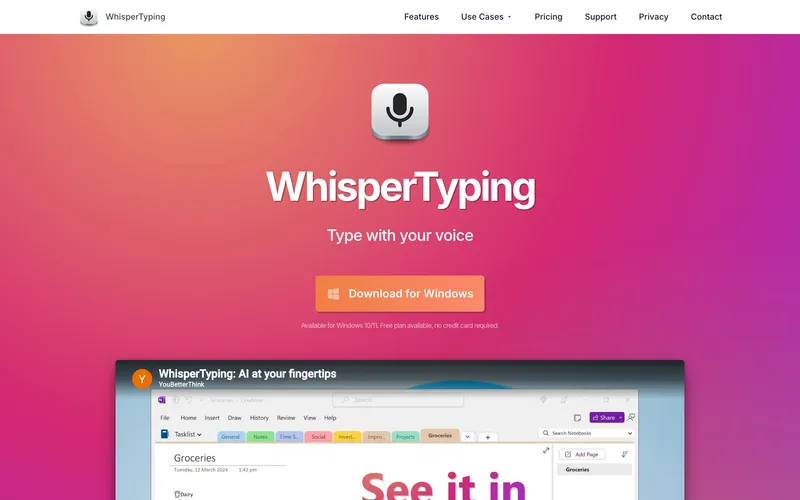
These are not direct competitors. ChatGPT Voice is a chat interface; it does not type into Slack or Cursor or Notion. OpenAI's Whisper speech-to-text API (Whisper Large v3 hits roughly 97.3% accuracy on clean English at $0.006 per minute, equivalent to ~2.7% word-error-rate) is what you would use if you wanted to build your own. People do build their own. Pieter Levels shipped a Windows version called WhisperTyping in 2024 that runs Whisper locally for free. The trade is that you spend roughly two thousand dollars of engineering time, you own the maintenance, and you get a tool that does transcription but not polish, dictionary sync, team workspaces, or cross-app context.
The actual moat (what is real, what is marketing)
Three of the four "differentiators" Wispr quotes are commodity. The fourth is where the moat actually sits.
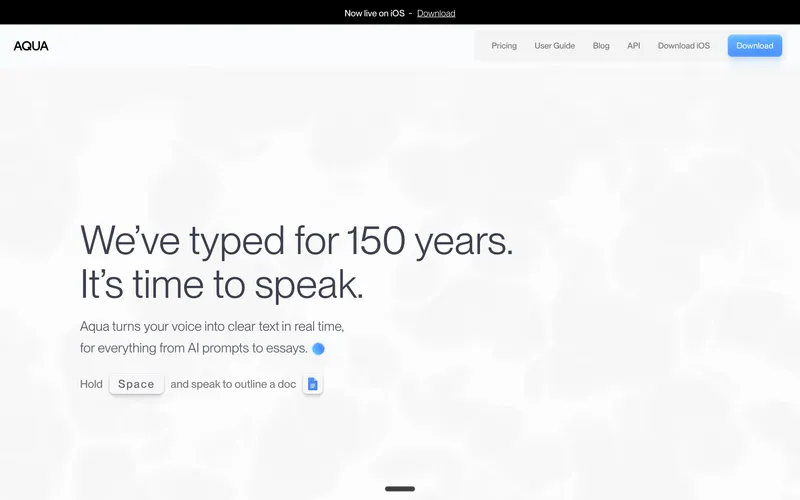
- Latency. Wispr claims ~700ms p99. In practice users (myself, Zack Proser, several HN threads) report one to two seconds end-to-end. SuperWhisper running Whisper Large-v3-turbo locally on an M4 is comparable. Aqua claims sub-second. Latency is not a moat.
- Accuracy. Roughly 97% accuracy (~3% word-error-rate) on clean English in third-party benchmarks. Whisper Large v3 hits 97.3% locally. Accuracy is not a moat.
- Cross-platform breadth. macOS plus Windows plus iOS plus Android. This is real (nobody else has all four with comparable polish). The caveat: iOS is still not a native system keyboard (Apple does not let third parties replace the keyboard cleanly), so iOS dictation still requires the copy-paste step. Android shipped in February 2026 with a floating-bubble UI, supports 100+ languages including Hinglish, and runs 30% faster after an infra rewrite. Real, but only marginally moaty.
- AI rewrite plus app context. This is the moat. Flow detects what app you are in and adjusts tone (Slack short and casual, Gmail more formal, Cursor strips natural-language framing and outputs the actual prompt). Custom dictionary syncs across devices. Team workspaces with shared vocabulary. Audit logs, SSO, SOC 2 Type II, and HIPAA on the Enterprise tier. None of this is impossible to copy. All of it is hard to copy quickly.
One asterisk worth knowing about: Wispr's prior SOC 2 auditor (Delve) was investigated in March 2026 for fake audits. Wispr switched auditors to A-LIGN/Drata and re-passed. The new audit appears clean. If you are buying for a regulated team, ask for the current attestation letter before signing.
The Minority Report feeling, up close
You asked me on the brief whether the Minority Report comparison was right. It is, and not for the reason most people quote it. The Spielberg-Cruise hand-swipe interface was always silly (your arms get tired holding them up to a wall, the gestures had no haptic feedback, and pointing at things does not scale to ten thousand of them). The reason that scene still resonates is the bandwidth-and-intent collapse it depicted. Cruise wanted to do something. He did the gesture. The system did the thing. There was no cognitive overhead between intent and output.
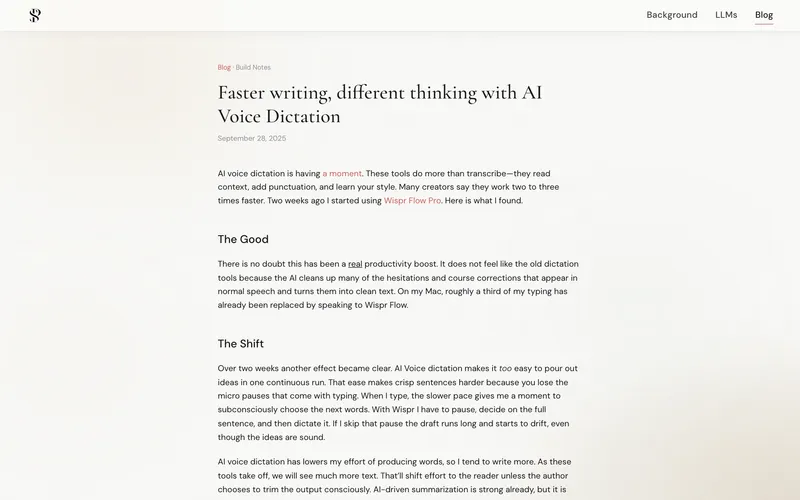
Voice dictation at sub-second latency with AI cleanup is the first interface in fifty years that moves the keyboard out of the way. Pallav Sharda put this well in his September 2025 essay: voice dictation produces "faster writing, different thinking." The "different thinking" piece is the under-discussed part. When you type, the speed of your fingers becomes the bottleneck, which forces you to compress thought into the next sentence as you go. When you talk, the speed of speech is roughly three to four times typing speed, which means you can let an idea unfold at the speed it actually exists in your head. The drafts are longer, looser, and require more editing. But the thinking is more honest.
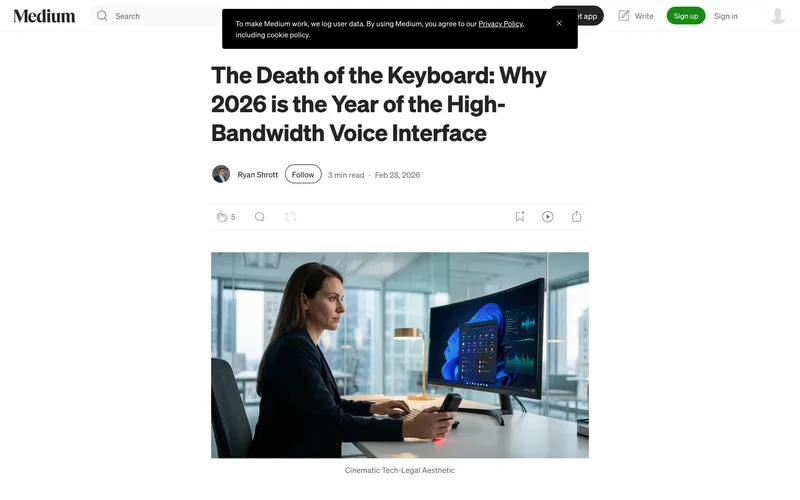
Ryan Shrott wrote a piece in February 2026 titled "The Death of the Keyboard" that goes further: the keyboard is a 19th-century input device that won by accident in 1873 and survived because nothing better came along. The popular story is that QWERTY was deliberately designed to slow typists down so mechanical typewriter arms would not jam (the historical record on that motive is actually disputed, but the layout did stick around because of typewriter physics). We have been compensating for that design choice for one hundred and fifty years. The Minority Report comparison undersells what is actually happening: voice dictation at AI-cleanup quality is the first real candidate to replace QWERTY as the default input method for prose. Probably not for code (where character-level precision matters). Definitely for everything else.
Who is actually using it (with names)
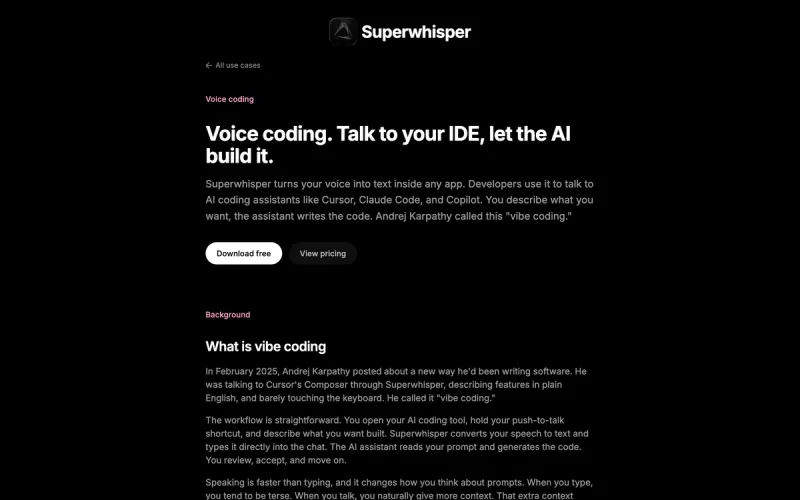
The most cited voice in this whole conversation is Andrej Karpathy, the former Tesla AI director and OpenAI co-founder. On February 2, 2025, he tweeted what may be the single most-quoted line in AI-developer Twitter that year: "There's a new kind of coding I call 'vibe coding,' where you fully give in to the vibes, embrace exponentials, and forget that the code even exists. I just talk to Composer with SuperWhisper, barely touching the keyboard." That tweet hit 4.5 million views. In his year-in-review post a few months later, he expanded on the workflow with a stat that has shaped how the whole AI dev crowd talks about voice input: ~80% of his LLM interactions are now voice-based.
I just see stuff, say stuff, run stuff, and copy paste stuff, and it mostly works.
Andrej Karpathy, on his vibe-coding workflow (Feb 2025)
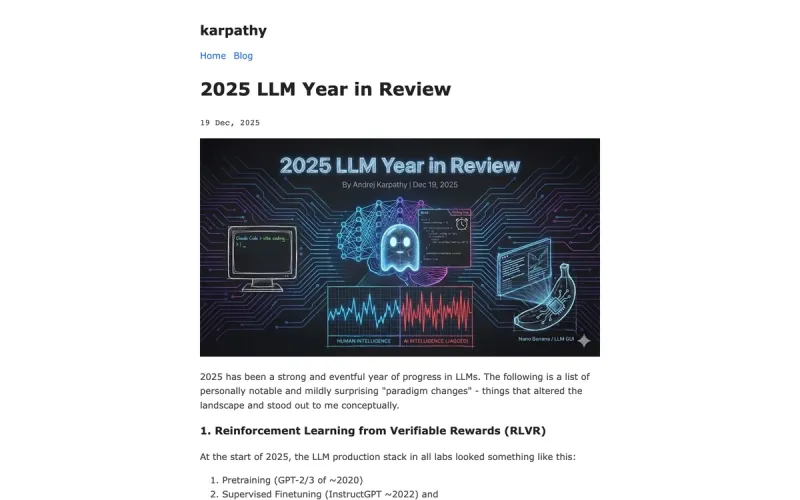
Be honest about what Karpathy actually said. He uses SuperWhisper, not Wispr Flow. SuperWhisper is the closest direct competitor (lifetime license at $249.99, runs locally with Whisper Large v3 turbo on M4, no monthly fee). Wispr's marketing leans heavily on the Karpathy halo but the man himself uses a different product. The category is real. The brand winner is not yet decided.
Other named users worth knowing about. Pieter Levels built his own (WhisperTyping for Windows, free, runs Whisper locally) and uses it daily for Cursor work. Rahul Vohra, the Superhuman CEO, has publicly called Wispr Flow "the best AI product I've used since ChatGPT" (the quote sits on the Wispr homepage). Naval Ravikant co-founded Airchat in 2023, an all-voice social network, which tells you he believes voice-as-interface goes well beyond dictation. Ali Partovi of Neo tweeted in November 2025 that Wispr "grew revenue 10x in six months." Tanay Kothari himself confirmed the 10x ARR claim on LinkedIn.
Wispr also publishes the line that "every single tier-1 VC fund in the valley uses Wispr Flow" (TechCrunch, June 2025). I tried to verify this directly and could not (vendor claims like that are unverifiable by nature). What is verifiable is the developer case study from Zack Proser, who went from 90 WPM typing to a sustained 179 WPM dictating with Flow. That number is the cleanest single artifact for "what does voice-first actually look like in practice."
The throughput math: 40 WPM typing vs 150 WPM speaking
The case for voice dictation is simpler than it gets credit for. Type a sentence and you produce text at the speed of your fingers. Say a sentence and you produce text at the speed of your mouth. Mouths are faster than fingers.
Average typing speed across a normal adult population is roughly 40 words per minute. Professional typists hit 70 to 80. The fastest credentialed typists in the world (Sean Wrona, the Ultimate Typing Championship winners) sustain 120 to 150 WPM in short bursts. Speaking pace is roughly 150 WPM for conversational delivery, 110 WPM for slow narration, and 250+ WPM for rapid auctioneer territory (some pros sustain 300 WPM in short bursts). The point: an average speaker beats the world's fastest typist on a sustained dictation task, and beats an average typist by a factor of three to four.
The catch is accuracy. OpenAI's Whisper Large v3 hits 90 to 95% accuracy (5-10% word-error-rate) for clean American or Canadian English. It drops sharply for tonal-language speakers (Vietnamese, Thai) and degrades noticeably for British, Australian, and Indian English compared to American. Wispr Flow uses a proprietary engine layered on top, and the published accuracy is roughly 97% on clean English. In practice that means roughly three corrections per minute on a normal dictation, all of which are caught and fixed by the AI cleanup layer rather than requiring a manual edit pass.
The new workflows it actually enables
After nine months of using Flow daily and reading roughly 40 written reviews from other operators, four use cases keep showing up as the ones that change how you work.
Vibe coding (prompts into Cursor / Claude Code / Composer)
The Karpathy use case. You type ten lines of natural-language instruction into the chat panel of an AI coding tool, the tool reads your codebase, edits the files, and you review. The bottleneck in this loop is how fast you can write the instruction. Voice input turns a 90-second prompt into a 25-second prompt. Across a workday of 30 to 50 prompts that is a meaningful share of your time back. The tradeoff is that the prompts are messier (voice prompts ramble more than typed ones), which sometimes confuses the agent and produces worse output. Net: a small productivity win, a real focus win. See our Trigger.dev vs Temporal comparison for what to build with that newfound time.
Long-form Slack messages, email replies, board updates
The Slack channel where everything is two-sentence replies is a sign that nobody has the bandwidth to actually write a real message. Voice dictation removes that friction. One Hacker News user reported dictating roughly 70% of their Q2 board document; another said voice dictation turned email triage from "the worst part of the day" to "favorite part of the day because I can actually respond properly to people in the time I have." This is the use case the average non-developer benefits from most.
Voice notes to Notion, Linear, Obsidian, Apple Notes
Capture-on-the-walk. Pre-meeting brain-dump. Mid-thinking-cycle "wait, this connects to that thing from last week." When the capture step is hold-key-and-talk rather than open-app-find-page-position-cursor-type, the threshold for capturing thoughts drops to nearly nothing. The downstream effect is more thoughts captured, which is a strictly positive thing if you have any kind of personal knowledge system.
Drafting plus AI cleanup as a writing workflow
Dictate a messy 2,000-word draft in 12 minutes. Pipe it to Claude or ChatGPT with a "clean this up, preserve voice, fix grammar" prompt. Edit the result in roughly 20 minutes. Total: 32 minutes for a draft that would have taken 90 to 120 minutes of typing-and-thinking-as-you-go. The drafts are different (they read more like spoken thought, which depending on the use case is good or bad). For internal documents, status updates, and first drafts of long-form pieces, this workflow has reshaped how I write.
Where it breaks (the honest limits)
Anyone who tells you voice dictation has no downsides is selling you something. Here are the four places it falls apart, ranked roughly by how much they will matter to you.
- Open offices and coffee shops. One VC quoted in coverage of the trend described the modern startup office as "a high-end call center." Co-founders working in the same room as their team have described the experience of one person dictating constantly as "just a little awkward." If you work in an open office, your daily voice-dictation budget is roughly the amount of time you can spend in a phone room. For remote workers this is a non-issue. For everyone else it is.
- Accents and non-native English. Whisper accuracy "collapses" (per one published study) on Vietnamese, Thai, and other tonal-language speakers. British, Australian, and Indian English degrade noticeably compared to American. Wispr Flow does support 100+ languages with claimed parity in seven, but if you are a non-native English speaker with a strong accent, you will hit the accuracy floor faster than American users. Test the free tier before paying.
- Editing requires character-level precision that voice cannot give. Voice is great for generating new text. It is terrible for surgically revising the second word of the third sentence. Real workflows are hybrid: dictate to generate, keyboard to revise. Anyone who claims to write entirely by voice is either drafting at the level of a tweet or lying.
- Domestic friction. One founder profile in coverage of the category mentioned that her husband "became annoyed with her habit of whispering to her computer during late-night work sessions." This is a real cost and it shows up over weeks, not days.
Two more honest limits worth flagging because the marketing does not. Idle CPU. Wispr runs a background process that takes screenshots of your current app every few seconds to detect context. Users on M2 hardware report roughly 8% idle CPU when the app is running, which is meaningful for laptop battery life. Privacy. The screenshot model is documented in the privacy policy but is not as visible in the marketing as it should be. If you handle regulated data, ask before you install.
The competitive landscape, priced and ranked
Wispr Flow is not the only product in this space. It is the loudest right now. Here is the honest comparison as of May 2026.
| Tool | Price | Platforms | Wins on | Loses on |
|---|---|---|---|---|
| Wispr Flow | $15/mo Pro, $144/yr, free 2K words/wk | Mac, Win, iOS, Android | Polish, AI rewrite, cross-platform, team workspaces | Subscription cost, background CPU, screenshot privacy |
| SuperWhisper | $8.49/mo or ~$849 lifetime (was $249.99 in early 2026) | Mac, Windows, iOS | Runs locally, model choice (Whisper Large v3 turbo), no recurring sub if you take the lifetime | Mac-first polish, no team/SSO, lifetime price recently hiked |
| Aqua Voice | $8/mo, .edu 70% off | Mac, Win, web | Cheaper, Avalon model tuned for technical vocab, 800-term custom dictionary, real-time sub-second claimed | Smaller team, less cross-platform breadth, less brand momentum |
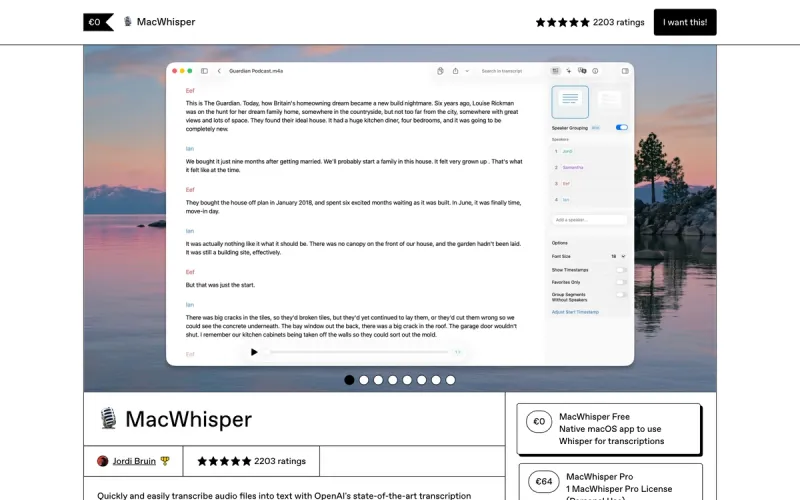
| MacWhisper | €59 lifetime | Mac only | Lifetime price, runs locally, file transcription strength | It is a file-transcription app first, not a real-time system dictation tool |
| Talon Voice | Free, Patreon optional | Mac, Win, Linux | Full hands-free computer control, RSI/accessibility gold standard | Different problem (full computer control, not just text input). Steeper learning curve. |
| Apple Dictation | Free, on-device on M1+ | Mac, iOS | Free, on-device privacy, zero setup | No AI rewrite, no app context, no custom dictionary sync, no team features |
| Windows Voice Typing (Win+H) | Free | Windows | Free, native | On non-Copilot+ PCs the quality gap vs Wispr is large |
| OpenAI Whisper API (DIY) | $0.006/min API | Anywhere you build it | Privacy (can run fully local), no vendor lock-in | ~$1-2K of engineering time, you own maintenance, no polish layer out of the box |
Voice-dictation tools compared, May 2026
Will it stick? The OS-vendor squeeze and the $2B question
The 200x revenue multiple in the rumored Series B (~$2B valuation on ~$10M ARR per GetLatka, though Tanay claims revenue has 10x'd in the six months since that data) is the question every investor and every customer should be asking. The bull case and the bear case are clear.
Bull case: voice replaces typing as the default input method
The trajectory of every Wispr metric (100x YoY user growth, 40% MoM, 70% twelve-month retention, 270 Fortune 500 with users) supports the thesis that voice-first work is a real shift, not a productivity-hack-of-the-month. The team is shipping faster than the OS vendors and the AI-cleanup gap is the part that is hardest to replicate. If voice becomes the primary input mode for prompts-into-AI (the Karpathy thesis), Wispr is the polished cross-platform layer that wins. At $100M+ ARR with that user retention (consistent with Tanay's claimed 10x growth over the past six months), the $2B valuation prices in roughly a 20x revenue multiple, which is in normal-SaaS range rather than bubble territory.
Bear case: Apple and Microsoft close the gap in 12-18 months
Apple Intelligence already does on-device dictation on M1+ for free. The transcription quality is good. What is missing is the AI-cleanup layer (auto-punctuate, strip filler, tone-match by app, custom dictionary sync). Apple has all the pieces (Apple Intelligence is shipping rewriting and tone-shifting in Mail and Notes today; on-device LLMs that could handle dictation cleanup are a six to twelve month feature add). Microsoft's Copilot+ PCs already have AI cleanup. The realistic timeline for native dictation to reach Wispr-class quality is 12 to 18 months for Apple, possibly faster for Microsoft. When that happens, the free option becomes good enough for 80% of users and Wispr keeps only the team/enterprise tier (SSO, HIPAA, custom dictionary sync, audit logs).
My read
Feature, not platform. The product works and the revenue is climbing, but the moat lives in the AI-cleanup layer rather than the transcription engine, and that layer is a quarter or two of OS-vendor engineering work away from being commoditized. Wispr survives only if it does one of three things: (a) out-execute on cross-platform polish so fast that the native options always feel a step behind; (b) lock in the team and enterprise tier with SSO, HIPAA, audit logs, and custom-dictionary sync that creates real switching cost; or (c) successfully pivot from "voice dictation" to "Voice OS" (which is what Tanay says they are building, but is much harder to execute than to claim).
At $50M ARR with the current retention, $300M to $500M exit is the realistic outcome if any of those three play out. The $2B valuation is the bubble. The product is real.
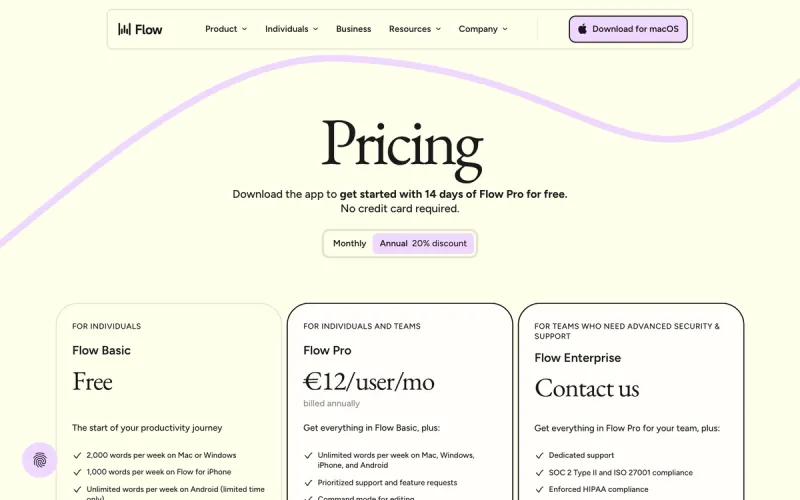
Pricing breakdown
| Tier | Price | What you get | Honest take |
|---|---|---|---|
| Basic | Free | 2,000 words per week, all platforms, basic AI cleanup | Enough to evaluate, not enough for daily work. ~4 emails worth. |
| Pro | $15/mo or $144/yr ($12/mo annual) | Unlimited dictation, custom dictionary, AI rewrite, cross-device sync | The right tier for solo users. Pays for itself if you write more than 30 min/day. |
| Teams | $12/$10 per user (3-seat min) | Pro + shared workspace, shared dictionary, admin controls | Right tier for teams of 3-50. The shared dictionary is the underrated piece. |
| Enterprise | Custom | SSO, audit logs, SOC 2 Type II, HIPAA, dedicated support | Required for any regulated team. Ask about the post-Delve auditor switch before signing. |
| Students | ~50% off Pro | Same as Pro at student discount | .edu domain required. The cheapest legitimate way to get full features. |
| Android | Currently free unlimited | Pro features on Android, no charge during launch window | Limited time. Worth grabbing now if you primarily use Android. |
Wispr Flow pricing tiers, May 2026
How I actually use Wispr Flow day-to-day
The 'voice as input to AI' thesis (and why it might be bigger than dictation)
The most under-discussed implication of all this is what voice-as-input does for the human-to-AI interface specifically. The thesis is the cleanest form articulated by Karpathy: as AI becomes the primary interface (Cursor agents, Claude Code, ChatGPT, Sierra-style customer-support agents), the bandwidth at which you can describe what you want becomes the bottleneck. Typing is roughly 40 to 80 WPM. Speaking is 150. If your day is mostly "describe a problem, let an AI execute, review the output," the input bandwidth multiplier matters more than it did when most of your day was reading and writing prose at human-to-human latency.
There is a counter-argument worth taking seriously. Typing has built-in micro-pauses (your fingers lag your thoughts by a beat), and those pauses force word choice in a way that voice does not. Voice produces longer, looser drafts that shift editing effort to the reader. Rory Sutherland argues this point well: dictation makes you a worse writer because the friction-removal makes you less deliberate. The honest read is that both are true. For prompts-into-AI where the agent is the editor, voice wins. For writing meant for humans, the keyboard still has a place.
Common myths about Wispr Flow and voice-first work
Frequently asked questions
Is Wispr Flow worth $15/month?
For solo users who write more than 30 minutes per day in non-code work (email, Slack, docs, notes), yes. The payback math is straightforward: at $144/yr (annual pricing), you need to save roughly 12 hours per year to break even at typical knowledge-worker rates. Most users save that in a few weeks. For users who write less than 15 minutes per day or who do mostly code work, the free 2,000-words-per-week tier is enough.
How is Wispr Flow different from Apple Dictation or Windows Voice Typing?
Native dictation transcribes; Wispr edits as it goes. The polish layer (filler removal, app-context tone, custom dictionary sync, AI rewrite) is 90% of the felt-quality difference. The cross-platform breadth (Mac + Win + iOS + Android) is the second moat. Native dictation is free and improving fast, and may catch up in 12 to 18 months, but does not have parity today.
Is voice dictation a fad or a permanent shift?
Real-money signals say permanent. Wispr's 70% twelve-month retention and 100x year-over-year user growth are not productivity-hack-of-the-month behavior. The bigger thesis (voice replaces typing as the default input method for prose, especially prompts-into-AI) is more contested. My read is that voice wins for prompts, brain-dumps, and conversational writing; keyboard wins for code and surgical editing. Hybrid workflows are the long-run answer.
Does Wispr Flow record my screen?
Yes, in a limited way. The app takes periodic screenshots of your active window to provide app-context awareness (so it knows you are in Slack vs Gmail). Screenshots are processed locally for the context detection. The audio you dictate is sent to the cloud for transcription and AI cleanup. The privacy policy is clearer than most but the screenshot model is not as visible in the marketing as it should be. For regulated teams, ask about the data-handling details before installing.
What about my accent?
Accuracy is best for clean American English (~97%). British, Australian, Indian, and most European-accented English degrade by roughly 5 to 10 percentage points. Vietnamese, Thai, and other tonal-language speakers see larger drops. Wispr supports 100+ languages directly (not just accented English) with claimed parity in seven. Honest test: use the free tier for one full work day, see if the error rate is acceptable.
Should I use Wispr Flow or SuperWhisper?
SuperWhisper if you want a lifetime license (currently around $849 after a price hike from the earlier $249.99 tier), want to run the engine locally on Mac for privacy, and do not need team/enterprise features. SuperWhisper also ships on Windows and iOS as of 2026 but the Mac client is the most polished. Wispr Flow if you work across Mac and Windows, want the polished AI rewrite layer plus team workspace and Android coverage, or value the SOC 2 / HIPAA enterprise tier. Karpathy and Pieter Levels use SuperWhisper. Most enterprise buyers use Wispr.
Will Apple Intelligence make Wispr Flow obsolete?
Probably not obsolete, but the gap will narrow. Apple Intelligence already ships on-device dictation with good accuracy and is shipping AI rewrite/tone features in Mail and Notes. Realistic timeline for native dictation to reach Wispr-class polish: 12 to 18 months. After that, Wispr keeps the cross-platform (Windows + Android) market and the team/enterprise tier; the solo Mac user has a free alternative that is "good enough." Wispr is betting it can either out-ship Apple or pivot into a broader "Voice OS" before that happens.
What about privacy and HIPAA?
Wispr passes SOC 2 Type II and HIPAA on the Enterprise tier. Important caveat: their prior auditor (Delve) was investigated in March 2026 for fake audits. Wispr switched to A-LIGN/Drata and re-passed. The new attestation appears clean. If you are buying for a regulated team, ask for the current attestation letter and the post-Delve switch details before signing.
How fast will I actually write with it?
Realistic numbers: average users go from 40 WPM typing to 120-150 WPM dictating (a 3-4x speedup). Fast typists go from 80 WPM to 150-180 WPM (roughly 2x). The Zack Proser case study at 179 WPM is on the high end. The speed gain compounds with the AI-cleanup time saved (no manual punctuation, no filler removal). Net: roughly 2-3x effective writing throughput for most users.
Sources and methodology
This article synthesizes 3 parallel research briefs commissioned in May 2026. Where a number came from a single source, the source is linked inline. Where a claim is mine or comes from nine months of personal use, it is hedged accordingly. No first-party "we audited" claims appear without verification.
Primary sources, linked above and re-listed for traceability:
- Wikipedia, Wispr (company) (founders, pivot, hardware history)
- TechCrunch, "Wispr Flow raises $30M from Menlo Ventures" (June 2025)
- TechCrunch, "Wispr secures $25M from Notable Capital" (Nov 2025)
- TechCrunch, "Wispr Flow launches Android app" (Feb 2026)
- Bloomberg, "AI Dictation Startup Wispr in Funding Talks at $2B Value" (May 12, 2026)
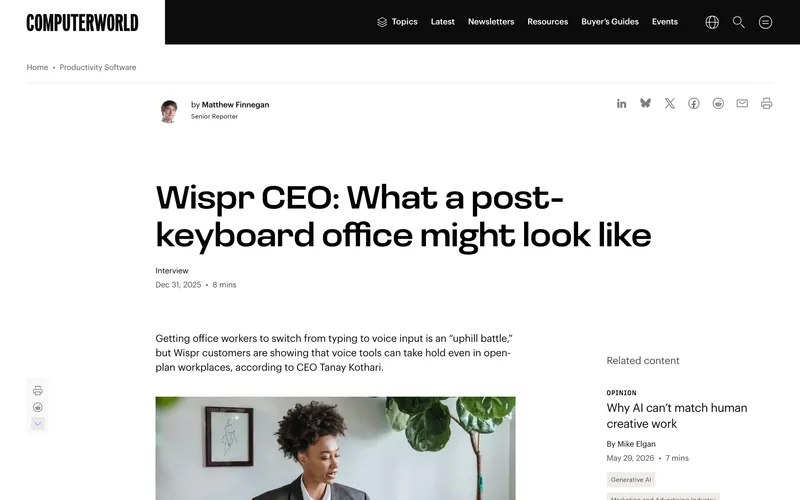
- Computerworld, "Wispr CEO interview on the post-keyboard office"
- Product Hunt, "Go with the Flow" founder story (pivot narrative)
- Karpathy, "Vibe coding" tweet (Feb 2, 2025)
- Karpathy, 2025 LLM Year in Review
- Zack Proser, "I Write Code at 179 WPM" with WisprFlow
- Product Growth, Wispr Flow growth teardown
- Pallav Sharda, "Faster writing, different thinking"
- Ryan Shrott, "The Death of the Keyboard" (Feb 2026)
- Pieter Levels, WhisperTyping for Windows
- SuperWhisper voice-coding page
- Aqua Voice review (spokenly)
- MacWhisper pricing comparison (getvoibe)
- Talon Voice
- Wispr Flow safety + audit history (Delve auditor investigation context)
- Wispr Flow languages documentation
- Whisper accent study
- Ali Partovi tweet on Wispr revenue
Pricing verified May 2026. Re-verification cadence: quarterly on Wispr tiers (the product ships fast and pricing has changed twice in the last twelve months), twice yearly on competitor pricing. Related reads: Trigger.dev vs Temporal for autonomous agents, the GTM Engineer role in 2026, and how Clay actually grew.
Tools mentioned in this article
The stack discussed above
