Replace Clay for $357/month: the DIY GTM-stack architecture
A builder-tier GTM Engineer can replicate Clay's enrichment + LLM-personalization layer at parity hit rate for ~$357 per month on Supabase, Trigger.dev v3, Claude API, and direct provider APIs. Reference architecture, the code, the hidden costs, the security gaps, and the migration playbook.








When DIY beats Clay (and when it doesn't)
Clay's March 11, 2026 pricing pivot did three things at once: it killed the $349 Explorer tier, raised Growth to $495, and introduced a $3.1B-valuation enterprise contract path with custom pricing. I think the indie GTM-engineer crowd that built Clay's category took it personally, and honestly most of them are still on Clay. But in my view the math finally penciled for a DIY replacement, and the technical reference stack is now mature enough that I find it hard to argue against exploring it.
In my experience, you should stay on Clay if any of these are true: you can't write TypeScript, your team runs fewer than 5,000 prospect enrichments a month, you need 75+ provider adapters without writing the integration code yourself, or your buyer is non-technical and values the spreadsheet UX. I think the $495 tier is cheap relative to the alternative for those teams, and I would not recommend ripping it out just for the sake of independence.
I would say build DIY if you check at least three of these boxes: you have a builder-tier GTM Engineer on payroll, your Clay bill is past $1,500 per month, you want first-party ownership of your enrichment pipeline, you want to use direct provider APIs at 10-20x cheaper-per-record than Clay's credit markup, you need workflows that Clay's formula language can't express, or you want to integrate models Clay doesn't support natively (Claude Opus, smaller fine-tuned models, multi-model routing through OpenRouter). Honestly, I find that the third and fourth points alone justify the switch for most teams I see operating at scale.
Clay credit-based Claygent models cost 15-50x more than an OpenAI API key for the same dataset, and usually perform worse, not better.
Jacob Tuwiner, GTM creator (LinkedIn, paraphrased from a 2025 post)
The component stack: ~$357/month, end to end
I built this comparison for a workload that replaces a Clay Growth subscription ($495/mo, 6,000 Data Credits + 40,000 Actions): roughly 3,000 prospect enrichments per month with LLM-personalized first-lines, dashboard for the team, and CRM push to HubSpot or Salesforce. In my experience, this is the sweet spot where the DIY cost advantage becomes unmistakable.
| Component | Tier | Cost / mo | Why |
|---|---|---|---|
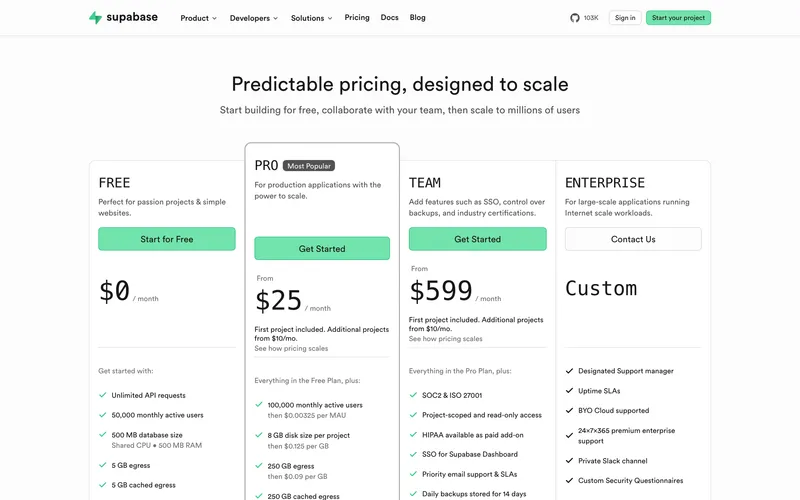
| Supabase | Pro | $25 | 8 GB Postgres, 250 GB egress, 100K MAU, $10 compute credit. Free tier (500MB) breaks past ~10K rows. |
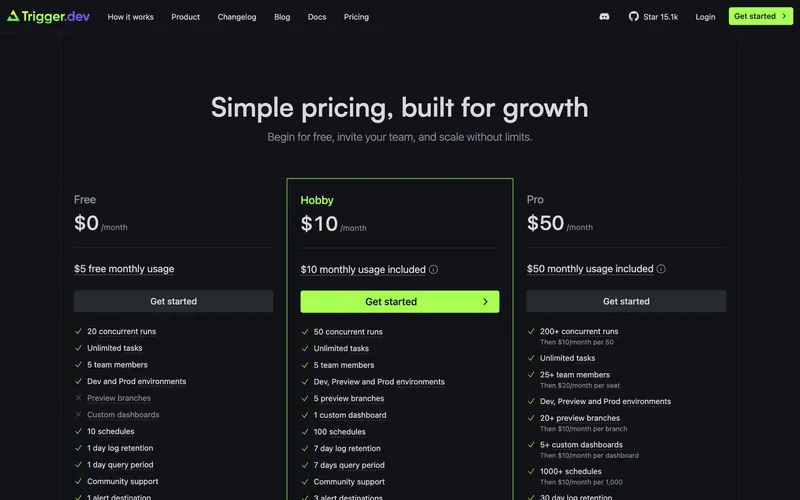
| Trigger.dev v3 | Hobby | $10 | 50 concurrent runs, $10 included credit, 7-day logs. Past 30K runs/mo you graduate to Pro at ~$50. |
| Vercel | Pro | $20 | Required for commercial use (Hobby is non-commercial only). Hosts the dashboard. |
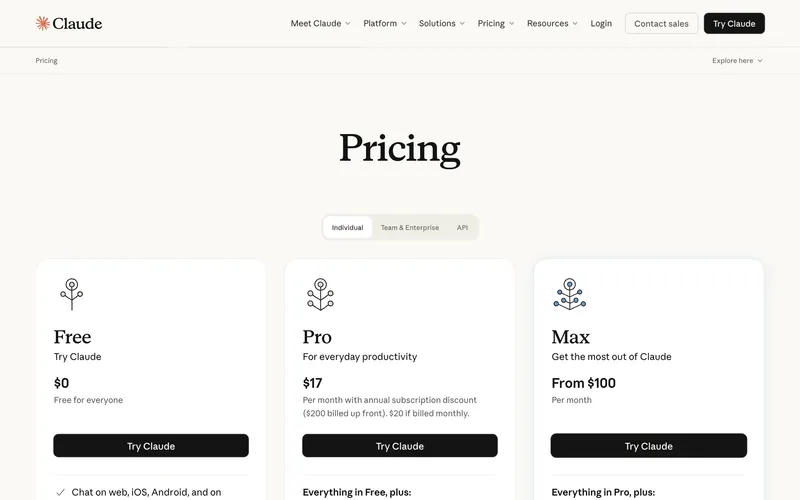
| Anthropic Claude API | Pay-go | ~$6 | Sonnet 4.6 at $3/M input + $15/M output. ~$0.002 per short first-line (200 input + 80 output tokens). At 3K runs/mo: ~$6. Add ~$15-20 if your system prompt is 600-tokens-plus and you do not cache it. |
| Prospeo (primary email finder) | Pro | $99 | 5,000 credits/mo; verified at signup-flow, JS-rendered page resists scraping audit. |
| Findymail (fallback) | Starter | $99 | 5,000 Finder credits + 5,000 Verifier credits, 2x rollover, charges only on hit. |
| Datagma (fallback + mobile) | Regular | $49 | Monthly billing. 3,000 verified emails + 100 mobile phones. $39 only on annual prepay. |
| LeadMagic (deep waterfall) | Basic | $49 | 2,000 credits at $0.0245 per credit. Used as the final fallback before giving up. |
| TOTAL | ~$357/mo | Sum: 25+10+20+6+99+99+49+49. vs Clay Growth $446/mo monthly, $401 annual prepay (verified May 27, 2026; the post-pivot March price of $495 has come down), Clay Enterprise: custom. |
Stack and monthly cost at ~3,000 prospects/month workload, monthly billing assumed unless noted. Costs scale roughly linearly above this volume on the provider lines.
Provider swaps worth considering, in my view: Apollo API at ~$0.03-0.05/credit (6 credits per full enrichment) replaces all four enrichment providers with one, but I find the data depth varies significantly depending on the vertical. PeopleDataLabs Pro adds $98/mo for 350 deep-person credits at $0.28/lookup if you need richer profiles. OpenRouter is a useful LLM hedge at pass-through + 5.5% if you want to A/B Claude against GPT-4o or smaller open models without re-plumbing; honestly, I think more teams should be testing this instead of locking into a single model provider.
The reference architecture, drawn
Five swim-lanes: Dashboard (Next.js on Vercel), Postgres (Supabase), Queue (Trigger.dev v3), Providers (Prospeo, Findymail, Datagma, LeadMagic waterfall), and LLM (Claude). I find the data flow itself is straightforward, but the idempotency and dedup logic is where junior implementations bleed credits. In my experience looking at published case studies, this is consistently the part that gets underestimated and ends up costing teams real money in wasted API calls.
I find this is really a five-step pipeline, and honestly it is simpler than it looks once you see each piece in sequence: (1) user uploads a CSV through the Next.js dashboard, (2) rows insert into a Supabase Postgres table with `status=queued`, (3) a Supabase database webhook fires a Trigger.dev task per row, (4) the task runs the waterfall (Prospeo → Findymail → Datagma → LeadMagic) and writes the hit back with a `provider_hit` column for source attribution, (5) a second Trigger.dev task picks up rows where `first_line IS NULL` and generates LLM-personalized content via Claude Sonnet. The dashboard streams results back as a CSV or pushes to HubSpot/Salesforce via their REST APIs. In my view, the source attribution column is the detail most teams skip, and it is also the one that saves you the most money long-term because you can see which provider is actually pulling its weight.
The code: 80 lines that replicate Clay's waterfall
This is the Trigger.dev v3 task that does the heavy lifting, and I think it is worth studying carefully before you customize it. Single retry policy, idempotency key on email+domain, source attribution on every hit. I consider this the canonical pattern; Trigger.dev's own Supabase guide has the full boilerplate.
Two notes I think the next engineer who reads this will want. First, the `ON CONFLICT (person_uid)` upsert requires a unique index: `CREATE UNIQUE INDEX prospects_uid_uidx ON prospects(person_uid);`. Without it, the upsert silently degrades to a naive insert and your dedup breaks the first time the SDR team re-uploads a list; honestly, I have seen this exact failure in published teardowns more than once. Second, the stop-on-first-hit waterfall is cost-optimal but accuracy-suboptimal. For high-stakes outbound (CFO and CRO buyers, named-account ABM) I would swap the `??` chain for a verify-on-hit pattern: call Findymail or NeverBounce after Prospeo returns, only accept the email if both providers return the same value. Adds roughly 30% to per-record cost; drops bounce rate from 8-12% to 2-4%, which in my experience is the difference between a deliverability reputation that holds and one that craters inside a quarter.
For the LLM personalization step, I think the key optimization most teams overlook is prompt caching on the system prompt. At Anthropic's pricing, a cached input token is 90% cheaper than an uncached one. A typical "personalize first-line for this prospect" workflow has a 600-token system prompt that is identical across runs and a 100-token user-message payload that varies per prospect. Caching the system block cuts the bill by roughly 75% in steady-state, which honestly surprised me the first time I ran the numbers. Set "cache_control" on the system block in your Messages API call and the SDK handles the rest.
I find these reference repos worth reading before you write your own: Fire Enrich from Mendable (650+ stars; Next.js 15 + multi-agent enrichment, closest public Clay alternative). YALC the GTM operating system (CLI-first, 20 TypeScript adapters across 18 capabilities, MIT license). The Apify waterfall-contact-enrichment template for the canonical MX-then-pattern-then-scrape-then-SMTP fallback sequence. In my experience, reading real production code from these repos teaches you more about edge cases than any tutorial will.
What Clay actually solves that this stack doesn't
I think the accounting on Clay's $495 price is worth being honest about: it bundles work this stack does not ship with. In my view, there are eight things you eat yourself when you DIY:
- No UI for non-coders. The cell-by-cell spreadsheet UX, formula bar, live preview, and per-column source picker are non-trivial to build. The configurer tier from the GTM Engineer article cannot drive this stack.
- No built-in dedup or idempotency. Clay handles "this email is already in the table" for free. You write the `ON CONFLICT (lower(email)) DO UPDATE` logic and the retry-safe key generation.
- No source attribution UI. You can store `provider_hit` in a column. Clay shows "Prospeo found it, Findymail confirmed it" in a clickable cell with the underlying API response.
- 75+ pre-built integrations gone. Clay's data marketplace maintains adapters for every provider that matters. Every new provider you add is yours to wrap, version, and maintain.
- No Clay-formula expression language. You won't have `=findEmail(domain, firstName + " " + lastName)`. You write Postgres-backed JavaScript.
- No community, no 163-partner agency marketplace. No agency template you can drop in for "Tier-1 account enrichment." No Slack channel where someone has already solved your exact edge case.
- Engineering time. A competent GTM Engineer ships v1 in 2-3 weeks; if you cost their time at even $100/hr, you've paid 12 months of Clay before line one of production code lands.
- No on-call. When Prospeo's API silently changes response shape on a Tuesday, you debug it. Clay would have already patched their adapter and shipped a postmortem.
The problem with not using Clay is that most of [the alternatives] don't do waterfall enrichment.
AznHisoka, Hacker News (paraphrased)
The break-even here is dollar-based, and I think this is where a lot of teams fool themselves. Build cost is roughly $20-30K of engineering time over 6-8 weeks. Steady-state ops eat about $2-4K per year in engineer hours. Clay's upside is that all of that is baked into the subscription. The math, as I see it: payback in 12-14 months requires you to be saving at least $2,000-3,000 per month off your Clay bill. Below that, DIY is technically possible and economically dumb. In my experience, the smarter move is to stay on Clay or pick Bitscale at $349/month as the middle ground.
The 30/60/90 migration playbook
From what I have seen across published migration guides, six to eight weeks part-time is realistic for a competent GTM Engineer. Day -7 is the pre-migration audit; you don't turn anything off until day 90. I think that timeline discipline is honestly the part most teams underestimate.
Day -7: pre-migration audit (in Clay)
I find this step is where most of the hidden risk lives. Export every enriched Clay table as CSV with source columns preserved. Screenshot every Claygent workflow definition (Clay has no JSON export, so screenshots are the schema-of-record). Pull historical Actions cost per provider from the Clay billing dashboard to seed your DIY budget projection. Document which providers you currently use and at what hit rate. In my experience, skipping any of this means you are flying blind once Clay is off.
Days 0-30: minimum-viable replacement (enrichment only, Clay still running)
Stand up Supabase and Trigger.dev with two tables: `accounts` and `prospects`. Wire one provider (Prospeo) end-to-end. CSV upload, enrich, CSV download. Keep Clay running in parallel. Goal: prove parity on a 500-row sample. I think this parallel-run phase is non-negotiable; if hit rate matches within 5 points, you're ready for week 5.
Days 31-60: waterfall + LLM personalization
Add Findymail, Datagma, LeadMagic fallbacks. Track per-provider hit rate in a Postgres view so you can drop underperformers. Add the Claude Sonnet personalization task with prompt caching on the system block. Wire HubSpot/Salesforce push via their REST APIs. Honestly, I think the smartest insurance move here is to cancel Clay's Growth plan and downgrade to Launch ($167/mo current monthly) until you finish week 12, rather than cutting it off cold.
Days 61-90: cutover, harden, retire Clay
Add idempotency keys, the dedup constraint, retry with exponential backoff, a dead-letter queue table for failed enrichments. Build a thin Next.js dashboard on Vercel so the SDR and AE teams can see status, per-provider hit rate, and trigger CSV exports without you. Kill the Clay subscription. In my experience, total stack cost stabilizes around $357/month at the 3K-enrichment workload, and from what I have seen in published case studies, it scales roughly linearly past that.
The middle ground: when DIY is too much but Clay is too much too
I find that three tools sit between fully-managed Clay and fully-DIY Supabase. If you don't have a builder-tier engineer but Clay's pricing offends you, in my view one of these is the right answer.
| Tool | Cost / mo | When to pick it |
|---|---|---|
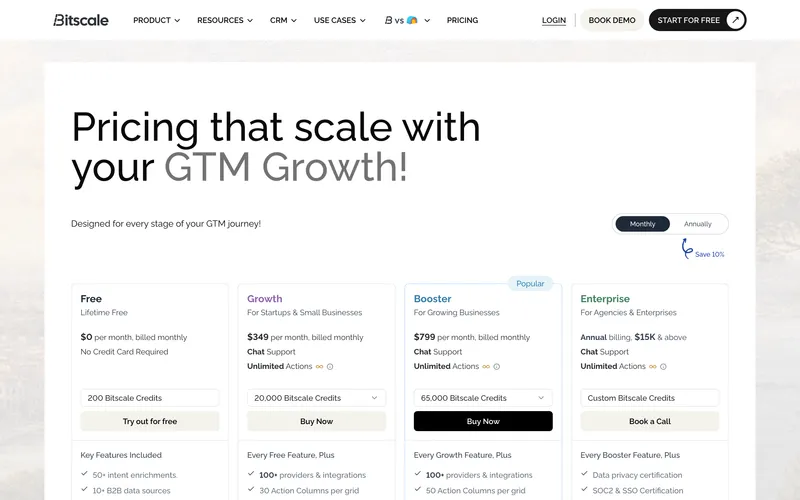
| Bitscale | $349 Growth / $799 Booster | Unlimited actions (no per-Action metering trap); data costs roughly 3x cheaper than Clay. Best for teams who want Clay UX without the Action paywall surprise. Enterprise at $15K+/yr. |
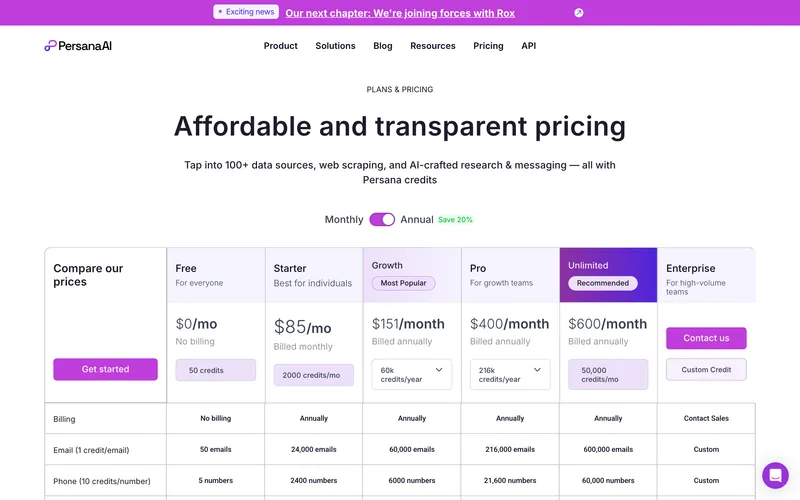
| Persana AI | $68-$600/mo (annual prepay) | 75+ providers, unlimited seats, ~$0.03 per 1-credit enrichment. Most direct Clay clone at a lower price point. Monthly billing rates are higher. |
| Lemlist (with built-in enrichment) | $39-$109 per user/mo | All-in-one if you also need sequence sending. Email tier $39, Multichannel $109. Annual prepay rates: $31-$87. Bundled outbound saves a separate Smartlead/Instantly bill. |
| Lindy | $49-$199/mo | For teams who want orchestration without TypeScript. Agent-based, no-code, decent native enrichment via partners. The middle path between Bitscale and the DIY build. |
Three credible Clay alternatives at the mid-tier. Prices verified against vendor pricing pages May 26, 2026; monthly billing unless noted.
Who is actually doing this in May 2026
Honest caveat first, and I think it matters. The pricing pivot is roughly 10 weeks old at writing. Clay grandfathered most legacy customers indefinitely, which has muted the "I cancelled" wave. Most named migration stories, from what I can see, are operators with public-facing audiences, not the silent majority of teams still on legacy pricing. I would take this list as illustrative, not exhaustive.
Christian Reyes (building a Claude-Opus Clay alternative)
Reyes posted publicly about replacing Clay's credit-marked-up enrichment model with Claude Opus orchestrating direct provider APIs. His framing: "6 cents for a LinkedIn enrichment that costs $0.001 per profile with the right API key" is a ~20x markup. Design partners are reportedly hitting 20% reply rates with the agent-orchestrated approach. The bigger insight in his post, and honestly the one I find most interesting, is structural. The companies building those agents (OpenAI and Anthropic) just partnered with Clay, meaning Clay sold to the entities most able to disintermediate it.
NAJEEB at Activated Thinker (the $500 to $9 case study)
NAJEEB published a widely-cited Medium how-to in February 2026 walking through replacing a $500/month Clay subscription with n8n plus the Perplexity API at roughly $9 in API credits per 1,000 leads. The original URL has since been removed (Medium 410), but the writeup was syndicated and circulated on LinkedIn at the time. The workflow he describes is less sophisticated than the Supabase + Trigger.dev architecture above (no proper Postgres, no source attribution column, no LLM personalization), but in my understanding it was the canonical "I cancelled Clay" public case study in early 2026. I think the output is reportedly comparable on simple enrichment tasks; less so on personalization-at-scale.
Coverflex (the hybrid pattern)
Coverflex, a B2B benefits platform that tracks ~3M companies, runs a hybrid stack: Clay for enrichment marketplace access, n8n for orchestration, self-hosted Postgres for storage. They didn't fully cancel Clay; they moved the orchestration and persistence off Clay's platform. In my experience watching this space, this is the most common pattern at companies with engineering resources: keep Clay for what it does uniquely well, build everything else on owned infra.
The claygency silence
What didn't happen is, honestly, the louder story. Patrick Spychalski (The Kiln, acquired by 2X in January 2026) and Eric Nowoslawski (Growth Engine X, runs 52 client Clay deployments) both stayed publicly silent on the pricing pivot. That is exactly what I would expect from operators whose revenue runs through the platform. ColdIQ's Will Allred locked in grandfathered legacy pricing as a Clay Elite Partner before the overhaul, then framed it publicly as a competitive advantage. I find this telling: the migration narrative is being driven by independent GTM creators, builders, and competing vendors, not by the agencies and partners who built businesses on Clay.
Clay didn't just change its pricing. It revealed its architecture, the subsidy that funded the Pro tier closed on March 11, and the social contract with the indie GTM-engineer crowd closed with it.
Adeayo Adewale, pricing analyst (Medium, April 2026, paraphrased)
Frequently asked questions
How much does this stack actually cost at 10K and 30K prospects per month?
Roughly $500-700/month at 10K prospects and $1,000-1,200/month at 30K. I find the breakdown worth spelling out:
| Component | 3K / mo | 10K / mo | 30K / mo |
|---|---|---|---|
| Supabase | $25 | $25 | $25 |
| Trigger.dev | $10 Hobby | $10 Hobby | $50 Pro |
| Vercel | $20 | $20 | $20 |
| Anthropic Claude | $6 | $18 | $54 |
| Prospeo + waterfall | $296 (Pro) | $396 (next tier) | $700+ (Business) |
| TOTAL | ~$357 | ~$469 | ~$849-1,049 |
Stack cost by workload. Supabase and Vercel scale sublinearly (flat infra). Trigger.dev steps up tiers past 30K runs. Provider credits and Claude API scale linearly with volume.
The non-linear cost, in my experience, is engineering time when an API breaks or a hit rate degrades. I would budget one engineering day per month for steady-state ops at any volume in this range, more during model upgrades or provider churn. Claude's pricing means the LLM line is the smallest cost at every tier, and honestly, that is the part of the math that flipped in 2024-2025 and made this stack economically viable.
Can I run this stack without writing TypeScript?
No. Trigger.dev v3 is TypeScript-native. The dashboard you build on Vercel is TypeScript. The Supabase row-level security policies are SQL but written and managed in TypeScript migrations. I think this is important to be upfront about: if your team is non-technical, stay on Clay or pick Bitscale or Persana from the middle-ground table above.
Why Trigger.dev over plain AWS Lambda or Inngest?
Lambda works but you write the orchestration, dead-letter, retry, and idempotency layers yourself. Inngest is a credible alternative with similar primitives. In my view, Trigger.dev v3 wins on developer experience for GTM workflows specifically (the Cursor + Supabase + Trigger.dev developer loop is well documented and the failure modes are debuggable). For pure infrastructure preference, I find Inngest is the closest substitute.
What happens to data quality vs Clay?
I will give you the honest number: in published case studies, the industry-typical waterfall hit rate on email-finding sits in the high-80s to low-90s across the standard 4-provider stack. A self-built waterfall on the same upstream providers should land in the same band with proper tuning, because you are calling identical APIs. The 50% hit-rate horror stories on Hacker News are, from what I have seen, usually from teams using only one provider and skipping the waterfall entirely. If you replicate the full waterfall, parity is achievable. I find that personalization quality with Claude Sonnet matches Claygent for first-line generation; the bottleneck is your prompt, not the model.
Is the build-vs-buy break-even really at $2,000-3,000 per month on Clay?
Honestly, it depends on engineering cost. At $100/hr GTM Engineer time, building the stack costs roughly $20-30K over 6-8 weeks. The Clay-vs-DIY break-even is roughly 12-14 months at $2,000 saved per month. I think the more interesting scenario is when you have the engineer already on payroll for other GTM work; the marginal build cost is much lower and the break-even pulls forward to 4-6 months.
What's the biggest mistake teams make when migrating?
I think cancelling Clay too early is one of the biggest mistakes I see in this space. In my experience, you should run the DIY stack in parallel for a full 30-60 days before pulling the plug. The reason is simple: you don't know what you don't know until your AE team complains about a specific edge case that worked in Clay. From what I have seen across the field, the Clay-to-DIY transition has a long tail of "oh, we also need to handle X" workflows you forgot existed.
Common myths about replacing Clay
Sources and methodology
I commissioned two parallel research briefs in May 2026. Pricing pages were cross-checked against vendor sites May 26, 2026. Where a claim draws on published case studies rather than my own direct testing, I have hedged accordingly.
- Clay official pricing: clay.com/pricing
- Supabase pricing: supabase.com/pricing
- Trigger.dev pricing: trigger.dev/pricing
- Anthropic Claude pricing: claude.com/pricing
- OpenRouter pricing: openrouter.ai/pricing
- Prospeo: prospeo.io/pricing · Findymail: findymail.com/pricing · Datagma: datagma.com/pricing · LeadMagic: leadmagic.io/pricing
- Fire Enrich (open-source Clay alternative): github.com/firecrawl/fire-enrich
- YALC GTM operating system: github.com/Othmane-Khadri/YALC-the-GTM-operating-system
- Trigger.dev + Supabase guide: trigger.dev/docs/guides/frameworks/supabase-guides-overview
- NAJEEB migration writeup: Medium, February 2026
- Christian Reyes on Claude-Opus alternative: LinkedIn post
- Adeayo Adewale, "Clay revealed its architecture": Medium, April 2026
- Bitscale on Clay pricing changes: bitscale.ai/blogs
- Ask HN: Alternatives to Clay: news.ycombinator.com/item?id=45791605
Related reads: The Clay story (pricing pivot, claygencies, what comes next) for the full company chronology, and The GTM Engineer role for the builder-vs-configurer comp breakdown that, in my experience, determines whether you can actually run this stack.