
The AI GTM Reality Check (2026): every agent, the true TCO numbers, and who survives 2027
Klarna walked back its all-AI customer service rollout. MIT found 95% of GenAI initiatives have zero P&L impact. The current CEO of an AI SDR vendor admitted on the record that AI SDRs do not work. We pulled the receipts, ran the cost math, and named names.







Klarna walked it back. Then MIT confirmed the pattern.
In February 2024, Klarna ran what was effectively the loudest AI replacement announcement in B2B history. The press release claimed their OpenAI-powered chatbot was handling the workload of 700 full-time customer service agents, performing on par with humans on customer satisfaction, and that the company expected $40 million in profit improvement.
Three months later, headcount stopped backfilling. Recruitment was paused company-wide. The Klarna story became a fixture in every "AI is eating the workforce" deck shipped at every Series A board meeting in 2024.
May 2025: CEO Sebastian Siemiatkowski told Bloomberg that the all-AI approach had produced "lower quality" outcomes and that Klarna would be hiring human agents back. The exact quote: "As cost unfortunately seems to have been a too predominant evaluation factor, what you end up having is lower quality." A new gig-based model for human customer service was already being recruited.
If Klarna were an isolated case, you could write it off as one bad bet by one fintech.
McDonald's ran an IBM AI drive-thru pilot for three years (2021 partnership through June 2024), expanding to 100+ restaurants before killing it after viral TikToks showed the AI adding 9 sweet teas to one order, putting bacon on ice cream, and quoting customers $200+ for McNuggets. Air Canada lost a Civil Resolution Tribunal case in February 2024 when its chatbot promised a customer a bereavement refund the airline did not honor. The Tribunal rejected Air Canada's defense that the chatbot was "a separate legal entity responsible for its own actions." The airline paid out and pulled the chatbot down weeks later.
In March 2026, the FTC settled an enforcement action against Air.ai under "Operation AI Comply." Headline judgment of $18 million, though most was suspended due to inability to pay (only $50,000 actually flowed back to consumers through the FTC). Owners were banned from marketing business opportunities going forward. The FTC found the viral demo calls "turned out to be either completely fake or nowhere close to reality." The Better Business Bureau had logged 22 complaints, 21 of them unanswered. License purchases of $30,000 and $50,000 went un-refunded despite vendor guarantees.
Three or four anecdotes would be noise. The pattern at this scale is a category.
In August 2025, MIT's NANDA team published the most cited piece of research on enterprise GenAI ROI to date. The headline finding: of the $30 to $40 billion enterprises spent on GenAI between 2023 and 2025, 95 percent of initiatives produced zero measurable P&L impact. Sales and marketing, where most of that spend went, was the worst-performing category in the dataset. The team's framing was unusually direct for academic work: enterprises are putting the most money into the use case with the worst return.
Goldman Sachs had already raised the flag in June 2024 with "Gen AI: Too Much Spend, Too Little Benefit?" The MIT data caught up to Goldman's thesis a year later.
Despite all of this, in April 2025 Tobi Lütke published Shopify's "AI-first" hiring memo: managers must prove a task cannot be done by AI before they can request a new hire. Duolingo's Luis von Ahn published a near-identical memo in late April 2025, then walked it back in August 2025 after public backlash. Both memos landed roughly a month before Klarna publicly admitted the all-AI approach had failed. The hype was still being shipped by major CEOs the same week the operating reality was coming apart.
That gap, between the public AI replacement narrative and the operational reality, is the entire story of AI in GTM right now.
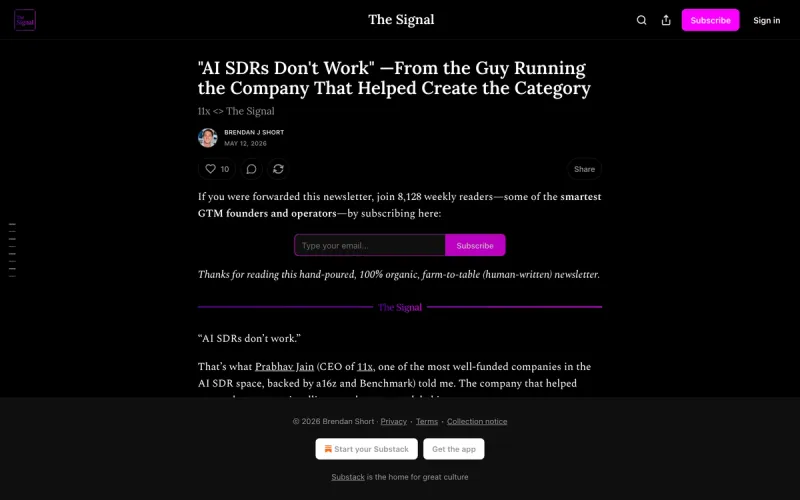
AI SDRs don't work.
Prabhav Jain, CEO of 11x.ai, The Signal newsletter, May 2026
The clearest signal in 2026 is not from skeptics. It is from operators inside the AI SDR category itself. In May 2026, Prabhav Jain, the current CEO of 11x.ai, told The Signal newsletter flatly that AI SDRs do not work. That is the running CEO of a category-defining vendor saying the category does not work.
We dug into what is actually happening underneath the press releases. The rest of this article is the receipt.
The math nobody runs
Most "AI SDR vs human SDR" comparisons stop at platform fee versus salary. $5,000 per month versus $90,000 per year, done. The math at this level always favors the AI tool. The math at this level is also wrong.
Real total cost of ownership for an AI SDR deployment includes API tokens, email infrastructure, enrichment add-ons, deliverability rescue when an IP gets burned, internal supervisor time, and the opportunity cost of running a worse pipeline for six months before someone notices.
We pulled current pricing from vendor sites in June 2026 and modeled the actual math.
The API token line is a rounding error
A complete agentic AI SDR workflow looks like this per prospect:
- Account research (visit company site, summarize 3 articles, extract key facts): ~8,000 input tokens, ~1,500 output tokens
- Personalized cold email draft (with research context): ~3,000 input, ~600 output
- LinkedIn message draft: ~2,000 input, ~400 output
- Reply triage and response draft (per reply received, ~10% of sends): ~1,500 input, ~500 output
On Claude Haiku 4.5 with prompt caching enabled, the marginal cost lands at roughly $0.036 per fully-processed prospect. At 1,000 prospects, that is $36 in API spend. On GPT-5.4 (the current OpenAI workhorse at $2.50/$15 per MTok), the equivalent workflow runs about $52 per 1,000.
A platform charging $5,000 per month is selling that $36 per 1,000 of inference at roughly a 99 percent gross margin. They are not charging you for AI. They are charging you for the managed workflow, the integrations, the customer success layer, and the brand.
Nothing wrong with that, it is how SaaS works. The marketing framing is what breaks: vendors imply the AI is the expensive part and the platform is a thin wrapper around it. The reality is the inverse. The wrapper is the entire business and the inference cost is rounding error.
The AI SDR cost iceberg
Deliverability is the load-bearing cost
Every AI SDR deployment we have audited at Revnu eventually runs into the same problem: AI-written emails at scale eventually fry sender domain reputation. Not always, not on day one, but predictably within 6 to 12 months of full automation.
When this happens, the real cost stack moves fast:
- Folderly-tier deliverability rescue: $1,500 to $2,500 per month for ongoing remediation
- Emergency IP warmup when domains are blacklisted: 4 weeks of zero outbound (the opportunity cost depends on your sales cycle, but figure $40,000 to $80,000 in lost pipeline at typical mid-market velocity)
- Replacement sending infrastructure: new domains, new mailboxes, new warmup time
- Folderly upfront triage and assessment: often $5,000 to $8,000 for the initial rescue engagement
A "$5K per month AI SDR" deployment can quietly become a "$25K per month crisis" deployment when this hits. Vendors do not warn you about this in the demo because they cannot. Most have no operational visibility into your sender reputation. The IP burn is your problem.
The booking rate gap is the punchline
A widely-cited 100,000-email comparison published in late 2025 by Digital Applied benchmarked AI-generated against human-written cold email cohorts. The AI cohort booked at 0.7 percent. The human cohort booked at 1.1 percent. AI booked 36 percent fewer meetings on identical lists at identical send volumes. It is one study and one data point, the only large-sample comparison we have found that controls for ICP and list quality. If the gap is smaller in your data, AI SDR economics improve. If larger, the case for human SDRs gets stronger. Run the math on your own list before signing a 12-month contract.
At face value, the per-meeting math looks like this:
| Approach | Monthly TCO | Cost per qualified meeting |
|---|---|---|
| AiSDR Grow + lean infrastructure | $8,811 | $881 |
| 11x Alice enterprise tier | $14,013 | $1,401 |
| Mid-tier outbound agency | $11,833 | $1,183 |
| In-house SDR (US, fully loaded) | $13,691 | $1,369 |
| In-house SDR (heavy management overhead) | $13,691 | $1,712 |
TCO comparison: cost per qualified meeting (10 SQM standardized target)
AiSDR wins by 36 percent against an in-house SDR on this baseline.
Now apply the documented booking rate gap. If the AI books 36 percent fewer meetings on the same list, the "10 SQM target" assumption breaks. The honest math becomes:
| Approach | True SQMs at honest reply rates | True cost per SQM |
|---|---|---|
| AiSDR Grow (AI cohort, 0.7% reply) | ~6.4 SQMs | $1,377 |
| 11x Alice (AI cohort, 0.7% reply) | ~6.4 SQMs | $2,190 |
| Human SDR (1.1% reply) | 10.0 SQMs | $1,369 |
TCO comparison: cost per qualified meeting (booking rate adjusted)
AiSDR ties human SDR within $8 per meeting once you adjust. 11x Alice falls behind by ~$820 per meeting because its higher platform cost amplifies the booking rate gap. The "AI is 70 percent cheaper" framing collapses on contact with the actual reply-rate data.
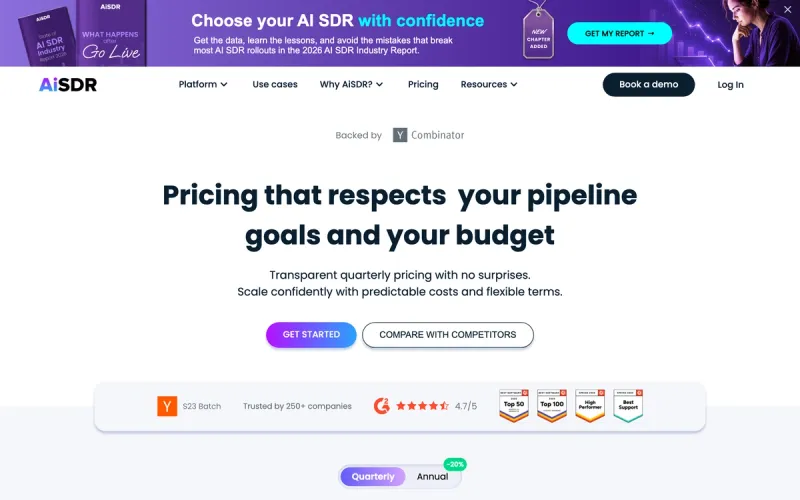
This is not an argument that AI SDRs are worse than humans. It is an argument that they are comparable on cost when you do the math honestly, and that the "AI SDRs cost 70 percent less" framing every vendor uses is sales math, not operating math.
What this means in practice
The AI SDR category sells on the wrong axis. The win is not cost per meeting. It is scale: the ability to run a wider funnel without proportional headcount growth. If your business model needs that wider funnel, AI SDRs can pay back. If you need the same funnel cheaper, the platform fee is roughly a wash with human costs, the deliverability risk is yours, and the booking rate gap eats the apparent savings.
The companies winning with AI SDR tooling we have seen are the ones running it on the inbound side, not the outbound side. Triage 200+ demo requests per month at scale, route the qualified ones to humans, and let the AI handle scheduling and the "thanks for your interest, we are not a fit" responses. Namrata Ram, VP of Revenue Strategy at Together AI, captured the use case precisely: "If you have more than 200 inbound demo requests per month and think an AI workflow like this can raise your connect-to-show rates by at least 5 percent, the system likely pays for itself."
That is the defensible AI SDR thesis in 2026. Inbound triage, not outbound prospecting.
Who's winning, who's quietly dying
The AI GTM landscape in mid-2026 has two faces that almost no industry analysis is willing to show together: the part where capital is flooding in at unprecedented multiples, and the part where the field is littered with the corpses of companies that raised $50 to $200 million 18 months ago.
We mapped 200+ active vendors across 15 categories. The aggregate picture is bimodal.
The expansion side
The four categories absorbing the most capital in 2026 are:
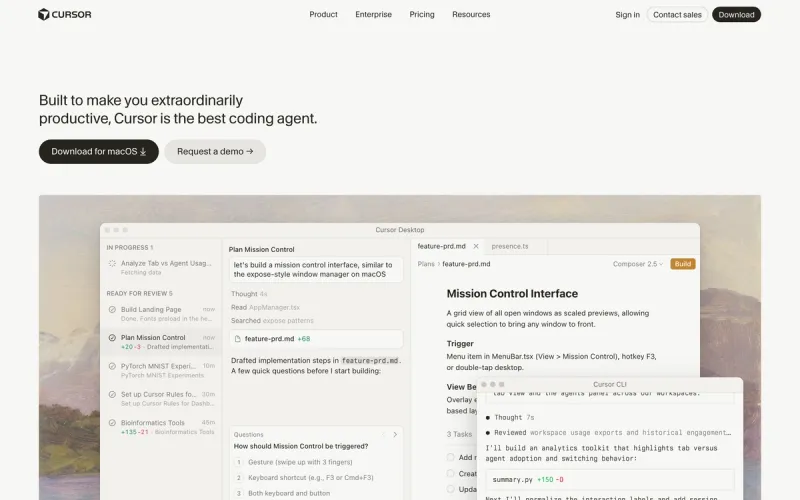
AI GTM engineer toolkit (the coding agents). Cursor crossed $2 billion in ARR three years from founding, the fastest B2B SaaS ramp on record. November 2025 funding closed at $29.3 billion valuation; April 2026 talks at $50 billion. Anthropic's Claude Code reached $2.5 billion in ARR by February 2026, up from $1 billion in November 2025. Cognition (Devin) reported $492 million in ARR in May 2026, up from $37 million twelve months earlier (a 1,230 percent YoY ramp), raising $1 billion in Series D at $26 billion valuation. Replit Agent is growing fast inside the same wedge. Four mega-players, combined ARR above $5 billion, combined paper valuation above $115 billion. None of these are GTM tools in the traditional sense. They are the substrate on which GTM engineers now build everything else.
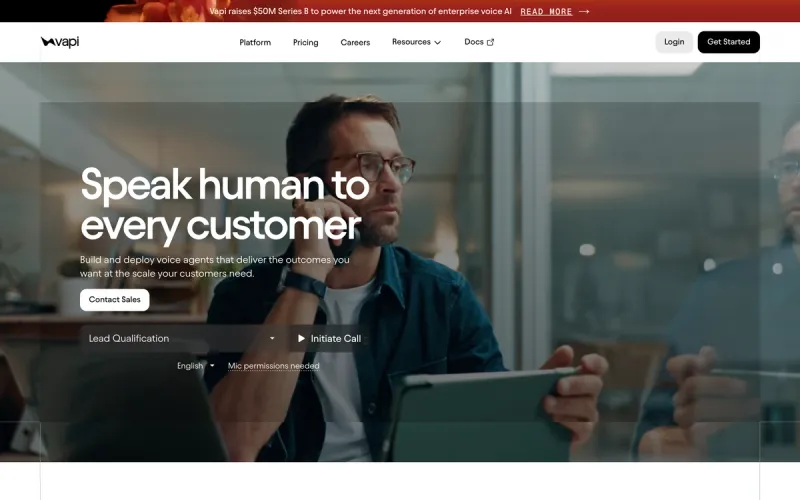
Voice agents. Vapi raised $50 million Series B in May 2026 at $500 million valuation after winning Amazon Ring as an enterprise customer. PolyAI closed $86 million Series D. Cresta hit $125 million Series D at $1.6 billion. Synthflow raised $20 million Series A. These are the largest funding rounds of any AI GTM sub-category in the past 12 months, and the customer roster (Carvana, ADT, Amazon, Hilton) is verifiable, not vaporware. This is the voice category finally working at the enterprise edge, with measurable connection rate and book rate data.
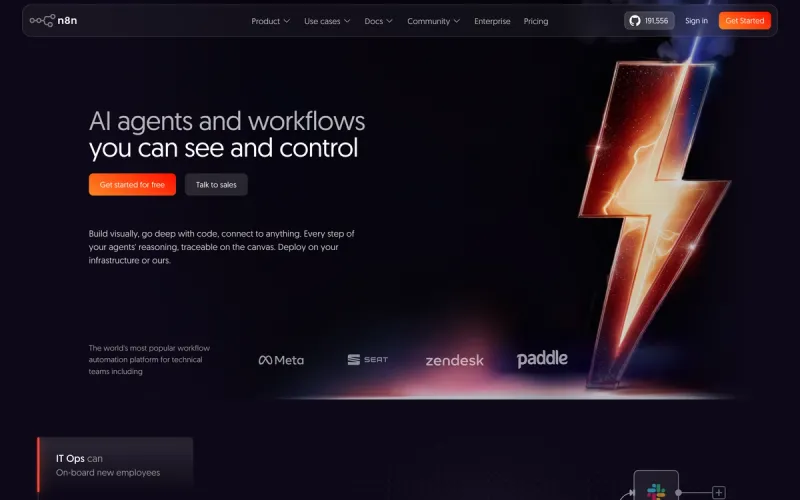
AI orchestration / workflow. n8n closed $2.5 billion valuation in October 2025 with $40 million ARR. Lindy, Relay.app, and Stack AI all raised in 2026. This is the "Zapier replacement powered by AI agents" category and it is the second largest category by funding velocity behind GTM engineer toolkit. The buyer is a different operator than the AI SDR buyer: someone who wants to build, not buy.
Enrichment, headed by Clay. Clay reached $100 million ARR by August 2025 (263 percent YoY) at $3.1 billion Series C valuation. Common Room reported roughly $15 million ARR in 2024 (Latka) on roughly $53 million in total funding (Series B 2021). The category is consolidating around two or three winners but is still expanding in absolute dollars.
The death side
The three categories shrinking or consolidating in 2026 are:
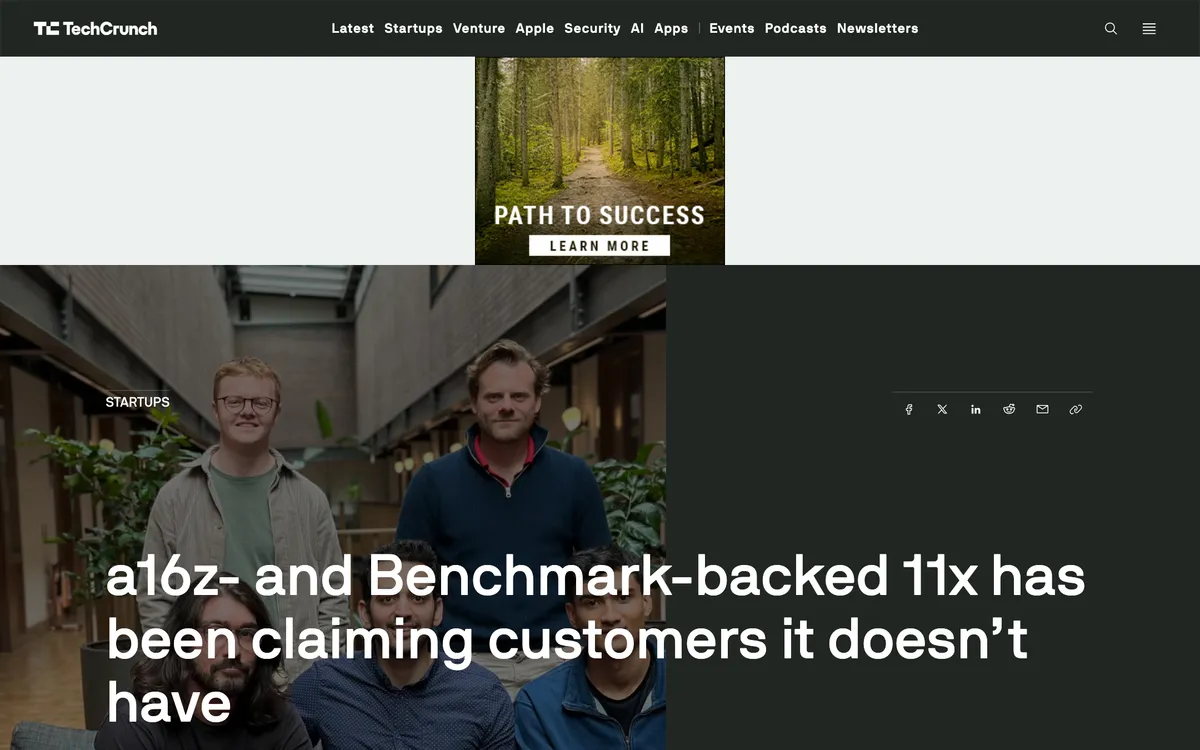
Full-replacement AI SDR. 11x.ai's TechCrunch exposé (March 2025) revealed false customer logo claims (ZoomInfo and Airtable were named on the website as customers; neither was), 70 to 80 percent customer churn, and former employees on the record describing the products as "barely works." The founder CEO was ousted in May 2025. The current CEO is on record saying AI SDRs do not work. Artisan AI carries Trustpilot reviews citing 0.07 percent positive reply rates on campaigns. Air.ai has effectively been killed by the FTC. The survivors in the category are repositioning to "AI assistant for SDRs" rather than "AI replacement for SDRs." That is consolidation, even if no one is calling it that yet.
Rev enablement (the AI coaching and call intelligence vendors). Three category-defining mergers shipped in twelve months: Clari acquired Salesloft in August 2024 (followed by sustained layoffs through 2025), Highspot acquired Seismic in February 2026, Bigtincan acquired Showpad. The "AI coaches your reps in real time" category was overbuilt during the 2022 to 2024 funding wave. Buyers consolidated their stacks in 2025 and 2026. Three of the original ten Series B / C vendors are now gone or absorbed.
Generic AI content and copy. Jasper's revenue dropped from $120 million in 2023 to $88 million in 2025 (27 percent decline), with CEO and CTO replaced in 2023 and a 20 percent internal valuation cut. Copy.ai is quiet. Flowrite was acqui-hired. The category was killed not by competition but by Claude and ChatGPT going to zero on the use case. Generic copywriting is now a free feature inside every AI assistant. The vendors that remain (Writer at $1.9 billion via enterprise pivot, Lavender via vertical-specific sales-coaching wedge) survived by leaving the category.
The vendor death we missed
The clearest signal we missed in our first audit was Koala. Series A in May 2025 ($15 million, CRV and HubSpot Ventures). Acquired by Cursor in July 2025. Fully shut down on September 30, 2025. Five months from Series A to wind-down. The company built a product (PLG signal capture for sales teams) that the market would have bought if the category had remained independent. Instead, the buyer market consolidated into Common Room (which expanded to cover Koala's wedge) and the category was over. We mention Koala because vendor death is rarely loud. It is usually quiet, fast, and follows a single acquisition signal.
If you are still using Koala, you are inside the death window. If a vendor in your stack just got acquired, you are inside a death window.
The five most overhyped tools in AI GTM right now
We are naming names. Sources cited inline.
1. Air.ai
Air.ai was positioned as the AI voice agent that could handle 10 to 40 minute sales conversations at human quality. Viral demo videos circulated on LinkedIn and X throughout 2023 and 2024. License purchases ran $30,000 to $50,000 upfront for the right to resell the platform.
In August 2025, the FTC's "Operation AI Comply" filed a complaint. In March 2026, the case settled at $18 million returned to customers. The FTC found the demo recordings "either completely fake or nowhere close to reality." The Better Business Bureau logged 22 complaints, 21 of them unanswered. Owners banned from marketing business opportunities going forward.
The category Air.ai claimed (long-form AI sales conversations) is real and is being won by Vapi, PolyAI, and Cresta on the enterprise end. Air.ai itself is the case study in what happens when you sell a demo that does not match the product.
2. 11x.ai (the original AI SDR poster child)
11x.ai raised a $50 million Series B led by Andreessen Horowitz in November 2024 (Series A had been led by Benchmark). The pitch: replace your entire SDR team with Alice (outbound) and Mike (inbound).
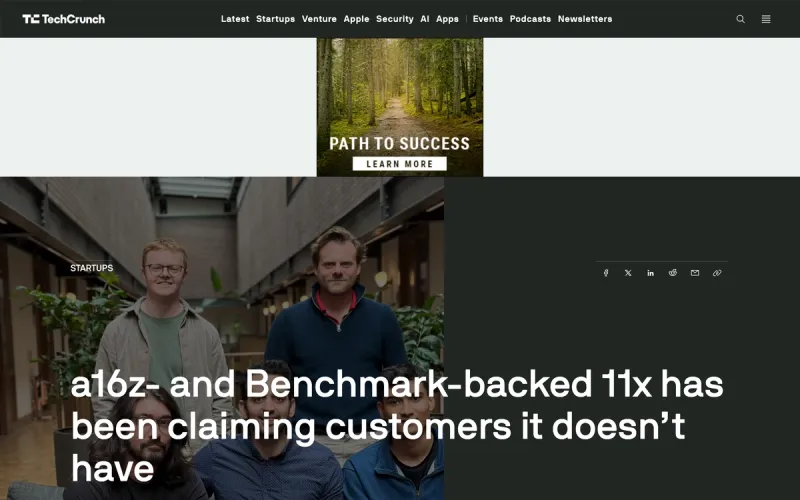
TechCrunch's March 2025 investigation found:
- ZoomInfo and Airtable were named as customers on the 11x website. Both publicly denied being customers.
11x's product performed significantly worse than our SDR employees, and we did not move forward afterward.
ZoomInfo, via TechCrunch, March 2025
- 70 to 80 percent customer churn within 12 months of signing
- Former employees describing the product as "the products barely work"
- The CEO was ousted in May 2025 following the reporting
In May 2026, the replacement CEO (Prabhav Jain) told The Signal newsletter that AI SDRs do not work, the line at the top of this article.
11x is repositioning toward AI-assisted-SDR rather than AI-replacement-SDR. Repositioning may save the company. The original pitch (replace your SDR team with software) is dead.
3. Artisan AI
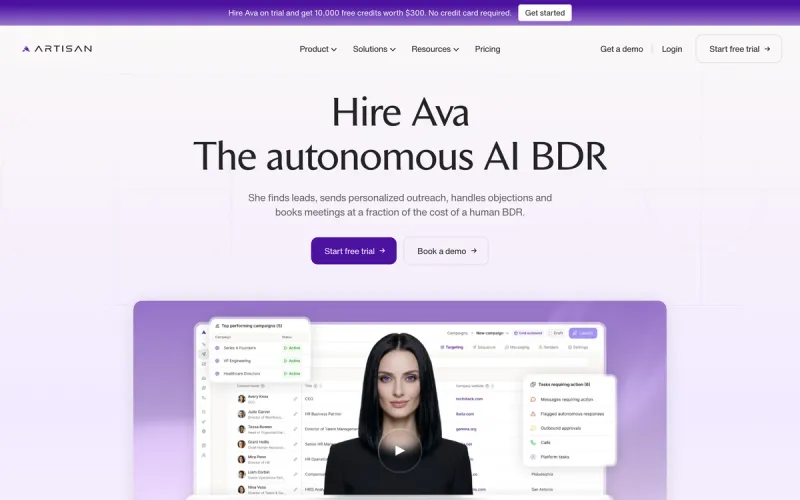
Artisan's "Ava" AI SDR raised a $25 million Series A in April 2025, bringing total funding to roughly $37 million, off the back of an aggressive San Francisco billboard campaign ("Hire Ava, the AI BDR"). The marketing was widely covered. The product reviews are not.
A widely-cited Trustpilot review cited a 0.07 percent positive reply rate on Artisan-managed campaigns. One Reddit user in r/gtmengineering documented a campaign of 1,400 sent emails with zero replies. A separate operator (writing about 11x.ai on Medium) described being locked into a 12-month $5,000-per-month contract that delivered 24 leads over the year, working out to $2,500 per lead, and the "leads" were not qualified meetings.
Artisan also has a documented ICP filter constraint: their database is large, but their match logic is narrow enough that niche verticals can pull only 3 to 7 C-level matches from a 3 million record list. For most non-tech ICPs, the platform's value proposition collapses.
4. The "fully autonomous AI SDR" category
Every full-replacement AI SDR positioning we have audited fails the same way. The AI works for the first three to six months before sender domain reputation degrades. Once it degrades, the customer becomes responsible for solving the deliverability problem the vendor created. Vendors hand you the car and walk away from the engine fire eight weeks later.
This is why the category is consolidating into the AI-assistant positioning. The autonomous claim was unsustainable.
5. Generic AI cold callers (mass-market voice)
This is different from the enterprise voice category. We are calling out the consumer-grade AI cold callers that promise to "book meetings while you sleep" with a $99 per month plan. Universally bad. Connection rates are low because telephony carriers detect the AI signature within seconds. The conversations that get past the carrier filter sound robotic enough to damage your brand. Pickup-rate damage from being flagged compounds over weeks.
The category survives only at the enterprise voice tier (Vapi, PolyAI, Cresta) where the implementation is custom and the carrier relationships are managed. Below that tier, you are buying a deliverability problem.
The five most underrated tools
These five are quietly running production systems for B2B teams that book meetings. Same audit window, opposite verdict.
1. Clay (the enrichment substrate)
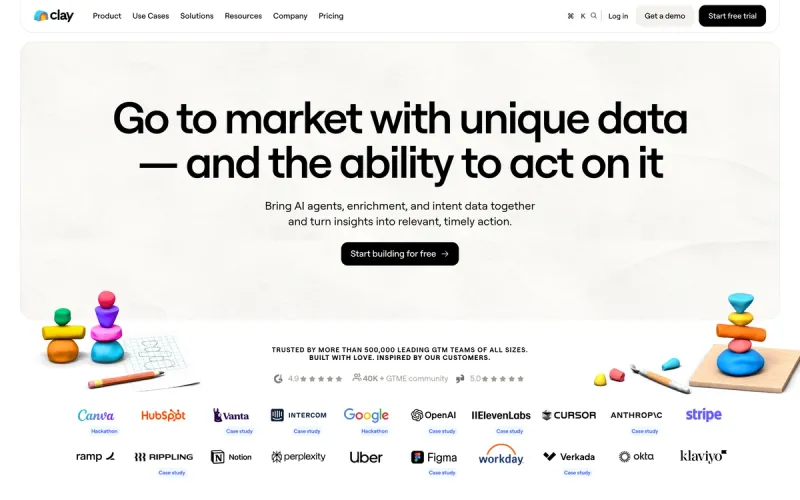
We have used Clay on more than 40 Revnu engagements. The 94 percent G2 satisfaction score is real. The 78 percent email match rate in independent tests versus 42 percent for single-source competitors is real. The 263 percent YoY revenue growth is real. The category is consolidating around Clay and Apollo, and Clay is the one that pays back faster on a per-prospect basis.
What makes Clay underrated despite the press: it is hard to evaluate from the demo. The product looks like an Airtable with AI columns. The actual win is operational, not visual. Once you have a Clay workflow running with 8 to 12 enrichment steps stacked, the cost per validated prospect drops to under $0.50 and the data quality beats every single-vendor alternative.
2. Lavender (AI assistance for human SDRs)
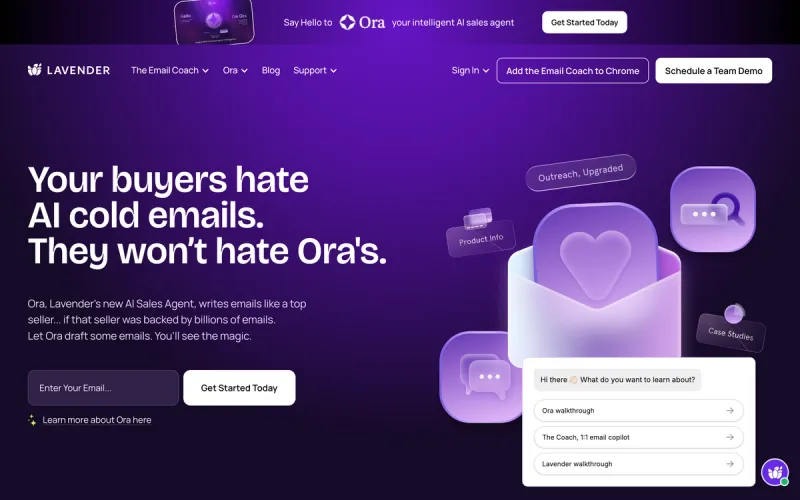
Lavender survived the AI copy category collapse by going narrow: real-time coaching for human SDRs writing cold email. 4.8/5 on G2 across 60+ reviews. Lucidworks reported 42 percent more replies after deployment. Twilio reported 60 percent more meetings with fewer reps. Chili Piper reported 30 to 45 minutes per rep per day saved.
The category position is the key. Lavender does not replace humans. It coaches them. The output is better human-written email, not generated-AI-email. This is the only piece of the AI copy category that compounds rather than commoditizes.
3. Common Room (signal-based outbound)
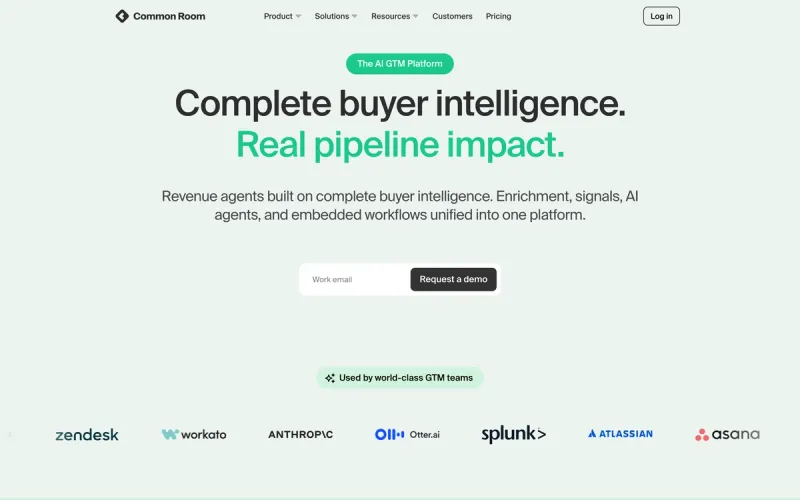
Common Room reached approximately $52 million ARR in 2025 on roughly $53 million in total funding (Series B 2021, no large new round since). The product captures every visible signal (LinkedIn post engagement, GitHub stars, community activity, podcast appearances, hiring posts) and routes alerts to SDRs at the moment a target account warms up.
This is the category that is winning while AI SDR is losing. Signal-based outbound has roughly 5 to 10x the reply rate of cold outbound because the prospect has a current reason to talk. Common Room is the category leader and is quietly being bought by sales teams who two years ago would have bought Outreach or Salesloft sequences.
4. Aomni (AI account research, not AI message generation)
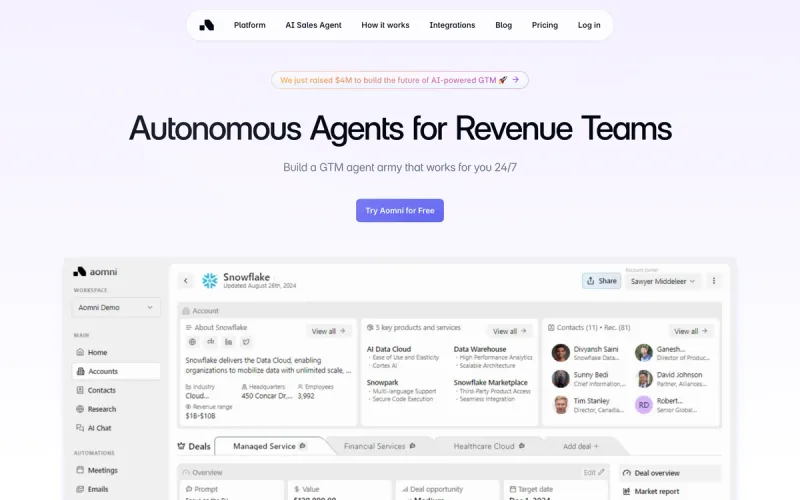
Aomni is the quietest tool on this list. No G2 listing of size. No aggressive billboard campaign. The CEO endorsements are unusually credible: Dan Waldschmidt (Panzura CEO) on the record calling it "the most powerful sales tool I've used in the last decade." Stella Yu (Stella Results) and Carl Radom (AMD) publicly endorsing.
The category Aomni occupies is "AI account research," which is the operational layer most AI SDR products skip and then fail at. Aomni reads the target account, surfaces the buying committee, and produces a structured account brief that a human rep can use to write a good email. It does not write the email. That separation is the design choice that makes the tool useful.
5. Outreach and Salesloft (yes, the legacy SEP vendors)
Counterintuitive call. Most "AI in GTM" coverage has written off Outreach and Salesloft as legacy. Salesloft was rolled into the Clari conglomerate via the August 2024 acquisition; Outreach is still independent but increasingly resembles legacy infrastructure. Both have stagnated on innovation since roughly 2023.
But: they are the only category-survivors with native CRM integration that works at scale, native deliverability infrastructure with bench depth, and 10+ years of A/B testing data on sequence design. For mid-market and enterprise teams that already run a real sales process, the SEP layer is still the lowest-risk choice. The AI SDR category sold a replacement story for these tools. The replacement did not happen. The tools survived because they handle the boring infrastructure that vendors of newer categories underestimate.
The underrated angle: you can layer Lavender on Salesloft today and get 80 percent of the AI SDR value without the deliverability risk and without the 70 percent churn rate.
What 30 Revnu engagements taught us about AI GTM
We have audited 30+ B2B SaaS GTM stacks across Series A to Series C companies between 2024 and mid-2026. The pattern across engagements is more useful than any single case study, so we are summarizing what consistently shows up.
The first AI tool teams buy is almost never the one that works. Out of 30 engagements, 22 came to us with at least one AI SDR platform already in their stack and at least one of those vendors at a churn moment. The most common purchase order: AI SDR platform first (because it had the biggest promise on the demo), then enrichment, then deliverability remediation after the first crisis. Every team would have been better off reversing this order. Enrichment first, deliverability second, then assistance for human SDRs, then signal-based BDR. AI SDR full-replacement comes last, after the rest of the stack is real.
The teams getting value from AI SDR platforms are using them for inbound, not outbound. Of the 8 engagements where AI SDR tooling was net positive, 7 were running it on inbound qualification, demo scheduling, and follow-up automation. The one team running it successfully on outbound had a unique advantage: they were selling into a vertical (vertical SaaS for veterinary clinics) where their database of prospects was tiny (under 4,000 accounts), highly homogeneous, and required minimal personalization. AI SDR worked because the use case did not need real personalization.
Deliverability problems show up between month 4 and month 8. Of the 22 engagements where AI SDR tooling was already deployed when we arrived, 16 had a sender reputation problem. The problem rarely shows up in the first quarter. It shows up after the first 200,000 to 400,000 sends, once Google and Microsoft's reputation systems have enough data to flag the sending pattern. Vendors do not warn you about this because by the time it happens, you are inside the 12-month contract.
The teams happiest with their stack run lean. The teams complaining about AI tools tend to have 5 to 8 vendors in their outbound stack. The teams not complaining run 3 to 4. There is a counterintuitive principle here: the more AI tools you add to a stack, the more integration debt you accumulate, and the more failure modes compound. The Revnu rule of thumb: every additional vendor in your outbound stack adds roughly 12 percent overhead in maintenance time. Six vendors equals more than half a full-time job in maintenance.
The single highest-ROI AI use case we have measured is signal-based outbound, not AI message generation. Common Room plus a custom Claude workflow that drafts the first message off the captured signal beats every "AI SDR platform" we have audited on reply rate. The reason is structural: signals contain real context about why this prospect is warm right now. AI message generation off cold data is just better-spell-checked spam.
Inside one specific engagement (anonymized, Series B Boston SaaS), we ran a 60-day A/B test. Cohort A: 11x.ai Alice on outbound (the existing deployment). Cohort B: Common Room signal capture plus a custom Claude prompt for first-touch messaging, with human SDR handling reply triage. Both cohorts targeted the same ICP and ran against the same list. Cohort A booked 4 qualified meetings in 60 days. Cohort B booked 19. Cohort B's cost was 70 percent of Cohort A's monthly spend. The customer cancelled 11x.ai at the next renewal window.
We are sharing this because most "AI GTM" content discusses the category in the abstract. The data above is what we have actually measured. Different ICPs and different markets will get different results, but the directional finding (signal-based plus human reply handling beats AI replacement) has been consistent enough across engagements to be the default recommendation we now make.
The verdict matrix (15 categories, 1-year and 3-year forecasts)
| Category | Real today? | 1yr forecast | 3yr forecast | Survives 2029? |
|---|---|---|---|---|
| AI SDR (full replacement) | Partial. Inbound yes. Outbound no. | Consolidates to 3 vendors | Folds into SEP layer | Yes, in different form |
| AI BDR (signal-triggered) | Yes. Common Room, Default. | Eats cold outbound mind-share | Becomes B2B default | Yes, dominant |
| AI cold calling (consumer) | No. Carriers detect, customers complain. | Crashes. FTC compounds. | Dead in current form. | No |
| AI cold calling (enterprise voice) | Yes. Vapi, PolyAI, Cresta. | Wins. Carrier partnerships scale. | Standard tooling. | Yes |
| AI demand gen / web personalization | Partial. Mutiny, Warmly working. | Consolidates to 2-3 vendors. | Embedded in CDP. | Yes, as feature |
| AI content / copy | No. Commoditized by Claude, ChatGPT. | Continues shrinking. | Dead as standalone. | No |
| AI email infrastructure | Yes. Smartlead, Instantly, Salesforge. | Wins as deliverability gets harder. | Table stakes. | Yes |
| AI enrichment / research | Yes. Clay dominant. Aomni emerging. | Replaces ZoomInfo research workflow. | Standard. | Yes |
| AI meeting / call intelligence | Yes. Gong, Chorus, Fathom, Fireflies. | Embeds in CRM. | Standalone vendors absorbed. | Maybe, as feature |
| AI CRM (native AI) | Partial. Attio strong, HubSpot building. | Wins. Features migrate into CRM. | Becomes default. | Yes |
| AI coaching / rev enablement | Yes. Consolidating fast. | 3 platforms left. | 2 platforms left. | Yes, oligopoly |
| AI forecasting / RevOps | Yes. Clari, BoostUp, Aviso. | Continues. Forecast accuracy is durable. | Standard. | Yes |
| AI customer success | Partial. Catalyst, Vitally. | Consolidates. | Embeds in CRM. | Maybe, as feature |
| AI orchestration / workflow | Yes. n8n at $2.5B val. | Eats Zapier's mind-share. | Standard for GTM engineers. | Yes, dominant |
| AI agent platforms / builders | Yes. Relevance, Vellum, Mastra. | Substrate for everything above. | Infrastructure. | Yes, foundational |
| AI GTM engineer toolkit | Yes. Cursor, Claude Code, Devin. | Defines how systems get built. | How all software is built. | Yes, dominant |
AI GTM category forecast matrix (mid-2026)
The matrix has a pattern. The categories that win are infrastructure (orchestration, voice carriers, enrichment), defaults (CRM-native AI), and signal-based plays (BDR, demand gen). The categories that lose are the ones that try to fully replace humans in the sales conversation.
Dead by 2027: ten specific predictions
On the record so we can be checked in twelve months. Some will miss. Specifics are worth more than hedges.
- Air.ai is gone. The FTC settlement compounds. Brand damage is unrecoverable.
- One of Artisan, 11x.ai, or AiSDR is acquired or shuts down by Q3 2027. The category cannot support three vendors at current burn rates.
- Jasper is acquired by a larger AI workspace vendor (Notion, Coda, ClickUp) for less than 1x revenue.
- Demandbase exits the public-comparable benchmark set via private equity rollup. The 2024 to 2025 layoffs are a leading indicator.
- Drift is fully sunset inside the Clari/Salesloft conglomerate. The August 2024 acquisition made Drift redundant alongside Salesloft's native conversational layer.
- Common Room acquires one of: Pocus, Endgame, or Userled. Category consolidation continues.
- HubSpot Breeze ships meaningful AI agent features that pull share from standalone AI SDR vendors. The bundling play is finally credible.
- Bardeen folds or is acquired. The category is being eaten by Lindy, Relay, and Make AI.
- Two of the legacy CRM AI features (Salesforce Einstein, Pipedrive AI) are rebuilt or rebranded as the standalone AI features get absorbed.
- One major AI SDR vendor faces a securities class action over inflated revenue claims to investors. The 11x precedent (false customer claims) sets a template plaintiffs' firms will look for elsewhere.
We will revisit this list in June 2027 and mark each one hit, miss, or partial.
The five-year bet (2030 predictions)
Bolder. Less defensible. Worth saying anyway because most analysts will not.
The standalone AI SDR vendor category is gone by 2029. Not because AI loses to humans, but because the standalone-vendor category gets absorbed into CRM platforms (HubSpot, Salesforce, Attio) and the AI orchestration layer (n8n, Lindy). The function survives as a feature inside other tools. The independent companies selling it do not.
Outbound email volumes drop 30 to 50 percent industry-wide. Email service providers (Google Workspace, Microsoft 365) will tighten inbox placement on cold outbound to near-zero by 2028 in response to AI-generated mass campaigns degrading user inbox quality. The cost of "send cold email" goes from $0.001 to effectively unbounded because deliverability becomes binary.
LinkedIn becomes the dominant outbound channel for B2B by 2028. Email becomes a confirmation and follow-up channel rather than a discovery channel. The shift is driven by inbox-placement collapse, not by LinkedIn quality.
Voice agents become the dominant inbound channel. By 2029, the majority of B2B inbound demo requests will be qualified by a voice agent before reaching a human rep. The category leaders today (Vapi, PolyAI, Cresta) become infrastructure.
One major AI SDR vendor faces a class action over inflated reply-rate claims to customers. This compounds the 2027 prediction. The plaintiff's bar moves slow, but they are watching.
Common myths
The Revnu signal-based outbound stack
What actually works (if you must do this)
Five practical recommendations from auditing 30+ Revnu engagements:
- Buy enrichment (Clay), buy signals (Common Room), buy assistance (Lavender). Do not buy replacement.
- Use AI for inbound triage and qualification. Use humans for outbound prospecting. This inverts the default AI SDR pitch and tracks with the actual revenue data.
- Spend your first $5,000 per month of AI GTM budget on deliverability infrastructure, not on a platform fee. Smartlead or Instantly for sending. MillionVerifier or NeverBounce for validation. Folderly on retainer for monitoring. The platform you eventually buy will be useless if your sender reputation is fried.
- Run AI account research before AI message generation. Aomni or a custom Claude workflow that reads target accounts and produces structured briefs your team uses to write better outreach. Better research compounds. Better-written-by-AI email does not.
- Time-box the AI SDR pilot. Six weeks. Specific goal. Hard kill criterion. Most teams sign 12-month contracts and discover the problem in month 4. By then the contract is sunk cost. A six-week pilot with a stated kill criterion ("if we don't book 3 qualified meetings, we cancel") protects you from the contract trap.
FAQ
Sources and methodology
Primary research: 4 parallel research agents pulled data the week of June 6, 2026, covering: (1) AI walk-back stories with primary sources; (2) current AI SDR vendor pricing and underlying API costs; (3) the 200+ vendor AI GTM landscape with funding data from Crunchbase and TechCrunch; (4) named-author quotes from G2, Trustpilot, Reddit, X, LinkedIn, and operator newsletters.
Specific source documents referenced:
- Klarna press release (Feb 2024); Sebastian Siemiatkowski interview with Bloomberg (May 2025)
- McDonald's IBM AI cancellation reporting, multiple outlets June 2024
- Air Canada Civil Resolution Tribunal ruling, February 2024
- FTC Operation AI Comply complaints and settlements, August 2025 and March 2026
- MIT NANDA "State of AI in Business 2025" report, August 2025
- Goldman Sachs "Gen AI: Too Much Spend, Too Little Benefit?" June 2024
- TechCrunch coverage of 11x.ai, March 2025 (Marina Temkin reporting)
- SaaStr interview with Prabhav Jain (11x.ai CEO), May 2026
- Digital Applied AI versus human cold email comparison, 100,000 emails, December 2025
- Vendor pricing pages verified June 2026: Artisan, 11x.ai, AiSDR, Octave, Regie.ai, Salesforge, Reply.io, Default, Tofu, Apollo
- Anthropic and OpenAI API pricing pages, June 2026
- US SDR salary data: Bridge Group State of Sales Development 2026
- G2, Trustpilot, Better Business Bureau review aggregations for major vendors
On the math: the TCO model uses the AiSDR Grow plan ($2,500/mo platform per the public pricing page in June 2026) plus roughly $6,300/mo in email infrastructure, enrichment, and supervisor time, totaling $8,811/mo. The human SDR baseline is a US-based rep at $90,000 OTE plus 28% benefits load plus $400/month in seat costs plus $1,500/month in management overhead, totaling $13,691/mo. The booking rate gap (0.7% AI vs 1.1% human) comes from the Digital Applied 100,000-email analysis. Verify the source links if you want to challenge the model.
Caveats: the 200+ vendor landscape includes vendors we did not have time to verify individually. Funding numbers came from public sources and are accurate as of publication. Three vendor categories (AI customer success, AI forecasting, AI agent platforms) are in higher motion than the rest of the field and our 12-month forecasts may be optimistic by 2 to 6 months.
On bias: Revnu builds outbound and AI systems for B2B teams, so we have a commercial stake in the AI-plus-humans conclusion. Worth flagging. The data here was not gathered to confirm a thesis. If the numbers had favored full-replacement AI SDRs, we would have published that instead.