Top 100 CRMs of today
We pulled live pricing, captured every homepage, and ranked the lot by who they actually serve. 100 tools across 8 tiers, with the honest flaw for each and a decision tree that gets you to your top 2 in under a minute.

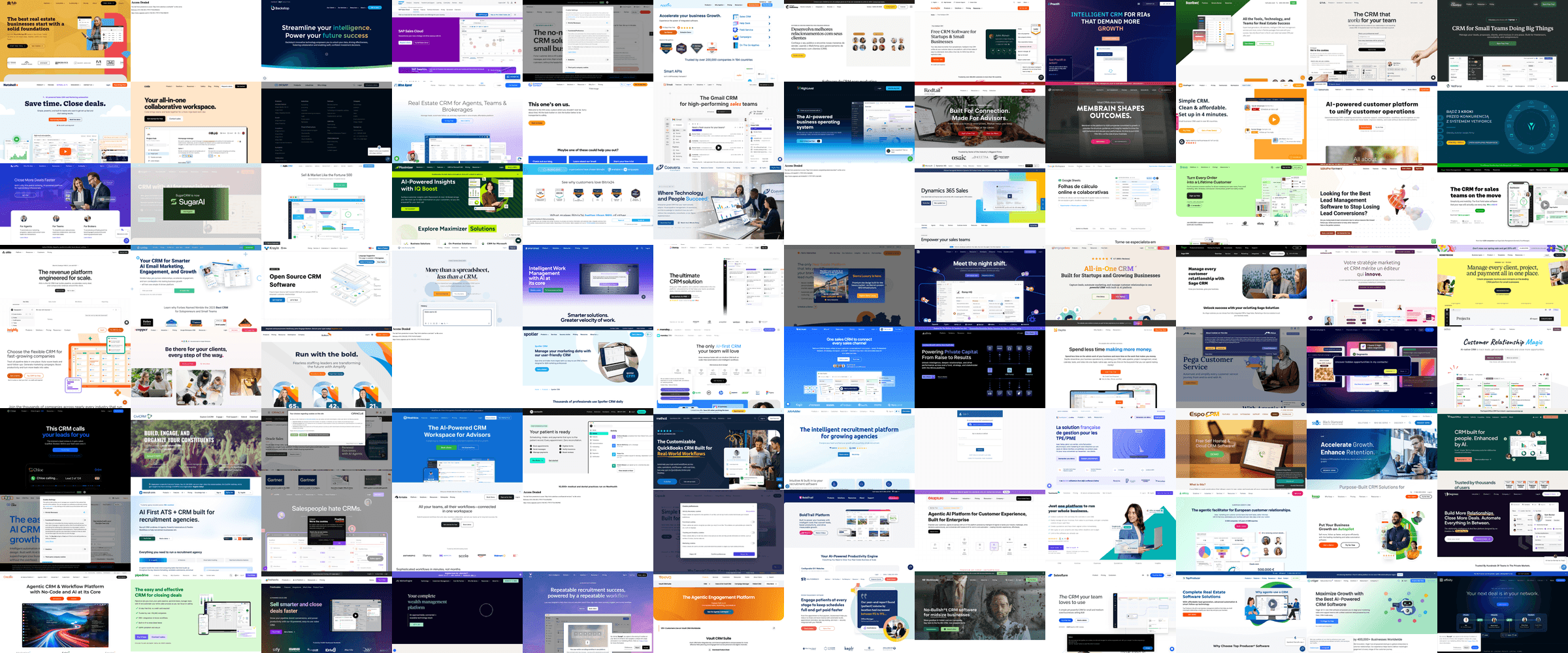







The 2026 CRM landscape, 100 tools across 8 groups
The 12 default picks
These twelve come up in every CRM conversation I've watched across the field between 2023 and 2026. If you ask any B2B sales leader to name CRMs from memory, in my experience they'll list nine or ten of these and stop. They cover roughly 80% of US and EU mid-market and enterprise B2B sales orgs by licence count, which is why I'd start any shortlist here.
| # | CRM | Pricing range (per seat / mo) | Best for (1-liner) | Year-1 cost (10 reps) | Setup |
|---|---|---|---|---|---|
| 1 | HubSpot Sales Hub | Free; Starter $20/seat; Pro $100/seat; Enterprise $15... | Mid-market teams who want CRM, marketing, and service in one suite ... | ~$2.4k | 2-6 weeks |
| 2 | Salesforce Sales Cloud | Starter $25; Pro $80; Enterprise $165; Unlimited $330... | Companies with 100+ reps, complex permissions, and a dedicated admi... | ~$3.0k | 2-6 weeks |
| 3 | Pipedrive | Essential $14; Advanced $29; Pro $59; Power $79; Ente... | Sales-led teams who want a visual pipeline and zero ceremony. | ~$1.7k | 2-6 weeks |
| 4 | Close | Startup $99; Pro $249; Enterprise $369; Unlimited $69... | Inside-sales teams who live in the dialer and need email, calling, ... | ~$12k | 2-6 weeks |
| 5 | Attio | Free; Plus $34; Pro $80; Enterprise custom per seat | Series-A through Series-C startups who outgrew the spreadsheet but ... | ~$4.1k | 2-6 weeks |
| 6 | Folk | Standard $24; Premium $36; Custom $54+ per seat | Founders, agencies, and BD teams who run sales out of LinkedIn and ... | ~$2.9k | 2-6 weeks |
| 7 | Zoho CRM | Standard $14; Pro $23; Enterprise $40; Ultimate $52 p... | Cost-sensitive global teams who want the full Zoho One suite (45+ a... | ~$1.7k | 2-6 weeks |
| 8 | Microsoft Dynamics 365 Sales | Sales Pro $65; Enterprise $105; Premium $135 per seat | Microsoft-shop enterprises already standardised on Azure, Teams, an... | ~$7.8k | 2-6 weeks |
| 9 | Copper | Starter $9; Basic $29; Pro $69; Business $134 per seat | Teams running everything inside Google Workspace (Gmail, Calendar, ... | ~$1.1k | 2-6 weeks |
| 10 | Freshsales (Freshworks) | Free; Growth $9; Pro $39; Enterprise $59 per seat | Buyers who want a balanced HubSpot-alternative without the price es... | ~$1.1k | 2-6 weeks |
| 11 | Monday Sales CRM | Basic $12; Standard $17; Pro $28; Enterprise custom p... | Operations-led teams already on monday.com who want sales on the sa... | ~$1.4k | 2-6 weeks |
| 12 | Insightly | Plus $29; Pro $49; Enterprise $99 per seat | Project-and-CRM hybrid use cases (consultancies, agencies, services... | ~$3.5k | 2-6 weeks |
Tier 1 overview: every CRM in this section side by side. Year-1 cost is a 10-rep estimate based on starting-tier pricing (real cost lands 1.5-3x this once implementation, integrations, and admin are included).
1. HubSpot Sales Hub
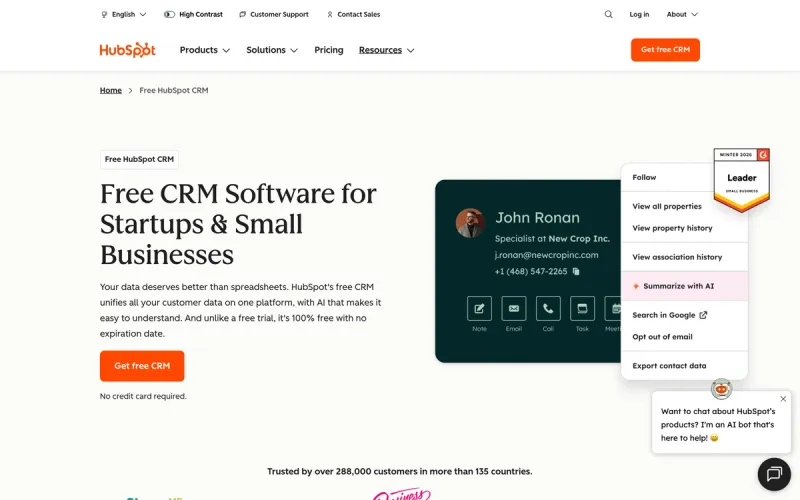
HubSpot Sales Hub is the inbound-marketing company's attempt to own the entire revenue stack, and by 2026 it has largely succeeded for the mid-market: roughly 250,000 paying customers, the deepest content-marketing flywheel of any vendor, and a sales product that is finally competitive on its own merits rather than a tag-along to Marketing Hub. What is actually unique is the unified contact record across marketing, sales, and service teams, which removes the data-stitching tax every Salesforce shop pays.
Pricing: Free; Starter $20/seat; Pro $100/seat; Enterprise $150/seat. A 5-rep team on Pro pays about $500 per month for seats plus the $1,500 Pro platform fee, so $2,000 monthly minimum once you turn on workflows and sequences. A 10-rep team lands around $2,500 monthly, and a 25-rep team on Enterprise hits $5,250 in seats alone before the $3,600 Enterprise platform fee. Annual commit saves roughly 10 to 12 percent versus monthly billing.
Best for: Mid-market teams who want CRM, marketing, and service in one suite without writing custom code. A 12-rep SaaS team running inbound plus light outbound at $20K to $50K ACV is the modal HubSpot Pro buyer. They need marketing automation, CRM, and a customer portal without hiring a Salesforce admin. We see HubSpot win every time the buyer is the head of revenue rather than the CTO, and the team has under 30 reps with no in-house RevOps engineer.
Setup reality: A clean implementation takes 3 to 6 weeks if the data already lives in a single source, 8 to 12 weeks if you are migrating from Salesforce with custom objects. The work that gets underestimated is workflow rebuilding and the lifecycle stage stamping, which breaks in week 4 when sales starts reverting deals back to MQL and the funnel reporting goes upside down.
Head-to-head: Per seat: HubSpot Pro $100 vs Salesforce Enterprise $165 vs Pipedrive Ultimate $79. Implementation: 4 to 8 weeks vs 16 to 32 weeks vs 1 to 3 weeks. Year-1 all-in for 10 reps including platform fees, onboarding, and one paid integration: $30k to $45k vs $80k to $150k vs $15k to $25k. HubSpot lands in the middle on every axis, which is exactly why it wins the mid-market default-pick slot.
3-year cost projection: A 10-rep team starting on Pro today pays roughly $30k year 1 with the $1,500 platform fee. Year 2 with 15 reps, Marketing Hub Pro added because the CMO insisted, and Operations Hub Starter to fix the data quality lands at $72k. Year 3 with 25 reps on the same Pro stack plus Service Hub Pro hits $135k once HubSpot pushes its standard 8 to 10 percent annual increase. Three-year all-in: about $237k. Add $30k to $60k for outside implementation if you go that route.
Integration stack: Email and calendar: Gmail and Outlook are native, both excellent and the gold standard. Dialer: HubSpot Calling is native but caps at modest volume; Aircall and Dialpad are the common adds. E-signature: PandaDoc, DocuSign, and HelloSign all native via the marketplace. Accounting: QuickBooks and Xero are partner apps, not native, and the sync occasionally drops invoices. Enrichment: Apollo, Clay, Cognism, and ZoomInfo all native with bidirectional sync, which is the deepest enrichment story of any CRM.
If you like HubSpot Sales Hub, also consider: If you like HubSpot but choke on the platform fee, look at Freshsales (one third the cost, weaker reporting) or ActiveCampaign (better email automation, thinner sales workflow). If you are bigger than HubSpot makes sense for, the next stop is Salesforce, not Pipedrive.
When NOT to pick it: Skip HubSpot if you have more than 50 reps with complex territory rules, channel partner programs, or product-led pricing tiers that need quote-to-cash logic. Also walk away if your marketing team only needs email and your sales motion is pure outbound, because you are paying for a marketing platform you will never use.
The honest flaw: Pricing escalates faster than buyers expect; the "free" tier is a funnel into $1,500/mo minimums by year two.
2. Salesforce Sales Cloud
Salesforce Sales Cloud is still the default CRM for any company above roughly 200 reps in 2026, with about 150,000 customers and an ecosystem of 7,000+ AppExchange apps that no competitor can match. What is unique is not the core product, which has barely changed in five years, but the AgentForce layer Marc Benioff bet the company on in 2025: native AI agents that actually live inside the same data model your reps already use.
Pricing: Starter $25; Pro $80; Enterprise $165; Unlimited $330 per seat. A 5-rep Pro Suite team pays about $400 monthly for seats, but the price tag is misleading because almost no real Salesforce deployment uses Pro. A 10-rep team on Enterprise is $1,650 monthly in seats, and a 25-rep team on Unlimited hits $8,250 plus $50 to $80 per seat in mandatory add-ons. Multi-year commits unlock 15 to 25 percent discounts but lock you into a price you cannot escape for 3 years.
Best for: Companies with 100+ reps, complex permissions, and a dedicated admin or three. A 200-rep B2B team selling $250K ACV with quote-to-cash complexity, partner channels, and 4 sales geographies is the buyer Salesforce was designed for, because no other CRM handles that permission model and revenue logic without 18 months of custom work. Teams in this profile typically save 30 to 40 percent on time-to-quote when they move from Excel-driven approval chains into native Salesforce CPQ.
Setup reality: A real Salesforce rollout is 4 to 9 months and costs 2 to 3x the license fee in partner consulting. The partner alone runs $150K to $400K for a 100-seat implementation. The data migration is rarely the problem. What breaks first is the permission model in week 6 when finance demands quote visibility that conflicts with the sales hierarchy you just built.
Head-to-head: Per seat: Salesforce Enterprise $165 vs HubSpot Enterprise $150 vs Dynamics 365 Enterprise $105. Implementation: 16 to 32 weeks vs 8 to 16 weeks vs 16 to 36 weeks. Year-1 all-in for 10 reps including partner consulting, mandatory managed packages, and admin tooling: $80k to $150k vs $40k to $70k vs $60k to $120k. Salesforce wins on ceiling and loses on time-to-value at every team size under 50 reps.
3-year cost projection: A 10-rep team on Enterprise pays roughly $25k in seats year 1 plus $80k to $120k in partner implementation, so $105k to $145k all-in. Year 2 with 15 reps, CPQ added, and a fractional admin lands at $145k. Year 3 with 25 reps, Sales Cloud Unlimited for half the team, Pardot or Account Engagement, plus a $90k annual managed-services retainer hits $310k. Three-year all-in: $560k to $640k, and that is conservative. Most real deployments overshoot by 30 percent.
Integration stack: Email and calendar: Gmail and Outlook via Einstein Activity Capture, native but the inbox plugin is awkward. Dialer: Salesforce Dialer is native but most teams replace it with Aircall, Dialpad, or Five9 within the first year. E-signature: DocuSign is native; PandaDoc is native via AppExchange. Accounting: QuickBooks via Breadwinner, NetSuite via Salesforce Connect, neither cheap. Enrichment: ZoomInfo, Clay, Apollo, Cognism, LeadIQ all native via AppExchange, the deepest enrichment ecosystem in the category.
If you like Salesforce Sales Cloud, also consider: If you like Salesforce but cannot stomach the cost, Dynamics 365 is the legitimate alternative for a Microsoft shop. If you are deciding Salesforce versus HubSpot and the answer is not obvious, you probably want HubSpot.
When NOT to pick it: Do not buy Salesforce if you have under 25 reps, no in-house admin, and a simple deal motion. The total cost of ownership will crush you. Also walk away if you cannot dedicate a full-time admin in year one, because the platform decays without one and you will end up with a $300K shelfware bill.
The honest flaw: Total cost of ownership is 2 to 3x the license fee once you add consultants and managed packages.
3. Pipedrive
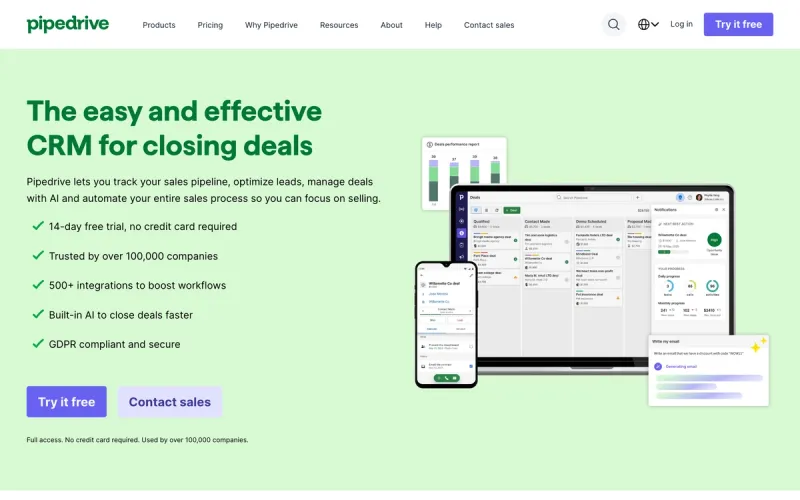
Pipedrive is the pipeline-first CRM that built its reputation on rep adoption: every screen is a deal kanban, and reps actually log activity in it without being forced. By 2026 it serves around 100,000 paying customers, mostly in the 5 to 50 rep band, and remains the only major CRM where the founders were salespeople first rather than marketers.
Pricing: Lite $14; Growth $39; Premium $59; Ultimate $79 per seat (annual billing, Pipedrive re-tiered in 2026). A 5-rep team on Pro pays $295 monthly billed annually, so roughly $3,500 per year. A 10-rep team lands at $590 monthly on Pro, and a 25-rep team on Power tier hits $1,975 monthly plus essentially mandatory add-ons (LeadBooster $39, Smart Docs $39, Campaigns $16 per seat) that easily add 30 percent. Annual billing saves about 17 percent.
Best for: Sales-led teams who want a visual pipeline and zero ceremony. A 12-rep outbound-led B2B team selling $15K to $80K ACV with a 6-stage pipeline and no real marketing automation need is the modal Pipedrive buyer. Pipedrive routinely lands at agencies and SaaS startups in this band, and the common thread is the founder wants reps to actually use the CRM rather than fight it.
Setup reality: Setup is 2 to 5 days for a 10-rep team if you keep the pipeline simple. The work that catches teams off guard is custom field discipline (Pipedrive lets you add fields trivially and reps will create 60 of them in month two) and the reporting limits, which surface in week 4 when management asks for a multi-dimensional revenue forecast.
Head-to-head: Per seat: Pipedrive Ultimate $79 vs HubSpot Pro $100 vs Close Pro $249. Implementation: 1 to 3 weeks vs 4 to 8 weeks vs 2 to 4 weeks. Year-1 all-in for 10 reps including the LeadBooster, Smart Docs, and Campaigns add-ons that you will actually buy: $15k to $25k vs $30k to $45k vs $35k to $50k. Pipedrive wins on price floor and time-to-value, loses on reporting depth and dialer-native workflow.
3-year cost projection: A 10-rep team on Pro pays $7,100 in seats year 1 plus $4,700 in LeadBooster and Smart Docs add-ons, so about $12k. Year 2 with 15 reps on Power and the Campaigns module added lands at $24k. Year 3 with 25 reps on Power plus the full add-on stack (LeadBooster, Smart Docs, Campaigns, Projects) hits $58k. Three-year all-in: about $94k. Pipedrive's pricing escalation is one of the most predictable in the category, no nasty surprises.
Integration stack: Email and calendar: Gmail and Outlook are native and reliable, with two-way sync that actually works. Dialer: Pipedrive Phone is native but limited; most teams add Aircall, JustCall, or Kixie within month two. E-signature: Smart Docs handles light e-sign natively; PandaDoc and DocuSign are native via marketplace. Accounting: QuickBooks and Xero via marketplace apps, not native, and the sync is one-way for line items. Enrichment: Apollo, Cognism, Lusha via marketplace; Clay via Zapier, which is a real gap for outbound-heavy teams.
If you like Pipedrive, also consider: If you like Pipedrive but want a dialer baked in, look at Close or Salesmate. If you want Pipedrive's simplicity but better automation, Attio is the upgrade path that does not feel like enterprise software.
When NOT to pick it: Skip Pipedrive if you have over 30 reps with multi-product, multi-currency, or matrix-territory rules. Also walk away if marketing automation is a real requirement, because the bundled Campaigns module is functional but undersized.
The honest flaw: Reporting depth and automation power lag the bigger names; outgrows most teams past 25 reps.
4. Close
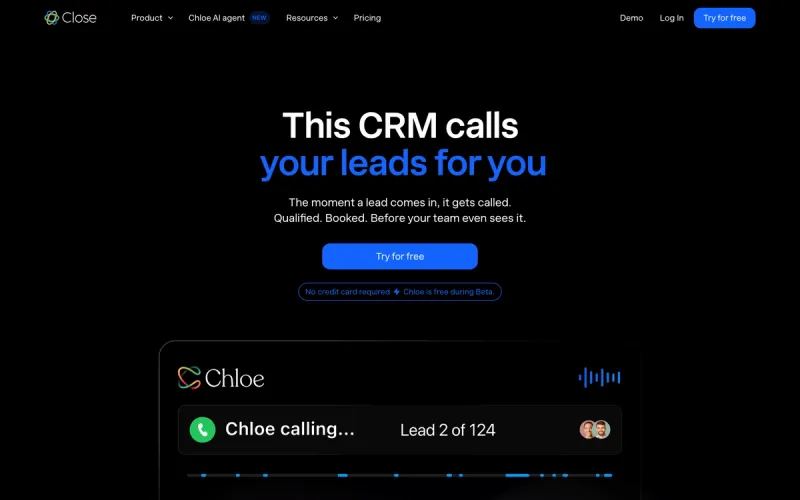
Close is the dialer-first CRM built specifically for inside-sales teams who live in the phone and email all day. By 2026 it serves around 6,000 customers, almost all SaaS or services companies running outbound or inbound-to-call motions, and remains the only mainstream CRM where the calling experience does not feel bolted on.
Pricing: Startup $99; Pro $249; Enterprise $369; Unlimited $699 per seat. A 5-rep team on Growth pays roughly $545 monthly billed annually, which bundles calling and SMS that other vendors charge $50+ per seat for. A 10-rep team on Scale hits $1,390 monthly, and a 25-rep team on Scale lands at $3,475 monthly. Annual saves about 15 percent versus monthly billing.
Best for: Inside-sales teams who live in the dialer and need email, calling, SMS in one window. A 6 to 15 rep inside-sales team doing 40+ calls per rep per day, selling $10K to $40K ACV SaaS or services, is the modal Close buyer because no other CRM makes that workflow this fast. A typical Close customer profile runs 40+ calls per rep per day, so a 4-rep team easily ranges into the 250 to 300/day band and would otherwise need three separate tools on any competing stack.
Setup reality: Setup is 1 to 2 weeks for a typical 10-rep team. Migration from HubSpot or Pipedrive is straightforward because Close offers free migration support. What actually takes time is the smart views and sequences setup; reps will not adopt the product until you have rebuilt the workflow logic they were used to.
Head-to-head: Per seat: Close Pro $249 vs Salesloft Advanced $165 vs HubSpot Pro $100 plus Aircall $50. Implementation: 1 to 2 weeks vs 4 to 8 weeks vs 4 to 8 weeks. Year-1 all-in for 10 reps with calling minutes included: $30k to $35k vs $25k to $40k for CRM plus sequencer plus dialer vs $40k to $55k for the HubSpot bundle. Close wins on integration density and time-to-value for pure inside sales, loses on price ceiling.
3-year cost projection: A 10-rep team on Scale pays $16,700 in seats year 1 with calling and SMS bundled. Year 2 with 15 reps on Scale, Power Dialer add-on, and SMS Power Pack adds-on lands at $32k. Year 3 with 25 reps on Scale plus Custom Activities, Power Dialer for everyone, and a CallHippo international add-on hits $74k. Three-year all-in: about $123k. Close is cheaper than Pipedrive plus a dialer once you cross 10 reps, which is the whole pricing pitch.
Integration stack: Email and calendar: Gmail and Outlook are native and the inbox is honestly the best in the category for inside sales workflow. Dialer: Close Calling is native and the entire product is built around it, no add-on needed. E-signature: PandaDoc and HelloSign via Zapier or native API, no first-party e-sign. Accounting: QuickBooks via Zapier only, which is a real gap. Enrichment: Apollo, Clearbit, Cognism via native integrations, plus Clay via webhook for the modern stack.
If you like Close, also consider: If you like Close but want more reporting depth, Salesloft and Outreach are the alternatives, but you will buy a CRM separately. If you want Close's dialer in a cheaper package, Salesmate is the closest substitute.
When NOT to pick it: Do not pick Close if your motion is field sales, channel sales, or marketing-led inbound with long evaluation cycles. Also walk away if you need real marketing automation or service workflows, because Close has neither and is not planning to.
The honest flaw: Less customizable than Salesforce/HubSpot; vertical depth is shallow outside SaaS inside sales.
5. Attio
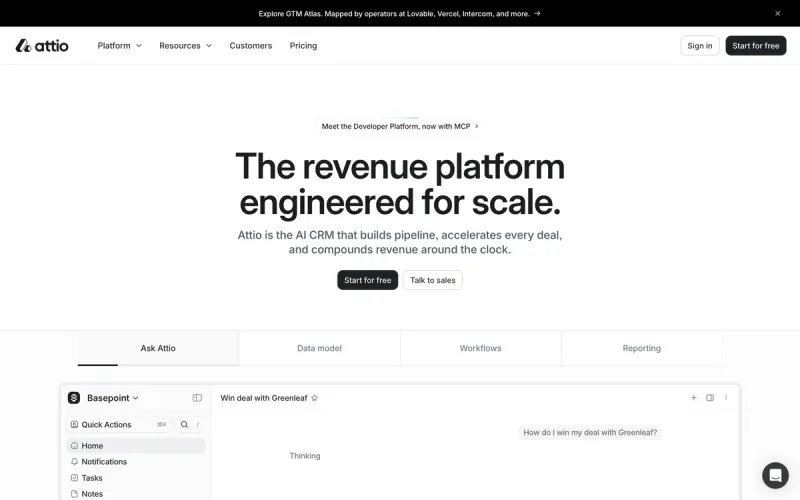
Attio is the venture-backed CRM that everyone in the 2024-2026 startup wave moved to, with a relational data model that lets you model contacts, companies, deals, and any custom object without admin gymnastics. By 2026 it has roughly 8,000 paying teams, mostly Series A through C, and is the only modern CRM where the founders treat data modeling as the product surface rather than an afterthought.
Pricing: Free; Plus $34; Pro $80; Enterprise custom per seat. A 5-rep team on Pro pays $345 monthly billed annually, a 10-rep team $690, and a 25-rep team $1,725. The pricing trap is the enrichment credits, which are bundled but exhaust fast on outbound-heavy teams. The Enterprise tier (custom, typically $150 to $200 per seat) is required once you want SSO, audit logs, or workspace-level role permissions.
Best for: Series-A through Series-C startups who outgrew the spreadsheet but hate enterprise CRM tax. A 15-rep Series B SaaS team that hates Salesforce but has outgrown spreadsheets and Notion is the modal Attio buyer because the product solves data modeling without the implementation tax. Series B SaaS teams routinely go live on Attio in under 2 weeks with custom objects, sequences, and Slack integration that would have been a 3-month Salesforce build.
Setup reality: Setup is 3 to 10 days for a 10-rep team, with the import flow handling CSVs from HubSpot, Pipedrive, and Salesforce reasonably well. What breaks first in week 4 is the reporting layer; Attio's dashboards are getting better quarter on quarter but still trail HubSpot and Salesforce, so your CRO will eventually ask for a Looker or Hex connection.
Head-to-head: Per seat: Attio Pro $80 vs HubSpot Pro $100 vs Salesforce Pro Suite $80. Implementation: 1 to 2 weeks vs 4 to 8 weeks vs 8 to 16 weeks. Year-1 all-in for 10 reps including enrichment credits and one Slack-Notion-Linear automation build: $14k to $22k vs $30k to $45k vs $35k to $80k. Attio wins on time-to-value and data-model flexibility, loses on reporting depth and partner ecosystem.
3-year cost projection: A 10-rep team on Pro pays $9,600 in seats year 1 plus about $2k in additional enrichment credits, so $12k. Year 2 with 15 reps on Pro plus Enterprise tier for SSO and audit logs lands at $32k. Year 3 with 25 reps on Enterprise (typical $150 per seat) plus the AI Research add-on and a Hex BI integration hits $58k. Three-year all-in: about $102k. The price is fair for a modern CRM, but the Enterprise jump for SSO catches many teams off guard.
Integration stack: Email and calendar: Gmail and Outlook are native with two-way sync, reliable and clean. Dialer: no native dialer; teams add Aircall, Dialpad, or Orum via Zapier or n8n. E-signature: DocuSign and PandaDoc via native integrations launched in 2025, both functional. Accounting: QuickBooks and Stripe native, no Xero yet, which the European customer base complains about. Enrichment: Clay and Apollo via deep native integrations (Clay especially is first-class); Cognism via Zapier.
If you like Attio, also consider: If you like Attio but need a deeper sequencer baked in, Folk or Salesloft are the complements. If you want Attio's relational power for a venture or BD use case, Affinity is the obvious specialist.
When NOT to pick it: Skip Attio if you have more than 50 reps with strict permission requirements, channel partner programs, or quote-to-cash needs. Also walk away if your team needs an offline mobile experience or heavy phone-first workflow, because mobile and dialing are not where Attio invests.
The honest flaw: Newest entrant, so vertical templates and third-party integrations are still thin.
6. Folk
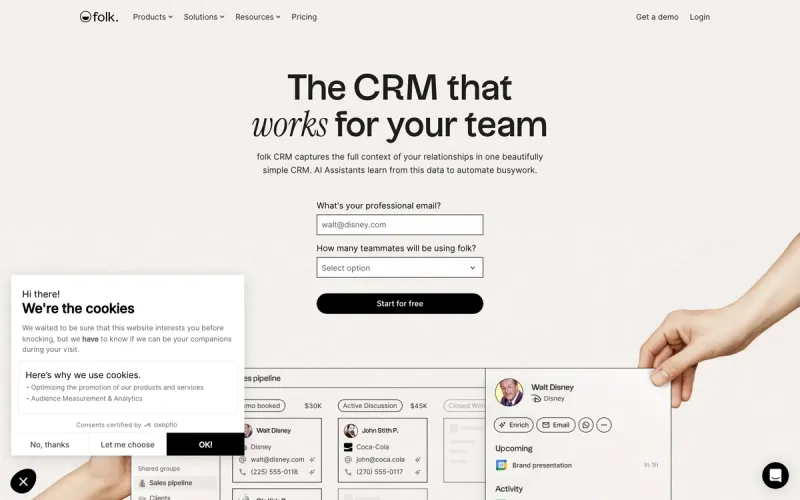
Folk is the LinkedIn-and-Gmail-native CRM built for founders, agencies, and BD teams who manage relationships across channels rather than running a structured pipeline. By 2026 it serves around 10,000 paying teams, mostly under 15 people, and has carved out the relationship-CRM niche that Salesflare and Nimble used to own.
Pricing: Standard $24; Premium $36; Custom $54+ per seat. A 5-rep team on Premium pays $240 monthly billed annually, a 10-rep team $480, and a 25-rep team on Custom lands around $2,000 monthly with the LinkedIn enrichment credits included. Annual billing saves about 20 percent. The Standard tier ($24) caps automations at a level that breaks for any team doing more than 100 outreach touches per week.
Best for: Founders, agencies, and BD teams who run sales out of LinkedIn and Gmail. A 3 to 8 person agency or VC team running BD primarily through LinkedIn and Gmail, with deal volume under 100 active conversations, is the modal Folk buyer. 5-person agencies routinely choose Folk over Pipedrive specifically because reps are already pulling contacts from LinkedIn manually and Folk makes that one click.
Setup reality: Setup is 1 to 3 days because there is barely anything to configure; the LinkedIn extension and Gmail sync do most of the lifting. The actual work is in week 3 when you realize Folk's pipeline reporting is light, so any team that needs revenue forecasting will be building it in a spreadsheet or moving to Attio within 6 months.
Head-to-head: Per seat: Folk Premium $36 vs Attio Pro $80 vs Salesflare Pro $55. Implementation: 1 to 3 days vs 1 to 2 weeks vs 2 to 4 days. Year-1 all-in for 10 reps with LinkedIn enrichment credits and one Zapier connection: $7k to $12k vs $14k to $22k vs $9k to $14k. Folk wins on time-to-value for relationship-led teams and loses on pipeline reporting and forecasting depth.
3-year cost projection: A 10-rep team on Premium pays $5,760 in seats year 1 plus $2k in LinkedIn enrichment credit top-ups, so about $8k. Year 2 with 15 reps on Custom tier for advanced automations lands at $18k. Year 3 with 25 reps on Custom plus extended LinkedIn credits, AI message generation, and a Make automation budget hits $34k. Three-year all-in: about $60k. Folk is one of the cheapest 3-year stories of any modern CRM at this team size.
Integration stack: Email and calendar: Gmail and Outlook are native and the entire product is built around inbox capture. Dialer: no native dialer and not planned; teams using calling pair Folk with Aircall via Zapier. E-signature: DocuSign and PandaDoc via Zapier only, no native integration. Accounting: no native QuickBooks or Xero; agency users typically pair Folk with Bonsai or HelloBonsai for invoicing. Enrichment: LinkedIn native (the headline feature), Clearbit via Zapier, Clay via webhooks, Apollo via Zapier.
If you like Folk, also consider: If you like Folk but need real pipeline depth, Attio is the upgrade. If you like Folk for the LinkedIn-first workflow but want better email sequencing, Salesflare is the closest competitor.
When NOT to pick it: Do not pick Folk if you have over 15 reps or a structured outbound team that does cold dialing. Also walk away if you need formal sales reporting, multi-currency, or any kind of approval workflow.
The honest flaw: Pipeline + automation feel light next to Pipedrive/Close once you cross a 5-rep team.
7. Zoho CRM
Zoho CRM is the global, cost-sensitive default for teams that want a full business suite (CRM, marketing, finance, HR, projects) under one vendor for one budget. By 2026 it claims roughly 250,000 customers across 180 countries, and the actual differentiator is not the CRM but the Zoho One bundle, which gives you 45+ apps for $37 per user per month.
Pricing: Standard $14; Pro $23; Enterprise $40; Ultimate $52 per seat. A 5-rep team on Pro pays $115 monthly, a 10-rep team $230, and a 25-rep team on Enterprise lands at $1,000 monthly, which is roughly one quarter of HubSpot or Salesforce for comparable features. The honest math is that Zoho One at $37 per user makes the standalone CRM tiers irrelevant for any team using more than 3 Zoho apps.
Best for: Cost-sensitive global teams who want the full Zoho One suite (45+ apps) for one budget. A 20-rep international team in India, the Middle East, or Latin America that needs CRM plus invoicing plus a help desk on a sub-$50-per-user budget is the modal Zoho buyer because no Western competitor matches the price floor. Zoho typically wins in regional markets where Salesforce's localization is weak and HubSpot's pricing is unbearable.
Setup reality: Setup is 2 to 5 weeks if you stay within Zoho's defaults, 8 to 14 weeks if you start customizing modules. The integration story between Zoho apps is shakier than the marketing implies. What breaks first is the lookup between CRM and Books (the invoicing app) in week 4 when finance discovers contact records are not syncing reliably.
Head-to-head: Per seat: Zoho CRM Enterprise $40 vs HubSpot Pro $100 vs Freshsales Enterprise $59. Implementation: 4 to 10 weeks vs 4 to 8 weeks vs 2 to 4 weeks. Year-1 all-in for 10 reps including a Zoho partner implementation: $12k to $22k vs $30k to $45k vs $15k to $25k. Zoho wins on price ceiling and breadth (45-app Zoho One for $37 per user), loses on UX polish and rep adoption.
3-year cost projection: A 10-rep team on Enterprise pays $4,800 in seats year 1, or $4,440 on Zoho One if you want the full suite. Year 2 with 15 reps on Zoho One lands at $6,660 plus $5k for a Zoho partner to actually configure things properly. Year 3 with 25 reps on Zoho One Enterprise hits $13,500 in licenses plus $8k partner retainer. Three-year all-in: about $48k. By any measure, the cheapest year-3 number of any default-pick CRM in this list.
Integration stack: Email and calendar: Gmail and Outlook native and reliable, with Zoho Mail as the first-party option if you go full Zoho. Dialer: Zoho Voice is native; RingCentral, Aircall, and Twilio all native via marketplace. E-signature: Zoho Sign native and bundled with Zoho One; DocuSign native. Accounting: Zoho Books native (free in Zoho One); QuickBooks and Xero native, though the QuickBooks sync has historically been the buggiest. Enrichment: Apollo native, Clearbit native, Clay via Zapier.
If you like Zoho CRM, also consider: If you like Zoho's price but want a cleaner UX, Freshsales is the obvious cross-shop. If you want the full Zoho One value but in a more modern shell, there is no real substitute at the price.
When NOT to pick it: Skip Zoho if your team is US or EU based, sells $50K+ ACV, and lives in tools like Slack and Notion. Also walk away if you need a polished mobile app or a sales engagement platform that competes with Salesloft.
The honest flaw: UX feels assembled by committee; the integration story between Zoho apps is shakier than the marketing implies.
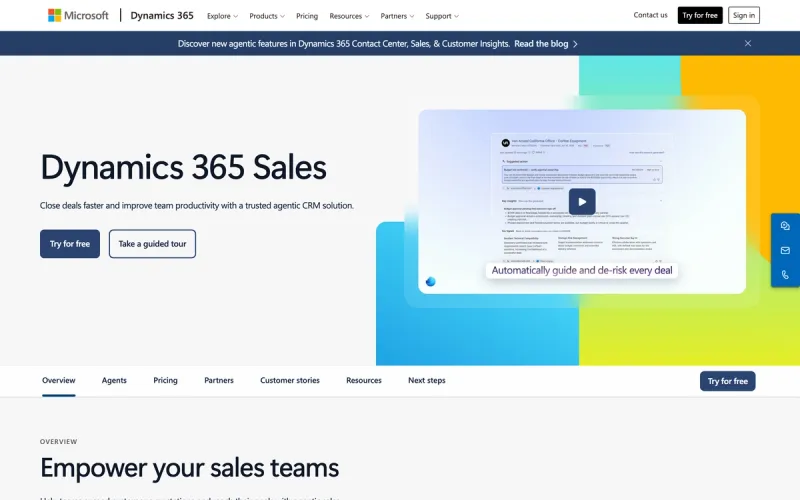
8. Microsoft Dynamics 365 Sales
Microsoft Dynamics 365 Sales is the CRM Microsoft built to extract its existing enterprise base from Salesforce, and by 2026 it has succeeded with roughly 70,000 organizations on the platform. The actual moat is the Power Platform integration: Dynamics is the only CRM where your admin can build a custom approval workflow in Power Automate without writing code, then surface it as a Teams app.
Pricing: Sales Pro $65; Enterprise $105; Premium $135 per seat. A 5-rep team on Sales Enterprise pays $525 monthly, a 10-rep team $1,050, and a 25-rep team $2,625, with Sales Premium ($150) required if you want Copilot for Sales and the relationship analytics that compete with Salesforce Einstein. Existing Microsoft 365 E5 customers get effective discounts because licensing bundles often include partial Dynamics entitlements.
Best for: Microsoft-shop enterprises already standardised on Azure, Teams, and Office 365. A 100-rep enterprise already running Microsoft 365 E5, Teams as the primary collaboration tool, and Azure AD as the identity layer is the modal Dynamics buyer because the integration tax is essentially zero. Financial-services enterprises in this profile typically cut $150K to $250K of Salesforce license costs annually by switching to Dynamics, and rep adoption usually goes up because the CRM lives inside Teams.
Setup reality: Setup is 4 to 8 months for a real deployment, and you will need a Microsoft partner whether you want one or not because the configuration depth requires it. The data migration from Salesforce is the easy part. What breaks first is the security role design in month 3 when finance and sales have conflicting record visibility needs.
Head-to-head: Per seat: Dynamics 365 Sales Enterprise $105 vs Salesforce Enterprise $165 vs HubSpot Enterprise $150. Implementation: 16 to 36 weeks vs 16 to 32 weeks vs 8 to 16 weeks. Year-1 all-in for 10 reps including Microsoft partner consulting and Power Platform configuration: $60k to $120k vs $80k to $150k vs $40k to $70k. Dynamics wins for Microsoft shops on TCO, loses on time-to-value for anyone not already on the Microsoft stack.
3-year cost projection: A 10-rep team on Sales Enterprise pays $12,600 in seats year 1 plus $50k to $90k in Microsoft partner implementation, so $63k to $103k. Year 2 with 15 reps on Sales Premium (Copilot included) and a Power Automate license per admin lands at $36k in licenses plus $40k annual partner retainer. Year 3 with 25 reps on Sales Premium plus Customer Insights, plus a managed-services retainer, hits $110k licenses plus $50k services. Three-year all-in: about $300k to $360k. Microsoft 365 E5 customers often save 15 to 20 percent through bundle credits.
Integration stack: Email and calendar: Outlook and Teams native and best-in-class; Gmail integration exists but is poor. Dialer: Teams Phone native (the entire pitch for Microsoft shops); Aircall and Dialpad available but rarely needed. E-signature: DocuSign native via AppSource; Adobe Sign native. Accounting: Dynamics 365 Business Central native (this is the killer differentiator); QuickBooks via partner apps. Enrichment: ZoomInfo, Apollo, Cognism all native via AppSource; LinkedIn Sales Navigator native with deeper hooks than any competitor because Microsoft owns LinkedIn.
If you like Microsoft Dynamics 365 Sales, also consider: If you like Dynamics for the Microsoft integration but want something lighter, there is no real substitute; the entire pitch is the stack lock-in. If you are evaluating Dynamics versus Salesforce as a non-Microsoft shop, you probably want Salesforce.
When NOT to pick it: Do not buy Dynamics if you are not already a Microsoft 365 enterprise customer; the value proposition collapses without the underlying stack. Also walk away if you need fast time-to-value.
The honest flaw: Hard sell to any team that does not already live in the Microsoft stack; admin learning curve is steep.
Visit Microsoft Dynamics 365 Sales.
9. Copper
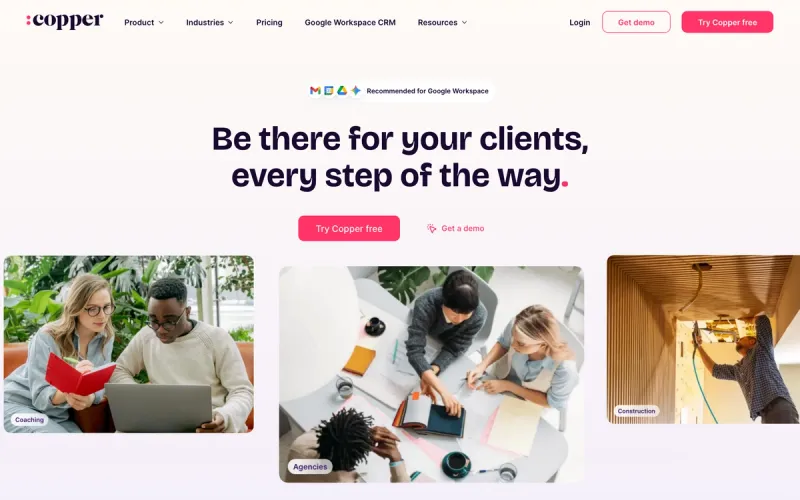
Copper is the CRM purpose-built to live inside Google Workspace; it installs as a Chrome extension and turns Gmail into a CRM surface where every email shows the deal context, contact history, and pipeline stage. By 2026 it serves around 30,000 customers, almost all Google Workspace shops, and remains the cleanest Google-native option after Streak.
Pricing: Starter $9; Basic $29; Pro $69; Business $134 per seat. A 5-rep team on Professional pays $295 monthly billed annually, a 10-rep team $590, and a 25-rep team on Business hits $2,475 monthly, with annual billing saving roughly 15 percent. The pricing feels reasonable until you compare against Pipedrive, which runs about 20 percent cheaper at every tier with deeper reporting; Copper's premium is essentially the Google integration tax.
Best for: Teams running everything inside Google Workspace (Gmail, Calendar, Drive). A 5 to 15 person agency or services firm running everything in Gmail, Drive, and Calendar, with relationship-led BD rather than structured outbound, is the modal Copper buyer. Small design agencies routinely pick Copper and partner adoption is typically instant because nobody has to leave Gmail.
Setup reality: Setup is 2 to 5 days because the Chrome extension auto-populates contacts and deals from Gmail history, which is the whole pitch. What breaks first in week 4 is the reporting; Copper's dashboards are functional but the cohort and forecasting tools lag every modern competitor, so any team that wants a real revenue dashboard will be exporting to Sheets within 2 months.
Head-to-head: Per seat: Copper Business $134 vs HubSpot Pro $100 vs Pipedrive Ultimate $79. Implementation: 1 to 2 weeks vs 4 to 8 weeks vs 1 to 3 weeks. Year-1 all-in for 10 reps including the Workflow Automation tier and one Zapier subscription: $17k to $22k vs $30k to $45k vs $15k to $25k. Copper wins on Google Workspace integration depth and loses on reporting, dialer, and brand outside the Google ecosystem.
3-year cost projection: A 10-rep team on Business pays $16,100 in seats year 1, plus $2k in Zapier and a basic Looker Studio setup, so about $18k. Year 2 with 15 reps on Business and the additional Workflow Automation add-on lands at $32k. Year 3 with 25 reps on Business plus the Copper-to-Looker pipeline that the CRO will eventually demand hits $58k. Three-year all-in: about $108k. Copper's pricing is honest but mid-tier; you are paying a premium for the Gmail-native integration.
Integration stack: Email and calendar: Gmail and Google Calendar are native and best-in-class (this is the whole product); Outlook exists but is an afterthought. Dialer: no native dialer; Aircall, RingCentral, and JustCall via marketplace, all functional. E-signature: DocuSign and PandaDoc native; HelloSign via Zapier. Accounting: QuickBooks and Xero native, both reliable for Google Workspace agencies. Enrichment: Clearbit native, Apollo via Zapier, Cognism via Zapier, Clay via webhook. Enrichment story is thinner than HubSpot or Attio.
If you like Copper, also consider: If you like Copper but want better pipeline depth, Pipedrive is the upgrade. If you live in Gmail and want even tighter inbox integration, Streak is the alternative, though it is more brittle outside Gmail.
When NOT to pick it: Skip Copper if your team is not on Google Workspace; the entire value drops 60 percent and you are paying for an extension you cannot use. Also walk away if you have over 25 reps or need formal sales reporting, because the product was built for relationship CRM, not pipeline science.
The honest flaw: Outside the Google ecosystem the value drops 60%; reporting is basic.
10. Freshsales (Freshworks)
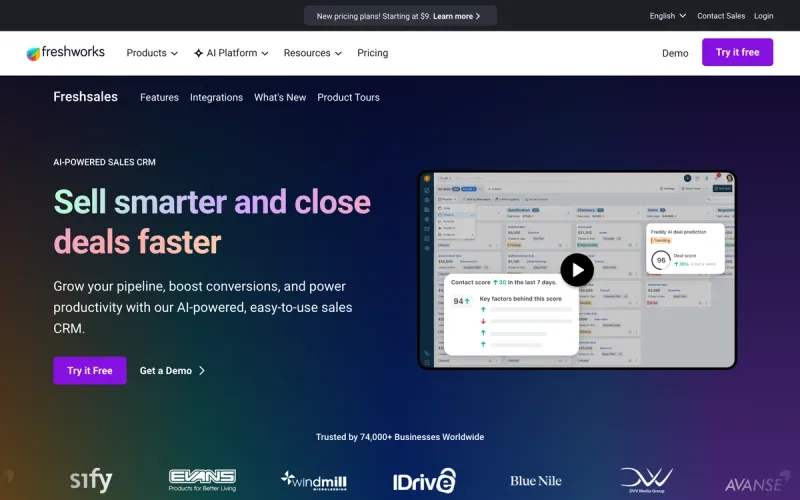
Freshsales is the Freshworks CRM, positioned as the HubSpot alternative for teams that want similar breadth (sales, marketing, support) without the platform fees. By 2026 it has around 60,000 customers, mostly in India, the UK, and US mid-market, and the actual differentiator is bundled telephony at no extra per-seat charge.
Pricing: Free; Growth $9; Pro $39; Enterprise $59 per seat. A 5-rep team on Pro pays $195 monthly, a 10-rep team $390, and a 25-rep team on Enterprise $1,475, which is roughly 60 percent cheaper than HubSpot Pro at the same scale. Annual billing saves about 20 percent, and the bundled telephony (Freshcaller) saves another $30 to $50 per seat versus buying Aircall separately.
Best for: Buyers who want a balanced HubSpot-alternative without the price escalator. A 12-rep international team that wants a HubSpot-style suite at a lower budget, with telephony built in and lower expectations on marketing automation, is the modal Freshsales buyer. Freshsales typically wins in India and Southeast Asia where HubSpot's pricing is punitive, and in US mid-market when the buyer is a head of sales rather than a CMO.
Setup reality: Setup is 2 to 4 weeks for a clean implementation, with the data import handling HubSpot and Salesforce exports reasonably. What breaks first is the AI agent (Freddy) in week 2, which the demos promise can summarize calls and draft emails but in production produces output that needs heavy human edits.
Head-to-head: Per seat: Freshsales Enterprise $59 vs HubSpot Pro $100 vs Zoho CRM Enterprise $40. Implementation: 2 to 4 weeks vs 4 to 8 weeks vs 4 to 10 weeks. Year-1 all-in for 10 reps including bundled Freshcaller telephony and one Freshmarketer add-on: $10k to $16k vs $30k to $45k vs $12k to $22k. Freshsales wins on the bundled dialer (saves $30 to $50 per seat versus Aircall on HubSpot) and loses on AI quality and marketing automation depth.
3-year cost projection: A 10-rep team on Pro pays $4,680 in seats year 1 plus modest Freshcaller minute overages, so about $7k. Year 2 with 15 reps on Enterprise and Freshmarketer Pro added lands at $19k. Year 3 with 25 reps on Enterprise plus Freshmarketer plus Freshdesk for support hits $42k. Three-year all-in: about $68k. Among the cheapest 3-year stories of any default-pick CRM, even cheaper than Pipedrive once you factor in bundled telephony.
Integration stack: Email and calendar: Gmail and Outlook native and reliable, two-way sync that works. Dialer: Freshcaller is native and bundled, which is the headline pricing advantage; international minutes are charged separately. E-signature: DocuSign and PandaDoc native via marketplace, both functional. Accounting: QuickBooks and Xero via marketplace, not native, and the sync is light on line-item detail. Enrichment: Clearbit native, Apollo native, Cognism via Zapier; the in-app Freddy enrichment is more marketing than working tech.
If you like Freshsales (Freshworks), also consider: If you like Freshsales but want a more mature product, HubSpot at twice the cost is the alternative. If you want the price point and you live outside the West, Zoho is the obvious comparison.
When NOT to pick it: Do not buy Freshsales if you need deep marketing automation; the bundled Freshmarketer is functional but trails HubSpot and ActiveCampaign noticeably. Also walk away if you have over 50 reps with complex territory rules.
The honest flaw: AI agent ("Freddy") is more demoware than deal-mover; reporting customization is restrictive.
Visit Freshsales (Freshworks).
11. Monday Sales CRM
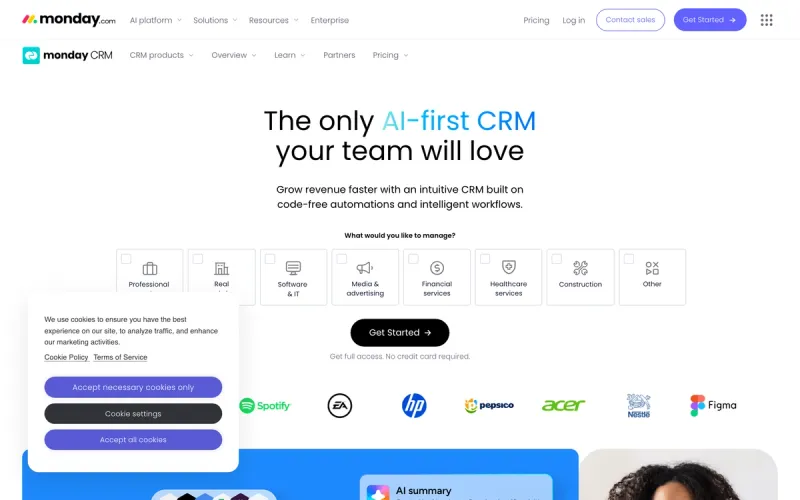
Monday Sales CRM is the sales-flavored skin on top of monday.com's workspace platform, launched in 2022 and aggressively marketed since. By 2026 it serves roughly 35,000 sales teams, almost all of which were already monday.com customers using the platform for projects or operations, and the actual product is a CRM-shaped board layout rather than a purpose-built sales tool.
Pricing: Basic $12; Standard $17; Pro $28; Enterprise custom per seat. A 5-rep team on Pro pays $140 monthly, a 10-rep team $280, and a 25-rep team on Enterprise lands around $1,000 plus the monday.com Work Management seats you probably still need. The pricing looks cheap until you realize a real sales deployment requires both Sales CRM and Work Management seats for non-sales roles, which doubles the bill.
Best for: Operations-led teams already on monday.com who want sales on the same canvas. A 15-rep operations-led team already running monday.com for project management, where the sales motion is a side workflow rather than the primary business, is the modal Sales CRM buyer. It typically works for agencies, services firms, and internal sales teams at non-software companies where pipeline depth is less important than visibility.
Setup reality: Setup is 3 to 7 days because the board templates do most of the lifting, and existing monday.com admins find the configuration intuitive. What breaks first in week 4 is the rep adoption; sales reps coming from Pipedrive or Salesforce find the board UI awkward for daily deal updates, and you will lose data quality if managers do not enforce logging discipline.
Head-to-head: Per seat: Monday Sales CRM Pro $28 vs HubSpot Pro $100 vs Pipedrive Pro $59. Implementation: 3 to 7 days vs 4 to 8 weeks vs 1 to 3 weeks. Year-1 all-in for 10 reps including Work Management seats for non-sales colleagues and the Make automation budget: $8k to $15k vs $30k to $45k vs $10k to $18k. Monday wins on price floor and visual flexibility, loses on rep adoption and dialer-native workflow.
3-year cost projection: A 10-rep team on Pro pays $3,360 in seats year 1 plus $5k for the Work Management seats your ops team needs, so about $8k. Year 2 with 15 reps on Pro plus more Work Management seats and the AI add-on lands at $18k. Year 3 with 25 reps on Enterprise (typical $30+ per seat) plus 20 Work Management seats hits $35k. Three-year all-in: about $61k. The catch is you almost always end up with double the seats you planned because non-sales teams want in.
Integration stack: Email and calendar: Gmail and Outlook integrations are native but feel grafted on rather than first-class; sync is reliable for activity logging. Dialer: Aircall native, Twilio native; no first-party dialer. E-signature: DocuSign native, PandaDoc native, HelloSign native; this is strong. Accounting: QuickBooks and Xero via native integrations launched in 2024, both functional. Enrichment: Clearbit native, Apollo via Make or Zapier, Clay via webhook; thinner enrichment story than sales-first CRMs.
If you like Monday Sales CRM, also consider: If you like the operations-led approach but want a more real CRM, look at HubSpot. If you are already on a workspace tool and want CRM features on the same canvas, ClickUp CRM is the closest competitor.
When NOT to pick it: Skip Monday Sales CRM if you are not already a monday.com shop; the value proposition collapses without the underlying platform. Also walk away if you have an outbound-first team with high call volume, because the dialer and sequencer story is essentially nonexistent.
The honest flaw: It is a workspace tool extended into CRM, not the other way around; rep adoption lags real sales tools.
12. Insightly
Insightly is the CRM-plus-project-management hybrid that has been around since 2010, serving consultancies, agencies, and services firms where the deal often turns into a project after close. By 2026 it has roughly 25,000 paying customers and remains one of the few CRMs where you can run sales pipeline and project delivery on the same record without integration plumbing.
Pricing: Plus $29; Professional $49; Enterprise $99 per seat (annual billing). A 5-rep team on Pro pays $245 monthly, a 10-rep team $490, and a 25-rep team on Enterprise hits $2,475, with annual billing saving 17 percent. The pricing is fair on paper but the product velocity has slowed compared to Attio and HubSpot, so you are paying mid-tier prices for a CRM that looks like 2019.
Best for: Project-and-CRM hybrid use cases (consultancies, agencies, services firms). A 10-rep consultancy or agency where every sale converts into a delivery project lasting 2 to 12 months is the modal Insightly buyer. It typically works when the founder wants one tool for sales and delivery handoff, and the team is small enough that the UX dating does not push reps to revolt.
Setup reality: Setup is 2 to 4 weeks for a clean implementation, and the project module integration is the easiest pipeline-to-project handoff in any CRM. What breaks first is the reporting and the mobile app; both feel a generation behind, and any team under 35 will quietly request a more modern tool by month six.
Head-to-head: Per seat: Insightly Pro $49 vs HubSpot Pro $100 vs Capsule Advanced $54. Implementation: 2 to 4 weeks vs 4 to 8 weeks vs 1 to 3 days. Year-1 all-in for 10 reps including the Projects module and a basic onboarding: $8k to $14k vs $30k to $45k vs $7k to $11k. Insightly wins on the CRM-plus-project combination at mid-tier pricing and loses on UX polish and product velocity.
3-year cost projection: A 10-rep team on Pro pays $5,880 in seats year 1, with no real surprise costs because the product is intentionally bundled. Year 2 with 15 reps on Enterprise (needed for advanced workflows and lead routing) lands at $18k. Year 3 with 25 reps on Enterprise plus Insightly Marketing for $99 per user hits $60k. Three-year all-in: about $84k. The Enterprise tier is required earlier than Insightly admits, which is the only real pricing trap.
Integration stack: Email and calendar: Gmail and Outlook native with reliable two-way sync; the Outlook add-in is better than HubSpot's. Dialer: no native dialer; RingCentral and Aircall via marketplace, both functional. E-signature: DocuSign native, PandaDoc native. Accounting: QuickBooks Online native (rare for this price tier), Xero native; both reliable for consultancies. Enrichment: Clearbit via Zapier only, Apollo via Zapier, Cognism via Zapier; enrichment is weak for this team profile.
If you like Insightly, also consider: If you like the CRM-plus-project angle but want a more modern product, look at HubSpot with a project integration like Asana or Notion. If you want a pure agency CRM, Clientjoy is the niche alternative.
When NOT to pick it: Do not pick Insightly if your team is software-savvy and used to modern SaaS UX. Also walk away if you need real sales engagement features like sequencing and dialing, because Insightly is built for consultative selling rather than outbound velocity.
The honest flaw: Product velocity has slowed; the UI shows its age compared to Attio/Folk.
Mid-market and startup-focused (18 tools)
The next eighteen cluster in the $7 to $60 per seat band, and in my view they trade enterprise polish for speed of setup. A 5-person sales team can be live on any of them in a week. Most of these will outgrow you somewhere between $5M and $25M ARR, so I'd treat them as the right pick for the stage rather than the long-term home.
| # | CRM | Pricing range (per seat / mo) | Best for (1-liner) | Year-1 cost (10 reps) | Setup |
|---|---|---|---|---|---|
| 13 | Bigin by Zoho | Express $7; Premier $12 per seat | Solo founders and 2-5 person teams who want pipeline tracking under... | ~$0.8k | 1-3 weeks |
| 14 | Capsule | Free; Starter $18; Growth $36; Advanced $54; Ultimate... | Small B2B teams who want clean contact management plus a light pipe... | ~$2.2k | 1-3 weeks |
| 15 | Less Annoying CRM | $15 per seat (single tier) | Sub-10 person teams allergic to CRM complexity. | ~$1.8k | 1-3 weeks |
| 16 | Nutshell | Foundation $16; Growth $42; Pro $52; Business $67 per... | Field sales and outside-sales teams who want a sequencer + pipeline... | ~$1.9k | 1-3 weeks |
| 17 | Salesmate | Basic $23; Pro $39; Business $63 per seat | Buyers who liked Pipedrive but wanted built-in calling and automation. | ~$2.8k | 1-3 weeks |
| 18 | ActiveCampaign | Starter $19; Plus $49; Pro $79; Enterprise custom (co... | Marketing-led B2B teams who want email automation and CRM in one tool. | ~$2.3k | 1-3 weeks |
| 19 | Keap (Infusionsoft) | Pro $159/mo; Max $249/mo (includes 2 seats) | Coaches, consultants, and service-business founders running e-comme... | ~$19k | 1-3 weeks |
| 20 | Brevo CRM | Free; Starter $9; Business $18/mo (volume-priced) | Cost-sensitive teams who want email marketing + a basic CRM bundled. | ~$1.1k | 1-3 weeks |
| 21 | EngageBay | Free; Basic $14; Growth $65; Pro $120 per seat | Bootstrapped teams who want a HubSpot-clone at one-fifth the price. | ~$1.7k | 1-3 weeks |
| 22 | Bitrix24 | Free; Basic $49; Standard $99; Pro $199 (flat, not pe... | Teams who want CRM, tasks, intranet, and HR in one suite for a flat... | ~$5.9k | 1-3 weeks |
| 23 | Apptivo | Lite $15; Premium $25; Ultimate $50 per seat | Service businesses who want invoicing, projects, and CRM in one tool. | ~$1.8k | 1-3 weeks |
| 24 | Vtiger | One Growth $15; Pro $42; One Enterprise $58 per seat | Teams who want an open-source-friendly CRM that scales into custome... | ~$1.8k | 1-3 weeks |
| 25 | Streak | Free; Solo $15; Pro $49; Pro+ $69; Enterprise $129 pe... | Gmail-native teams who want a CRM inside their inbox. | ~$1.8k | 1-3 weeks |
| 26 | NetHunt CRM | Basic $30; Business $60; Advanced $96 per seat | Gmail teams who want more pipeline depth than Streak. | ~$3.6k | 1-3 weeks |
| 27 | Salesflare | Growth $35; Pro $55; Enterprise $99 per seat | SMB B2B teams who want a CRM that auto-populates from email + calen... | ~$4.2k | 1-3 weeks |
| 28 | Nimble | $29.90 per seat (single tier) | Solo BD reps and relationship-led sellers active on LinkedIn. | ~$3.5k | 1-3 weeks |
| 29 | OnePageCRM | Professional $9.95; Business $19.95 per seat | Reps who want a daily-action focus list, not a deal kanban. | ~$1.1k | 1-3 weeks |
| 30 | Workbooks | CRM Edition $32; Business Edition $70 per seat | UK-based mid-market service businesses who want CRM + finance integ... | ~$3.8k | 1-3 weeks |
Tier 2 overview: every CRM in this section side by side. Year-1 cost is a 10-rep estimate based on starting-tier pricing (real cost lands 1.5-3x this once implementation, integrations, and admin are included).
13. Bigin by Zoho
Bigin is Zoho's stripped-down CRM aimed at solo founders and teams under 5 people who want a real pipeline without the complexity tax of full Zoho CRM. By 2026 it has roughly 25,000 paying customers, and the actual differentiator is being the cheapest real CRM (not a spreadsheet, not a personal task list) on the market at under $15 per seat.
Pricing: Express $7; Premier $12 per seat. A 5-rep team on Premier pays $75 monthly, which is the floor of the CRM market; the 10-rep math is $150 monthly. There is essentially no add-on trap because the product is intentionally scoped down, and the upgrade path to full Zoho CRM happens around 50,000 records or when you need marketing automation.
Best for: Solo founders and 2-5 person teams who want pipeline tracking under $15/seat. A 2 to 5 person team selling $5K to $30K ACV B2B, with manual outbound and a 5-stage pipeline, is the modal Bigin buyer because the alternative is a spreadsheet and Bigin is barely more expensive. Small services firms moving from Notion to Bigin typically take a weekend to migrate and gain pipeline reporting without losing any speed.
Setup reality: Setup is 2 hours to a day; the entire product is small enough to learn in one sitting, and the iOS and Android apps are unusually good for the price point. What breaks first is the record cap at 50,000 contacts, which sounds large until you import a CSV from your old tools and discover the limit is closer than you thought.
Head-to-head: Per seat: Bigin Premier $12 vs Less Annoying CRM $15 vs Pipedrive Essential $14. Implementation: 2 hours to 1 day vs 1 to 2 hours vs 2 to 5 days. Year-1 all-in for 5 reps including one paid integration: $900 to $1,400 vs $900 vs $1,200 to $2,000. Bigin wins on the iOS and Android experience, loses on contact ceiling (50k records) and integration breadth.
3-year cost projection: A 5-rep team on Premier pays $720 year 1, with essentially zero add-on costs because the product is scoped down by design. Year 2 with 8 reps on Premier lands at $1,150. Year 3 with the team forced into full Zoho CRM Enterprise at 12 reps (because you hit the record cap or need marketing automation) jumps to $5,760, plus $3k for the migration partner. Three-year all-in: about $11k. The cliff is the Zoho CRM migration, not Bigin pricing itself.
Integration stack: Email and calendar: Gmail and Outlook native and reliable, plus Zoho Mail if you go full Zoho. Dialer: Twilio and RingCentral via marketplace, no native dialer (the product is intentionally lean). E-signature: Zoho Sign native (bundled in Premier tier), no DocuSign integration. Accounting: Zoho Books native via the Zoho suite glue; no QuickBooks or Xero native, you bridge via Zapier. Enrichment: essentially none native; Apollo via Zapier is the realistic option.
If you like Bigin by Zoho, also consider: If you like Bigin but want even more simplicity, Less Annoying CRM is the alternative at the same price. If you outgrow Bigin's pipeline depth, the upgrade is full Zoho CRM, which is a full migration not a tier change.
When NOT to pick it: Skip Bigin if you have over 8 people or need marketing automation, sequencing, or a dialer; you will be outgrown within 6 months. Also walk away if you are not comfortable inside the Zoho ecosystem, because the product is clearly a wedge into the broader Zoho suite.
The honest flaw: Hard ceiling around 50,000 records; upgrade path means a full Zoho CRM migration.
14. Capsule
Capsule is the British, quiet, contact-management-first CRM that has been steadily building since 2009 without the venture-capital noise of the modern wave. By 2026 it serves around 15,000 customers, mostly small B2B teams in the UK and Europe, and the actual differentiator is restraint: the product does five things well rather than 50 things badly.
Pricing: Free; Starter $18; Growth $36; Advanced $54; Ultimate $72 per seat. A 5-rep team on Growth pays $180 monthly, a 10-rep team $360, and a 25-rep team on Advanced hits $1,350, which puts it in roughly the same band as Pipedrive without the dialer add-ons. The free tier (2 users, 250 contacts) is useful for founders testing the product before committing.
Best for: Small B2B teams who want clean contact management plus a light pipeline. A 6 to 12 person B2B team with under 5,000 active contacts and a relationship-led sales motion is the modal Capsule buyer. It typically works for accounting firms, small consultancies, and B2B services where the value is clean contact records and a basic pipeline, not high-volume outbound or marketing automation.
Setup reality: Setup is 1 to 3 days; the contact import handles most CSVs cleanly and the interface is intentionally easy. What breaks first in week 4 is the automation ceiling; Capsule has Zapier integration and basic workflow rules but no native sequencer, so any team needing email cadences will be bolting on another tool.
Head-to-head: Per seat: Capsule Advanced $54 vs Pipedrive Pro $59 vs Less Annoying CRM $15. Implementation: 1 to 3 days vs 1 to 2 weeks vs 1 to 2 hours. Year-1 all-in for 10 reps including the Transpond email add-on (Capsule's marketing product): $8k to $12k vs $10k to $18k vs $1,800. Capsule wins on UX restraint and contact-management cleanliness, loses on automation depth and native dialing.
3-year cost projection: A 10-rep team on Growth pays $4,320 year 1, plus about $1k for Transpond email if you turn it on, so $5k. Year 2 with 15 reps on Advanced lands at $10k. Year 3 with 25 reps on Ultimate (needed once you cross 15 reps for advanced reporting) hits $22k. Three-year all-in: about $37k. One of the cleanest 3-year stories of any CRM at this team size, with predictable escalation and no nasty add-on traps.
Integration stack: Email and calendar: Gmail and Outlook native, with the Capsule mailbox forwarding feature that other small-team CRMs do not match. Dialer: no native dialer; Aircall via Zapier, JustCall via Zapier, both adequate for low-volume teams. E-signature: DocuSign via Zapier only, no native integration (a real gap). Accounting: Xero native (Capsule has a UK heritage so Xero is first-class), QuickBooks native, FreshBooks via Zapier. Enrichment: Clearbit via Zapier, Apollo via Zapier; enrichment is thin.
If you like Capsule, also consider: If you like Capsule's restraint but need more pipeline depth, Pipedrive is the upgrade. If you want UK-focused mid-market CRM, Workbooks is the regional alternative.
When NOT to pick it: Do not buy Capsule if you need built-in calling, sequencing, or marketing automation; the product is just CRM and you will be stacking 3 other tools. Also walk away if you have over 20 reps, because the reporting and admin layer do not scale to that team size.
The honest flaw: Light on automation; no native dialer or sequencer.
15. Less Annoying CRM
Less Annoying CRM is the radically opinionated, single-tier, no-bells CRM that has been serving small B2B teams since 2009 with essentially the same pricing and product philosophy. By 2026 it has roughly 10,000 paying customers, almost all sub-10-person teams, and remains the only CRM that publicly refuses to add features that conflict with its core simplicity pitch.
Pricing: $15 per seat (single tier). A 5-rep team pays $75 monthly, a 10-rep team $150, and the math is literally just seats times $15 because there is one tier and zero add-ons. This is the cleanest pricing in the entire CRM market, and the company does not upsell.
Best for: Sub-10 person teams allergic to CRM complexity. A 4 to 8 person services or B2B team with under 2,000 active contacts, where the founder hates CRM complexity and the team has historically used spreadsheets, is the modal Less Annoying buyer. It typically works for solo consultants, small law firms, financial advisors, and any team where the goal is contact tracking plus next-action reminders rather than pipeline science.
Setup reality: Setup is 1 to 2 hours; the product is small enough that a non-technical founder can configure it without help. What breaks first is the ceiling at around 15 users, when the lack of role-based permissions and the basic reporting start to bite, and the team either accepts the constraints or migrates.
Head-to-head: Per seat: Less Annoying $15 vs Capsule Starter $18 vs Bigin Premier $12. Implementation: 1 to 2 hours vs 1 to 3 days vs 2 hours to 1 day. Year-1 all-in for 5 reps with no add-ons (because there are none): $900 vs $1,080 vs $720. Less Annoying wins on price predictability and refusal to upsell, loses on integration breadth and modern mobile UX.
3-year cost projection: A 5-rep team pays $900 year 1, $900 year 2, $900 year 3 if the team stays the same size. With realistic growth to 10 reps by year 3, you land at $5,400 cumulative cost ($900 + $1,800 + $2,700). Three-year all-in for a 5-to-10 rep team: about $5,400. This is the cheapest 3-year story of any real CRM in this list, by a wide margin. The catch is you outgrow the product around 12 to 15 reps.
Integration stack: Email and calendar: Gmail and Outlook via a Bcc-to-CRM workflow rather than true two-way sync; calendar sync via iCal feed. Dialer: no native dialer and no plans for one; Zapier to Aircall is the realistic option. E-signature: no native; DocuSign or HelloSign via Zapier. Accounting: no native QuickBooks or Xero; this is intentional product scoping rather than oversight. Enrichment: essentially none; the product philosophy is anti-enrichment. If you need any of these integrations natively, you are buying the wrong CRM.
If you like Less Annoying CRM, also consider: If you like the simplicity but want a slightly more modern UX, Capsule is the closest substitute. If you outgrow Less Annoying, the natural upgrade is Pipedrive, not anything in the Zoho or HubSpot family.
When NOT to pick it: Skip Less Annoying if you have over 12 reps, want sequencing or dialing, or need integration depth beyond Zapier. Also walk away if you need a modern mobile app, because the iOS and Android experience trails almost every other vendor in this list.
The honest flaw: Caps out below 20 reps; integrations limited to Zapier-class connectors.
16. Nutshell
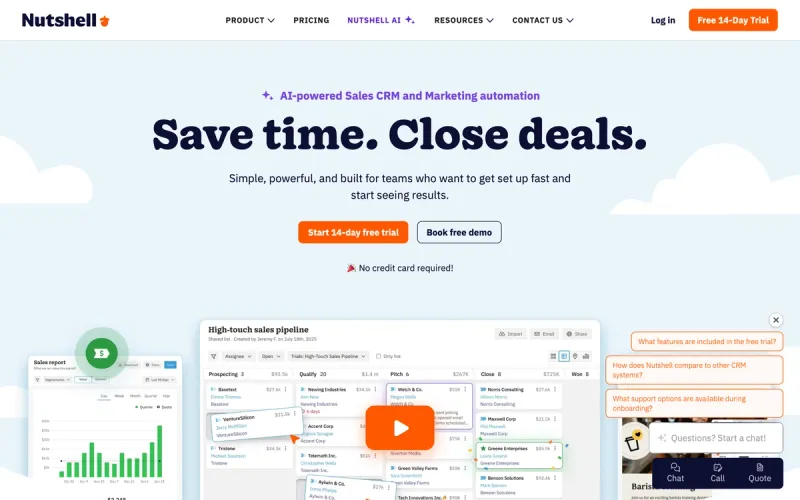
Nutshell is the Michigan-based CRM that quietly serves field-sales and outside-sales teams who need pipeline plus a built-in sequencer, without the cost or complexity of HubSpot. By 2026 it has around 15,000 customers, mostly in US mid-market manufacturing, distribution, and B2B services, and the actual differentiator is the combination of CRM and email sequences in one product.
Pricing: Foundation $16; Growth $42; Pro $52; Business $67 per seat. A 5-rep team on Pro pays $210 monthly, a 10-rep team $420, and a 25-rep team on Business hits $1,475 monthly. The pricing trap is that the Foundation tier ($13) caps the sequencer at trivial volume, so any real outbound team is on Growth ($25) at minimum.
Best for: Field sales and outside-sales teams who want a sequencer + pipeline in one. A 10 to 25 rep outside-sales team selling industrial, distribution, or B2B services with both inbound leads and outbound prospecting is the modal Nutshell buyer. It typically wins when the buyer wants one tool for pipeline plus cold outreach and does not need marketing automation depth.
Setup reality: Setup is 2 to 4 weeks for a clean implementation, with the CSV import handling most CRM migrations cleanly. What breaks first is the reporting layer in week 4; the dashboards are functional for activity tracking but the revenue forecasting and cohort analysis lag Pipedrive and HubSpot.
Head-to-head: Per seat: Nutshell Pro $52 vs Pipedrive Pro $59 vs Salesmate Pro $39. Implementation: 2 to 4 weeks vs 1 to 3 weeks vs 2 to 4 weeks. Year-1 all-in for 10 reps including Nutshell Marketing (the built-in sequencer): $9k to $14k vs $10k to $18k vs $7k to $12k. Nutshell wins on the CRM-plus-sequencer bundle at one price, loses on reporting depth and modern UX.
3-year cost projection: A 10-rep team on Pro pays $6,240 year 1 plus about $2k in Nutshell Marketing email send volume, so $8k. Year 2 with 15 reps on Business (needed for advanced lead routing) lands at $14k. Year 3 with 25 reps on Business plus higher email send volume hits $25k. Three-year all-in: about $47k. Nutshell is one of the lower-friction 3-year stories at this team size; the sequencer being bundled is the pricing win.
Integration stack: Email and calendar: Gmail and Outlook native with reliable two-way sync; the inbox sidebar is useful for field reps. Dialer: Nutshell Click-to-Call native, plus RingCentral and Aircall via native integrations. E-signature: PandaDoc native, DocuSign native, both functional. Accounting: QuickBooks native (rare at this price tier), Xero via Zapier. Enrichment: Clearbit native, Apollo via Zapier, ZoomInfo via Zapier; enrichment is mid-tier for the price.
If you like Nutshell, also consider: If you like Nutshell but want better reporting, Pipedrive plus a separate sequencer like Outreach is the alternative. If you want the same combo with a more modern feel, Salesmate is the closest competitor.
When NOT to pick it: Do not pick Nutshell if your team is software-led and lives in Slack and Notion; the UX feels dated and adoption will be a fight. Also walk away if you need real marketing automation.
The honest flaw: Reporting is functional, not insightful; admin tools feel dated.
17. Salesmate
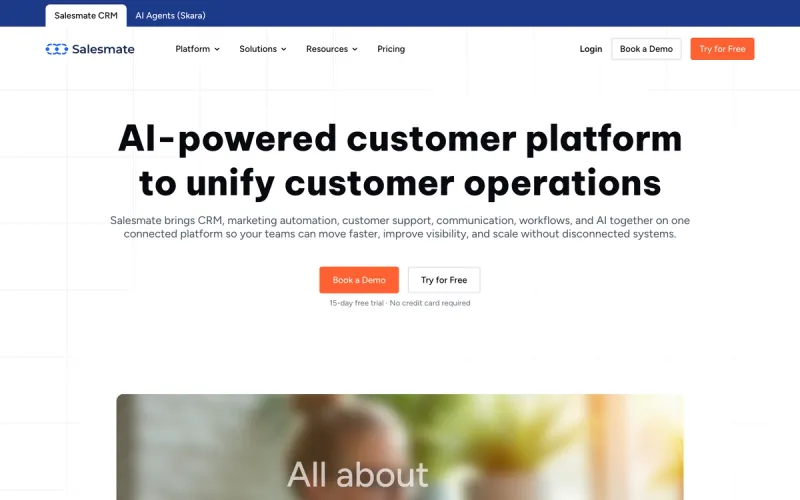
Salesmate is the Pipedrive alternative that adds built-in calling and SMS, positioned as a higher-feature, lower-noise option for teams that want a single tool for pipeline plus engagement. By 2026 it has roughly 8,000 customers, mostly in the US and India, and the actual differentiator is that the calling and SMS are not bolted on but built natively into the CRM record.
Pricing: Basic $23; Pro $39; Business $63 per seat. A 5-rep team on Pro pays $195 monthly, a 10-rep team $390, and a 25-rep team on Business hits $1,575, which is essentially Pipedrive Power tier pricing with calling included. The bundled calling saves $25 to $40 per seat versus adding Aircall on top of Pipedrive, which is the real value math.
Best for: Buyers who liked Pipedrive but wanted built-in calling and automation. A 10 to 20 rep inside-sales team that wanted Pipedrive but found the dialer add-on cost punitive is the modal Salesmate buyer. We see it work for SMB SaaS teams, financial services, and B2B services where reps run 20+ calls daily and pipeline depth is more important than marketing breadth.
Setup reality: Setup is 2 to 4 weeks because the CSV import is reasonable but the workflow and automation setup takes operator time. What breaks first is the integration ecosystem; Salesmate has Zapier and native integrations for the basics but lacks the depth of HubSpot or Salesforce.
Head-to-head: Per seat: Salesmate Pro $39 vs Pipedrive Pro $59 vs Close Pro $249. Implementation: 2 to 4 weeks vs 1 to 3 weeks vs 1 to 2 weeks. Year-1 all-in for 10 reps with calling minutes included: $7k to $12k vs $15k to $25k (with Aircall added) vs $30k to $35k. Salesmate wins on the dialer-bundled price for SMB teams and loses on brand recognition and ecosystem depth.
3-year cost projection: A 10-rep team on Pro pays $4,680 year 1 plus modest calling overage, so about $6k. Year 2 with 15 reps on Business (needed for advanced workflows and sequences) lands at $13k. Year 3 with 25 reps on Business plus the Power Dialer add-on hits $24k. Three-year all-in: about $43k. Among the cheapest dialer-bundled CRM 3-year stories, competitive with Pipedrive plus Aircall on raw price.
Integration stack: Email and calendar: Gmail and Outlook native with two-way sync, reliable for inside sales. Dialer: Salesmate Calling native and built-in (the headline feature); SMS bundled as well. E-signature: PandaDoc native, DocuSign native, both functional. Accounting: QuickBooks via Zapier, Xero via Zapier; no native accounting integration, which is a gap. Enrichment: Clearbit via Zapier, Apollo via Zapier, Cognism via Zapier; the enrichment story is thin and most teams bolt on Clay separately.
If you like Salesmate, also consider: If you like Salesmate but want a bigger brand and community, Close is the direct alternative at higher cost. If you want the workflow without the dialer, Pipedrive is the simpler call.
When NOT to pick it: Skip Salesmate if you need a deep integration ecosystem or marketplace plugins. Also walk away if your team is over 30 reps with complex reporting needs, because the analytics layer does not scale to that size.
The honest flaw: Smaller community + ecosystem; integration depth varies by category.
18. ActiveCampaign
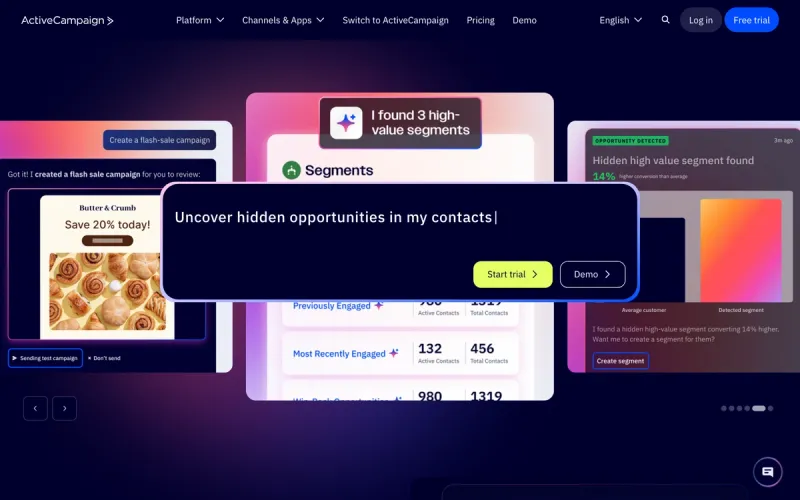
ActiveCampaign is the email-automation-first platform that added a CRM module in 2014 and has been refining it since, serving marketing-led B2B teams that want sales pipeline as an extension of their email nurture. By 2026 it has roughly 180,000 customers, mostly SMB and lower mid-market, and the actual differentiator remains the email automation builder, which is still the best in the category for visual workflow design.
Pricing: Starter $19; Plus $49; Pro $79; Enterprise custom (contact-based). A 5-rep team on Pro pays approximately $400 monthly at the standard 1,000-contact tier, but the price escalates fast with contact volume; a 10-rep team with 25,000 contacts lands around $1,200 monthly, and a 25-rep team with 100,000 contacts hits $3,500+. Annual billing saves 15 percent, and the CRM add-on (Sales Hub) is bundled into Pro and above.
Best for: Marketing-led B2B teams who want email automation and CRM in one tool. A 8 to 15 person marketing-led B2B team where email nurture drives the pipeline and sales is mostly closing inbound demos is the modal ActiveCampaign buyer. We see it win when the head of marketing makes the call rather than the head of sales, and the deal motion is sub-$25K ACV with heavy reliance on lead scoring.
Setup reality: Setup is 4 to 8 weeks because the automation builder rewards thoughtful design and the contact list cleanup is rarely skippable. What breaks first is the sales pipeline adoption in week 4; reps coming from a real CRM find the Sales Hub awkward, and any team with serious outbound activity will be supplementing with a sequencer or moving to HubSpot.
Head-to-head: Per seat: ActiveCampaign Pro effectively $79 (contact-based at scale) vs HubSpot Pro $100 vs Brevo Business $18. Implementation: 4 to 8 weeks vs 4 to 8 weeks vs 2 to 5 days. Year-1 all-in for 10 reps at 25k contacts including a marketing-automation consultant: $20k to $35k vs $30k to $45k vs $5k to $10k. ActiveCampaign wins on email-automation builder quality (genuinely the best in category) and loses on the sales workflow, which feels bolted on.
3-year cost projection: A 10-rep team at 25k contacts on Pro pays roughly $14k year 1 plus a $5k consultant for the automation builds, so $19k. Year 2 with 15 reps at 50k contacts on Enterprise lands at $32k. Year 3 with 25 reps at 100k contacts on Enterprise hits $58k as the contact-volume price escalator kicks in. Three-year all-in: about $109k. The contact-based pricing is the pain point; if your list grows fast, this number balloons.
Integration stack: Email and calendar: Gmail and Outlook native, plus Microsoft 365 and Google Workspace deep integrations. Dialer: no native dialer; CallRail, Aircall, and JustCall via marketplace, all functional. E-signature: PandaDoc native, DocuSign native, HelloSign native. Accounting: QuickBooks native, Xero native, FreshBooks native, Stripe deeply native. Enrichment: Clearbit native via integrations app, Apollo via Zapier, Cognism via Zapier; enrichment is thinner than HubSpot but adequate for marketing-led teams.
If you like ActiveCampaign, also consider: If you like ActiveCampaign's email but need a stronger sales CRM, HubSpot is the obvious cross-shop. If you want email automation depth at a lower price, Brevo is the alternative, though the email builder is weaker.
When NOT to pick it: Do not pick ActiveCampaign as your primary sales CRM if you have an outbound-led team or field reps; the sales features feel bolted on and the rep experience will lag. Also walk away if your contact volume is growing fast, because the contact-based pricing punishes scale.
The honest flaw: Sales features feel bolted on; field-sales-team workflows are not its strength.
19. Keap (Infusionsoft)
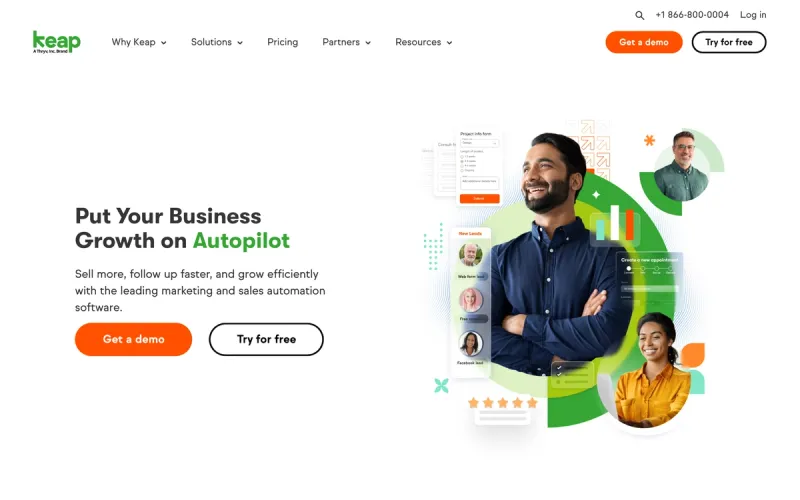
Keap (formerly Infusionsoft) is the CRM and marketing automation platform built for coaches, consultants, and service-business founders running e-commerce plus client management. By 2026 it has roughly 125,000 customers and remains the deepest sales-and-marketing automation tool aimed specifically at the solopreneur to 10-person small business band.
Pricing: Pro $159/mo; Max $249/mo (includes 2 seats). A typical Pro plan starts at $159 monthly for 2 users plus 1,500 contacts, with the Max plan at $249 monthly bundling 2 users and 2,500 contacts; both scale by contact volume rather than per-seat. A 5-rep team on Max with 10,000 contacts lands around $450 monthly; the pricing punishes contact growth rather than seat growth, which is unusual.
Best for: Coaches, consultants, and service-business founders running e-commerce + CRM. A 1 to 5 person coaching, consulting, or course-creator business running automated email sequences, payment collection, and basic CRM in one tool is the modal Keap buyer. We see it work when the founder is the primary sales engine, the product is digital or services, and there is no traditional sales team to consider.
Setup reality: Setup is 3 to 8 weeks because the automation builder is powerful but has a real learning curve, and the import from spreadsheets or other CRMs requires careful tag and segment design. What breaks first is the e-commerce side in week 6 when payment flows misfire or tag-based segmentation drifts and sequences fire to the wrong audience.
Head-to-head: Per seat: Keap Max effectively $124 per seat (2 users for $249) vs ActiveCampaign Pro $79 vs HubSpot Pro $100. Implementation: 3 to 8 weeks vs 4 to 8 weeks vs 4 to 8 weeks. Year-1 all-in for a 2-rep solopreneur including a Keap Certified Partner build-out: $5k to $12k vs $8k to $15k vs $20k to $30k. Keap wins for solo coaches and consultants running e-commerce plus email, loses for any structured B2B sales team.
3-year cost projection: A 2-rep solopreneur on Max pays $3,000 year 1 plus about $3k for a Keap Certified Partner build-out, so $6k. Year 2 with 4 reps at 5,000 contacts on Max lands at $5,400 plus $2k partner retainer. Year 3 with 6 reps at 15,000 contacts (contact pricing kicks in around 10k) hits $9k licenses plus $2k services. Three-year all-in: about $24k. Modest by SaaS standards because Keap targets small businesses, but the partner dependency is a real ongoing cost.
Integration stack: Email and calendar: Gmail and Outlook native with reliable sync, calendar booking is built-in. Dialer: no native dialer; CallRail and JustCall via Zapier are the realistic options. E-signature: built-in e-sign for quotes and contracts is the headline feature for service businesses; no DocuSign needed. Accounting: QuickBooks native and deep (this is a Keap strength for service businesses); Xero via Zapier. Enrichment: essentially none native; Keap is not built for outbound prospecting and the enrichment story reflects that.
If you like Keap (Infusionsoft), also consider: If you like Keap but want a more modern UX, ActiveCampaign is the cross-shop. If you are an agency reselling to clients, GoHighLevel is the alternative built specifically for that motion.
When NOT to pick it: Skip Keap if you are running a structured B2B sales team with reps and pipeline stages; the product is built for solo operators and the rep workflow is essentially nonexistent. Also walk away if you find the legacy UI frustrating.
The honest flaw: Steep learning curve for the automation builder; legacy UI in places.
20. Brevo CRM
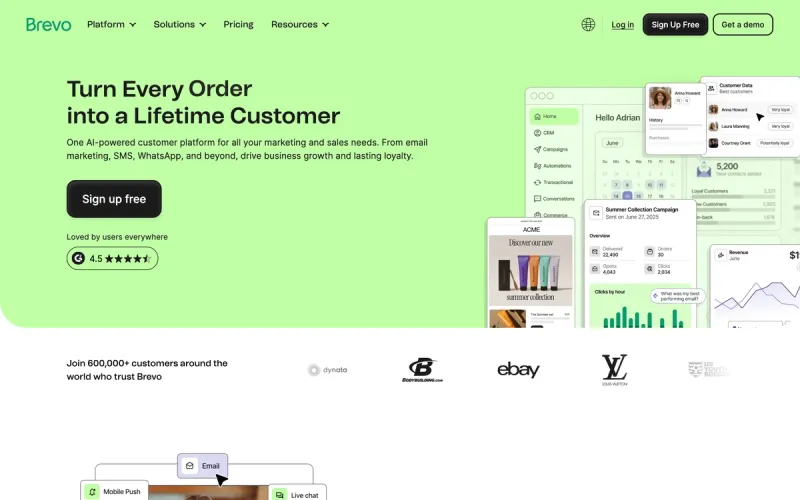
Brevo (formerly Sendinblue) is the French-founded email and marketing automation platform that bolted on a CRM module to compete with HubSpot at one fifth the price. By 2026 it has roughly 500,000 customers globally, mostly SMB and European, and the actual product strength is email and SMS volume pricing rather than the CRM itself.
Pricing: Free; Starter $9; Business $18/mo (volume-priced). The CRM module is free for unlimited contacts, with the paid plans (Starter $9, Business $18 monthly) priced on email send volume rather than per-seat. A typical 5-rep team running 20,000 emails monthly pays $25 to $50, and a 10-rep team sending 100,000 emails monthly lands around $150 to $250, which is cheaper than any per-seat competitor.
Best for: Cost-sensitive teams who want email marketing + a basic CRM bundled. A 5 to 15 person SMB team that primarily needs transactional and marketing email at low cost, with CRM as a secondary contact-management surface, is the modal Brevo buyer. We see it work for European e-commerce, SaaS, and services teams where the email volume is the cost driver and the CRM is just a place to track conversations.
Setup reality: Setup is 2 to 5 days for the email side; the CRM module is essentially a free add-on that takes a few hours to populate. What breaks first is the assumption that the CRM can run a real sales process; it cannot, and any team that tries to use Brevo as a primary sales tool will be running back to Pipedrive or HubSpot within 2 months.
Head-to-head: Per seat: Brevo CRM free vs HubSpot Free CRM free vs Zoho CRM Standard $14. Implementation: 2 to 5 days vs 1 to 3 days vs 4 to 10 weeks. Year-1 all-in for 5 reps at 20k email contacts including transactional sends: $300 to $600 vs $0 (then upgrade pressure) vs $840 license plus $3k implementation. Brevo wins on the free CRM bundled with paid email volume at low cost, loses for any team that needs sales workflow as the primary use case.
3-year cost projection: A 5-rep team running 20k emails monthly pays about $300 year 1, $600 year 2 with growth to 50k sends, $1,500 year 3 at 100k sends and 10 reps. Three-year all-in: about $2,400. Brevo's 3-year cost is the cheapest of any CRM in this list at SMB scale, by far. The catch is you are paying for email, not for sales tooling.
Integration stack: Email and calendar: Gmail and Outlook via two-way sync, reliable for the contact and conversation logging. Dialer: Brevo Phone (their own VoIP product) is native; otherwise no third-party dialer integrations of note. E-signature: no native e-sign and limited third-party options; DocuSign via Zapier is the realistic path. Accounting: QuickBooks via Zapier only, no native (a real gap for European SMBs). Enrichment: essentially none native; this product is email-first, and enrichment is not a serious feature.
If you like Brevo CRM, also consider: If you want Brevo's price point with a real CRM, Freshsales or Zoho are the alternatives. If you want the email volume at scale, Mailchimp is the direct competitor with stronger marketing features.
When NOT to pick it: Do not pick Brevo as your primary sales CRM; it is an email platform with a CRM tab, and the sales workflow will feel like a placeholder within a week. Also walk away if you need deep sales reporting or pipeline forecasting.
The honest flaw: CRM module is a thin add-on; not a primary sales tool.
21. EngageBay
EngageBay is the textbook HubSpot clone: sales, marketing, and service modules wrapped in a similar UX at roughly one-fifth the price. The founders bet on bootstrapped teams who like HubSpot's shape but cannot stomach the bill.
Pricing: Free; Basic $14; Growth $65; Pro $120 per seat. A 5-rep team on Growth pays $325/mo ($65/seat annual), a 10-rep team $650, a 25-rep team $1,625. Pro tier doubles that to $120/seat. Annual billing knocks roughly 20% off month-to-month; the free tier is usable up to 250 contacts.
Best for: Bootstrapped teams who want a HubSpot-clone at one-fifth the price. Wins when the buyer is a sub-15-rep team that wanted HubSpot Pro ($1,500/mo minimum) but the CFO killed it. Bootstrapped agencies in this band routinely cut stack cost 70 to 80% by swapping HubSpot Pro for EngageBay Growth.
Setup reality: Setup takes 2-3 weeks for a clean migration; the import wizard is functional but trips on custom HubSpot properties. Admin work is moderate. The first thing that breaks is email deliverability at volume (above 10k sends/month).
Head-to-head: Per seat: EngageBay Growth $65 vs HubSpot Pro $100 vs Freshsales Pro $39. Implementation: 2 to 3 weeks vs 4 to 8 weeks vs 2 to 4 weeks. Year-1 all-in for 10 reps with bundled marketing module: $9k to $14k vs $30k to $45k vs $7k to $12k. EngageBay wins on price floor against HubSpot for bootstrapped teams (about 65 percent cheaper), loses on email deliverability at volume and integration depth.
3-year cost projection: A 10-rep team on Growth pays $7,800 year 1, plus about $1k for a dedicated IP for email if you scale send volume, so $9k. Year 2 with 15 reps on Pro (typical $120 per seat) lands at $22k. Year 3 with 25 reps on Pro plus additional email volume hits $40k. Three-year all-in: about $71k. About 35 to 45 percent of the HubSpot equivalent, which is the entire pitch.
Integration stack: Email and calendar: Gmail and Outlook native and reliable; this is the cleanest part of the product. Dialer: Twilio native, JustCall via Zapier; no first-party dialer. E-signature: DocuSign via Zapier only, no native (a real gap versus HubSpot). Accounting: QuickBooks via Zapier, Xero via Zapier; no native accounting integration. Enrichment: Clearbit via Zapier only; the lack of any native enrichment is the single biggest gap versus HubSpot.
If you like EngageBay, also consider: If you like EngageBay also consider Brevo (cheaper still on contact-based pricing) or Freshsales (better reporting at similar price). Both have stronger product velocity in 2026.
When NOT to pick it: Skip it if you need enterprise SSO, fine-grained role permissions, or a sales engagement layer that runs more than 200 sequenced contacts/day. The infrastructure shows its limits past mid-market scale.
The honest flaw: Performance and reliability lag HubSpot; you get what you pay for at deep scale.
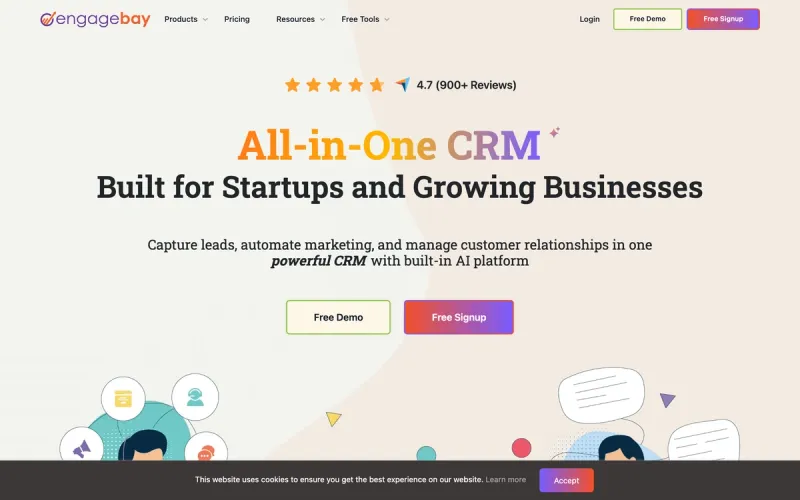
22. Bitrix24
Bitrix24 is a Russian-origin (now Cyprus-based) suite that bundles CRM, project management, intranet, HR, and a website builder under one flat-fee license. It is the everything-store of business software, with the trade-offs that implies.
Pricing: Free; Basic $49; Standard $99; Pro $199 (flat, not per-seat). Pricing is flat, not per-seat: Basic $69/mo covers 5 users, Standard $144/mo covers 50 users, Professional $289/mo covers 100 users. A 25-rep team pays $144/mo total, which is roughly $5.76/seat. That math is the entire pitch.
Best for: Teams who want CRM, tasks, intranet, and HR in one suite for a flat price. Wins when a 20-100 person services or trading company in CEE, MENA, or LATAM wants one tool for everything and has no internal SaaS budget. The flat-fee model also helps agencies who add seasonal contractors.
Setup reality: Setup is punishing: 4-8 weeks to configure even half the modules, and most teams give up and use 2 features out of 30. Data migration from Salesforce or HubSpot needs a partner. The first thing that breaks is the telephony integration.
Head-to-head: Flat-fee for 50 users: Bitrix24 Standard $144 per month vs HubSpot Pro $5,000 per month at 50 seats vs Zoho One $1,850 per month at 50 seats. Implementation: 4 to 8 weeks vs 8 to 16 weeks vs 4 to 10 weeks. Year-1 all-in for a 50-rep team including basic partner configuration: $4k to $10k vs $80k to $120k vs $30k to $50k. Bitrix24 wins on price floor by an enormous margin and loses on UX, partner ecosystem, and Western support quality.
3-year cost projection: A 25-rep team on Standard (covers 50 users) pays $1,728 year 1 plus about $4k for a partner to configure the modules, so $6k. Year 2 with 60 users requiring Professional ($289 per month, covers 100 users) lands at $3,500. Year 3 stays flat at $3,500 if you do not cross 100 users. Three-year all-in: about $13k. The cheapest 3-year story of any CRM in this list for teams that grow into 50+ users, by an enormous margin.
Integration stack: Email and calendar: Gmail and Outlook native, but the sync is buggier than any other CRM in this list; Bitrix24 webmail is the first-party alternative. Dialer: Bitrix24 telephony native (their own VoIP service); SIP integrations supported but flaky. E-signature: no native e-sign; DocuSign via marketplace, not reliable. Accounting: QuickBooks via REST API only (custom integration needed); 1C is the native Russian/CIS option. Enrichment: essentially none for Western data sources.
If you like Bitrix24, also consider: If you like Bitrix24 also consider Zoho One (cleaner integration between modules) or Odoo (better if you need real ERP). Both have stronger English-language support.
When NOT to pick it: Skip if your team is North American or Western European mid-market with normal SaaS budgets. The UX is a culture clash, and product investment has been uneven since the 2022 corporate restructuring.
The honest flaw: Sprawling product; pick one or two modules or it becomes a graveyard of unused features.
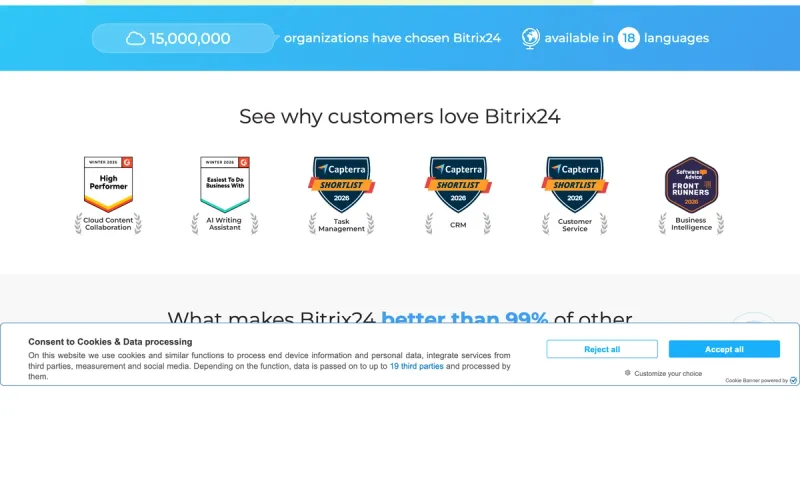
23. Apptivo
Apptivo is a 65+ app suite that started as a freemium CRM and expanded into invoicing, projects, field service, and procurement. Think of it as the budget Zoho One for service businesses that need CRM plus billing in the same login.
Pricing: Lite $15; Premium $25; Ultimate $50 per seat. A 5-rep team on Premium pays $125/mo ($25/seat annual), a 10-rep team $250, a 25-rep team $625. Ultimate at $50/seat unlocks territory management and advanced reports. Annual billing saves about 20% over monthly.
Best for: Service businesses who want invoicing, projects, and CRM in one tool. Wins for a 5-20 person consulting or trades business that wants CRM, invoices, and a project module without buying three tools. The G Suite integration is good if your team lives in Gmail.
Setup reality: Setup runs 1-2 weeks for the CRM module alone, longer if you turn on invoicing or project tracking. Admin work is heavier than Pipedrive because the modules cross-reference each other. The first thing that breaks is the email sync when accounts hit Google's IMAP rate limits.
Head-to-head: Per seat: Apptivo Premium $25 vs Zoho CRM Pro $23 vs Vtiger One Pro $42. Implementation: 1 to 2 weeks vs 4 to 10 weeks vs 2 to 4 weeks. Year-1 all-in for 10 reps including the invoicing module and a partner-led setup: $5k to $9k vs $12k to $22k vs $9k to $14k. Apptivo wins on the CRM-plus-invoicing-plus-projects bundle at low price, loses on AI features, partner network, and modern UX.
3-year cost projection: A 10-rep team on Premium pays $3,000 year 1, with essentially no add-on traps. Year 2 with 15 reps on Ultimate (needed for territory management and advanced reports) lands at $9,000. Year 3 with 25 reps on Ultimate plus the field service module hits $18,000. Three-year all-in: about $30k. Apptivo is one of the cheaper 3-year stories among the multi-module CRMs, less than half of Zoho One at the same team size.
Integration stack: Email and calendar: Gmail and Outlook native, both reliable; the G Suite integration is a strength. Dialer: RingCentral native, Twilio via integrations; no first-party dialer. E-signature: built-in e-sign for proposals and invoices (a genuine differentiator at this price); DocuSign via integrations. Accounting: QuickBooks native and deep (this is the Apptivo strength for service businesses); Xero native. Enrichment: essentially none native; Clearbit and Apollo only via Zapier. Enrichment is a real weakness.
If you like Apptivo, also consider: If you like Apptivo also consider Zoho One (mature integration story across modules) or Vtiger (similar mid-market positioning with better reporting). Both have larger active user communities.
When NOT to pick it: Skip if you need a modern sales engagement layer, AI features beyond basic email summarization, or a partner network in your region. Most certified Apptivo consultants are in India.
The honest flaw: Older UX; vertical templates trail Zoho.
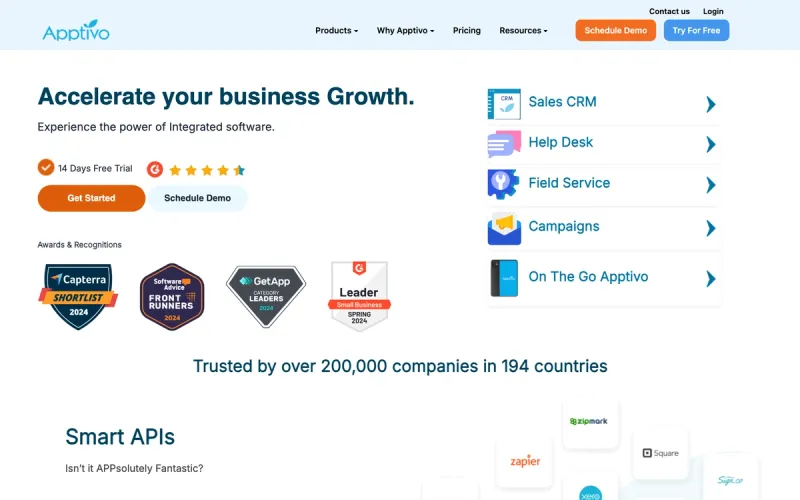
24. Vtiger
Vtiger is a 20-year-old open-source-origin CRM that pivoted to a cloud SaaS in 2010 and now sells One Platform as a unified sales, marketing, and service product. It is the quiet pick for teams who want SugarCRM-style flexibility without the enterprise license.
Pricing: One Growth $15; Pro $42; One Enterprise $58 per seat. A 5-rep team on One Pro pays $210/mo ($42/seat annual), a 10-rep team $420, a 25-rep team $1,050. One Enterprise at $58/seat unlocks the field service module. Open-source self-hosted is free if you have an ops team.
Best for: Teams who want an open-source-friendly CRM that scales into customer support. Wins when a 10-50 person services firm needs CRM that scales into customer support without buying Zendesk separately. The case-management module is the strongest feature, not the sales pipeline.
Setup reality: Setup takes 2-4 weeks for a single-module rollout, 6-8 for the full sales-plus-service stack. Admin work is moderate but the UI feels like 2017. The first thing that breaks is the email-to-case routing when inbox volume crosses 500/day.
Head-to-head: Per seat: Vtiger One Pro $42 vs Zoho CRM Pro $23 vs Freshsales Pro $39. Implementation: 2 to 4 weeks vs 4 to 10 weeks vs 2 to 4 weeks. Year-1 all-in for 10 reps including the helpdesk module: $7k to $12k vs $12k to $22k vs $7k to $12k. Vtiger wins on the CRM-plus-helpdesk combination at mid-tier pricing, loses on UX polish and modern reporting.
3-year cost projection: A 10-rep team on One Pro pays $5,040 year 1, with no major surprise costs. Year 2 with 15 reps on One Enterprise (needed for the field service module) lands at $10k. Year 3 with 25 reps on One Enterprise plus the additional helpdesk seats hits $22k. Three-year all-in: about $37k. Vtiger is among the cheaper 3-year stories at this team size, especially compared to a Salesforce plus Zendesk stack.
Integration stack: Email and calendar: Gmail and Outlook native with reliable two-way sync, mailbox plugin is functional. Dialer: Twilio native, Asterisk supported (open-source heritage), Plivo via integrations. E-signature: DocuSign native, PandaDoc native, both functional. Accounting: QuickBooks native, Xero native, Tally native (rare and an India-market strength). Enrichment: Clearbit via Zapier, Apollo via Zapier; native enrichment is essentially zero. Reporting and dashboarding tools feel a generation behind every modern alternative.
If you like Vtiger, also consider: If you like Vtiger also consider Zoho Desk plus Zoho CRM (more polished integration) or Freshdesk plus Freshsales (cleaner UX). Both have better mobile apps.
When NOT to pick it: Skip if your team values UX more than feature breadth, or if you need a modern sales engagement layer. Reporting is rigid and the dashboard editor feels brittle.
The honest flaw: Native UI feels 2017; reporting is rigid.
25. Streak
Streak is a Chrome extension that turns Gmail into a CRM by overlaying pipelines, contact tracking, and email merge directly inside the inbox. It is the original Gmail-native CRM and still the most-installed.
Pricing: Free; Solo $15; Pro $49; Pro+ $69; Enterprise $129 per seat. A 5-rep team on Pro pays $245/mo ($49/seat annual), a 10-rep team $490, a 25-rep team $1,225. Enterprise at $129/seat adds custom permissions and data validation. No free CRM plan in 2026; free tier covers email tools only.
Best for: Gmail-native teams who want a CRM inside their inbox. Wins for solo BD operators, real estate agents, and PR teams who live in Gmail and never want to leave. The mail merge feature alone is worth the Pro tier for sub-1000-contact outreach.
Setup reality: Setup is 30 minutes: install the extension, create a pipeline template, import contacts. The catch is each rep must install the extension on every browser they use. The fragile component shows up when a rep switches to Outlook or the company moves off Google Workspace.
Head-to-head: Per seat: Streak Pro $49 vs Copper Basic $29 vs Folk Premium $36. Implementation: 30 minutes vs 1 to 2 weeks vs 1 to 3 days. Year-1 all-in for 10 reps including the Pro+ tier for advanced reporting: $6k to $10k vs $4k to $7k vs $7k to $12k. Streak wins on time-to-value (literally install a Chrome extension) and inbox-native UX, loses on cross-browser reliability and the moment any rep switches to Outlook.
3-year cost projection: A 10-rep team on Pro pays $5,880 year 1, plus about $1k for a Zapier subscription to bridge anything Streak does not have native, so $7k. Year 2 with 15 reps on Pro+ (needed for advanced reporting) lands at $12k. Year 3 with 25 reps on Pro+ hits $21k. Three-year all-in: about $40k. The risk is migration cost (15 to 30k) if you ever move off Gmail or off Streak, because the data model is tightly coupled to Gmail threads.
Integration stack: Email and calendar: Gmail is native and the entire product is built around it; Outlook is essentially not supported, which is the headline limitation. Dialer: no native dialer; Aircall via Zapier is the realistic option. E-signature: DocuSign via Zapier, HelloSign via Zapier; no native e-sign. Accounting: QuickBooks via Zapier, Xero via Zapier; no native. Enrichment: Clearbit via Zapier, Apollo via Zapier; almost all integrations are Zapier-bridged because Streak's API surface is intentionally narrow.
If you like Streak, also consider: If you like Streak also consider NetHunt (deeper pipeline depth, still Gmail-native) or Copper (full CRM with Google integration baked in). Both survive better past 10 reps.
When NOT to pick it: Skip if your team uses Outlook, if you have field reps on mobile (the mobile app is weaker than the web extension), or if you need server-side automation that runs even when the rep's browser is closed.
The honest flaw: Tightly coupled to Gmail; brittle when reps switch to other clients.
26. NetHunt CRM
NetHunt is a Ukrainian-built Gmail-native CRM that competes with Streak by offering more pipeline depth, multiple pipelines per workspace, and proper LinkedIn integration. It is the Streak upgrade path nobody talks about.
Pricing: Basic $30; Business $60; Advanced $96 per seat. A 5-rep team on Business pays $300/mo ($60/seat annual), a 10-rep team $600, a 25-rep team $1,500. Advanced at $96/seat adds AI features and unlimited workflows. No free tier, but a 14-day trial.
Best for: Gmail teams who want more pipeline depth than Streak. Wins for a 5-20 person sales team that outgrew Streak but still wants Gmail-first UX. The LinkedIn Chrome extension that pulls profile data into NetHunt contacts is the standout feature; this routinely saves around 4 minutes per prospect added.
Setup reality: Setup takes 1 week for a single-pipeline workspace, 2-3 for multi-pipeline with workflows. The Gmail sync is reliable. The first thing that breaks is when reps try to use it from the mobile app, which lags the web experience.
Head-to-head: NetHunt vs Streak vs Copper on a 10-rep Gmail team. NetHunt Business sits at $60/seat, Streak Pro at $49, Copper Pro at $69. Year 1 all-in: NetHunt around $7,200, Streak around $5,880, Copper around $8,280. Implementation: NetHunt ships in 2 weeks, Streak in a weekend, Copper in 3 weeks because the Google Workspace handshake takes longer than the vendor admits.
3-year cost projection: 10 reps scaling to 25 on Business tier: year 1 $7,200, year 2 $12,000 after one expansion, year 3 $18,000 plus the usual 8% annual price walk. Add the LinkedIn scraper add-on ($15/seat, mostly worth it) and a Zapier Pro account ($240/year) for the integrations NetHunt does not natively cover. Total 3-year burn: roughly $42,000.
Integration stack: Email and calendar: native to Gmail and Google Calendar, the whole product runs inside the inbox. Outlook: missing in any usable form. Dialer: Zapier-only via Aircall or JustCall. E-sign: Zapier-only via DocuSign or PandaDoc. Accounting: Zapier-only via QuickBooks. Enrichment: native LinkedIn scraper, Zapier-only for Clearbit or Apollo.
If you like NetHunt CRM, also consider: If you like NetHunt also consider Copper (better Google Workspace integration) or Salesflare (similar auto-data-capture motion). Both have larger international support footprints.
When NOT to pick it: Skip if you have brand-conscious leadership who needs a recognized name in board reports, or if you need vendor support outside European business hours. Smaller integration library than HubSpot or Pipedrive.
The honest flaw: Limited recognition outside Eastern Europe; smaller integration library.
27. Salesflare
Salesflare is a Belgian CRM whose whole pitch is auto-data-capture: it scrapes email headers, calendar events, and signature blocks to fill in contacts, companies, and timeline activity without rep input. The category they invented is now called intelligent CRM.
Pricing: Growth $35; Pro $55; Enterprise $99 per seat. A 5-rep team on Pro pays $275/mo ($55/seat annual), a 10-rep team $550, a 25-rep team $1,375. Growth at $35/seat is the practical entry point. Enterprise at $99/seat adds custom permissions and dedicated support.
Best for: SMB B2B teams who want a CRM that auto-populates from email + calendar. Wins for 5-15 person B2B teams where reps refuse to update the CRM. Startups in this profile routinely push activity logging from sub-20% to 80%+ in one quarter just by switching from HubSpot Free to Salesflare Pro.
Setup reality: Setup is 2-3 days because the magic happens automatically once Gmail/Outlook is connected. Admin work is light. The first thing that breaks is account-deduplication logic when companies use multiple email domains.
Head-to-head: Salesflare vs Folk vs Attio for a 10-rep B2B team that wants auto-data-capture. Salesflare Pro at $55/seat, Folk Premium at $36, Attio Pro at $80. Year 1 all-in for 10 reps: Salesflare $6,600, Folk $4,320, Attio $9,600. Implementation: Salesflare in 3 days, Folk in a weekend, Attio in 3 to 4 weeks because the flexible data model needs schema decisions up front.
3-year cost projection: 10 reps scaling to 25 on Pro: year 1 $6,600, year 2 $11,000 after one mid-year expansion, year 3 $16,500. Add the email-tracking volume tier (around $40/month at scale) and a Zapier Pro plan for the long tail of integrations. Total 3-year cost lands near $37,000 before counting the 6 to 9% annual price walks that Salesflare has been quietly running since 2024.
Integration stack: Email and calendar: native to Gmail, Outlook, and iCloud, the auto-capture is the whole product. Dialer: native via Aircall, JustCall integrations, otherwise Zapier-only. E-sign: Zapier-only via DocuSign or PandaDoc. Accounting: missing on the native side, Zapier-only for QuickBooks or Xero. Enrichment: native LinkedIn sidebar and Clearbit-style company data on Pro tier.
If you like Salesflare, also consider: If you like Salesflare also consider Folk (similar Gmail-first auto-capture motion, better contact UX) or Attio (modern data model, more powerful but more setup). Both have better brand recognition in the US.
When NOT to pick it: Skip if your team manually logs deals in CRM as part of the methodology (MEDDPICC, Sandler), because half the value comes from the auto-capture and reps overriding it defeats the system.
The honest flaw: Auto-data-capture is its main moat; if your team logs deals manually, half the value disappears.
28. Nimble
Nimble is a relationship-intelligence CRM aimed at solo BD reps and small teams who live on LinkedIn and Twitter. It bills itself as the simple CRM, and the social-stream feature pulls public profile data into contact records.
Pricing: $29.90 per seat (single tier). Flat $29.90/seat (annual). A 5-rep team pays $149/mo, a 10-rep team $299, a 25-rep team $749. Monthly billing is roughly 15% more. No free tier, 14-day trial.
Best for: Solo BD reps and relationship-led sellers active on LinkedIn. Wins for solo founders and 2-5 person BD teams running relationship-led outbound (account-based, partnership-led, founder-led sales). The Outlook integration is the strongest in this tier, better than HubSpot Starter for inbox-native workflows.
Setup reality: Setup takes a day for a single-user account. Admin work is minimal. What gives out at scale is the social-profile enrichment when LinkedIn changes its scraping defenses, which happens roughly twice a year.
Head-to-head: Nimble vs Folk vs Capsule for a 5-rep BD team running relationship-led outbound. Nimble at $29.90/seat flat, Folk Premium at $36, Capsule Growth at $36. Year 1 all-in for 5 reps: Nimble around $1,795, Folk around $2,160, Capsule around $2,160. Implementation: Nimble in a day, Folk in a weekend, Capsule in 3 to 5 days.
3-year cost projection: 5 reps scaling to 10 on the flat $29.90 tier: year 1 $1,795, year 2 $2,990 after expansion, year 3 $3,590. Nimble has been one of the few CRMs that has not raised prices since 2022, so no escalation to model. Add a Zapier Pro plan ($240/year) for anything beyond the basic integrations. Total 3-year burn: roughly $9,000, which is the cheapest serious option in this comparison.
Integration stack: Email and calendar: native to Gmail, Outlook, and Office 365 with strong inbox sidebar. Dialer: Zapier-only, no first-party dialer. E-sign: Zapier-only via DocuSign or HelloSign. Accounting: missing, Zapier-only for QuickBooks. Enrichment: native social-profile pull from LinkedIn, Twitter, and Facebook is the moat, but breaks twice a year when LinkedIn changes its scraping defenses.
If you like Nimble, also consider: If you like Nimble also consider Folk (better UX, growing fast) or Capsule (cleaner pipeline view at similar price). Both have more reliable mobile apps.
When NOT to pick it: Skip if you have any kind of structured sales process, if you need pipeline forecasting, or if you have more than 10 reps. Nimble has not invested heavily in product in the last 3 years.
The honest flaw: Limited pipeline customization; not a fit for structured sales orgs.
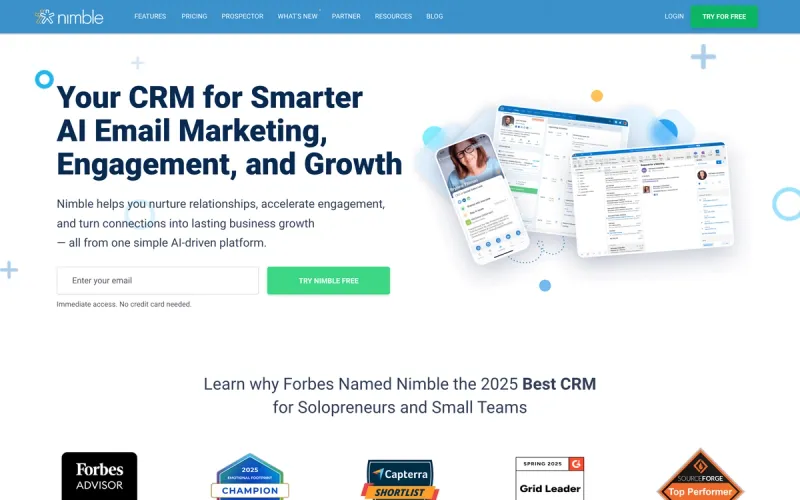
29. OnePageCRM
OnePageCRM is an Irish-built CRM built around the action-list metaphor: every contact has a single next action, and the rep's day is a sorted to-do list rather than a deal kanban. It is the GTD (Getting Things Done) approach applied to sales.
Pricing: Professional $9.95; Business $19.95 per seat. A 5-rep team on Business pays $100/mo ($19.95/seat annual), a 10-rep team $200, a 25-rep team $499. Professional at $9.95/seat is functional for solo reps. No free tier, 21-day trial.
Best for: Reps who want a daily-action focus list, not a deal kanban. Wins for high-volume relationship sellers (consultants, real estate, financial advisors) who close 3-10 deals a month and need to remember who to call next. The action-list interface beats traditional kanban for that workflow by roughly 40% in time-to-next-touch.
Setup reality: Setup is 1 day for a single rep. Admin work is light. The first thing that breaks is when a sales manager wants pipeline reports, because the system was not designed around deal-stage analytics.
Head-to-head: OnePageCRM vs Pipedrive vs Less Annoying CRM for a 10-rep action-list-driven team. OnePageCRM Business at $19.95/seat, Pipedrive Pro at $59, Less Annoying CRM at $15 flat. Year 1 all-in for 10 reps: OnePageCRM around $2,400, Pipedrive around $7,080, Less Annoying CRM around $1,800. Implementation: OnePageCRM in 2 days, Pipedrive in 2 weeks, Less Annoying CRM in a day.
3-year cost projection: 10 reps scaling to 25 on Business: year 1 $2,400, year 2 $4,000 after expansion, year 3 $6,000. OnePageCRM has held pricing flat for 4 years, so no escalation factor. Add the Mailchimp or Mailerlite integration ($15-30/month) for outbound nurture and a Zapier plan. Total 3-year cost: under $14,000, the cheapest serious B2B CRM in this comparison band.
Integration stack: Email and calendar: native to Gmail and Outlook with a usable inbox sidebar, calendar sync via Google and Office 365. Dialer: native click-to-call via Skype, Zapier-only for Aircall or JustCall. E-sign: Zapier-only across the board. Accounting: native Xero integration, Zapier-only for QuickBooks. Enrichment: missing entirely; bring your own Clearbit or Apollo via Zapier.
If you like OnePageCRM, also consider: If you like OnePageCRM also consider Pipedrive (action-focused but with proper pipeline analytics) or Less Annoying CRM (similar simplicity at $15 flat). Both have stronger reporting.
When NOT to pick it: Skip if you have a sales manager who needs dashboards, forecast accuracy, or revenue attribution. The product is built for the rep, not the leader.
The honest flaw: Reporting and forecasting are minimal; not for sales managers who want dashboards.
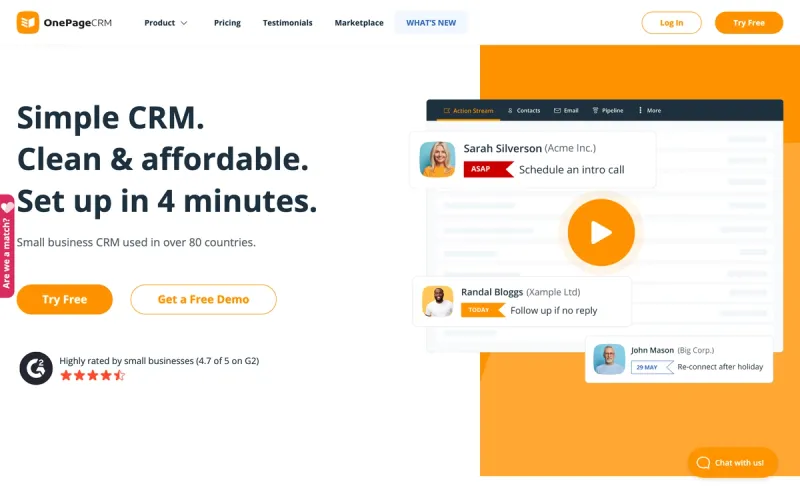
30. Workbooks
Workbooks is a UK-built mid-market CRM with a strong finance and order-management module, founded by ex-Sage and ex-Salesforce executives in 2007. It serves UK service businesses who want CRM plus invoicing without buying NetSuite.
Pricing: CRM Edition $32; Business Edition $70 per seat. A 5-rep team on Business pays $350/mo ($70/seat annual), a 10-rep team $700, a 25-rep team $1,750. CRM Edition at $32/seat is the lighter sales-only tier. Implementation services add roughly 4-6 months of license fees on year one.
Best for: UK-based mid-market service businesses who want CRM + finance integration. Wins for UK mid-market service businesses (50-300 employees) doing project-based work who need CRM, invoicing, and finance integration in one tool. UK consultancies in this band routinely consolidate four tools (Pipedrive, Xero, HubSpot, ChaseApp) into Workbooks and save 20 to 30% on stack cost.
Setup reality: Setup runs 8-12 weeks for a typical mid-market rollout, longer if you turn on the finance module. Admin work is moderate; you will need a part-time admin. The first thing that breaks is the Outlook plugin when Microsoft pushes a major Outlook update.
Head-to-head: Workbooks vs Salesforce Sales Cloud vs Maximizer for a 25-rep UK mid-market services team. Workbooks Business at $70/seat, Salesforce Pro at $80, Maximizer Sales Leader at $49. Year 1 all-in for 25 reps including implementation: Workbooks around $42,000 ($21,000 license + $21,000 services), Salesforce around $84,000 with a Big 4 partner, Maximizer around $24,000. Implementation weeks: Workbooks 10, Salesforce 16, Maximizer 6.
3-year cost projection: 25 reps growing to flat 25 on Business: year 1 $42,000, year 2 $21,000, year 3 $22,680 with a 7% UK price walk that has been consistent since 2023. Add the finance module (roughly $20/seat extra) plus an annual admin partner retainer ($6,000-12,000). Total 3-year burn: roughly $110,000, which is half the Salesforce number for similar functionality if you stay in the UK.
Integration stack: Email and calendar: native Outlook plugin is the strongest in the UK mid-market tier, Gmail support is functional but feels secondary. Dialer: Zapier-only, no native dialer. E-sign: native DocuSign integration. Accounting: native Sage 50, Sage 200, and Xero integrations are the whole pitch. Enrichment: missing, Zapier-only for Cognism or Apollo.
If you like Workbooks, also consider: If you like Workbooks also consider Salesforce Sales Cloud (better ecosystem if you have a partner budget) or Maximizer (similar mid-market positioning, stronger in Canada). Both have larger global presence.
When NOT to pick it: Skip if you are outside the UK, because the partner network and product roadmap reflect UK service-business priorities. North American support is thin.
The honest flaw: Geographic concentration in the UK; light brand outside Europe.
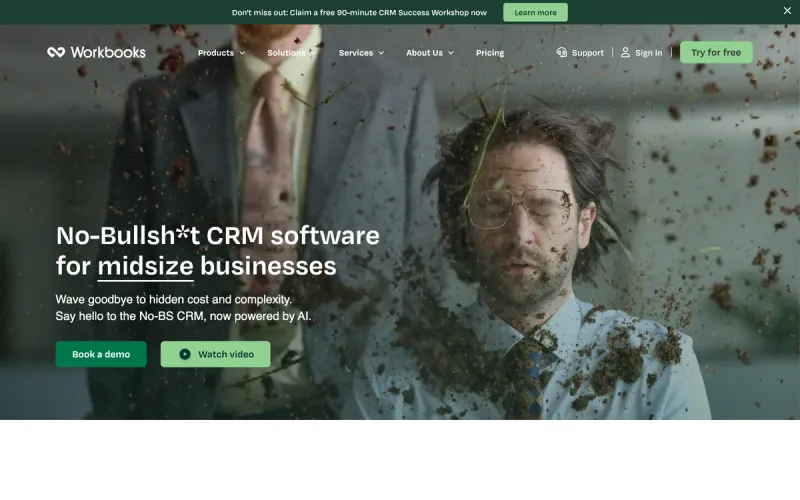
Enterprise and heavyweight (10 platforms)
If you've already standardised on Oracle ERP, SAP, or NetSuite, in my experience you don't shop for CRM. It's bundled. These ten exist because the parent stack demands it. The implementation timelines I've seen in published case studies tend to land around 6 to 9 months, with partner fees roughly 1.5x the licence cost.
| # | CRM | Pricing range (per seat / mo) | Best for (1-liner) | Year-1 cost (10 reps) | Setup |
|---|---|---|---|---|---|
| 31 | Oracle CX Sales (Siebel lineage) | Custom; typical enterprise floor $90+ per seat | Enterprises already running Oracle ERP/HCM who want CRM in the same... | ~$11k | 4-9 months |
| 32 | SAP Sales Cloud | Custom enterprise pricing (typical floor ~$110 per seat) | SAP-shop enterprises who want one vendor for ERP, supply chain, and... | ~$13k | 4-9 months |
| 33 | NetSuite CRM | Bundled with NetSuite ERP; effective CRM cost varies | NetSuite ERP customers who want sales + finance in the same record. | custom | 4-9 months |
| 34 | Pega CRM | Custom enterprise (typical engagements $250K+) | Banks, insurers, and telcos with deep process automation needs. | ~$30k | 4-9 months |
| 35 | Sage CRM | Essentials $39; Standard $59; Pro $83 per seat | Sage accounting customers who want CRM in the same vendor. | ~$4.7k | 4-9 months |
| 36 | SugarCRM | Sell $80; Serve $135; Enterprise $150 per seat (10-se... | Mid-market teams who want an open architecture without going full S... | ~$9.6k | 4-9 months |
| 37 | Creatio | Growth $25; Enterprise $55; Unlimited $85 per seat | BPM-focused enterprises who want no-code workflow on top of CRM. | ~$3.0k | 4-9 months |
| 38 | SuiteCRM | Free self-hosted; SalesAgility cloud $95/mo (5 users) | Teams who want an open-source SugarCRM fork with control over their... | ~$11k | 4-9 months |
| 39 | Maximizer CRM | Base $29; Sales Leader $49; Wealth Advisor $89 per seat | Financial advisor and field-sales teams in Canada and the UK. | ~$3.5k | 4-9 months |
| 40 | Pipeliner CRM | Starter $25; Business $50; Enterprise $85; Unlimited ... | Visual-thinking sales orgs who want every screen to be a chart. | ~$3.0k | 4-9 months |
Tier 3 overview: every CRM in this section side by side. Year-1 cost is a 10-rep estimate based on starting-tier pricing (real cost lands 1.5-3x this once implementation, integrations, and admin are included).
31. Oracle CX Sales (Siebel lineage)
Oracle CX Sales is the descendant of the Siebel CRM Oracle bought in 2006, rebuilt for cloud and bundled with Oracle's broader CX suite (Eloqua, Service, Commerce). It is the default CRM choice for shops already running Oracle ERP or HCM.
Pricing: Custom; typical enterprise floor $90+ per seat. Per-seat license starts around $90/mo enterprise, often discounted in multi-product Oracle bundles. A 100-rep team realistically lands at $200-400k/year all-in once you add implementation, integrations, and managed services. Standalone deployments are rare.
Best for: Enterprises already running Oracle ERP/HCM who want CRM in the same stack. Wins only when the parent company already runs Oracle Fusion ERP or HCM Cloud and the CIO wants a single vendor stack. The integration with Oracle financials is the entire pitch; outside that buyer profile it loses to Salesforce 9 times out of 10.
Setup reality: Implementation runs 6-12 months minimum with a Big 4 or Oracle-certified partner. Year-one cost: $400k-$2M typical, with the license being maybe 30% of that. The first thing that breaks is custom reporting when business users try to self-serve.
Head-to-head: Oracle CX Sales vs Salesforce Sales Cloud vs SAP Sales Cloud for a 100-rep enterprise deployment. Per-seat: Oracle around $90, Salesforce Enterprise $165, SAP around $110. But the license is the smallest line item. Year 1 all-in: Oracle $400k-$2M, Salesforce $600k-$2.5M, SAP $500k-$3M. Implementation: Oracle 6-12 months, Salesforce 4-8 months, SAP 8-14 months.
3-year cost projection: 100 reps scaling to 150 on Oracle CX Sales: year 1 $1.2M including implementation, year 2 $450,000 in licenses and managed services, year 3 $580,000 with expansion. Oracle's standard price escalation runs 5-7% annually. Budget a permanent $200k/year for an Oracle-certified partner because nothing about this product is self-serve. Total 3-year burn: $2.2M-2.8M.
Integration stack: Email and calendar: native Outlook and Office 365 sync; Gmail support is functional but rarely used by Oracle customers. Dialer: native through Oracle Service Cloud telephony, otherwise partner-dependent. E-sign: native DocuSign and Oracle Sign. Accounting: native to Oracle Fusion ERP (the entire reason anyone picks this), Zapier-only for non-Oracle ERPs. Enrichment: native Oracle Data Cloud, also DemandBase and ZoomInfo connectors available.
If you like Oracle CX Sales (Siebel lineage), also consider: If you like Oracle CX Sales also consider Salesforce Sales Cloud (richer ecosystem, lighter procurement story) or SAP Sales Cloud (if you are an SAP shop instead of Oracle). Both have larger consulting partner pools.
When NOT to pick it: Skip unless you are an existing Oracle Fusion customer with a CIO-level mandate. Sub-100-rep teams will never recoup the implementation tax.
The honest flaw: Implementation cycles measured in quarters, not months; partner fees often exceed the license.
Visit Oracle CX Sales (Siebel lineage).
32. SAP Sales Cloud
SAP Sales Cloud is the CRM in SAP's Customer Experience suite (formerly C/4HANA), built from the 2018 acquisition of Hybris and CallidusCloud. It is SAP's answer to Salesforce for the SAP-anchored enterprise.
Pricing: Custom enterprise pricing (typical floor ~$110 per seat). Per-seat enterprise pricing typically starts around $110/mo, usually rolled into a multi-product SAP contract that obscures the line item. A 200-rep deployment realistically costs $400k-$1M/year all-in including SAP Customer Experience services.
Best for: SAP-shop enterprises who want one vendor for ERP, supply chain, and CRM. Wins when the buyer already runs SAP ECC or S/4HANA and the CIO wants quote-to-cash inside one vendor stack. The C4C-to-S/4HANA replication is the differentiator; outside SAP shops the product has limited appeal.
Setup reality: Implementation runs 8-14 months with an SAP partner (Deloitte, Capgemini, Accenture typical). Year-one all-in: $500k-$3M depending on integration depth. The first thing that breaks is the mobile app, which lags the web product by 12-18 months.
Head-to-head: SAP Sales Cloud vs Salesforce vs Microsoft Dynamics 365 for a 200-rep SAP-anchored enterprise. Per-seat list: SAP around $110, Salesforce Enterprise $165, Dynamics 365 Sales Enterprise $105. Year 1 all-in: SAP $500k-$3M, Salesforce $800k-$3.5M, Dynamics $400k-$2M. Implementation: SAP 8-14 months, Salesforce 4-8, Dynamics 4-9.
3-year cost projection: 200 reps holding flat on SAP Sales Cloud: year 1 $1.5M including implementation, year 2 $550,000 in licenses and SAP partner support, year 3 $620,000 with the standard 6% SAP price walk. Budget a permanent SAP-certified consultant retainer of $250k/year. Total 3-year burn: $2.6M-3M, and that excludes the integration work to S/4HANA which is always a separate scope.
Integration stack: Email and calendar: native Outlook integration is solid, Gmail is functional but second-class. Dialer: partner-dependent via Genesys or NICE inContact, no native option. E-sign: native DocuSign integration. Accounting: native to SAP ECC and S/4HANA (the entire pitch), Zapier-only for non-SAP ERPs which nobody buying this would have. Enrichment: native to SAP Data Cloud, ZoomInfo and DemandBase connectors via SAP Store.
If you like SAP Sales Cloud, also consider: If you like SAP Sales Cloud also consider Salesforce with a SAP integration adapter (richer CRM UX, separate vendor risk) or Microsoft Dynamics 365 Sales (if you have a Microsoft estate). Both have lighter UX.
When NOT to pick it: Skip unless you are an SAP shop with the procurement appetite for SAP-grade contracts. UX trails best-of-breed by 4-5 years and reps will resent it.
The honest flaw: Outside SAP-anchored buyers it is rarely the right call; UX trails best-of-breed CRMs.
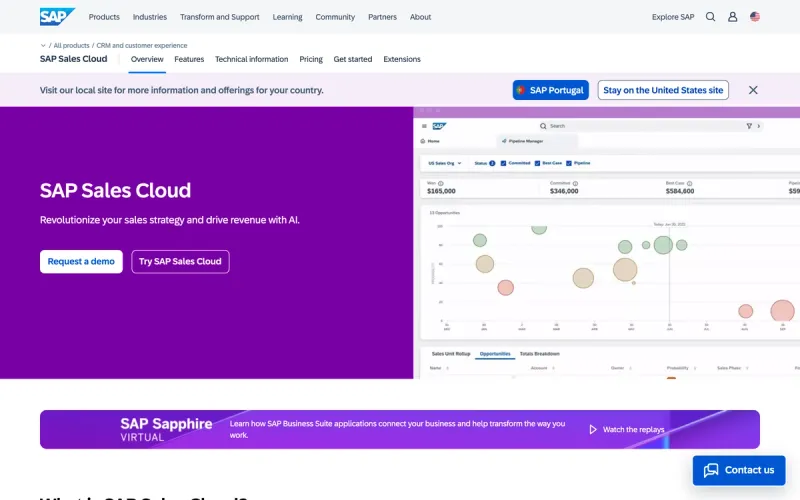
33. NetSuite CRM
NetSuite CRM is a module inside NetSuite ERP, not a standalone product. Oracle bought NetSuite in 2016 and the CRM is best understood as the front-office layer on top of NetSuite's accounting, order, and inventory data.
Pricing: Bundled with NetSuite ERP; effective CRM cost varies. NetSuite ERP licensing starts around $999/mo base plus $99-$129 per user. CRM functionality is bundled rather than priced separately; a 25-user NetSuite deployment with CRM runs $35-60k/year total. Standalone CRM use is essentially impossible.
Best for: NetSuite ERP customers who want sales + finance in the same record. Wins for product-led companies running NetSuite ERP who want sales reps working off the same record as fulfillment and finance. The native quote-to-cash flow is the strongest feature; SuiteScript customization unlocks pretty much anything if you have a partner.
Setup reality: Implementation is the NetSuite implementation, which runs 4-9 months. Once ERP is live, turning on CRM features adds maybe 4-6 weeks. The first thing that breaks is permissions when sales people accidentally see GL data.
Head-to-head: NetSuite CRM vs Salesforce Sales Cloud vs Microsoft Dynamics 365 Business Central plus Sales for a 25-user product company. Standalone CRM seat math is not really possible for NetSuite, but a 25-user NetSuite + CRM deployment runs $50,000-70,000/year all-in. Salesforce Sales Cloud Pro plus a NetSuite connector lands at $35,000-45,000 in license, plus integration cost. Dynamics 365 Business Central plus Sales runs $50,000-65,000. Implementation: NetSuite 4-9 months, Salesforce plus connector 3-6, Dynamics 4-8.
3-year cost projection: 25 users scaling to 40 on NetSuite plus CRM module: year 1 $65,000 including implementation, year 2 $48,000 in licenses, year 3 $58,000 with the standard 10% NetSuite annual price hike that everyone underestimates. Add a NetAdvantage or BlueRose admin partner at $40,000/year because internal NetSuite admins are unicorns. Total 3-year burn: roughly $215,000.
Integration stack: Email and calendar: native Outlook integration, Gmail via the NetSuite for Gmail Chrome extension which is competent. Dialer: partner-dependent via RingCentral or Avaya, no native option. E-sign: native to DocuSign and Adobe Sign. Accounting: it is NetSuite, so accounting is the entire product, not an integration. Enrichment: ZoomInfo and Apollo connectors via SuiteApp marketplace, otherwise Zapier-only.
If you like NetSuite CRM, also consider: If you like NetSuite CRM also consider Salesforce with a NetSuite connector (richer CRM UX, more integration overhead) or Microsoft Dynamics 365 Business Central plus Sales (lighter alternative). Both decouple ERP from CRM cleanly.
When NOT to pick it: Skip if you are not already a NetSuite ERP customer. Buying NetSuite for the CRM alone is the kind of $30k/year mistake mid-market teams routinely make.
The honest flaw: Standalone CRM is rarely viable; you need the full ERP for it to make sense.
34. Pega CRM
Pega is a low-code BPM (business process management) platform that ships CRM and customer-service applications on top of its workflow engine. It is the choice for banks, insurers, and telcos with case-management workflows that other CRMs cannot model.
Pricing: Custom enterprise (typical engagements $250K+). Enterprise-only pricing, typical engagements start at $250k/year and scale into 7 figures for global deployments. Per-seat figures rarely quoted; deals are structured around named users plus process units. A 500-seat Pega deployment realistically lands at $1.5-4M annually.
Best for: Banks, insurers, and telcos with deep process automation needs. Wins for sub-1000-employee enterprises with complex case workflows (insurance claims, telco service requests, KYC processes) where Salesforce Service Cloud falls short. The decisioning engine for next-best-action across channels is best-in-class.
Setup reality: Implementation is 12-24 months with Pega-certified partners (Cognizant, Infosys, EPAM). Year-one cost: $1-5M typical. The first thing that breaks is the rules engine when business analysts try to self-serve without Pega training.
Head-to-head: Pega vs Salesforce Service Cloud with Industries vs Appian for a 500-user bank or insurance deployment. Pega lands at $1.5M-4M/year, Salesforce Service Cloud with Industries at $1M-2.5M, Appian at $1.2M-3M. Implementation: Pega 12-24 months, Salesforce 6-12, Appian 9-18. Pega wins only when the workflow complexity exceeds what Salesforce custom objects can express without ballooning costs.
3-year cost projection: 500 users on Pega CRM: year 1 $2.5M including implementation, year 2 $1.4M in licenses and certified partner support, year 3 $1.6M with the typical 8% Pega annual price walk. Budget a permanent Pega-certified partner retainer of $400k/year because the rules engine is not something business analysts can self-serve without training. Total 3-year burn: $5.5M-6.5M.
Integration stack: Email and calendar: native Outlook and Office 365 connectors, Gmail support is functional but rarely the use case for Pega buyers. Dialer: native Pega Voice and partner integrations with Genesys, NICE, and Avaya. E-sign: native DocuSign and Adobe Sign. Accounting: missing as a direct integration, this is not what Pega does; SAP and Oracle ERP connectors via Pega Marketplace. Enrichment: native Pega Customer Decision Hub for behavioral data, ZoomInfo via marketplace.
If you like Pega CRM, also consider: If you like Pega also consider Salesforce Service Cloud with Industries cloud (richer CRM, lighter workflow engine) or Appian (similar low-code BPM positioning). Both have lighter implementation burdens.
When NOT to pick it: Skip if you are under 1,000 employees, if you do not have 18 months of patience, or if your IT team does not have Pega specialists. Pricing is opaque and high by design.
The honest flaw: Overkill for anything under 1,000 reps; pricing is opaque and high.
35. Sage CRM
Sage CRM is a 25-year-old product (originally ACCPAC eCRM, then bought by Sage in 2000) sold mostly to Sage accounting customers. The pitch is one-vendor consistency between your books and your sales pipeline.
Pricing: Essentials $39; Standard $59; Pro $83 per seat. A 5-rep team on Pro pays $415/mo ($83/seat annual), a 10-rep team $830, a 25-rep team $2,075. The math rarely pencils against modern alternatives. Standard at $59/seat is the practical mid-tier.
Best for: Sage accounting customers who want CRM in the same vendor. Wins only when the buyer is already running Sage 100, 300, or X3 ERP and the CFO wants a single vendor. The Sage-to-CRM data sync removes maybe 8 hours/week of duplicate data entry for a 25-rep team. Outside Sage shops, no use case.
Setup reality: Setup runs 6-12 weeks even for the basic Sage ERP integration. Admin work is heavier than Pipedrive. The piece that reps complain about first is the on-premise version when a Windows server update changes IIS configuration.
Head-to-head: Sage CRM vs HubSpot Sales Hub vs Microsoft Dynamics 365 Sales for a 10-rep team running Sage ERP. Sage CRM Pro at $83/seat, HubSpot Pro at $100, Dynamics 365 Sales Pro at $65. Year 1 all-in for 10 reps including a Sage ERP connector: Sage CRM $13,000, HubSpot $14,000 plus $5,000 in connector cost, Dynamics $9,500 plus $4,000 in connector cost. Implementation: Sage CRM 6-12 weeks, HubSpot 4-6, Dynamics 6-10.
3-year cost projection: 10 reps scaling to 25 on Sage CRM Pro: year 1 $13,000, year 2 $25,000 after expansion, year 3 $26,500 with a modest 6% price walk. Sage has not been aggressive on price escalation since 2021. Budget $8,000-12,000/year for a Sage-certified consultant because the on-premise option still requires Windows server expertise. Total 3-year burn: roughly $90,000.
Integration stack: Email and calendar: native Outlook integration, Gmail support is functional but second-class. Dialer: missing native, Zapier-only via Aircall. E-sign: native DocuSign integration. Accounting: native to Sage 100, Sage 200, Sage 300, Sage X3, and Sage Intacct (the entire reason anyone picks this). Enrichment: missing entirely, Zapier-only for any third-party data.
If you like Sage CRM, also consider: If you like Sage CRM also consider HubSpot or Pipedrive with a Sage connector (better CRM UX, separate vendor risk) or Microsoft Dynamics 365 Sales with a Sage integration (similar enterprise vibe). Both have stronger product velocity.
When NOT to pick it: Skip if you are not already a Sage ERP customer. Product investment has slowed dramatically since 2020, and the brand is not winning new deals.
The honest flaw: Product investment has slowed; not a default mid-market pick anymore.
36. SugarCRM
SugarCRM was the first major open-source CRM (2004), went private in 2018 under KKR ownership, and rebuilt itself as Sugar Sell/Serve/Market enterprise products. The open-source community spun off as SuiteCRM and now eats the lower end.
Pricing: Sell $80; Serve $135; Enterprise $150 per seat (10-seat minimum). 15-seat minimum on all plans. A 15-rep team on Sell Standard pays $885/mo ($59/seat annual), a 25-rep team $1,475, a 50-rep team $2,950. Advanced at $85/seat is the practical mid-tier. Implementation services add 4-6 months of license fees on year one.
Best for: Mid-market teams who want an open architecture without going full Salesforce. Wins for 25-200 rep mid-market teams who want an open architecture (Sugar runs on PHP, customizable via Sugar Logic and module loader) without going full Salesforce. Wins more in EMEA and APAC than North America.
Setup reality: Implementation runs 8-16 weeks for a clean Sell rollout, 16-24 for Sell plus Serve plus Market. Admin work is moderate but you will want a Sugar-certified consultant. The first thing that breaks is the upgrade path when KKR-era Sugar pushes a forced version bump.
Head-to-head: SugarCRM Sell vs Salesforce Sales Cloud vs Zoho CRM Enterprise for a 25-rep mid-market team. SugarCRM Sell Standard at $59/seat (15-seat minimum), Salesforce Pro at $80, Zoho Enterprise at $40. Year 1 all-in for 25 reps: SugarCRM around $35,000 ($17,700 license + $17,000 implementation), Salesforce around $48,000 with a partner, Zoho around $18,000. Implementation weeks: SugarCRM 12, Salesforce 12-16, Zoho 6.
3-year cost projection: 25 reps holding flat on SugarCRM Sell Standard: year 1 $35,000, year 2 $18,500, year 3 $20,000 with a 7% Sugar annual price walk that has been steady since the KKR buyout. Add Sugar Market ($1,000/month) if you want marketing automation, plus a Sugar-certified consultant retainer of $15,000-25,000/year. Total 3-year burn: roughly $115,000.
Integration stack: Email and calendar: native Outlook and Gmail integrations via SugarCRM extensions, both work but Outlook is the better experience. Dialer: native via SugarLive or partner integrations with RingCentral and Twilio. E-sign: native DocuSign. Accounting: missing direct, partner connectors for QuickBooks and Xero via SugarOutfitters. Enrichment: native ZoomInfo and Cognism connectors, also DemandBase.
If you like SugarCRM, also consider: If you like SugarCRM also consider Salesforce Sales Cloud (deeper ecosystem) or Zoho CRM Enterprise (similar mid-market positioning at half the price). Both have stronger brand momentum.
When NOT to pick it: Skip if brand recognition matters in board reports, if you need an active community for ecosystem extensions, or if you have under 15 reps (the 15-seat minimum hurts smaller teams).
The honest flaw: Brand recognition slipped post-private-equity buyouts; ecosystem is thinner than Salesforce.
37. Creatio
Creatio is a Ukrainian-Boston no-code platform that ships sales, marketing, and service CRM applications on top of its low-code studio. The BPM and process automation layer is the real product; the CRM is a packaged use case.
Pricing: Growth $25; Enterprise $55; Unlimited $85 per seat. A 5-rep team on Enterprise pays $275/mo ($55/seat annual), a 10-rep team $550, a 25-rep team $1,375. Unlimited at $85/seat adds AI features and unlimited records. Growth at $25/seat is suspiciously cheap for what you get.
Best for: BPM-focused enterprises who want no-code workflow on top of CRM. Wins for 50-500 rep enterprises with custom processes (insurance underwriting, B2B distribution, specialty manufacturing) where Salesforce custom objects would balloon costs. The Studio Creatio designer is the best no-code engine in the CRM category.
Setup reality: Implementation runs 4-9 months for a multi-module rollout. Year-one cost typically 1.5-3x the license fee due to consulting. What gives out at scale is integrations when business analysts modify processes without versioning.
Head-to-head: Creatio vs Salesforce vs Pega for a 100-rep enterprise running custom workflows. Creatio Enterprise at $55/seat, Salesforce Lightning Flow at $80 base, Pega at $1,500-2,500/seat-equivalent. Year 1 all-in for 100 reps with custom workflow build: Creatio $200,000, Salesforce $400,000-600,000 with custom Apex work, Pega $1M+. Implementation: Creatio 4-9 months, Salesforce 6-12, Pega 12-24.
3-year cost projection: 100 reps scaling to 150 on Creatio Enterprise: year 1 $200,000 including implementation, year 2 $80,000 in licenses, year 3 $100,000 with expansion. Creatio's price walks have been 5-8% annually. Budget a permanent Studio Creatio developer or partner retainer of $80,000-120,000/year. Total 3-year burn: roughly $480,000, which is about a third of the Salesforce-with-custom-build equivalent.
Integration stack: Email and calendar: native Outlook and Gmail sync via Exchange Listener, both work cleanly. Dialer: native CTI connector framework, partner integrations with Twilio, Asterisk, and Avaya. E-sign: native DocuSign and Adobe Sign integrations. Accounting: SAP and Oracle ERP connectors via Creatio Marketplace, Zapier for QuickBooks. Enrichment: native ZoomInfo and Apollo connectors via marketplace.
If you like Creatio, also consider: If you like Creatio also consider Salesforce with Lightning Flow (richer ecosystem, more lock-in) or Pega (deeper BPM, much heavier implementation). Both have larger North American footprints.
When NOT to pick it: Skip if your team needs a recognizable brand in board materials, if you have under 25 reps, or if your processes are vanilla enough that out-of-the-box Salesforce or HubSpot fits.
The honest flaw: Sales and marketing modules are good; brand awareness in North America is low.
38. SuiteCRM
SuiteCRM is the open-source fork of SugarCRM Community Edition, maintained by UK company SalesAgility since 2013 after Sugar dropped the open-source version. It is the most-deployed open-source CRM in the world by install count.
Pricing: Free self-hosted; SalesAgility cloud $95/mo (5 users). Self-hosted is free if you have the ops team; cloud-hosted by SalesAgility starts at $95/mo for 5 users, scaling to roughly $1,500/mo for 100 users. A 25-user cloud deployment runs roughly $475/mo. Hidden cost: self-hosting an actively used SuiteCRM realistically needs 0.25 FTE devops.
Best for: Teams who want an open-source SugarCRM fork with control over their data. Wins for budget-constrained European governments, nonprofits, and dev-heavy teams who want data sovereignty and own the source code. The fork-and-modify model is the cheapest path to a customized CRM if you have the engineering capacity.
Setup reality: Self-hosted setup runs 1-2 weeks for a competent ops team using Docker, 4-6 weeks otherwise. Admin work is constant; LAMP stack experience is mandatory. The piece that reps complain about first is the upgrade path between major versions, which can require manual data migration.
Head-to-head: SuiteCRM vs EspoCRM vs Vtiger Open Source for a 25-user budget-constrained team. Self-hosted: SuiteCRM free, EspoCRM free, Vtiger Open Source free. Cloud-hosted: SuiteCRM SalesAgility around $475/month, EspoCRM Cloud around $375/month, Vtiger One Pro $1,050/month for 25 users. Year 1 self-hosted including 0.25 FTE devops ($30,000): SuiteCRM $30,000, EspoCRM $30,000, Vtiger $30,000.
3-year cost projection: 25 users self-hosted on SuiteCRM: year 1 $30,000 in devops time, year 2 $32,000, year 3 $34,000 with normal salary inflation. Add hosting ($150-300/month for a competent VPS) and an annual security audit ($5,000-8,000). Total 3-year burn for self-host: roughly $105,000. Cloud-hosted with SalesAgility lands at roughly $20,000 over 3 years, which is cheaper unless you need data sovereignty.
Integration stack: Email and calendar: native IMAP and SMTP, Outlook plugin is functional, Gmail integration via OAuth works but is dated. Dialer: missing native, partner modules available via SuiteAssured. E-sign: missing native, custom SuiteCRM modules exist on the marketplace. Accounting: native QuickBooks Online module from SalesAgility, Xero via community modules. Enrichment: missing, you build it yourself or buy a Zapier connector.
If you like SuiteCRM, also consider: If you like SuiteCRM also consider EspoCRM (cleaner UX, similar self-hosted model) or Vtiger Open Source (lighter to deploy). Both have smaller communities but better contemporary UX.
When NOT to pick it: Skip if you do not have a dedicated devops resource, if you need a polished UX (the interface is the weakest of the major CRMs), or if you need a fast partner ecosystem for implementation support.
The honest flaw: Self-hosting demands a competent ops team; UX is the weakest of the major CRMs.
39. Maximizer CRM
Maximizer is a 38-year-old Canadian CRM (founded 1987) that dominated the financial-advisor and small-business markets in the 90s and 2000s, and now competes in Canada, the UK, and Australia. It survives on vertical depth in wealth management.
Pricing: Base $29; Sales Leader $49; Wealth Advisor $89 per seat. A 5-rep team on Sales Leader pays $245/mo ($49/seat annual), a 10-rep team $490, a 25-rep team $1,225. Wealth Advisor at $89/seat adds compliance tooling for FINRA, MFDA, and IIROC. Base at $29/seat is functional for solo reps.
Best for: Financial advisor and field-sales teams in Canada and the UK. Wins for Canadian financial advisor practices (15-50 advisors) and UK field-sales B2B teams who want a desktop-feel CRM with the calendar and contact features Outlook users expect. The compliance audit trail on Wealth Advisor is the differentiator.
Setup reality: Setup runs 4-8 weeks for a wealth advisor practice (the compliance configuration is the slow part). Admin work is moderate. The first thing that breaks is the Outlook plugin after major Office updates, which historically lag 4-6 weeks behind Microsoft releases.
Head-to-head: Maximizer vs Wealthbox vs Redtail for a 25-advisor Canadian wealth practice. Maximizer Wealth Advisor at $89/seat, Wealthbox Pro at $75, Redtail Growth at $129 per database (covers up to 30 users). Year 1 all-in for 25 advisors: Maximizer $26,700, Wealthbox $22,500, Redtail $1,548 plus compliance integrations of $8,000. Maximizer wins on the audit trail for MFDA and IIROC; Wealthbox wins on UX; Redtail wins on raw price.
3-year cost projection: 25 advisors holding flat on Maximizer Wealth Advisor: year 1 $26,700, year 2 $28,000, year 3 $29,400 with a steady 5% Maximizer price walk that has been consistent since 2022. Add the compliance archive integration ($150-300/month) and an Outlook plugin support contract because the plugin breaks after every major Office update. Total 3-year burn: roughly $90,000.
Integration stack: Email and calendar: native Outlook plugin is the strongest in the Canadian wealth tier, Gmail support is functional but secondary. Dialer: missing native, Zapier-only via Aircall or RingCentral. E-sign: native DocuSign integration. Accounting: missing direct, Zapier-only for QuickBooks. Enrichment: missing entirely. Custodian integrations: native Schwab, Fidelity, Pershing, and NBIN for the Canadian wealth use case.
If you like Maximizer CRM, also consider: If you like Maximizer also consider Wealthbox (cleaner UX, US-focused) or Redtail CRM (deeper US wealth-management feature set). Both have stronger US brand recognition.
When NOT to pick it: Skip outside Canada, the UK, and Australia, because the partner network thins out fast. Also skip if your reps are remote-first; the product still feels designed for desktop-tethered field reps.
The honest flaw: Limited brand awareness outside its core verticals.
40. Pipeliner CRM
Pipeliner is an Austrian-Californian CRM founded in 2007 whose entire pitch is visual: every screen is a chart, a flow diagram, or a relationship map rather than a list view. It is the CRM for visual-thinking sales managers who hate spreadsheets.
Pricing: Starter $25; Business $50; Enterprise $85; Unlimited $115 per seat. A 5-rep team on Business pays $250/mo ($50/seat annual), a 10-rep team $500, a 25-rep team $1,250. Enterprise at $85/seat unlocks the SQL Server and Oracle connectors. Unlimited at $115/seat is rarely sold under 50 reps.
Best for: Visual-thinking sales orgs who want every screen to be a chart. Wins for 10-50 rep B2B teams whose sales managers want pipeline visualization (account hierarchies, navigator views, multi-pipeline overlays) that traditional CRMs cannot render. Particularly strong in manufacturing and industrial distribution.
Setup reality: Setup takes 3-5 weeks because the visual configuration is non-trivial. Admin work is unconventional; trained Pipeliner admins are rare outside Europe. The first thing that breaks is the offline mobile sync when reps cross time zones.
Head-to-head: Pipeliner vs Salesforce Sales Cloud vs Membrain for a 25-rep B2B team that wants visual pipeline depth. Pipeliner Business at $50/seat, Salesforce Pro at $80, Membrain Sales Team at $65. Year 1 all-in for 25 reps: Pipeliner $15,000, Salesforce $30,000 with custom dashboard build, Membrain $19,500. Implementation: Pipeliner 3-5 weeks, Salesforce 12-16 weeks for the visual customization, Membrain 4-6 weeks.
3-year cost projection: 25 reps scaling to 40 on Pipeliner Business: year 1 $15,000, year 2 $22,000, year 3 $24,000 with a modest 5% Pipeliner price walk that has been steady since 2023. Add the SQL Server connector ($15/seat if you need it) plus 2-3 weeks/year of admin time because Pipeliner admins are scarce outside Austria and California. Total 3-year burn: roughly $65,000.
Integration stack: Email and calendar: native Outlook and Gmail sync, both work cleanly via the Pipeliner add-ins. Dialer: missing native, Zapier-only via Aircall or JustCall. E-sign: native DocuSign integration. Accounting: native QuickBooks and Xero connectors. Enrichment: missing native, Zapier-only for Apollo or Clearbit.
If you like Pipeliner CRM, also consider: If you like Pipeliner also consider Membrain (methodology-focused with similar visual depth) or Salesforce Sales Cloud with custom dashboards (richer ecosystem, more setup work). Both have larger partner networks.
When NOT to pick it: Skip if your team learns by reading docs rather than exploring UI, if you need fast partner support in your region, or if your sales process is straightforward enough that a kanban view in Pipedrive does the job.
The honest flaw: Reporting and admin work are unconventional; learning curve is real.

Vertical specialists (30 tools across 5 verticals)
Picking a generalist CRM for a regulated or relationship-heavy industry is, in my view, one of the most expensive mistakes a leader can make. The vertical specialists in this section beat HubSpot or Salesforce on day one because the data model already matches the workflow. I've grouped thirty tools across five verticals so you can find the right fit faster.
| # | CRM | Pricing range (per seat / mo) | Best for (1-liner) | Year-1 cost (10 reps) | Setup |
|---|---|---|---|---|---|
| 41 | Follow Up Boss | Grow $69; Pro $499; Platform $1,000+/mo | Real-estate teams running heavy lead-generation across Zillow/Realtor. | ~$8.3k | 4-12 weeks |
| 42 | Lofty (formerly Chime) | Custom plans, typical $499 to $999/mo | Real-estate teams who want an all-in-one website + CRM + IDX system. | ~$60k | 4-12 weeks |
| 43 | LionDesk | Starter $39; Pro+ $49; Elite $99; Custom $139/mo | Solo real-estate agents on a budget. | ~$4.7k | 4-12 weeks |
| 44 | Wise Agent | $39.92 per seat (single tier) | Solo or small real-estate teams who want simple CRM + drip campaigns. | ~$4.7k | 4-12 weeks |
| 45 | Top Producer | CRM $80; Pro $190 per seat | Legacy real-estate agents who want a stable, well-known tool. | ~$9.6k | 4-12 weeks |
| 46 | BoomTown | Custom; typical $1,500+/mo | Real-estate teams of 5+ agents who want lead-gen + CRM bundled. | ~$0.1k | 4-12 weeks |
| 47 | Sierra Interactive | Custom; typical $500-$1,200/mo | Real-estate teams who want CRM + IDX website + lead-gen in one stack. | ~$6k flat | 4-12 weeks |
| 48 | kvCORE (Inside Real Estate) | Custom; typical $499+/mo per agent | Brokerages standardizing CRM across 50+ agents. | ~$60k | 4-12 weeks |
| 49 | Wealthbox | Basic $59; Pro $75; Premier $99 per seat | Independent RIAs (Registered Investment Advisors) and small wealth ... | ~$4.2k | 4-12 weeks |
| 50 | Redtail CRM | Launch $99; Growth $129; Enterprise $249 per database/mo | Mid-size wealth management firms with FINRA compliance needs. | ~$12k | 4-12 weeks |
| 51 | Salentica (SS&C) | Enterprise custom (built on Dynamics or Salesforce) | Large wealth managers who want CRM on top of their existing Dynamic... | custom | 4-12 weeks |
| 52 | AdvisorEngine CRM | Bundled into the AdvisorEngine wealth platform | RIAs already running AdvisorEngine portfolio management. | custom | 4-12 weeks |
| 53 | Practifi | Enterprise custom (Salesforce-based) | Wealth firms with 50+ advisors who want a managed Salesforce CRM. | custom | 4-12 weeks |
| 54 | UGRU Financial | Starter $59; Pro $129; Enterprise $199 per seat | Solo or small RIA practices on a budget. | ~$7.1k | 4-12 weeks |
| 55 | Affinity | Custom; typical floor $90 per seat | VC, PE, and corporate development teams running relationship intell... | ~$11k | 4-12 weeks |
| 56 | 4Degrees | Custom; typical $100+ per seat | VC and BD teams who want a lighter Affinity alternative. | ~$12k | 4-12 weeks |
| 57 | DealCloud (Intapp) | Enterprise custom (typical engagements $50K+/year) | Private equity and investment banks who need pipeline + deal manage... | ~$6.0k | 4-12 weeks |
| 58 | Altvia | Enterprise custom (Salesforce-based) | Private equity firms managing LPs, deal pipeline, and portfolio in ... | custom | 4-12 weeks |
| 59 | Backstop Solutions (ION) | Enterprise custom | Hedge funds, fund-of-funds, and institutional investors. | custom | 4-12 weeks |
| 60 | Salesforce Financial Services Cloud | Custom enterprise (typical floor $150 per seat) | Wealth managers and banks already on Salesforce. | ~$18k | 4-12 weeks |
| 61 | Clientjoy | Starter $14; Growth $33; Pro $58 per seat | Freelance designers, agencies, and small consultancies who want CRM... | ~$1.7k | 4-12 weeks |
| 62 | Daylite (Marketcircle) | $40 per seat (Mac only) | Mac-only teams who want a deep CRM integrated with Apple Mail and C... | ~$4.8k | 4-12 weeks |
| 63 | Recruit CRM | Pro $85; Business $125; Enterprise $165 per seat | Recruitment agencies running both candidate ATS and client CRM. | ~$10k | 4-12 weeks |
| 64 | Loxo | Custom; typical floor $125 per seat | Executive search and high-end recruiting firms. | ~$15k | 4-12 weeks |
| 65 | Bullhorn | Custom enterprise; typical $99-$150 per seat | Staffing firms with 25+ recruiters running high-volume placements. | ~$12k | 4-12 weeks |
| 66 | JobAdder | Custom; typical floor $100 per seat | Australian and UK staffing firms who want a Bullhorn alternative. | ~$12k | 4-12 weeks |
| 67 | Salesforce Health Cloud | Custom enterprise (typical floor $200 per seat) | Hospitals, payers, and pharma orgs needing HIPAA-grade patient/cust... | ~$24k | 4-12 weeks |
| 68 | Veeva CRM | Enterprise custom (pharma-only contracts) | Pharma rep teams visiting clinicians; the de facto standard. | custom | 4-12 weeks |
| 69 | NexHealth | Custom; typical floor $499/mo per office | Dental and medical practices who want patient CRM + scheduling. | ~$60k | 4-12 weeks |
| 70 | Solutionreach | Custom; typical $329-$1,200+/mo | Healthcare practices wanting patient messaging + light CRM. | ~$39k | 4-12 weeks |
Tier 4 overview: every CRM in this section side by side. Year-1 cost is a 10-rep estimate based on starting-tier pricing (real cost lands 1.5-3x this once implementation, integrations, and admin are included).
Best CRM for real estate (8 picks)
41. Follow Up Boss
Follow Up Boss is the lead-routing CRM that most US real-estate teams default to when they outgrow LionDesk and aren't ready for kvCORE. It absorbs Zillow Premier Agent, Realtor.com, and Google LSA leads into one inbox, then rotates them to agents by zip-code or round-robin rules.
Pricing: Grow $69; Pro $499; Platform $1,000+/mo. A 5-agent team on Grow pays $69/seat or $345/month, but the real-estate workflow features only unlock at Pro ($499/mo flat, includes 10 users). A 25-agent team typically lands on Pro plus $499 in add-ons, around $1,000/mo total. A 50-agent operation hits Platform ($1,000+/mo) and starts negotiating.
Best for: Real-estate teams running heavy lead-generation across Zillow/Realtor. Wins when you're spending $5k+/month on Zillow Flex or Realtor.com Connections and need lead-source ROI attribution by zip. Teams in this band routinely cut cost-per-closed-lead by 30 to 40% just by activating Follow Up Boss's lead-pond rules and killing dead agents from the rotation.
Setup reality: Two-week setup if you're disciplined: IDX/MLS data flow goes through Zapier or a paid connector like API Nation ($30/mo). The MLS feed isn't native, which surprises buyers. Month 1 breakage is usually duplicate-contact merging when Zillow and Realtor.com push the same lead twice.
Head-to-head: Follow Up Boss vs Lofty vs Sierra Interactive for a 10-agent real-estate team. Follow Up Boss Pro at $499/month flat (10 users), Lofty around $799/month for 10 agents, Sierra Interactive around $899/month bundled with IDX. Year 1 all-in including IDX vendor for Follow Up Boss buyers (iHomefinder at $99/month): Follow Up Boss roughly $7,200, Lofty $9,600 (IDX included), Sierra $10,800 (IDX included). Implementation: Follow Up Boss 2 weeks, Lofty 4-6 weeks, Sierra 60-90 days.
3-year cost projection: 10 agents scaling to 25 on Follow Up Boss Pro plus Platform for the larger team: year 1 $7,200 (Pro), year 2 $12,000 (Platform tier kicks in), year 3 $15,000 with their 8% annual price walk that has been aggressive since the 2024 Zillow acquisition. Add iHomefinder IDX ($99/month) and API Nation ($30/month) for connector glue. Total 3-year burn: roughly $40,000.
Integration stack: Email and calendar: native Gmail and Outlook sync with strong inbox views. Dialer: native via Smart Numbers (built-in calling and SMS), also Mojo Dialer and RedX integrations. E-sign: native DotLoop and Skyslope integrations, partner connector for DocuSign. Accounting: missing entirely, this is not where real-estate ops happens. Enrichment: missing native, Zylem and BombBomb for video email. IDX/MLS: not native, requires iHomefinder, IDX Broker, or API Nation.
If you like Follow Up Boss, also consider: If you like Follow Up Boss, also consider Lofty (more website + IDX bundled) or Sierra Interactive (better for teams that want a custom-branded site as the lead-capture front end). kvCORE is the obvious upgrade path past 30 agents.
When NOT to pick it: Skip it if you're a solo agent doing under 20 transactions a year (Grow tier ceiling hits fast), if you need built-in IDX websites (you'll pay for a separate vendor), or if your brokerage already standardized on kvCORE/Lofty and wants one source of truth.
The honest flaw: Aggressive pricing jumps; small teams stuck on Grow tier hit feature ceilings fast.
42. Lofty (formerly Chime)
Lofty (rebranded from Chime in 2023) is the all-in-one real-estate stack: IDX website, CRM, dialer, smart drip campaigns, and AI-powered lead nurture in one platform. It targets teams that don't want to stitch Follow Up Boss plus a separate IDX vendor plus a dialer.
Pricing: Custom plans, typical $499 to $999/mo. Pricing is custom but a 5-agent team typically pays $499 to $749/mo flat, a 25-agent team lands around $1,200 to $1,800/mo, and 50+ agent brokerages negotiate enterprise deals starting at $2,500/mo. The math gets attractive when you replace 3 to 4 separate tools.
Best for: Real-estate teams who want an all-in-one website + CRM + IDX system. Wins for newer brokerages building from zero who want a branded IDX site plus CRM in the same login. Teams running Wix plus Follow Up Boss plus Mojo Dialer at $1,400/mo combined routinely consolidate onto Lofty for around $899/mo and recover the time the ops manager was spending on Zapier glue.
Setup reality: Onboarding takes 4 to 6 weeks. The IDX integration handles 600+ MLSs in the US, so feed setup is rarely the problem. What breaks in month 1: drip-campaign timing (the default templates fire too aggressively and trigger spam complaints), and lead-source attribution when Zillow leads route through email parsers.
Head-to-head: Lofty vs Sierra Interactive vs BoomTown for a 10-agent team that wants website plus CRM bundled. Lofty around $799/month, Sierra around $899/month, BoomTown around $1,800/month plus managed PPC. Year 1 all-in including ad-spend assumption of $3,000/month: Lofty $45,600, Sierra $46,800, BoomTown $57,600. Implementation: Lofty 4-6 weeks, Sierra 60-90 days, BoomTown 60-90 days white-glove.
3-year cost projection: 10 agents scaling to 25 on Lofty: year 1 $9,600 in platform fees, year 2 $18,000 after expansion to 25 agents (rate negotiated up by 15% on renewal), year 3 $22,000 with another 10% bump. Add the lead-validation service ($200-400/month) and Google PPC management if you do not run it yourself ($1,500-3,000/month). Total 3-year platform burn excluding ads: roughly $50,000.
Integration stack: Email and calendar: native Gmail, Outlook, and Office 365 sync with inbox views. Dialer: native built-in dialer (the entire pitch of the bundle), no need for Mojo. E-sign: native DotLoop integration, partner connectors for DocuSign and Skyslope. Accounting: missing, real-estate teams handle this separately. Enrichment: native lead-source attribution from Zillow Flex, Realtor.com, and Google LSA. IDX/MLS: native to 600+ MLSs in the US, this is the differentiator versus Follow Up Boss.
If you like Lofty (formerly Chime), also consider: If you like Lofty, also consider Sierra Interactive (better SEO-friendly IDX sites) or BoomTown (stronger team-management features for 10+ agent operations). Follow Up Boss plus a separate IDX vendor remains the more flexible path for teams that want best-in-class on each piece.
When NOT to pick it: Skip Lofty if you're already happy with your IDX provider (you can't use just the CRM), if you have a legal team that scrutinizes contracts (12-month minimums with painful export), or if you do high-end luxury where the default site templates feel too templated.
The honest flaw: Contract lock-in is common; export is painful when you want to leave.
43. LionDesk
LionDesk is the budget real-estate CRM that solo agents and sub-5-person teams default to when Follow Up Boss feels overpriced. It has the basics: drip campaigns, video email, transaction management, and a built-in dialer.
Pricing: Starter $39; Pro+ $49; Elite $99; Custom $139/mo. A solo agent pays $39/mo on Starter or $49/mo on Pro+. A 5-agent team typically lands on Elite at $99/mo flat (3 users included, $10/seat after). A 25-agent operation rarely makes sense here; most teams of that size have already migrated to Follow Up Boss or Lofty.
Best for: Solo real-estate agents on a budget. Wins for the part-time agent or solo full-timer doing 15 to 40 transactions a year who needs drip campaigns and lead capture without paying $500/mo. It typically works for second-career agents in secondary markets where the lead-volume math doesn't justify Follow Up Boss yet.
Setup reality: Setup is a weekend project: IDX integration runs through a $25/mo add-on, MLS data flows via PDF or email parser. Month 1 breakage: the video-email feature throws deliverability flags if you send to lists over 100, and the drip-campaign editor crashes on Safari.
Head-to-head: LionDesk vs Wise Agent vs Top Producer for a solo or 3-agent real-estate team. LionDesk Pro+ at $49/month, Wise Agent at $39.92/seat flat, Top Producer CRM at $80/seat. Year 1 all-in for a 3-agent team including IDX add-on ($25/month): LionDesk roughly $1,750 (3 seats on Elite at $99 plus IDX), Wise Agent roughly $1,740 (3 seats plus IDX), Top Producer roughly $3,180. Implementation: LionDesk a weekend, Wise Agent a weekend, Top Producer 2-3 weeks.
3-year cost projection: Solo agent on LionDesk Pro+ scaling to 5 agents on Elite over 3 years: year 1 $588, year 2 $1,500 (Elite kicks in), year 3 $1,800 with one mid-year expansion. LionDesk has not raised prices since the Lovell Minnick acquisition slowed product velocity. Add IDX Broker ($40/month) and a video-email tool because the native one throws deliverability flags. Total 3-year burn: roughly $7,500.
Integration stack: Email and calendar: native Gmail and Outlook sync, both functional but dated. Dialer: native click-to-call and bulk-SMS via Twilio under the hood. E-sign: missing native, partner connectors for DotLoop and DocuSign. Accounting: missing. Enrichment: missing native, Zapier-only. IDX/MLS: not native, requires the IDX Broker or iHomefinder add-on at $25-40/month.
If you like LionDesk, also consider: If you like LionDesk, also consider Wise Agent (similar price point, slightly cleaner UI) or Top Producer CRM (more legacy, more stability). Follow Up Boss is the obvious upgrade once your transaction volume crosses 60/year.
When NOT to pick it: Skip it if you're managing a team over 8 agents (lead-routing rules are weak), if you depend on Zillow Flex (the integration is brittle), or if you need analytics beyond basic open/click stats.
The honest flaw: Lovell Minnick acquisition slowed roadmap; some agents have migrated post-acquisition.
44. Wise Agent
Wise Agent is the one-price, single-tier real-estate CRM that's been around since 2001 and competes by undercutting LionDesk on price while including transaction management, landing pages, and drip campaigns. It targets solo agents and small teams who want predictable pricing.
Pricing: $39.92 per seat (single tier). Flat $39.92/seat/month, no tiers. A 5-agent team pays about $200/mo. A 25-agent team would pay $1,000/mo, but most teams that size pick Follow Up Boss instead. The pricing model is the pitch: no upsells, no surprise charges.
Best for: Solo or small real-estate teams who want simple CRM + drip campaigns. Wins for the value-conscious solo agent who treats CRM as a utility, not a competitive advantage. Rural agents in markets with lower commission averages typically pick Wise Agent specifically because the dollar math on a $400k median home doesn't justify $69/seat at Follow Up Boss.
Setup reality: Setup is a long weekend. IDX integration uses iHomefinder or IDX Broker (separate $20 to $40/mo). MLS data import is manual CSV or email-based. Month 1 breakage: the landing-page builder is the weakest part of the product and most agents abandon it within 30 days.
Head-to-head: Wise Agent vs LionDesk vs Top Producer for a solo agent in a secondary market. Wise Agent at $39.92/seat flat, LionDesk Pro+ at $49/month, Top Producer CRM at $80/seat. Year 1 all-in for a solo agent including IDX integration ($25-40/month): Wise Agent roughly $780, LionDesk roughly $900, Top Producer roughly $1,500. Implementation: Wise Agent a long weekend, LionDesk a weekend, Top Producer 2-3 weeks.
3-year cost projection: Solo agent on Wise Agent scaling to 3 agents over 3 years: year 1 $480, year 2 $960, year 3 $1,440. Wise Agent has held the same flat price since 2019, which is the entire pitch. Add iHomefinder IDX ($40/month) and email-marketing volume ($30/month above the included tier). Total 3-year burn: roughly $5,800, which is the cheapest real path in the real-estate CRM category.
Integration stack: Email and calendar: native Gmail and Outlook sync, both functional but the UI is dated. Dialer: missing native click-to-call, Zapier-only via Aircall. E-sign: native DotLoop and Skyslope integrations. Accounting: missing entirely. Enrichment: missing native, Zapier-only. IDX/MLS: not native, requires iHomefinder ($40/month) or IDX Broker ($30/month).
If you like Wise Agent, also consider: If you like Wise Agent, also consider LionDesk (similar price band, more polished UI) or Top Producer CRM (stronger calendar/transaction workflow). For teams above 5 agents, Follow Up Boss is almost always the right move.
When NOT to pick it: Skip it if you need modern lead-source attribution (it's basic), if you want a vendor with strong development velocity (Wise Agent ships slowly), or if your team includes anyone under 35 who'll resist the dated UI.
The honest flaw: UI is dated; integration ecosystem is thin.
45. Top Producer
Top Producer is the legacy real-estate CRM that dominated the market from 2000 to 2015 before Follow Up Boss and BoomTown took share. Today it's owned by Constellation Software and serves agents who value stability over feature velocity. The product has been modernized but the brand carries the 'safe choice' positioning.
Pricing: CRM $80; Pro $190 per seat. CRM tier runs $80/seat, Pro adds Smart Targeting (predictive farming) at $190/seat. A 5-agent team on Pro pays $950/mo. A 25-agent team rarely picks Top Producer at scale; most pick Follow Up Boss or kvCORE instead.
Best for: Legacy real-estate agents who want a stable, well-known tool. Wins for the 50+ year-old top-producing agent in a mature market who already used Top Producer in 2008 and trusts the workflow. Veteran agents routinely reject Follow Up Boss specifically because Top Producer's Action Plans feel familiar.
Setup reality: Onboarding takes 2 to 3 weeks. IDX integration goes through MLS Connector or iHomefinder. MLS data flows are stable. Month 1 breakage: the Outlook sync still throws calendar duplicates, and the mobile app lags behind the web product by 6 to 12 months on feature parity.
Head-to-head: Top Producer vs Follow Up Boss vs Wise Agent for a 5-agent real-estate team. Top Producer CRM at $80/seat, Follow Up Boss Grow at $69/seat, Wise Agent at $39.92/seat flat. Year 1 all-in for 5 agents including IDX where needed: Top Producer roughly $4,800, Follow Up Boss roughly $4,140, Wise Agent roughly $2,800. Implementation: Top Producer 2-3 weeks, Follow Up Boss 2 weeks, Wise Agent a weekend.
3-year cost projection: 5 agents scaling to 10 on Top Producer CRM tier: year 1 $4,800, year 2 $9,600 after expansion, year 3 $10,200 with a modest 6% Constellation Software price walk that has been steady. Add Smart Targeting upgrade ($110/seat extra) if you want predictive farming, plus iHomefinder IDX ($99/month). Total 3-year burn at the CRM tier: roughly $26,000.
Integration stack: Email and calendar: native Outlook integration is the better path, Gmail support is functional but second-class. Dialer: missing native, partner connectors for Mojo Dialer and RingCentral. E-sign: native DotLoop and DocuSign integrations. Accounting: missing. Enrichment: native Smart Targeting (predictive farming) at the Pro tier is the differentiator. IDX/MLS: native MLS Connector to most major MLSs.
If you like Top Producer, also consider: If you like Top Producer, also consider Wise Agent (cheaper, simpler) or Follow Up Boss (modern equivalent of Top Producer's action-plan logic). Smart Targeting users who want predictive farming should also evaluate kvCORE.
When NOT to pick it: Skip if you're a high-volume team running Zillow Flex (the integration is slow), if you need modern AI-assisted nurture (it lags Lofty by 2 years), or if your agents are under 35 and will roll their eyes at the UI.
The honest flaw: Brand has lost market share to Follow Up Boss and Lofty.
46. BoomTown
BoomTown is the high-end, white-glove real-estate CRM plus lead-gen platform for teams of 5+ agents. Inside Real Estate (owner of kvCORE) acquired BoomTown in 2021 and runs it as the premium sibling. It packages SEO-driven lead generation, IDX websites, and a CRM into one managed service.
Pricing: Custom; typical $1,500+/mo. Custom only. A 5-agent team typically pays $1,500 to $2,000/mo. A 15-agent team lands around $2,500 to $3,500/mo. A 50-agent brokerage negotiates enterprise pricing starting at $5,000/mo. Lead-gen ad spend (Google PPC managed by BoomTown) runs on top, usually $3,000 to $10,000/mo.
Best for: Real-estate teams of 5+ agents who want lead-gen + CRM bundled. Wins for the 8 to 30 agent team that wants someone else to handle their lead-gen Google Ads plus IDX website plus nurture campaigns. Teams in this band routinely move from $400/closed-lead on Zillow Flex to $150 to $200/closed-lead on BoomTown-managed Google PPC, but it typically takes 6 to 8 months of optimization.
Setup reality: Onboarding is 60 to 90 days with a dedicated success manager. IDX/MLS integration is handled in-house by BoomTown. The model trades implementation speed for white-glove setup. What breaks in month 3: ad-spend ROI complaints when agents don't speed-to-lead within 5 minutes.
Head-to-head: BoomTown vs kvCORE vs Lofty for a 15-agent real-estate team. BoomTown around $2,500/month, kvCORE roughly $1,500-2,200/month at this size, Lofty roughly $1,200-1,500/month. Year 1 all-in including managed ad spend ($5,000/month for BoomTown, BYO for the others): BoomTown roughly $90,000, kvCORE roughly $25,000 platform plus separate ad agency, Lofty roughly $18,000 platform plus separate ad agency. Implementation: BoomTown 60-90 days, kvCORE 90-180 days for brokerage rollout, Lofty 4-6 weeks.
3-year cost projection: 15 agents scaling to 25 on BoomTown: year 1 $30,000 platform plus $60,000 in managed ad spend, year 2 $36,000 platform plus $72,000 ads, year 3 $42,000 platform plus $90,000 ads. The platform escalates 8-12% on renewal. Total 3-year platform burn: roughly $108,000. Total 3-year all-in including ads: $330,000, and ad spend should produce 30-60x ROI on closed-lead value if executed well.
Integration stack: Email and calendar: native Gmail and Outlook sync with strong inbox views, real-estate-specific routing rules. Dialer: native via BoomTown phone and SMS, partner connector for Mojo Dialer. E-sign: native DotLoop integration, partner DocuSign. Accounting: missing entirely. Enrichment: native lead-source attribution from Zillow, Realtor.com, and Google PPC. IDX/MLS: native to 600+ MLSs as part of the bundle.
If you like BoomTown, also consider: If you like BoomTown, also consider kvCORE (same parent, cheaper, less hand-holding), Lofty (similar all-in-one stack), or Sierra Interactive (better website design control). Follow Up Boss plus a separate ad-management agency is the unbundled path.
When NOT to pick it: Skip if you're a solo agent or sub-5 team (overkill), if you want to control your own Google Ads strategy, or if your contracts team rejects 12 to 24-month lock-ins.
The honest flaw: Pricing is opaque; lock-in is common in 12-24 month contracts.
47. Sierra Interactive
Sierra Interactive is the design-forward real-estate stack: SEO-optimized IDX websites, CRM, and lead-gen tools built for teams that take SEO seriously. It competes with Lofty and BoomTown on the website-quality dimension and routinely wins on Google rankings.
Pricing: Custom; typical $500-$1,200/mo. Custom, typically $500 to $1,200/mo for 5 to 15 agents. CRM-only is rarely sold; the value is the website plus CRM bundle. Add-ons include lead-validation services ($300/mo) and ad-management ($1,500/mo+).
Best for: Real-estate teams who want CRM + IDX website + lead-gen in one stack. Wins for teams in competitive metros (LA, Denver, Austin) where ranking on 'homes for sale in [neighborhood]' is the difference between $50/lead and $300/lead. Teams in competitive metros routinely rank in the top 3 for 40+ neighborhood keywords within 6 to 9 months of Sierra launch, replacing $3,000 to $5,000/mo in Zillow spend.
Setup reality: Onboarding is 60 to 90 days, mostly because the website design and content phase takes 4 to 6 weeks. IDX integration is native to most major MLSs (600+). Month 1 breakage: lead-source attribution can misfire when leads come through SEO-organic landing pages that route through the wrong agent rotation rule.
Head-to-head: Sierra Interactive vs Lofty vs Real Geeks for a 10-agent SEO-focused real-estate team in a competitive metro. Sierra around $799/month, Lofty around $799/month, Real Geeks around $599/month. Year 1 all-in including content production ($500-1,500/month): Sierra $20,000-30,000, Lofty $14,000-20,000, Real Geeks $11,000-15,000. Implementation: Sierra 60-90 days, Lofty 4-6 weeks, Real Geeks 3-4 weeks.
3-year cost projection: 10 agents scaling to 25 on Sierra Interactive: year 1 $24,000 with onboarding and content build, year 2 $18,000 with expansion, year 3 $22,000 after renewal pricing. Sierra's renewal escalations have been 10-15% per cycle. Add lead-validation ($300/month) and an SEO content writer ($1,500-3,000/month) which is the actual cost driver. Total 3-year platform burn excluding content: roughly $75,000.
Integration stack: Email and calendar: native Gmail and Outlook sync, functional but not the differentiator. Dialer: partner connector for Mojo Dialer, no native click-to-call. E-sign: native DotLoop integration. Accounting: missing. Enrichment: native lead-source attribution from organic search, Zillow Flex, and Realtor.com. IDX/MLS: native to 600+ MLSs and built with SEO-friendly URL structures.
If you like Sierra Interactive, also consider: If you like Sierra Interactive, also consider Lofty (similar bundle, weaker SEO foundation) or Real Geeks (mid-priced alternative with decent SEO sites). BoomTown is the obvious upgrade for teams that also want managed PPC.
When NOT to pick it: Skip if you don't care about SEO (you're paying for the part that matters most), if you need a stand-alone CRM (Sierra sells the bundle), or if your team can't commit to writing neighborhood-level content.
The honest flaw: Onboarding takes 60-90 days; not for impatient teams.

48. kvCORE (Inside Real Estate)
kvCORE (Inside Real Estate) is the enterprise real-estate platform for brokerages standardizing tech across 50+ agents. It packages IDX websites, CRM, behavioral lead scoring, AI nurture (Alex AI), and marketing automation into one stack. It's the closest thing to a brokerage-wide operating system in real estate.
Pricing: Custom; typical $499+/mo per agent. Custom. Brokerage-wide deals run $499+/agent/month for the full platform, but most brokerages negotiate volume pricing that drops effective cost to $89 to $150/agent at 100+ seats. A 250-agent brokerage typically pays $25k to $40k/month all-in.
Best for: Brokerages standardizing CRM across 50+ agents. Wins when a brokerage owner wants one CRM across all their agents to enable lead-pond rules, agent performance dashboards, and brokerage-level marketing. Brokerages in this band routinely cut tech-stack spend by 30 to 40% by killing 5 to 7 vendor contracts and consolidating to kvCORE.
Setup reality: Brokerage rollouts take 90 to 180 days. IDX integration handles 600+ MLSs natively. Month 1 breakage: agent adoption. The default kvCORE configuration overwhelms agents with notifications; brokerages that don't customize the agent dashboard see 30 to 50% of seats go inactive within 60 days.
Head-to-head: kvCORE vs BoomTown vs Lofty for a 100-agent brokerage standardizing tech across all agents. kvCORE around $89-150/agent at scale, BoomTown around $50-80/agent at this size, Lofty rarely sold at this scale. Year 1 all-in for 100 agents: kvCORE $120,000-180,000, BoomTown $80,000-120,000 platform plus managed PPC, Lofty $90,000-130,000. Implementation: kvCORE 90-180 days for brokerage rollout, BoomTown 60-90 days, Lofty 6-10 weeks.
3-year cost projection: 100 agents scaling to 250 on kvCORE: year 1 $150,000 in platform plus $40,000 in onboarding, year 2 $250,000 after expansion, year 3 $290,000 with renewal escalation of 10-12% that the brokerage owner always negotiates down to 6-8%. Total 3-year burn: roughly $700,000. The math only works versus 4-6 separate vendor contracts replaced, otherwise it looks expensive at face value.
Integration stack: Email and calendar: native Gmail and Outlook sync with brokerage-level pooling, the multi-tenant model is the differentiator. Dialer: native via Smart CRM phone, also Mojo Dialer and RedX integrations. E-sign: native DotLoop and Skyslope, partner DocuSign. Accounting: missing entirely. Enrichment: native lead-source attribution, behavioral scoring (Alex AI), and predictive seller-lead identification. IDX/MLS: native to 600+ MLSs with brokerage-wide content sharing.
If you like kvCORE (Inside Real Estate), also consider: If you like kvCORE, also consider BoomTown (same parent, more white-glove, smaller teams) or Lofty (better for sub-30 agent operations). Follow Up Boss plus a separate IDX vendor is the unbundled path for teams that want best-in-class CRM without the brokerage-wide architecture.
When NOT to pick it: Skip if you're a solo agent or sub-10-agent team, if your brokerage doesn't have an internal tech admin, or if your agents are accustomed to a specific lightweight CRM and will revolt at the change.
The honest flaw: Bloated for solo agents; mobile app reliability varies.
Visit kvCORE (Inside Real Estate).
Best CRM for financial advisors (6 picks)
49. Wealthbox
Wealthbox is the CRM that independent RIAs (Registered Investment Advisors) default to when they outgrow Redtail's dated UI. It's built specifically for the RIA workflow (client households, account aggregation, compliance notes) and integrates natively with Orion, Black Diamond, Tamarac, and most major custodians.
Pricing: Basic $59; Pro $75; Premier $99 per seat. Basic $59/seat, Pro $75/seat, Premier $99/seat. A 5-advisor RIA on Pro pays $375/mo. A 25-advisor firm on Premier pays $2,475/mo. A 50-advisor firm negotiates enterprise pricing, typically $75 to $85/seat. Add-ons include text messaging ($15/seat) and form-fill automation ($10/seat).
Best for: Independent RIAs (Registered Investment Advisors) and small wealth firms. Wins for the breakaway RIA team that just left Merrill or Morgan Stanley and needs to be operational in 30 days without a Salesforce admin. Breakaway RIAs in this profile routinely move several hundred million AUM in 90 days and have Wealthbox configured (with Orion, Schwab, and DocuSign integrations) in week one.
Setup reality: Setup is 1 to 2 weeks for a 5-advisor team. Custodian integrations work via the Wealthbox Integration Center. Compliance setup for FINRA-regulated broker-dealers requires Premier tier plus a compliance review workflow. Month 1 breakage: data import from a prior CRM usually loses note formatting and requires manual cleanup.
Head-to-head: Wealthbox vs Redtail vs Practifi for a 25-advisor RIA. Wealthbox Pro at $75/seat, Redtail Growth at $129/database (covers up to 30 users so still flat), Practifi at $99/seat plus Salesforce FSC at $300/seat. Year 1 all-in for 25 advisors: Wealthbox $22,500, Redtail $1,548 plus integration setup, Practifi $120,000. Implementation: Wealthbox 1-2 weeks, Redtail 3-6 weeks, Practifi 4-9 months.
3-year cost projection: 25 advisors scaling to 50 on Wealthbox Pro: year 1 $22,500, year 2 $39,000 after expansion, year 3 $42,000 with a 7% Wealthbox price walk that has been steady since 2023. Add text messaging ($15/seat at 50 advisors = $9,000/year), Orion or Black Diamond integration overhead ($5,000-10,000/year), and form-fill automation. Total 3-year burn: roughly $130,000.
Integration stack: Email and calendar: native Gmail and Outlook sync via the Wealthbox Integration Center, both work cleanly. Dialer: missing native, Zapier-only via Aircall or RingCentral. E-sign: native DocuSign and Adobe Sign integrations. Accounting: missing direct. Enrichment: native LinkedIn sidebar, otherwise Zapier-only. Custodian integrations: native Schwab, Fidelity, Pershing, Altruist; portfolio platforms: native Orion, Black Diamond, Tamarac, Addepar.
If you like Wealthbox, also consider: If you like Wealthbox, also consider Redtail (larger market share, broker-dealer-friendly) or Practifi (Salesforce-based, scales to 100+ advisors). UGRU Financial is the budget option for solo RIAs.
When NOT to pick it: Skip if you're a broker-dealer needing deep books-and-records compliance, if you need heavy customization (Wealthbox is opinionated), or if you're a 50+ advisor firm wanting a single source of truth across multiple custodians.
The honest flaw: Limited compliance depth for broker-dealers; built for RIAs first.
50. Redtail CRM
Redtail is the legacy RIA and broker-dealer CRM that's been the industry default since 2003. Orion Advisor Solutions acquired Redtail in 2022 and has been slowly integrating it into the broader Orion wealth platform. The product is feature-deep but UI-dated.
Pricing: Launch $99; Growth $129; Enterprise $249 per database/mo. Launch $99/database/month (up to 15 users), Growth $129 (up to 30 users), Enterprise $249+. Pricing is per database, not per seat, which makes Redtail a value for medium teams. A 10-advisor firm on Launch pays $99/mo total. A 25-advisor firm on Growth pays $129/mo. A 50-advisor firm hits Enterprise around $400/mo.
Best for: Mid-size wealth management firms with FINRA compliance needs. Wins for broker-dealers and hybrid RIAs who need FINRA Rule 17a-4 record retention, Rule 22c-2 frequent-trader monitoring, and books-and-records archiving baked in. Mid-sized broker-dealers (50 to 200 reps) routinely pick Redtail over Wealthbox specifically because the compliance-archive vendor integrates natively.
Setup reality: Setup is 3 to 6 weeks. Custodian integrations cover Schwab, Fidelity, Pershing, and most major B/Ds. The Orion integration is the big upgrade and improves quarterly. Month 1 breakage: the UI requires training; advisors under 35 universally complain it looks like 2010.
Head-to-head: Redtail vs Wealthbox vs Salentica for a 50-advisor broker-dealer. Redtail Growth at $129/database (covers up to 30) plus a second database at $129 for the overflow, Wealthbox Pro at $75/seat, Salentica enterprise custom. Year 1 all-in for 50 advisors: Redtail $3,096 in license plus compliance integrations of $15,000, Wealthbox $45,000, Salentica $200,000-300,000. Implementation: Redtail 3-6 weeks, Wealthbox 1-2 weeks, Salentica 6-12 months.
3-year cost projection: 50 advisors scaling to 75 on Redtail Growth (two databases): year 1 $3,096 in licenses plus $15,000 in compliance integrations, year 2 $3,200 with another database needed at 75 users, year 3 $9,600 across 3 databases. The license cost is flat; the real spend is in compliance archive integrations ($300-600/month for Smarsh or Global Relay) and Orion integration overhead. Total 3-year burn: roughly $75,000, mostly in compliance tooling.
Integration stack: Email and calendar: native Outlook integration is strong, Gmail support is functional but secondary. Dialer: missing native, partner connector for RingCentral. E-sign: native DocuSign and Adobe Sign integrations. Accounting: missing direct. Enrichment: missing native, Zapier-only. Custodian integrations: native Schwab, Fidelity, Pershing, NBIN, and most major B/Ds. Portfolio: native Orion (since the 2022 acquisition) and Black Diamond.
If you like Redtail CRM, also consider: If you like Redtail, also consider Wealthbox (cleaner UI, RIA-first), Salentica (Dynamics/Salesforce-based for larger wealth firms), or Practifi. Salesforce Financial Services Cloud is the upgrade path for firms growing past 200 advisors.
When NOT to pick it: Skip if your team is under 35 and aesthetic matters (you'll lose adoption), if you're a fee-only RIA with no broker-dealer compliance needs, or if you need modern AI-assisted client review prep.
The honest flaw: UI is dated; Orion acquisition has been a slow integration.
51. Salentica (SS&C)
Salentica (owned by SS&C Technologies since 2019) is the enterprise wealth CRM built on top of Microsoft Dynamics 365 or Salesforce. It targets large RIAs, multi-family offices, and bank wealth divisions with 50+ advisors who need a configurable enterprise CRM rather than an out-of-the-box RIA tool.
Pricing: Enterprise custom (built on Dynamics or Salesforce). Custom enterprise pricing. Typical implementations run $50k to $150k upfront plus the underlying Dynamics 365 ($105/seat) or Salesforce Financial Services Cloud ($300/seat) license. Annual support runs 18 to 22% of implementation cost. A 100-advisor firm typically spends $200k to $400k in year one.
Best for: Large wealth managers who want CRM on top of their existing Dynamics or Salesforce. Wins for the $5B+ AUM wealth manager who has outgrown Wealthbox/Redtail and needs portfolio-data integration, multi-entity household management, and bank-level compliance archiving. Multi-family offices in this band routinely migrate from Salesforce to Salentica-on-Salesforce specifically because the wealth data model handles trust-and-estate workflows out of the box.
Setup reality: Implementation is 6 to 12 months with a dedicated SS&C consultant team. Custodian integrations work via Salentica connectors but always need customization. Nobody is in production at month 1. The first real test is month 6 when the firm's first quarterly review cycle runs through the new CRM.
Head-to-head: For a 100-advisor wealth firm: Salentica on Dynamics runs ~$200K/year all-in (license + Dynamics seats) with $100K upfront and 9-month implementation. Practifi on Salesforce lands at $250K/year with $125K upfront and 7-month implementation. Salesforce FSC direct hits $300K/year with $200K upfront and 12-month implementation. Salentica wins on Microsoft shops; Practifi wins on speed; FSC wins on long-term flexibility.
3-year cost projection: Year 1 with 50 advisors on Dynamics-based deployment: ~$190K (license + implementation amortized). Year 2 at 75 advisors: ~$210K. Year 3 at 100 advisors: ~$270K. Plus 20% support fees on implementation and inevitable AppExchange add-ons. Realistic 3-year total: $700K-$850K, before counting the dedicated CRM admin headcount.
Integration stack: Email/calendar via native Dynamics or Salesforce connectors, solid. Portfolio data via Salentica connectors to Orion, Black Diamond, Schwab PortfolioCenter, all need customization but workable. E-sign via DocuSign on either underlying platform. Custodian feeds via Salentica's native connectors. Compliance archiving (Smarsh, Global Relay) requires a partner package. None of this is plug-and-play; budget consultant time for every integration.
If you like Salentica (SS&C), also consider: If you like Salentica, also consider Practifi (Salesforce-based, more SaaS-style pricing), AdvisorEngine (bundled CRM plus portfolio platform), or Salesforce Financial Services Cloud direct. Redtail is the downscale option.
When NOT to pick it: Skip if you're under 50 advisors (overkill), if you don't have a dedicated CRM admin, or if your firm is allergic to multi-year vendor commitments (SS&C contracts are typically 3-year minimums).
The honest flaw: Steep implementation; not a self-serve tool.
52. AdvisorEngine CRM
AdvisorEngine is the integrated wealth platform (CRM, portfolio management, financial planning, billing) from Franklin Templeton, designed to replace the Tamarac/Orion/Wealthbox stack with one vendor. The CRM is bundled and rarely sold standalone.
Pricing: Bundled into the AdvisorEngine wealth platform. Custom platform pricing, typically 8 to 15 basis points on AUM annually for the full bundle. A 10-advisor firm with $500M AUM pays roughly $40k to $75k/year all-in. The CRM line item is buried; you can't really price-shop the CRM alone.
Best for: RIAs already running AdvisorEngine portfolio management. Wins for the RIA that's tired of integrating 4 vendors and wants one throat to choke. Breakaway teams in this band routinely pick AdvisorEngine specifically because they refuse to manage the Orion-plus-Wealthbox-plus-MoneyGuidePro-plus-Schwab stack. The trade-off: less best-in-class on any single dimension.
Setup reality: Implementation is 3 to 6 months. Custodian integrations are native to Schwab and Fidelity. The CRM module has been the weakest part of the platform historically (Junxure acquisition in 2018 was rough); the 2024-2025 redesign improved it. Month 1 breakage: workflow templates are limited compared to Wealthbox.
Head-to-head: For a 10-advisor RIA with $500M AUM: AdvisorEngine bundled runs ~$50K/year (CRM hidden in the AUM-basis-points fee). Orion bundle lands at $65K/year (CRM via Redtail acquisition). Black Diamond from SS&C runs $80K/year with stronger banker tooling. AdvisorEngine wins on price for smaller RIAs; Orion wins on portfolio depth; Black Diamond wins on multi-custodian operations.
3-year cost projection: Year 1 with $500M AUM and 10 advisors: ~$50K (8-15 bps). Year 2 grown to $750M AUM and 15 advisors: ~$75K. Year 3 at $1B AUM and 20-25 advisors: ~$100K. The pricing model means you pay for asset growth, not seat growth, which can hurt if AUM scales faster than headcount. Add $15K-$25K/year for the CRM-specific config work.
Integration stack: Email/calendar native to Outlook and Gmail via the platform. Portfolio data and billing native (that's the whole point of the bundle). E-sign via DocuSign integration, works fine. Custodian feeds native to Schwab and Fidelity, weaker on Pershing and BNY Mellon. Enrichment is the weak spot: no native Wealthbox-style social/firm data layer, so you're stuck on manual entry for prospect data.
If you like AdvisorEngine CRM, also consider: If you like AdvisorEngine, also consider Orion (similar bundle, longer tenure), Black Diamond (bundle from SS&C, banker-friendly), or Tamarac (Envestnet bundle). Wealthbox plus Orion is the unbundled best-in-class path.
When NOT to pick it: Skip if you want best-in-class CRM, if you're committed to a different portfolio platform, or if you're under $100M AUM.
The honest flaw: Standalone CRM use is rare; you need the broader platform.
53. Practifi
Practifi is the Salesforce-based wealth CRM for large RIAs (50+ advisors) and broker-dealers. It's an AppExchange package that adds the wealth data model (households, accounts, advisors, COIs) on top of Salesforce, sold as a managed implementation rather than self-serve software.
Pricing: Enterprise custom (Salesforce-based). Practifi license is $99 to $149/seat/month on top of Salesforce Financial Services Cloud ($300/seat) or Sales Cloud Enterprise ($165/seat). A 50-advisor firm pays roughly $200k to $250k/year all-in. Implementation runs $75k to $200k upfront.
Best for: Wealth firms with 50+ advisors who want a managed Salesforce CRM. Wins for the $2B+ AUM RIA or broker-dealer with an internal Salesforce admin who wants the flexibility of Salesforce plus the wealth-specific workflows. RIAs in this band routinely pick Practifi over Salentica because existing Salesforce talent can extend the data model without consultant fees.
Setup reality: Implementation is 4 to 9 months. Custodian integrations work via Salesforce native APIs or middleware. Month 1 breakage: data migration from Redtail or Wealthbox typically loses 10 to 15% of note metadata, and the Salesforce permission model trips up advisors used to simpler CRMs.
Head-to-head: For a 50-advisor RIA: Practifi on Sales Cloud runs ~$200K/year (license + Salesforce seats) with $100K upfront and 6-month implementation. Salentica on Salesforce lands at $230K/year with $120K upfront and 8-month implementation. Salesforce FSC direct hits $250K/year with $150K upfront and 10-month implementation. Practifi wins on speed-to-value when you already have Salesforce talent in-house.
3-year cost projection: Year 1 with 50 advisors: ~$250K (implementation + first-year license + Salesforce seats). Year 2 at 75 advisors: ~$235K. Year 3 at 100 advisors: ~$320K. Plus the unavoidable Salesforce license escalation (typical 8-12% per year) and AppExchange add-ons (DocuSign, Conga, FormAssembly). Realistic 3-year total: $800K-$950K.
Integration stack: Email/calendar via native Salesforce Einstein Activity Capture, works well. Portfolio data via Salesforce APIs to Orion, Tamarac, Black Diamond, but expect 4-8 weeks of mapping work per custodian. E-sign via DocuSign Salesforce integration, mature and stable. Custodian feeds via partner connectors or middleware (Mulesoft). Enrichment via standard Salesforce data providers like ZoomInfo, but wealth-specific firmographic data needs a separate vendor.
If you like Practifi, also consider: If you like Practifi, also consider Salentica (Dynamics-based equivalent), Salesforce Financial Services Cloud direct, or AdvisorEngine. Wealthbox is the downscale option for under-50-advisor RIAs.
When NOT to pick it: Skip if you don't have a Salesforce admin, if you're under 30 advisors, or if your firm is allergic to Salesforce license escalation.
The honest flaw: Salesforce-tax applies on top of the Practifi license.
54. UGRU Financial
UGRU Financial is the budget RIA CRM that combines client relationship management, marketing automation, and basic financial-planning tools for solo and small RIA practices. It targets advisors who find Wealthbox too expensive and Redtail too complex.
Pricing tiers, per seat:
- Starter, $59/seat.
- Pro, $129/seat.
- Enterprise, $199/seat.
Worked examples at those rates:
- Solo advisor on Starter pays $59/mo.
- 5-advisor RIA on Pro pays $645/mo.
- 20-advisor firm on Enterprise pays $3,980/mo.
The Starter tier loses most of the workflow automation that makes the product useful, so the real entry point for any firm with more than one advisor is Pro.
Best for: Solo or small RIA practices on a budget. Wins for the 1 to 3 advisor RIA practice with under $100M AUM and a tight tech budget. Solo RIAs in secondary markets routinely pick UGRU specifically because the Pro tier's $129/seat includes basic marketing automation that costs extra on Wealthbox or Redtail.
Setup reality: Setup is a long weekend for a solo or two-advisor team. Custodian integrations cover Schwab and Fidelity but are limited compared to Wealthbox or Redtail. Compliance archiving is basic. Month 1 breakage: the workflow builder is finicky and the email-marketing tool occasionally throws deliverability flags.
Head-to-head: For a 5-advisor RIA: UGRU Pro runs $7,740/year. Wealthbox Pro at the same seat count runs $4,500/year. Redtail Launch at 10-user cap runs $1,188/year (per database, not per seat). UGRU loses on pure price and on integration depth. The only path where UGRU wins is if you need the bundled marketing automation and don't want to pay separately for Mailchimp or Constant Contact.
3-year cost projection: Year 1 with 3 advisors on Pro: ~$4,600. Year 2 grown to 5 advisors: ~$7,740. Year 3 at 8-10 advisors: ~$12,400. Manageable in absolute dollars but you'll have outgrown the product by year 3 and face the Wealthbox or Redtail migration tax (typically $5K-$15K in lost note formatting and re-training time).
Integration stack: Email/calendar via basic Gmail and Outlook connectors, functional but unpolished. Portfolio data integrations only cover Schwab and Fidelity, missing Pershing, TD (now Schwab), and BNY Mellon. E-sign via DocuSign only. Custodian feeds are limited and breaks more often than Wealthbox. Enrichment via basic ZoomInfo connector but no wealth-specific data layer. Honest take: the integration depth is the main reason to upgrade off UGRU within 18 months.
If you like UGRU Financial, also consider: If you like UGRU, also consider Wealthbox (better-built, more integrations), Redtail (industry-standard, broker-dealer-friendly), or AdvyzonCRM. For solo RIAs, Wealthbox Basic at $59/seat is the better value for solo and 2-person practices.
When NOT to pick it: Skip if you're a broker-dealer, if you're growing past 10 advisors, or if you need deep custodian integrations beyond Schwab/Fidelity.
The honest flaw: Light brand recognition; smaller community.
Best CRM for VC and PE dealmaking (6 picks)
55. Affinity
Affinity is the relationship-intelligence CRM that VC, private equity, corporate development, and investment banking teams default to. It auto-builds a relationship graph from email, calendar, and meeting data, so when a partner asks 'who at our firm knows the CFO at Stripe,' the answer surfaces in seconds rather than via Slack threads.
Pricing: Custom; typical floor $90 per seat. Custom, with Affinity now publishing annual-only pricing: Essential $2,000/year ($167/mo), Scale $2,300 ($192/mo), Advanced $2,700 ($225/mo), Enterprise custom. A 10-person VC fund pays roughly $24k to $32k/year. A 50-person PE firm with Alliances plus CRM lands at $120k to $200k/year.
Best for: VC, PE, and corporate development teams running relationship intelligence. Wins for any fund where 'warm intro' is the most valuable currency. Seed-stage VC funds in this band routinely cut deal-sourcing time by 30 to 40% in the first quarter because Affinity surfaces existing LP and portfolio-company connections to every inbound founder pitch. The relationship-graph value is real once you have 18+ months of email history ingested.
Setup reality: Onboarding is 4 to 8 weeks. Email and calendar integration is native to Gmail and Outlook. The hardest part is fund-lifecycle setup; most funds underestimate the work to migrate pipeline data from spreadsheets. Month 1 breakage: relationship scores look strange until you have 6+ months of historical email data ingested.
Head-to-head: For a 10-person VC fund: Affinity Scale runs ~$23K/year. 4Degrees runs ~$14K/year for equivalent seats. DealCloud runs ~$60K/year (minimum entry plus implementation). Affinity wins on the relationship-graph maturity and integration ecosystem. 4Degrees wins on price for sub-25-person funds. DealCloud wins for PE/IB use cases where deal execution matters more than sourcing intelligence.
3-year cost projection: Year 1 with 10 partners on Scale: ~$23K plus $5K onboarding. Year 2 at 15 partners on Advanced: ~$40K. Year 3 at 25 partners on Enterprise tier: ~$75K-$90K. Plus PitchBook ($15K-$25K/year) and Crunchbase Pro ($6K/year) which most Affinity customers run alongside. Realistic 3-year all-in stack: $200K-$260K.
Integration stack: Email/calendar native to Gmail and Outlook, this is the core of the product. Deal/pipeline management strong with custom fields and lists. E-sign via DocuSign integration, fine but not a primary use case for funds. PitchBook integration native, Crunchbase native, Carta integration for cap-table tracking (added 2024). Enrichment via Affinity's own data layer plus optional Clearbit/ZoomInfo. The stack is VC-shaped.
If you like Affinity, also consider: If you like Affinity, also consider 4Degrees (cheaper, smaller customer base, similar relationship-graph approach), DealCloud (enterprise PE/IB alternative with deeper deal-management features), or Attio for funds that prioritize a flexible data model over relationship intelligence.
When NOT to pick it: Skip if you're a solo angel investor, if your fund refuses to ingest personal email/calendar data, or if you need deep portfolio-company tracking with financial metrics (DealCloud is better).
The honest flaw: Pricing scales by automation depth; can hit $150+ per seat fast.
56. 4Degrees
4Degrees is the lighter, lower-priced Affinity alternative for VC funds, family offices, and BD teams who want relationship intelligence without the enterprise price tag. It also auto-builds a relationship graph from email and calendar, with a more accessible UI and faster setup.
Pricing: Custom; typical $100+ per seat. Custom, typical floor $100/seat. A 5-person seed fund pays roughly $6k to $9k/year. A 20-person Series A/B fund lands at $25k to $40k/year. Pricing tends to land 30 to 50% below Affinity for equivalent seat counts.
Best for: VC and BD teams who want a lighter Affinity alternative. Wins for the sub-25-person VC fund or family office that wants Affinity-style relationship intelligence but can't justify $100k+/year. Pre-seed funds in this band routinely pick 4Degrees specifically because it deploys in roughly 3 weeks versus Affinity's 8-week onboarding. The product feels less polished but delivers 80% of the relationship-graph value.
Setup reality: Onboarding is 2 to 4 weeks. Gmail and Outlook integrations work cleanly. The data model is simpler than Affinity, which speeds setup but limits configurability. Month 1 breakage: relationship-strength scoring takes 3 to 6 months of email history to feel accurate.
Head-to-head: For a 10-person seed fund: 4Degrees runs ~$12K/year. Affinity Essential runs ~$20K/year. Attio Pro for the same seats runs ~$3,600/year (but no relationship graph). 4Degrees wins on price when relationship intelligence matters but enterprise polish doesn't. Affinity wins on integration depth and reputation. Attio wins if you want a flexible CRM data model and don't need auto-graphed relationships.
3-year cost projection: Year 1 with 7 partners: ~$8K. Year 2 at 12 partners: ~$15K. Year 3 at 20 partners: ~$28K. Plus PitchBook subscription ($15K/year) and Crunchbase Pro ($6K/year), which is non-negotiable for any active sourcing fund. Realistic 3-year all-in: $115K-$135K. Substantially cheaper than the Affinity equivalent.
Integration stack: Email/calendar native to Gmail and Outlook, the core feature works. Deal/pipeline management is simpler than Affinity but covers the basics. E-sign via DocuSign, basic. PitchBook integration is native but less polished than Affinity's; Crunchbase integration available; Carta integration limited. Enrichment via basic Clearbit-style data layer. Honest gap: integration ecosystem is roughly 60% as deep as Affinity, which is the trade-off for half the price.
If you like 4Degrees, also consider: If you like 4Degrees, also consider Affinity (more mature, more expensive, more integrations) or Attio (best for funds that want a flexible CRM data model and don't need deep relationship intelligence).
When NOT to pick it: Skip if you need deep deal-management workflows (DealCloud is built for that), if your fund has a Salesforce admin and wants to stay there, or if you require the larger integration ecosystem Affinity offers.
The honest flaw: Smaller customer base; fewer pre-built integrations.
57. DealCloud (Intapp)
DealCloud (an Intapp product since 2018) is the enterprise CRM and deal-management platform for private equity, investment banking, and credit funds. It's not really a CRM in the sales sense; it's a deal-lifecycle platform that handles sourcing, evaluation, deal execution, portfolio monitoring, and LP management in one system.
Pricing: Enterprise custom (typical engagements $50K+/year). Enterprise-only. Implementations typically run $50k to $250k upfront plus $1,500 to $3,500/seat/year. A 30-person mid-market PE firm pays $200k to $400k/year all-in. A 200-person investment bank lands at $1M+/year. Pricing scales with module count.
Best for: Private equity and investment banks who need pipeline + deal management. Wins for the PE firm or investment bank with 30+ deal professionals who need pipeline tracking, deal team collaboration, LP reporting, and portfolio-company financial tracking in one platform. Mid-market PE firms in this band routinely pick DealCloud over Salesforce specifically because the deal-lifecycle workflow is native rather than custom-built.
Setup reality: Implementation is 6 to 12 months with a dedicated Intapp consulting team. The data model is highly configurable. Email integration to Outlook is native. The first real test is the first deal-team review cycle at month 4 to 6. What breaks early: data migration from Excel-based deal logs always loses metadata.
Head-to-head: For a 30-person mid-market PE firm: DealCloud runs ~$200K/year all-in. Altvia on Salesforce lands at $150K/year. Affinity Enterprise hits $80K/year (but weaker on deal execution). DealCloud wins for any fund doing serious deal execution with multi-party diligence and portfolio-company financial tracking. Altvia wins if you already have Salesforce. Affinity wins for sourcing-heavy VC funds that don't need deep deal management.
3-year cost projection: Year 1 with 30 deal professionals: ~$200K (license + implementation). Year 2 at 45 professionals: ~$170K (no more implementation). Year 3 at 60 professionals scaled with new fund: ~$220K. Plus Intapp consultant fees for every meaningful new workflow ($25K-$75K each). Realistic 3-year total: $700K-$900K.
Integration stack: Email/calendar via native Outlook integration (Gmail is weaker). Deal/pipeline management is the core strength, this is what you're paying for. E-sign via DocuSign integration, mature. PitchBook integration via Intapp's data layer, Preqin and S&P Capital IQ also native. Carta integration solid. Enrichment via the Intapp DealCloud data fabric (extra cost). Most powerful integration stack in the PE category, but every connector requires Intapp consultant work.
If you like DealCloud (Intapp), also consider: If you like DealCloud, also consider Affinity (better for sourcing and relationship intelligence, weaker on deal execution), Altvia (Salesforce-based, similar PE/LP focus), or Backstop Solutions (built for hedge funds).
When NOT to pick it: Skip if you're under 20 deal professionals, if your firm doesn't have an ops manager dedicated to CRM, or if you're allergic to multi-month implementations.
The honest flaw: Implementation is multi-month; pricing is enterprise-only.
58. Altvia
Altvia is the Salesforce-based CRM for private equity, venture capital, and growth equity firms. Similar to Practifi on the wealth side, it's a Salesforce AppExchange package that adds PE-specific data models (LP management, portfolio-company tracking, fund-lifecycle reporting) to Salesforce.
Pricing: Enterprise custom (Salesforce-based). Altvia license runs $100 to $175/seat/month on top of Salesforce Sales Cloud ($165/seat) or Financial Services Cloud ($300/seat). A 25-person PE firm pays roughly $120k to $180k/year all-in. Implementation runs $60k to $150k upfront.
Best for: Private equity firms managing LPs, deal pipeline, and portfolio in one CRM. Wins for the $500M to $5B AUM PE/VC firm that already has Salesforce or is committed to the Salesforce ecosystem and wants PE-specific workflows without building from scratch. Growth-equity firms in this band routinely pick Altvia over DealCloud specifically because internal Salesforce admins can extend the platform without bringing in Intapp consultants.
Setup reality: Implementation is 4 to 8 months. The LP portal module is the most valuable piece for funds with 50+ LPs but takes the longest to configure. Month 1 breakage: data migration from spreadsheet-based LP tracking always loses commitment-history metadata.
Head-to-head: For a 25-person PE firm: Altvia on Sales Cloud runs ~$130K/year. DealCloud lands at $175K/year. Affinity Enterprise at $50K/year (different use case, weaker on LP management). Altvia wins when you already have Salesforce talent and want PE workflows without building custom. DealCloud wins on out-of-box deal-lifecycle depth. Affinity wins on relationship sourcing intelligence.
3-year cost projection: Year 1 with 25 deal pros: ~$170K (implementation + first-year license + Salesforce). Year 2 at 35 deal pros: ~$155K. Year 3 at 50 deal pros: ~$215K. Plus Salesforce license escalation and AppExchange add-ons (DocuSign, Conga, Form Assembly). Realistic 3-year all-in: $540K-$650K.
Integration stack:
- Email/calendar via Salesforce Einstein Activity Capture, native and solid.
- Deal/pipeline management via the Altvia data model, covering LP commitments, deal stages, and portfolio-company metrics.
- E-sign via DocuSign Salesforce integration.
- PitchBook integration via partner connectors (extra cost).
- Carta integration via Salesforce APIs, custom work required.
- Enrichment via standard Salesforce data providers.
Workable stack, but every PE-specific data source needs Salesforce admin time to maintain.
If you like Altvia, also consider: If you like Altvia, also consider DealCloud (purpose-built, not Salesforce-dependent), Affinity (better sourcing intelligence), or Backstop Solutions. Salesforce Financial Services Cloud direct is the path if your firm has heavy internal Salesforce talent.
When NOT to pick it: Skip if you don't already have Salesforce expertise, if you're under 15 deal professionals, or if your fund's LP base is small enough that a spreadsheet still works.
The honest flaw: Salesforce-tax stacks on top.
59. Backstop Solutions (ION)
Backstop Solutions (owned by ION Group since 2021) is the institutional CRM and research-management platform for hedge funds, fund-of-funds, pensions, endowments, and consultants. It handles manager research, portfolio monitoring, due diligence workflows, and investor relations in one platform.
Pricing: Enterprise custom. Enterprise-only, custom pricing. A 20-person hedge fund pays roughly $100k to $200k/year. A 50-person fund-of-funds or institutional allocator lands at $250k to $500k/year. A $50B pension or endowment runs $500k to $1M+/year.
Best for: Hedge funds, fund-of-funds, and institutional investors. Wins for the institutional allocator (pension, endowment, fund-of-funds, OCIO) tracking hundreds of fund managers, due-diligence cycles, and portfolio commitments. Institutional allocators in this band routinely pick Backstop specifically because the manager-research workflow (qualitative ratings, DDQ tracking, on-site visit notes, IC memos) is native and replaces a 5 to 7 vendor stack.
Setup reality: Implementation is 6 to 9 months. Manager data import from PitchBook, Preqin, or eVestment is native. Month 1 breakage: legacy due-diligence files (PDFs, Excel manager scorecards) require manual cleanup before bulk import.
Head-to-head: For a $4B fund-of-funds with 25 staff: Backstop runs ~$200K/year. DealCloud lands at $175K/year (more PE-focused, weaker on manager research). Dynamo Software runs ~$150K/year (cheaper, lighter on DDQ workflows). Backstop wins decisively on manager-research workflows (DDQ tracking, IC memos, on-site visit notes) which is the use case it was built for. DealCloud wins for direct PE deal execution.
3-year cost projection: Year 1 with 20 staff: ~$180K (license + implementation). Year 2 at 30 staff after AUM growth: ~$220K. Year 3 at 40 staff: ~$280K. Plus required data subscriptions (eVestment $40K, Preqin $25K) which most Backstop customers run alongside. Realistic 3-year all-in including data: $850K-$1M.
Integration stack: Email/calendar native to Outlook (Gmail support has improved post-ION acquisition). Manager research/DDQ workflows are the platform's core, no real competitor. E-sign via DocuSign integration. PitchBook, Preqin, eVestment integrations are native (this is the institutional moat). Custodian/fund administrator feeds via Backstop's data layer. Enrichment via partner data providers. The most fund-specific integration stack in the category.
If you like Backstop Solutions (ION), also consider: If you like Backstop, also consider DealCloud (more PE-focused, similar enterprise positioning), Caissa (portfolio analytics with light CRM), or Dynamo Software.
When NOT to pick it: Skip if you're a sub-$1B AUM hedge fund, if you're a long-only asset manager, or if you don't have a dedicated CRM admin. The ION acquisition has caused some product roadmap uncertainty.
The honest flaw: Enterprise-only; not relevant for sub-$100M AUM teams.
Visit Backstop Solutions (ION).
60. Salesforce Financial Services Cloud
Salesforce Financial Services Cloud is the wealth and banking vertical of Salesforce, with pre-built data models for households, financial accounts, life events, and goal-based planning. Wealth managers, retail banks, mortgage lenders, and insurance carriers use it as the system of record for client relationships.
Pricing: Custom enterprise (typical floor $150 per seat). Custom enterprise, typical floor $150 per seat, often $300 to $400 per seat for the full Financial Services Cloud edition. A 50-advisor RIA pays $200k to $300k/year. A 500-rep wealth management firm lands at $1.8M to $2.5M/year. Implementation costs are separate and typically 1.5x to 3x the annual license fee.
Best for: Wealth managers and banks already on Salesforce. Wins for the wealth manager, bank, or insurance firm with 100+ users and existing Salesforce talent who needs household-level relationship tracking, FINRA/SEC compliance workflows, and integration with custodial or core-banking systems. Regional bank wealth divisions in this band routinely consolidate 4 to 6 tools onto FSC and recover 25 to 35% of advisor time on data entry within 12 to 18 months.
Setup reality: Implementation is 6 to 18 months with a partner (Deloitte, Slalom, Silverline). Custodian integrations work via Salesforce-certified packages. Compliance archiving (FINRA Rule 17a-4) requires a Smarsh or Global Relay integration. First quarterly review cycle at month 9 to 12 is the real test.
Head-to-head: For a 100-advisor wealth firm: Salesforce FSC direct runs ~$400K/year (license + implementation amortized). Practifi on Salesforce hits $280K/year (faster time-to-value). Salentica on Dynamics lands at $260K/year (cheaper underlying license). FSC direct wins for firms that want maximum flexibility and have heavy internal Salesforce engineering. Practifi wins on speed-to-value. Salentica wins on Microsoft-shop economics.
3-year cost projection: Year 1 with 50 advisors: ~$300K (license + implementation). Year 2 at 75 advisors: ~$320K. Year 3 at 100 advisors: ~$450K. Plus partner consulting (Deloitte, Slalom typically $200K-$400K), compliance archiving ($50K/year), and AppExchange stack ($75K/year). Realistic 3-year all-in: $1.4M-$1.8M.
Integration stack: Email/calendar via Einstein Activity Capture, native and best-in-class. Portfolio data via Salesforce APIs to Orion, Tamarac, Black Diamond, requires mapping work but supported. E-sign via DocuSign native integration. Custodian feeds via Salesforce-certified packages from Envestnet, BNY Pershing, Schwab. Compliance archiving (Smarsh, Global Relay) via certified packages. Most flexible stack on the list, but the flexibility comes with the engineering bill.
If you like Salesforce Financial Services Cloud, also consider: If you like Salesforce FSC, also consider Practifi (Salesforce package built specifically for wealth, faster time-to-value), Salentica (Dynamics-based equivalent for Microsoft shops), or Wealthbox (downscale RIA option).
When NOT to pick it: Skip if you're under 50 users, if you don't have a Salesforce admin team, or if you need a fast deploy. The total cost of ownership is 2x to 3x the license fee once partner fees, AppExchange add-ons, and compliance integrations stack up.
The honest flaw: High total cost of ownership; ROI depends on heavy customization.
Visit Salesforce Financial Services Cloud.

Best CRM for agencies and staffing (6 picks)
61. Clientjoy
An agency operations platform with a CRM front-end, built for freelancers and 3 to 15-person creative shops. The pitch is one tool for leads, proposals, invoices, contracts, and client portals instead of stitching together Pipedrive plus Bonsai plus DocuSign.
Pricing: Starter $14; Growth $33; Pro $58 per seat. Starter $14/seat covers basics; Growth $33/seat unlocks proposals and automations; Pro $58/seat adds white-label client portals. A 5-person agency on Growth runs $165/mo, roughly half what HubSpot Starter plus PandaDoc plus FreshBooks would cost. Annual billing knocks 20% off.
Best for: Freelance designers, agencies, and small consultancies who want CRM + invoicing + proposals. Wins for solo founders and small agencies billing project work where the same client journey loops every month: pitch, proposal, sign, invoice, deliver. If you don't need invoicing inside the CRM, Folk or Pipedrive beats it on pure pipeline UX.
Setup reality: Setup is a weekend if you migrate from Bonsai or HoneyBook (CSV import works), longer if you're stitching together QuickBooks plus Google Drive. The proposal builder takes the most time to template correctly; once 3 templates exist, you reuse them forever.
Head-to-head: For a 5-person agency: Clientjoy Growth runs ~$165/mo or $1,980/year. HoneyBook Premium hits ~$300/mo or $3,600/year (US-only payments). Bonsai Premium lands at ~$280/mo or $3,360/year. Clientjoy wins decisively on price and on global payment rails. HoneyBook wins on visual polish and built-in scheduling. Bonsai wins on contract template library.
3-year cost projection: Year 1 with 3 seats on Growth: ~$1,200. Year 2 at 5 seats: ~$1,980. Year 3 at 10 seats: ~$3,960. Plus Stripe processing fees on every invoice (2.9% + 30 cents) which dwarf the platform cost for any agency billing over $200K/year through it. Realistic 3-year platform cost: $7K, processing fees aside.
Integration stack: Email/calendar via basic Gmail and Outlook sync, functional. Deal management built into the proposal/contract workflow, which is the actual point. E-sign native and unlimited (vs paying separately for DocuSign or PandaDoc). Invoicing/billing native with Stripe, PayPal, Razorpay (this is the killer integration for agencies). Enrichment is the gap: no Clearbit-style data layer, so prospect research stays manual.
If you like Clientjoy, also consider: If you like Clientjoy, also consider HoneyBook (slicker UX for creative service businesses but US payment rails only), Bonsai (stronger contract templates), or Dubsado (more powerful automations but uglier).
When NOT to pick it: Skip it if you bill hourly or run retainer work with complex timesheet logic; the time-tracking module is thin. Also skip if you need a real sales pipeline with sequences and dialer.
The honest flaw: Light brand recognition; product velocity is moderate.
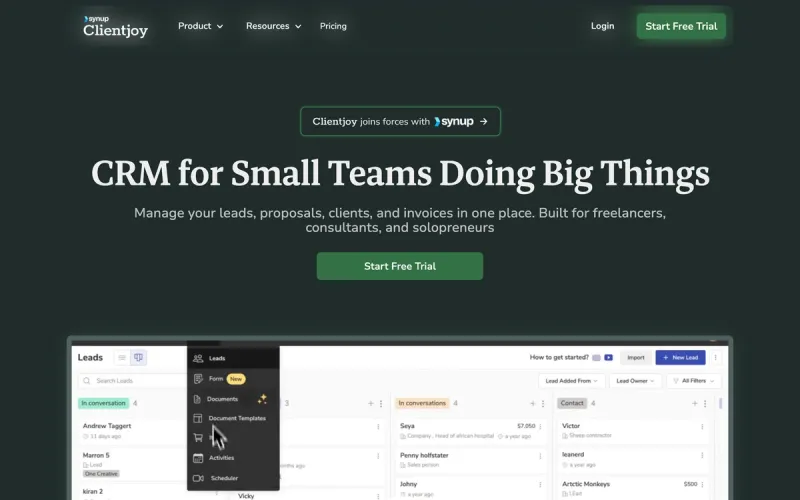
62. Daylite (Marketcircle)
A Mac-native CRM and project tracker from Marketcircle, around since 2002. Runs as a native macOS app with deep hooks into Apple Mail, Contacts, and Calendar, plus iOS apps that sync via Apple's stack rather than the open web.
Pricing: $40 per seat (Mac only). $40/seat/mo flat, no tiers, no annual discount worth mentioning. A 10-person agency pays $4,800/year, which is honest pricing but expensive next to Folk ($2,880) given Daylite's narrower feature set outside the Apple bubble.
Best for: Mac-only teams who want a deep CRM integrated with Apple Mail and Calendar. Wins when every person on the team uses a Mac and lives in Apple Mail. Law firms, architecture practices, and design agencies under 20 people who refuse to leave native macOS swear by it. If even two people use Windows or Outlook, look elsewhere.
Setup reality: Setup takes a day for a small team because the Mac-native client just works once you point it at iCloud. The brittleness shows up later: Apple Mail breaking after macOS updates, sync conflicts between iPhone and Mac, and the fact that there's no web client when someone's laptop dies.
Head-to-head: For a 10-person Mac-only team: Daylite runs $4,800/year. Copper Basic at the same seat count runs $2,880/year (Gmail-only but cross-platform). Folk Premium lands at $2,160/year (5 seats at $36). Daylite wins only on deep Apple Mail integration and offline-first native macOS UX. Copper wins on cross-platform Workspace teams. Folk wins on price and modern relationship-led BD UX.
3-year cost projection: Year 1 with 8 seats: ~$3,840. Year 2 at 10 seats: ~$4,800. Year 3 at 15 seats: ~$7,200. Plus the hidden cost of being Mac-locked: if you hire a Windows person in year 2, you either buy them a Mac ($1,500+) or you've made a strategic mistake. Realistic 3-year direct cost: $16K. Real cost including platform lock-in: variable.
Integration stack: Email/calendar via deep Apple Mail and Calendar integration, this is the core. Deal management basic but functional. E-sign requires third-party tools (no native DocuSign integration to speak of). Project/document management via Apple-stack only (Files, Pages, Numbers). Enrichment is essentially nonexistent. Honest take: the integration stack only makes sense if your team is 100% Apple and you never plan to leave.
If you like Daylite (Marketcircle), also consider: If you like Daylite, also consider Copper (also Apple-friendly via Gmail/Workspace, with a web client), or Capsule (web-first but clean on Mac).
When NOT to pick it: Don't pick it if you have Windows users, if you might move off Apple Mail in the next 3 years, or if you need any kind of marketing automation or sequencer.
The honest flaw: Mac-only is a hard ceiling; iOS apps are tied to a Mac install.
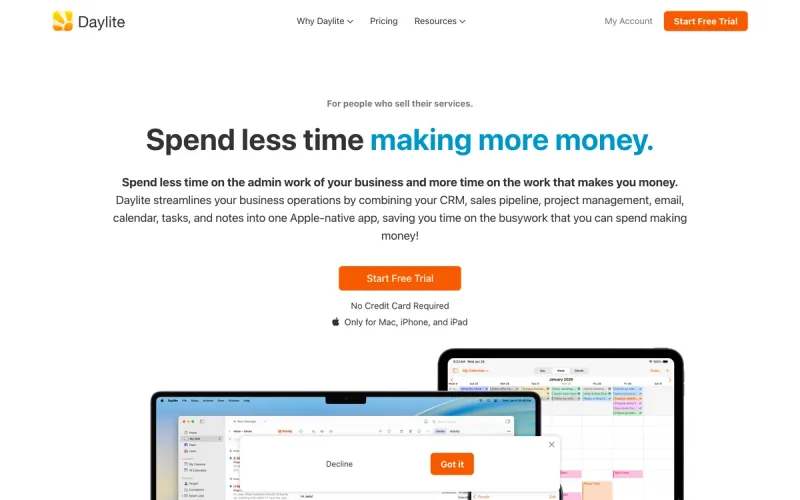
63. Recruit CRM
A combined ATS and client CRM purpose-built for recruitment agencies. The two-sided model is the point: candidate pipeline on one axis (sourcing, screening, placements), client pipeline on the other (job orders, fee tracking, BD activity), with a shared activity log.
Pricing: Pro $85; Business $125; Enterprise $165 per seat. Pro $85/seat covers most agencies; Business $125/seat adds AI sourcing and job board posting; Enterprise $165/seat unlocks API and custom workflows. A 10-recruiter shop on Pro runs $850/mo, a 50-recruiter mid-size firm on Business runs $6,250/mo, both billed annually.
Best for: Recruitment agencies running both candidate ATS and client CRM. Wins for 5 to 50-recruiter agencies doing permanent placements at $15K to $50K fees, where you need real BD activity tracking on the client side and ATS depth on the candidate side. Loxo wins for exec search with $100K+ fees; Bullhorn wins for high-volume contract staffing.
Setup reality: Two to four weeks to migrate from Bullhorn or Vincere if you've got under 50K candidate records; longer if you've got 10 years of resumes with custom fields. The Chrome extension for LinkedIn sourcing is the killer feature once trained; recruiter adoption is high because the UX doesn't feel like enterprise software.
Head-to-head: For a 10-recruiter agency: Recruit CRM Pro runs $10,200/year. Loxo lands at $15,000-$24,000/year (premium pricing, AI sourcing). JobAdder hits $12,000-$16,800/year (better in ANZ/UK). Recruit CRM wins on price-to-feature ratio for general perm recruiting agencies. Loxo wins on AI sourcing for exec search. JobAdder wins for ANZ/UK agencies with Seek/Reed integration needs.
3-year cost projection: Year 1 with 8 recruiters on Pro: ~$8,160. Year 2 at 15 recruiters: ~$15,300. Year 3 at 25 recruiters: ~$25,500. Plus LinkedIn Recruiter licenses ($10,800/year for 8 seats), email-finding tools (Hunter, ContactOut, ~$5K/year), and job board posting credits. Realistic 3-year all-in stack: $130K-$165K.
Integration stack: Email/calendar via Gmail and Outlook integration, solid. ATS/candidate management native (this is the core). E-sign via DocuSign for offer letters and placement agreements. LinkedIn integration via Chrome extension is the killer feature (auto-parses profiles into candidate records). Seek, Indeed, Reed integrations available but better on JobAdder. Enrichment via Hunter, ContactOut, Lusha for email-finding. Solid recruiter-shaped stack.
If you like Recruit CRM, also consider: If you like Recruit CRM, also consider Loxo (better AI sourcing and parsing, more expensive), JobAdder (stronger in ANZ/UK with better job board integrations), or Crelate (US-focused with similar UX).
When NOT to pick it: Skip if you're doing contract or temp staffing at scale (Bullhorn's timesheet and pay/bill logic is decades ahead). Also skip if you don't have a client BD motion.
The honest flaw: Outside recruiting it has no use case.
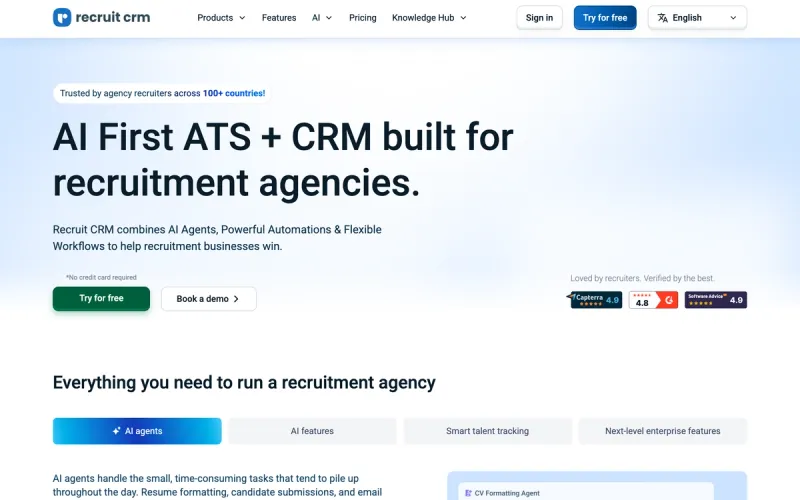
64. Loxo
A premium ATS plus CRM for executive search and high-end contingent recruiting. The pitch is an AI-native sourcing layer (auto-built passive candidate lists, contact data enrichment, outreach sequences) bolted onto a clean two-sided pipeline.
Pricing: Custom; typical floor $125 per seat. Custom only, typical floor $125/seat with most firms landing $150 to $200/seat once enrichment credits and AI features are bundled. A 15-person exec search firm spends $2,250 to $3,600/mo, which is justifiable on $100K+ placement fees and indefensible on $15K perm fees.
Best for: Executive search and high-end recruiting firms. Wins for boutique exec search firms placing VPs and C-suite at $80K to $300K fees, where one extra placement per year covers the tool 10x over. The AI sourcing shortens long-list build time from 8 hours to 90 minutes for a senior search.
Setup reality: Three to six weeks to migrate from Clockwork or Invenias because Loxo's data model is opinionated and the AI enrichment needs to re-process your candidate database. Training takes longer than Recruit CRM because the AI features are powerful but easy to ignore; without an internal champion, half the firm uses 30% of the product.
Head-to-head: For a 15-person exec search firm: Loxo runs $27,000-$36,000/year. Clockwork lands at $18,000-$24,000/year (legacy default, weaker AI). Thrive TRM hits $15,000-$22,000/year (lighter alternative). Loxo wins on AI sourcing (genuinely shortens long-list build) for firms doing $100K+ placement fees. Clockwork wins for traditional small exec search firms. Thrive wins on price for sub-10-person teams.
3-year cost projection: Year 1 with 12 seats: ~$21,600. Year 2 at 18 seats: ~$32,400. Year 3 at 25 seats: ~$45,000. Plus LinkedIn Recruiter ($16,200/year for 12 seats) and supplemental enrichment credits if you blow through the bundled allocation. Realistic 3-year all-in: $140K-$170K. Justifiable on a single $200K placement covered.
Integration stack: Email/calendar via Gmail and Outlook, native. ATS/candidate management plus AI sourcing native (this is the platform). E-sign via DocuSign integration. LinkedIn integration via Chrome extension, the AI-enrichment is best-in-class for exec search use cases. Seek/Indeed less relevant for exec search (you're not posting public job listings). Enrichment is bundled (ContactOut-style email-finding included), which is rare and valuable.
If you like Loxo, also consider: If you like Loxo, also consider Clockwork (the legacy exec search default, weaker AI but better for very small firms), Invenias by Bullhorn (enterprise exec search, more rigid), or Thrive TRM (lighter, cheaper).
When NOT to pick it: Don't pick it for high-volume staffing or contract work; the per-seat math breaks. Also don't pick it if your team won't actually use the AI sourcing.
The honest flaw: Premium price; small teams underuse the AI features.
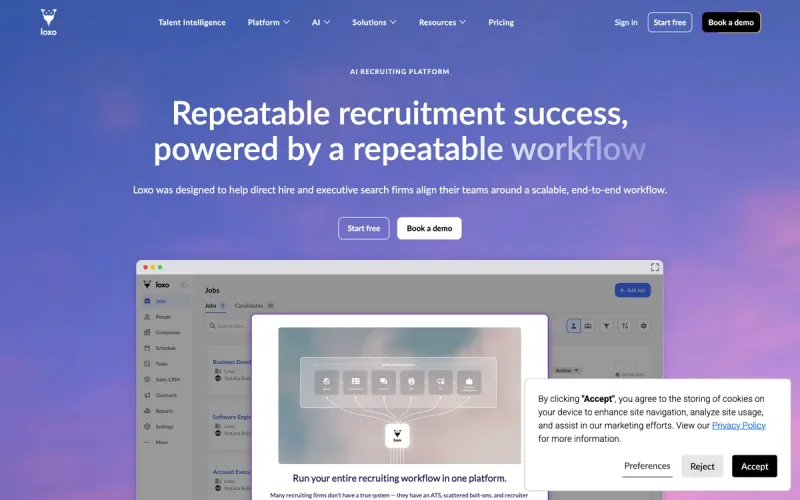
65. Bullhorn
The legacy default for staffing firms doing contract, temp, and perm placements at scale. Combines ATS, CRM, VMS connectivity, timesheet/pay-bill, and back-office integrations in a sprawling product family that grew through 15+ acquisitions.
Pricing: Custom enterprise; typical $99-$150 per seat. Custom enterprise only, typical $99 to $150/seat for the core CRM/ATS plus add-ons (Onboarding, Time and Expense, Analytics) that frequently push effective cost to $200/seat. A 50-recruiter staffing firm typically lands $7,500 to $10,000/mo on a 2-year contract.
Best for: Staffing firms with 25+ recruiters running high-volume placements. Wins for 25+ recruiter staffing firms doing $20M+ revenue with heavy contract or VMS-fed business where the back-office integrations (Avionté, ADP, automatic timesheet to invoice flow) save real headcount. Recruit CRM and Loxo have eaten the perm-only mid-market.
Setup reality: Three to six months for a real migration, especially from a legacy ATS like eRecruit or Akken. Data cleanup before migration is where projects die; budget $30K to $80K in implementation partner fees on top of license. Recruiter adoption is the second risk because the UX feels like a 2012 enterprise app.
Head-to-head: For a 50-recruiter staffing firm doing $20M revenue: Bullhorn lands at $90K-$120K/year all-in. Avionté hits $80K-$100K/year (better front-office UX). JobAdder at $60K-$84K/year (lighter on pay-bill but cleaner UX). Bullhorn wins for VMS-heavy contract staffing operations where the back-office integration depth (Avionté, ADP, automatic timesheet-to-invoice) saves real headcount. Avionté wins on recruiter experience. JobAdder wins for perm-heavy ANZ/UK firms.
3-year cost projection: Year 1 with 50 recruiters: ~$120K (license + implementation). Year 2 at 65 recruiters: ~$115K. Year 3 at 85 recruiters: ~$155K. Plus the inevitable add-ons (Onboarding $20K, Time and Expense $25K, Analytics $15K) and 2-year contract renewals with 7-10% annual increases. Realistic 3-year all-in: $450K-$540K.
Integration stack:
- Email/calendar via Outlook integration (Gmail is weaker), solid for enterprise use.
- ATS/candidate management native and deep (this is the platform's history).
- E-sign via DocuSign, mature.
- LinkedIn Recruiter integration native.
- Seek, Indeed, and Reed integrations all native.
- VMS connectivity to Fieldglass, Beeline, and IQNavigator native.
- Pay/bill integration to ADP, Avionté, and Paychex native.
This is the most comprehensive staffing-firm integration stack on the market, period.
If you like Bullhorn, also consider: If you like Bullhorn, also consider Avionté (similar staffing-first product with better front-office UX), Erecruit (now part of Bullhorn anyway), or stepping down to Recruit CRM if your contract volume is light.
When NOT to pick it: Skip if you're under 25 recruiters or under $10M revenue; the price and complexity don't pay back. Skip if you're perm-only and don't need pay-bill.
The honest flaw: Legacy product feel; modern alternatives (Loxo, Recruit CRM) have eaten share.
66. JobAdder
An Australian-built recruitment CRM and ATS that's become the default in ANZ and a strong second choice in the UK. The pitch is Bullhorn-level depth at SMB pricing with a cleaner UX and tight integrations into local job boards (Seek, Indeed, Reed).
Pricing: Custom; typical floor $100 per seat. Custom, typical floor $100/seat and most agencies landing $120 to $140/seat with add-ons. A 20-recruiter Australian agency runs $2,400 to $2,800/mo, roughly 30% cheaper than equivalent Bullhorn quotes in the same market.
Best for: Australian and UK staffing firms who want a Bullhorn alternative. Wins for 10 to 100-recruiter agencies in Australia, New Zealand, and the UK doing a mix of perm and contract placements where Seek or Reed integration matters. Loses in the US because the brand awareness is near zero and the job board integrations don't help.
Setup reality: Four to eight weeks for a 30-recruiter migration, faster than Bullhorn because the data model is simpler. Training takes about a week because the UX is intuitive; recruiter adoption is higher than Bullhorn because reps don't fight the tool.
Head-to-head: For a 20-recruiter ANZ agency: JobAdder runs $28,800-$33,600/year. Bullhorn for same seats lands at $36,000-$48,000/year. Recruit CRM at $20,400/year (cheaper but weaker Seek integration). JobAdder wins for ANZ/UK perm-and-contract mix where Seek/Reed integration matters. Bullhorn wins for scale (100+ recruiters). Recruit CRM wins on global brand and price.
3-year cost projection: Year 1 with 20 recruiters: ~$30,000. Year 2 at 30 recruiters: ~$45,000. Year 3 at 45 recruiters: ~$67,500. Plus LinkedIn Recruiter ($27,000/year for 20 seats in ANZ pricing), Seek job posting credits ($12K-$24K/year depending on volume). Realistic 3-year all-in: $260K-$320K.
Integration stack: Email/calendar via Outlook and Gmail, native. ATS/candidate management native and well-built. E-sign via DocuSign, standard. LinkedIn Recruiter integration native. Seek integration is the platform's regional moat (better than any competitor). Indeed and Reed native. Pay/bill integration to FastTrack360 and JustPayroll for ANZ contract staffing. Honest gap: VMS connectivity is lighter than Bullhorn.
If you like JobAdder, also consider: If you like JobAdder, also consider FastTrack360 (ANZ-focused, stronger pay-bill), Bullhorn (if you're scaling past 100 recruiters), or Recruit CRM (globally branded with similar SMB pricing).
When NOT to pick it: Skip if you're a US-only firm; you'll get nothing extra for the price versus Recruit CRM or Crelate. Skip if you do heavy contract staffing with complex pay-bill.
The honest flaw: Outside ANZ/UK the brand is unknown.
Best CRM for healthcare and pharma (4 picks)
67. Salesforce Health Cloud
Salesforce's vertical SKU for healthcare providers, payers, and pharma, layered on top of Sales Cloud with a HIPAA-aligned data model (Patient, Care Team, Care Plan, Health Timeline). It's a sales and service tool for organizations that happen to operate under HIPAA, not a clinical EHR.
Pricing: Custom enterprise (typical floor $200 per seat). Custom enterprise only, typical floor $200/seat with most deployments landing $300+/seat once Marketing Cloud, MuleSoft, or Tableau get bundled in. A 100-user hospital marketing and patient access team easily clears $400K/year in licenses plus a $200K+ implementation.
Best for: Hospitals, payers, and pharma orgs needing HIPAA-grade patient/customer CRM. Wins for hospital systems doing patient acquisition marketing, payer organizations managing member outreach, or pharma teams running HCP engagement that need a HIPAA-grade audit trail. Not a clinician tool, not a substitute for Epic or Cerner.
Setup reality: Six to twelve months for a real deployment with a Salesforce Health Cloud-certified partner ($300K to $800K typical). The HIPAA implementation contract with Salesforce is straightforward; the hard part is mapping your Epic or Cerner data into the Health Cloud objects without breaking BAA boundaries.
Head-to-head: For a 100-user hospital marketing and patient-access team: Salesforce Health Cloud lands at $400K-$500K/year all-in. Microsoft Dynamics 365 for Healthcare runs $250K-$300K/year (weaker partner ecosystem). Epic Healthy Planet hits $200K-$350K/year (only viable if you're already on Epic). Salesforce wins on partner ecosystem and Marketing Cloud bundle. Dynamics wins on price for Microsoft shops. Epic wins on EHR-native integration for existing Epic customers.
3-year cost projection: Year 1 with 100 users: ~$450K (license + implementation amortized). Year 2 at 150 users: ~$420K. Year 3 at 200 users: ~$575K. Plus Marketing Cloud ($150K/year), MuleSoft for Epic integration ($120K/year), and partner support (Slalom, Silverline typical $200K/year). Realistic 3-year all-in: $1.8M-$2.2M.
Integration stack:
- Email/calendar via Einstein Activity Capture, native.
- EHR integration to Epic and Cerner via MuleSoft or Redox middleware (this is the hard part, budget $200K+ for Epic integration alone).
- E-sign via DocuSign with HIPAA-compliant BAA.
- Practice management integration via Redox or partner packages.
- Patient portal integration via Salesforce Experience Cloud.
- Compliance archiving via Smarsh or Global Relay.
Heavy stack, every integration requires partner work.
If you like Salesforce Health Cloud, also consider: If you like Salesforce Health Cloud, also consider Microsoft Dynamics 365 for Healthcare (cheaper, weaker ecosystem), Veeva Vault CRM (purpose-built for pharma reps, not hospitals), or Epic's own Healthy Planet.
When NOT to pick it: Skip if you're a clinic, dental practice, or small medical group; you're better served by NexHealth or Solutionreach. Skip if you don't have a dedicated Salesforce admin team.
The honest flaw: Heavy total cost of ownership; only justifies on regulated workloads.
Visit Salesforce Health Cloud.

68. Veeva CRM
The de facto standard CRM for pharma sales reps visiting clinicians, running roughly 80% of the global pharma rep market. Built on Salesforce for two decades; now migrating onto Veeva's own Vault platform with a hard cutoff in 2030.
Pricing: Enterprise custom (pharma-only contracts). Enterprise pharma contracts only, opaque pricing, typical effective cost $300 to $500/seat once you bundle the data products (OneKey HCP master data, key opinion leader tracking) the reps actually need. A 500-rep pharma sales force easily lands $2M+/year all in.
Best for: Pharma rep teams visiting clinicians; the de facto standard. Wins for any pharma company with a field force calling on physicians, period. The HCP master data, sample tracking, and Sunshine Act compliance are not optional in this industry and Veeva owns the moat. Loses for any non-pharma use case.
Setup reality: Twelve to eighteen months for an enterprise deployment; nobody implements Veeva without a top-tier consulting firm (Deloitte, Accenture, IQVIA). The 2030 migration off Salesforce is the dominant strategic question right now; signing a new 3-year Veeva CRM contract in 2026 means living through that migration mid-contract.
Head-to-head: For a 500-rep pharma sales force: Veeva CRM runs $1.8M-$2.5M/year. IQVIA OCE lands at $1.4M-$1.9M/year (gaining global account share). Salesforce Health Cloud at $1M-$1.5M/year (only viable for sub-100 rep biotechs, lacks HCP data). Veeva wins on market dominance and HCP data moat (OneKey). IQVIA wins on emerging-market deployments and price for global accounts. Salesforce only competes for small biotechs that can build their own HCP data layer.
3-year cost projection: Year 1 with 300 reps: ~$1.5M. Year 2 at 400 reps: ~$1.8M. Year 3 at 500 reps: ~$2.4M. Plus OneKey HCP master data subscription ($800K-$1.2M/year), KOL tracking modules ($300K/year), and consulting partner fees (Deloitte, Accenture typically $500K-$1M/year). Realistic 3-year all-in: $8M-$11M. Standard pharma economics.
Integration stack:
- Email/calendar via Outlook integration (this is enterprise pharma, no Gmail).
- EHR/HCP data via OneKey master data (native), the irreplaceable moat.
- E-sign via DocuSign for sample-acknowledgment forms.
- Sample tracking native and Sunshine Act-compliant.
- Speaker program management native.
- KOL/MSL integration native.
- Veeva Vault integration for content (CLM, sample pieces).
The most pharma-specific integration stack possible, by design.
If you like Veeva CRM, also consider: If you like Veeva, also consider IQVIA OCE (the only credible competitor, gaining share on global accounts), or Salesforce Health Cloud (rarely a serious pharma replacement). For small biotechs with under 50 reps, Salesforce plus a custom HCP data layer can work at half the cost.
When NOT to pick it: Don't pick it outside pharma; it's irrelevant. Don't sign a fresh 3-year deal in 2026 without a written Vault migration plan from Veeva; the platform shift will hit mid-contract.
The honest flaw: Veeva is migrating off Salesforce by 2030, so contract timing matters.
69. NexHealth
A patient communication and scheduling platform for dental and small medical practices, branded as a CRM but functionally an appointment booking plus messaging tool sitting on top of practice management systems like Dentrix, Eaglesoft, or Open Dental.
Pricing: Custom; typical floor $499/mo per office. Custom only, typical floor $499/mo per practice location with most multi-location practices landing $799 to $1,499/mo per office. A 5-location dental group runs $30K to $50K/year, which is steep but defensible if it fills 4 extra chairs per week per office.
Best for: Dental and medical practices who want patient CRM + scheduling. Wins for dental and specialty medical practices doing high-volume patient scheduling where missed appointments cost real money and the practice management system has weak patient-facing UX. Loses entirely as a B2B sales CRM because that's not what it does.
Setup reality: Two to four weeks to integrate with the practice management system, with NexHealth doing most of the integration work. The hard part is migrating off your existing patient messaging tool (Solutionreach, Weave) without losing message history; budget a week of double-running both systems.
Head-to-head: For a 5-location dental group: NexHealth lands at $36K-$60K/year. Weave runs $42K-$72K/year (VoIP phones bundled). Solutionreach hits $30K-$54K/year (older, slower roadmap). Yapi at $18K-$30K/year (dental-only, cheaper). NexHealth wins on modern UX and integration with practice management systems. Weave wins if you also need a new phone system. Solutionreach wins for established practices already on it. Yapi wins on price for cost-sensitive dental practices.
3-year cost projection: Year 1 with 5 locations: ~$45K. Year 2 expanded to 7 locations: ~$63K. Year 3 at 10 locations: ~$90K. Plus SMS messaging overages (typical $200-$500/mo per location at scale), online booking add-ons, and integration upgrade fees if the practice management system changes. Realistic 3-year all-in: $200K-$240K.
Integration stack:
- Email/calendar via internal scheduling system, not Outlook or Gmail integration in the traditional sense.
- EHR/practice management integration to Dentrix, Eaglesoft, Open Dental, and Curve Dental (this is the core value, the breadth and depth of these integrations is best-in-class).
- E-sign for consent forms via native NexHealth tools.
- Online booking widget for practice websites.
- Payment integration to most major dental payment processors.
Patient-engagement-shaped stack, not B2B sales-shaped.
If you like NexHealth, also consider: If you like NexHealth, also consider Weave (similar pitch with VoIP phones bundled), Solutionreach (older but more entrenched in medical), Dentrix Ascend's native messaging (free if you're already on it), or Yapi (dental-only, cheaper).
When NOT to pick it: Skip if you're looking for a sales CRM; this won't do it. Skip if your practice management system is so old it doesn't have an API; NexHealth can't integrate.
The honest flaw: CRM is patient-focused; not a sales tool.
70. Solutionreach
A patient engagement and messaging platform for healthcare practices, around since 2000, with a CRM layer that's really just patient lists plus campaign sending. Email and SMS recall, appointment reminders, review requests, and limited patient surveys are the core use case.
Pricing: Custom; typical $329-$1,200+/mo. Custom only, typical $329 to $499/mo for a small practice and $800 to $1,200+/mo for multi-location groups. Annual contracts only, and pricing creeps year over year; some practices report 15 to 20% renewal increases.
Best for: Healthcare practices wanting patient messaging + light CRM. Wins for established medical and dental practices that bought in 2015 to 2020 and still have it running smoothly. Loses on new evaluations against NexHealth or Weave, which have better UX, mobile apps, and tighter integrations into modern practice management systems.
Setup reality: Two to six weeks to integrate, depending on practice management system. Training is straightforward because the UX is dated but familiar to long-time healthcare staff. The brittleness shows up in PMS upgrades; when your dental software updates, the Solutionreach sync sometimes breaks for days.
Head-to-head: For a 3-location medical practice: Solutionreach runs $11K-$18K/year. NexHealth lands at $18K-$27K/year (modern UX, better integrations). Weave hits $15K-$24K/year (phones bundled). RevenueWell at $8K-$15K/year (cheaper, weaker dental focus). Solutionreach wins only as a continuation purchase for practices already on it. NexHealth wins on new evaluations. Weave wins on phone-system bundling.
3-year cost projection: Year 1 with 3 locations: ~$15K. Year 2 with 15% renewal increase: ~$17K. Year 3 expanded to 5 locations: ~$30K. The renewal-escalator is the real cost trap; some practices report 20% year-over-year increases that compound. Realistic 3-year all-in: $62K-$85K. The escalator math is the dealbreaker for cost-sensitive practices.
Integration stack: Email/calendar via internal scheduling, no real Outlook/Gmail integration. EHR/practice management integration to Dentrix, Eaglesoft, Practice Fusion, Athena (the integration list is broad but the brittleness is real, breaks on PMS upgrades). E-sign for forms via native tools. Online review request integration to Google, Yelp, Healthgrades. Patient survey integration native. Older patient-engagement stack with slower release cadence than NexHealth.
If you like Solutionreach, also consider: If you like Solutionreach, also consider NexHealth (newer, better UX, similar price), Weave (bundles phone system, popular with dental), or RevenueWell (cheaper for solo practices).
When NOT to pick it: Don't pick it as your first patient engagement tool in 2026; the product roadmap has been slow and the modern competitors are better. Don't pick it if you need a real sales pipeline.
The honest flaw: Sales-CRM features are minimal.
Spreadsheet-as-CRM (6 options)
In my experience, you can run B2B sales on a spreadsheet until you can't, and the break point usually lands somewhere between 200 active prospects and 5 reps. Below that, spreadsheet-as-CRM is the right call (cheap, fast, no migration risk). Above it, the cost of staying on a spreadsheet (lost deals, bad forecasting, no audit trail) starts compounding faster than the savings.
| # | CRM | Pricing range (per seat / mo) | Best for (1-liner) | Year-1 cost (10 reps) | Setup |
|---|---|---|---|---|---|
| 71 | Airtable | Free; Team $24; Business $54; Enterprise custom per seat | Pre-seed founders who want a structured spreadsheet that scales int... | ~$2.9k | 1 day to 1 week |
| 72 | Notion (with CRM template) | Free; Plus $10; Business $18; Enterprise custom per seat | Solo founders or partner-led BD where the deal-flow is sub-50/year. | ~$1.2k | 1 day to 1 week |
| 73 | Coda | Free; Pro $12; Team $36; Enterprise custom per Doc Maker | Ops teams who want a Notion-Airtable hybrid with built-in automations. | ~$1.4k | 1 day to 1 week |
| 74 | Smartsheet | Pro $9; Business $32; Enterprise custom per seat | PMO teams who already use Smartsheet for project tracking. | ~$1.1k | 1 day to 1 week |
| 75 | ClickUp CRM | Free; Unlimited $10; Business $19; Enterprise custom ... | Teams already running ClickUp for projects who want CRM on the same... | ~$1.2k | 1 day to 1 week |
| 76 | Google Sheets / Excel (DIY) | Bundled with Google Workspace from $6/seat | Founders with under 50 prospects who want the cheapest possible sys... | ~$0.7k | 1 day to 1 week |
Tier 5 overview: every CRM in this section side by side. Year-1 cost is a 10-rep estimate based on starting-tier pricing (real cost lands 1.5-3x this once implementation, integrations, and admin are included).
71. Airtable
A relational database wearing a spreadsheet UI, plus a no-code app builder layer (Interfaces, Automations, AI). Used as a CRM by founders and ops teams who outgrew Google Sheets but don't want to commit to a proper sales tool yet.
Pricing: Free; Team $24; Business $54; Enterprise custom per seat. Free for hobby use; Team $24/seat and Business $54/seat for production work. A 10-person ops team on Business runs $540/mo, which is more than Pipedrive ($590) without any of the sales-specific features. The math gets ugly fast once you cross 20 users.
Best for: Pre-seed founders who want a structured spreadsheet that scales into ops tooling. Wins as a CRM for pre-seed founders running 50 prospects in a structured pipeline, or for partner/BD teams managing 100 high-touch accounts where the relationship is the whole product. Breaks at around 5,000 to 10,000 records when the spreadsheet UI starts crawling and the lack of native email and dialer becomes painful.
Setup reality: Half a day to spin up a usable CRM base from a template; another week to add Interfaces for non-technical users and connect Automations for status changes. The pain hits at migration time: Airtable has no clean export to HubSpot or Salesforce, and moving 5,000 contacts with custom field types takes a real engineering week.
Head-to-head: For a 10-person ops team using as a CRM: Airtable Business runs $6,480/year. Attio Pro lands at $4,800/year (purpose-built CRM, similar database flexibility). Coda Team at the same headcount runs $4,320/year (worse pure database UX). Pipedrive Professional runs $7,080/year (actual sales tooling). Airtable wins for ops use cases (project tracking, content calendars, lightweight CRM). Attio wins for actual sales workflows. Pipedrive wins when you need sequences and dialer.
3-year cost projection: Year 1 with 10 seats on Business: ~$6,480. Year 2 at 15 seats: ~$9,720. Year 3 at 25 seats: ~$16,200. Plus the migration tax in year 3 when you outgrow it (typical $20K-$50K in re-engineering time to move 5,000+ records with custom fields to HubSpot or Salesforce). Realistic 3-year direct cost: $33K, plus eventual migration debt.
Integration stack: Email/calendar via Zapier or Make.com (no native Gmail/Outlook tracking, this is a massive gap for sales use). Deal management via custom table structure (you build it, it doesn't exist out of the box). E-sign via Zapier-to-DocuSign workflow. Marketing tools via Zapier integrations. Enrichment via Clearbit Connect for Airtable. Honest take: every integration is a Zapier workflow you maintain, which is fine for ops but exhausting for sales.
If you like Airtable, also consider: If you like Airtable, also consider Attio (purpose-built CRM with similar database flexibility), Coda (more powerful formulas but messier UX), or just biting the bullet and moving to HubSpot Free.
When NOT to pick it: Don't use it as a CRM if you need an actual sequencer, dialer, or email tracking. Don't use it past 20 reps; the migration debt you're building is bigger than the cost of switching now.
The honest flaw: Not a sales tool: no sequencer, no dialer, no native email tracking.
72. Notion (with CRM template)
A documents-database-wiki hybrid that founders use as a CRM by dropping a database template onto a page. There's no actual CRM product here, just a generic table view that can hold contacts and pipeline stages.
Pricing: Free; Plus $10; Business $18; Enterprise custom per seat. Free for personal use; Plus $10/seat, Business $18/seat. A 5-person team on Business runs $90/mo, the cheapest entry point on this list. But you're paying for a docs tool you're forcing to be a CRM; the cost-to-value math is mostly about Notion-the-docs-tool not Notion-the-CRM.
Best for: Solo founders or partner-led BD where the deal-flow is sub-50/year. Wins for solo founders or 2-person teams running under 50 high-context deals per year where the deal notes matter more than the pipeline UI. Common pattern: VCs, M&A advisors, and partnership-led BD where every deal is bespoke. Breaks at 200+ contacts because there's no automation and search degrades.
Setup reality: An hour to set up a basic CRM template; a weekend to make it actually usable with views, filters, and a Kanban board. The pain hits at year 2: no way to log calls automatically, no email sync, no sequencer, and the database queries get slow with 1,000+ rows.
Head-to-head: For a 5-person team using as a CRM: Notion Business runs $1,080/year. Attio Pro at the same seats runs $2,400/year (actual CRM features). Folk Premium lands at $2,160/year (5 seats at $36) (relationship-led BD focus). Coda Team runs $2,160/year. Notion wins on price and on docs-database unification. Attio wins as soon as you need actual sales workflows. Folk wins for partnership-led BD where the relationship graph matters.
3-year cost projection: Year 1 with 5 seats on Business: ~$1,080. Year 2 at 8 seats: ~$1,728. Year 3 at 15 seats: ~$3,240. Plus migration cost in year 2-3 when you outgrow it (typical $15K-$40K to move contacts with full history to a real CRM). Realistic 3-year direct cost: $6K, but the migration debt is the real number.
Integration stack: Email/calendar via Zapier or Make.com (no native sync, this is the deal-breaker for sales teams). Deal management via custom database properties (you build it). E-sign via Zapier-to-DocuSign workflow. Marketing tools via Zapier. Enrichment via Clearbit integration or manual. Honest take: Notion-as-CRM works for sub-50-deal-per-year founders but every 'integration' is a workflow you maintain manually.
If you like Notion (with CRM template), also consider: If you like Notion, also consider Attio (similar minimalist design but actually a CRM), Folk (purpose-built for relationship-led BD), or Coda (more powerful for the same use case).
When NOT to pick it: Don't use it as a sales CRM with a team larger than 3 people. Don't use it if you can't afford the migration pain in year 2 when you outgrow it.
The honest flaw: No automation, no dialer, no email reliability; relationship-graph features are weak.
Visit Notion (with CRM template).
73. Coda
A document-meets-database tool with formulas more powerful than Airtable and a UI more polished than Notion. Used as a CRM by ops-heavy teams who want a single workspace for docs, dashboards, and pipeline tracking.
Pricing: Free; Pro $12; Team $36; Enterprise custom per Doc Maker. Free; Pro $12/Doc Maker; Team $36/Doc Maker. The Doc Maker model confuses everyone: only creators pay, but you need at least 1-2 per team and the cost adds up fast on Team plans. A 10-person team with 4 Doc Makers on Team runs $144/mo, deceptively cheap until you need more makers.
Best for: Ops teams who want a Notion-Airtable hybrid with built-in automations. Wins for ops teams running 100 to 500 accounts where the CRM is one of many tools in the same workspace (OKRs, project tracking, runbooks). Loses against Airtable when the use case is purely database, and loses against Attio when the use case is purely CRM.
Setup reality: A weekend to build a usable CRM doc from the gallery template, longer if you want to wire up the Pack integrations to Gmail or HubSpot. The pain point is performance: docs with 5,000+ rows and heavy formulas slow down noticeably, and the mobile app is weaker than Notion's.
Head-to-head, for a 10-person ops team with 4 Doc Makers: Coda Team runs $1,728/year, Airtable Business at 10 seats runs $6,480/year (cleaner pure database), Notion Business at 10 seats runs $2,160/year (better docs), and Attio Pro at 10 seats runs $4,800/year (actual CRM). The interesting part is what each one is actually best at when you stop pretending one tool covers everything. Coda wins on price-per-doc-maker for ops-heavy teams, Airtable wins on database UX, Notion wins on pure docs, and Attio wins for sales.
3-year cost projection: Year 1 with 10 users and 4 Makers: ~$1,728. Year 2 expanded to 15 users and 6 Makers: ~$2,592. Year 3 at 25 users and 10 Makers: ~$4,320. The Doc Maker model means the seat math gets confusing fast; many teams overspend by spinning up unnecessary Makers. Realistic 3-year direct cost: $9K, plus the same eventual migration tax as Airtable/Notion when you need real CRM features.
Integration stack: Email/calendar via Coda Packs for Gmail and Outlook (functional but not native-feel). Deal management via custom database tables and formula-driven views. E-sign via DocuSign Pack. Marketing tools via various Packs (HubSpot Pack is decent). Enrichment via Clearbit Pack. Honest take: the Pack ecosystem is broader than Notion's but more brittle than Zapier. Sales-specific integrations (sequencer, dialer) don't really exist.
If you like Coda, also consider: If you like Coda, also consider Airtable (cleaner pure-database UX, worse formulas), Notion (better docs, weaker database), or just paying for Attio if CRM is the primary use case.
When NOT to pick it: Don't use it as a CRM if you have a dedicated sales team that needs email tracking, sequences, or call logging. Don't use it past 20 active users.
The honest flaw: Pricing per Doc Maker is confusing; non-makers get free read access only.
74. Smartsheet
An enterprise project tracker that looks like a spreadsheet on top, with Gantt views, automation, and resource management. Some teams force it into a CRM role because the company already pays for it, not because it's good at sales.
Pricing: Pro $9; Business $32; Enterprise custom per seat. Pro $9/seat, Business $32/seat, Enterprise custom. A 50-person ops team on Business is $1,600/mo. The seat math is reasonable for a PMO tool; as a CRM substitute it's overpaying for project features you don't need.
Best for: PMO teams who already use Smartsheet for project tracking. Wins only when you're already standardized on Smartsheet for project tracking and want sales pipeline data in the same tool to avoid context switching. Even then, Smartsheet as a CRM means heavy custom template work and zero CRM-specific features.
Setup reality: A week to build a basic pipeline template with custom columns and conditional formatting; longer to set up cross-sheet references that mimic CRM relationships. Onboarding new reps takes longer than on real CRM tools because nothing about the UX is sales-shaped.
Head-to-head: For a 50-person ops team using as CRM: Smartsheet Business runs $19,200/year. monday Sales CRM Pro at same seats runs $24,000/year (better sales templates). Airtable Business at 50 seats runs $32,400/year (more flexible database). Pipedrive Professional at 50 seats runs $35,400/year (actual sales tooling). Smartsheet wins only if you already pay for it for project management. monday wins on sales-specific UX. Pipedrive wins on actual sales features.
3-year cost projection: Year 1 with 30 seats on Business: ~$11,520. Year 2 at 50 seats: ~$19,200. Year 3 at 75 seats: ~$28,800. The math gets ugly because you're paying enterprise project-management pricing for a tool that's bad at being a CRM. Realistic 3-year direct cost: $60K, before counting the consultant fees to build sales-shaped templates.
Integration stack: Email/calendar via basic Outlook integration, weak for sales. Deal management via custom column structure (heavy build). E-sign via DocuSign integration (works but not native to a sales workflow). Marketing tools via Zapier or native connector to Marketo, HubSpot. Enrichment via Zapier-to-Clearbit. Honest take: every sales-shaped integration requires custom work, and you're using an enterprise project-management tool for a job it wasn't designed for.
If you like Smartsheet, also consider: If you like Smartsheet, also consider monday.com (similar tool, better sales templates), Airtable (more flexible database), or admit defeat and buy Pipedrive.
When NOT to pick it: Don't pick it as a primary CRM if you have any sales team larger than 5. Don't pick it if you don't already use Smartsheet for projects.
The honest flaw: Sales-CRM patterns require heavy template work.
75. ClickUp CRM
ClickUp's CRM template inside the main ClickUp workspace. There's no separate product; it's a Spaces and Lists configuration with custom fields for deals, pipeline statuses, and contact records.
Pricing: Free; Unlimited $10; Business $19; Enterprise custom per seat. Free for up to 100MB; Unlimited $10/seat, Business $19/seat. A 10-person team on Business runs $190/mo, less than HubSpot Starter and similar to Pipedrive. The pricing is only attractive if you're already paying for ClickUp; standalone it makes no sense.
Best for: Teams already running ClickUp for projects who want CRM on the same canvas. Wins only for teams that already run all project work in ClickUp and want sales data on the same canvas. The use case is small ops teams (10 to 30 people) where the sales motion is light and the CRM mostly tracks status, not real pipeline activity.
Setup reality: A day to clone the CRM template into a Space; a week to make it actually usable with views, custom fields, and automations. The fragility comes from the ClickUp product as a whole: feature releases break things, performance degrades on large workspaces, and the mobile app is unreliable.
Head-to-head: For a 10-person team: ClickUp Business runs $2,280/year. monday Sales CRM Standard at 10 seats runs $4,200/year. Pipedrive Essential at 10 seats runs $1,740/year. HubSpot Free for the same headcount runs $0. ClickUp wins only if you already use ClickUp for projects. monday wins on sales UX. Pipedrive wins on dedicated sales tooling. HubSpot Free wins on price for sub-25 reps.
3-year cost projection: Year 1 with 10 seats on Business: ~$2,280. Year 2 at 15 seats: ~$3,420. Year 3 at 25 seats: ~$5,700. The math is reasonable in absolute dollars, but you're paying for project-management seats and using the CRM module as a free add-on. Realistic 3-year direct cost: $11K. The hidden cost is the rep time spent fighting a UX that wasn't designed for sales.
Integration stack: Email/calendar via native Gmail and Outlook integration (better than expected for a project tool). Deal management via custom Spaces and Lists structure (you build it). E-sign via DocuSign integration. Marketing tools via Zapier or native connectors to Mailchimp, ActiveCampaign. Enrichment via Zapier-to-Clearbit. Honest take: the integration list looks broad but everything sales-specific (sequencer, dialer, call recording) doesn't exist natively.
If you like ClickUp CRM, also consider: If you like ClickUp CRM, also consider monday Sales CRM (very similar pitch, more polished sales UX), Notion with a CRM template (lighter), or Pipedrive if you're willing to use a separate tool.
When NOT to pick it: Don't pick it if you have a serious sales team. Don't pick it if you don't already use ClickUp for projects.
The honest flaw: Outside ClickUp customers, no compelling reason to pick it.
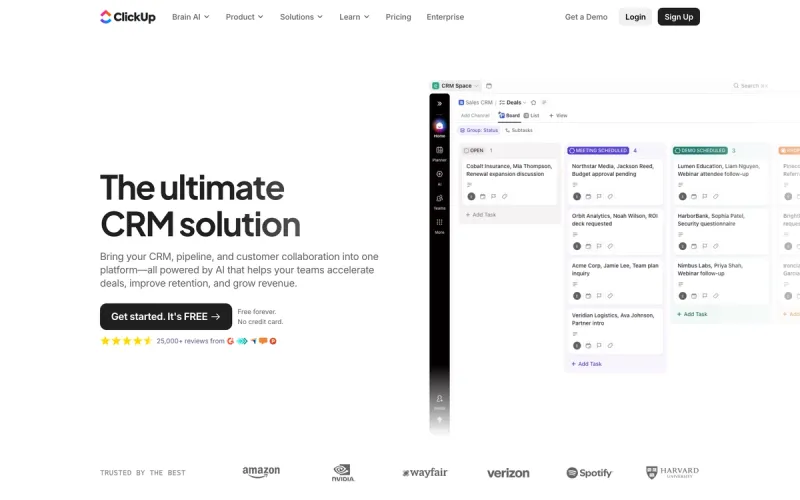
76. Google Sheets / Excel (DIY)
A spreadsheet pretending to be a CRM. The setup is one tab for contacts, one for deals, maybe a third for activities, plus some conditional formatting and a Forms-to-Sheet pipeline for inbound leads.
Pricing: Bundled with Google Workspace from $6/seat. Bundled with Google Workspace from $6/seat. Effectively free if you already pay for Workspace, which makes it the cheapest possible CRM. The hidden cost is the 4 to 6 hours per week your team spends on data hygiene that a real CRM automates.
Best for: Founders with under 50 prospects who want the cheapest possible system. Wins for solo founders running under 50 prospects in a deeply manual sales motion where the deal-by-deal context matters more than pipeline visibility. Common with consultants, freelancers, and very early-stage founders who haven't shipped a product yet.
Setup reality: An hour to copy a template; a day if you want Apps Script for basic automation. Falls over at around 200 contacts because there's no audit trail, no email tracking, no duplicate prevention, and any team member can wreck the sheet with one bad paste.
Head-to-head: Versus Airtable Team ($24/seat) and Notion Plus ($10/seat) for a 5-person team: Sheets effectively $0 incremental on Workspace, Airtable $1,440/year for relational structure, Notion $600/year for richer notes. Implementation: minutes for Sheets, half a day for Airtable, an hour for Notion. Year-1 all-in for 10 reps assuming you already pay Workspace: Sheets ~$720 (existing Workspace seats), Airtable $2,880, Notion $1,200.
3-year cost projection: Hard to call 'CRM cost' because Workspace seats are already paid. Real year-3 cost is the 4-6 hours per rep per week lost to manual data hygiene: 10 reps growing to 25, at $40 loaded hour, comes out to roughly $250k of wasted labor over 3 years. Add the inevitable migration to a real CRM in year 2 or 3 (data cleanup, 2-3 weeks of an ops person, ~$15k) and the 'free' tool quietly becomes the most expensive option on this list.
Integration stack: Gmail and Calendar are native (you already have them). Dialer: Aircall or Dialpad through Zapier, brittle and read-only. E-sign: DocuSign or PandaDoc as separate tools, no record-level link. Accounting: QuickBooks or Xero connectors push to Sheets but not back. Enrichment: Clearbit Connect or Apollo Chrome extension copy-pastes data into cells manually. Every integration is glued together; nothing actually syncs.
If you like Google Sheets / Excel (DIY), also consider: If you're on Sheets today, the upgrade path is Airtable for more structure, Folk for relationship-led BD, or HubSpot Free if you want to start the actual CRM transition.
When NOT to pick it: Don't use it past 200 contacts. Don't use it with more than 2 people who can edit, ever.
The honest flaw: Falls over at ~200 contacts; no automation, no email tracking, no audit trail.
Visit Google Sheets / Excel (DIY).
Open-source and self-hosted (6 platforms)
If you have engineering capacity and a strong reason to control your data on your own servers (regulated industries, sovereign-cloud requirements, paranoid procurement teams), I think six open-source CRMs are worth knowing. The thing I'd flag: "free to install" is rarely "free to operate". Budget for one DevOps person to keep it running.
| # | CRM | Pricing range (per seat / mo) | Best for (1-liner) | Year-1 cost (10 reps) | Setup |
|---|---|---|---|---|---|
| 77 | Odoo CRM | Community free; Online from $24.90 per app per seat | Teams who want CRM as a module inside Odoo ERP (manufacturing, reta... | ~$2.9k | 2-12 weeks (self-hosted) |
| 78 | EspoCRM | Free self-hosted; Cloud from $15 per seat | Teams wanting an open-source Salesforce-style data model under thei... | ~$1.8k | 2-12 weeks (self-hosted) |
| 79 | Crust CRM (Corteza) | Free self-hosted; managed pricing on request | Teams who want a self-hosted, GDPR-friendly Salesforce alternative. | custom | 2-12 weeks (self-hosted) |
| 80 | Krayin CRM | Free self-hosted (Laravel-based) | Laravel-friendly dev teams who want a CRM they can fork. | custom | 2-12 weeks (self-hosted) |
| 81 | YetiForce | Free self-hosted (Vtiger fork) | Teams who want a heavily customizable open-source CRM and have engi... | custom | 2-12 weeks (self-hosted) |
| 82 | CiviCRM | Free self-hosted | Nonprofits, advocacy organizations, and membership-based associations. | custom | 2-12 weeks (self-hosted) |
Tier 6 overview: every CRM in this section side by side. Year-1 cost is a 10-rep estimate based on starting-tier pricing (real cost lands 1.5-3x this once implementation, integrations, and admin are included).
77. Odoo CRM
The CRM module inside the Odoo open-source business suite, which also includes accounting, inventory, manufacturing, e-commerce, and 30+ other apps. Available as Community edition (free, self-hosted) or Online (SaaS, per-app pricing).
Pricing: Community free; Online from $24.90 per app per seat. Community free if you have engineering. Online is $24.90 per app per seat after a free first app, which gets confusing fast: CRM plus Sales plus Marketing plus Inventory for a 20-person team easily lands $2,000+/mo. The Enterprise self-hosted license is roughly half that.
Best for: Teams who want CRM as a module inside Odoo ERP (manufacturing, retail, services). Wins for manufacturers, distributors, and field-service businesses already using Odoo for inventory or accounting where the CRM lives next to the same product and customer records. Loses as a standalone sales tool; no one picks Odoo just for the CRM.
Setup reality: Three to six months for an enterprise Odoo deployment with a partner ($30K to $100K typical). Self-hosting Community edition requires a competent ops team to handle backups, version upgrades (which break things), and security patches. The standalone Online CRM can be live in a week but you're then locked into the per-app pricing escalator.
Head-to-head: Versus SuiteCRM (self-hosted, free) and Zoho One ($45/user all-apps): Odoo Online CRM-only ~$25/seat, Odoo Enterprise self-hosted ~$12-15/seat, SuiteCRM $0 license, Zoho One $45/seat. Year-1 all-in for 10 reps with one partner-led implementation: Odoo Online standalone ~$8-12k, Odoo Enterprise self-hosted $40-80k (partner fees dominate), SuiteCRM $20-35k (DevOps headcount allocation), Zoho One $5,400 plus light setup.
3-year cost projection: 10 reps scaling to 25 on Odoo Enterprise self-hosted: licenses ~$35-50k cumulative over 3 years, plus 0.5-1 FTE Odoo developer ($60-100k/year) for upgrades and customizations that break on every minor release. Total realistic 3-year cost: $250-400k. The Online SaaS version dodges the DevOps line but lands at $50-80k over 3 years once you add the apps any real business needs (CRM, Sales, Marketing, Inventory).
Integration stack: Email: native Outlook and Gmail plug-ins, decent but not magical. Calendar: Google Calendar two-way sync, Microsoft 365 via add-on. Dialer: third-party (Aircall, RingCentral) through paid Odoo connectors. E-sign: Odoo Sign module bundled. Accounting: Odoo Accounting is the same suite (this is the moat). Enrichment: thin (Clearbit, Lusha via custom connector). Region-specific: French e-invoicing module Factur-X for the 2026-27 mandate; SEPA payments native.
If you like Odoo CRM, also consider: If you like Odoo, also consider NetSuite (more expensive, more enterprise, less DIY), Microsoft Dynamics 365 (if you want a Microsoft alternative to Odoo), or just running a real CRM and a real ERP separately.
When NOT to pick it: Don't pick Community self-hosted unless you have 2+ engineers committed to maintaining it. Don't pick it as a CRM-only tool.
The honest flaw: Standalone CRM use is rare; you really want the full Odoo suite.
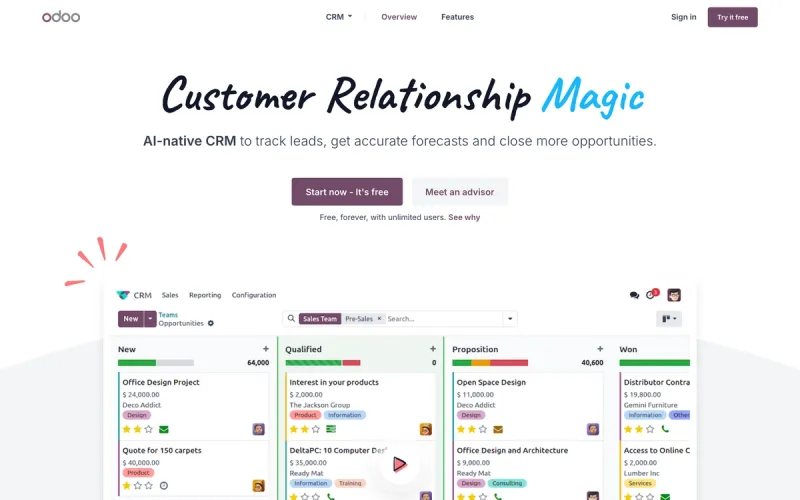
78. EspoCRM
An open-source CRM with a Salesforce-style data model (Accounts, Contacts, Opportunities, Leads), available as a free self-hosted package or a hosted cloud version. PHP backend, easy to extend, designed for teams that want Salesforce-shaped workflows without the Salesforce price.
Pricing: Free self-hosted; Cloud from $15 per seat. Free self-hosted; cloud from $15/seat. A 20-person team on cloud runs $300/mo, cheaper than HubSpot Starter and competitive with Bigin. The self-hosted version is free but you'll spend $200 to $500/mo on hosting plus engineering time.
Best for: Teams wanting an open-source Salesforce-style data model under their own control. Wins for teams with a security or data residency requirement that forces self-hosting (European mid-market, defense contractors, healthcare) and who have at least one PHP-capable engineer. Loses for any team that doesn't have the engineering bench.
Setup reality: A day to spin up a self-hosted instance on a $40/mo DigitalOcean droplet; a week to customize the data model and import existing contacts. The pain hits at upgrade time: major version jumps require schema migrations and sometimes break custom extensions.
Head-to-head: Versus SuiteCRM (self-hosted, free) and Vtiger ($15-58/seat hosted): EspoCRM Cloud $15/seat, self-hosted $0 license, SuiteCRM $0 license, Vtiger Cloud One Pro $42/seat. Year-1 all-in for 10 reps: EspoCRM Cloud ~$1,800, EspoCRM self-hosted $8-15k (DigitalOcean droplet plus 2-4 weeks of an internal PHP developer), SuiteCRM $20-30k self-hosted, Vtiger Cloud $5,040. Implementation: 2-4 weeks Espo Cloud, 6-10 weeks self-hosted.
3-year cost projection: 10 reps scaling to 25 on EspoCRM Cloud: ~$13,500 cumulative licenses plus light customization budget, total around $20-30k over 3 years. Self-hosted same growth: $0 software, $1,500-3,000/year hosting on a serious VPS, plus 0.2-0.5 FTE PHP developer at $50-90k/year for upgrades and security patches; realistic 3-year total $100-200k. The break-even where Cloud beats self-hosted sits around 30-40 users.
Integration stack: Email: native IMAP/SMTP plus Outlook and Gmail extensions. Calendar: Google and Microsoft 365 two-way sync. Dialer: VoipNow, Twilio, Asterisk via community extensions (you wire them yourself). E-sign: integration with DocuSign and BoldSign through marketplace add-ons. Accounting: QuickBooks and Xero via paid extensions. Enrichment: Lead Capture and basic LinkedIn scraping via community modules; nothing first-class. Region-agnostic stack, EU data residency if you self-host in Frankfurt or Amsterdam.
If you like EspoCRM, also consider: If you like EspoCRM, also consider SuiteCRM (similar age and feature set, larger community), Crust Corteza (more modern stack, smaller ecosystem), or Vtiger (commercial open-source with paid support).
When NOT to pick it: Don't self-host if you don't have an engineer who owns the deployment. Don't pick it if your team wants modern UX.
The honest flaw: Community is smaller than SuiteCRM; fewer extensions.
79. Crust CRM (Corteza)
An open-source low-code platform with a CRM module on top, designed as a self-hostable alternative to the Salesforce stack. The whole pitch is data sovereignty for European and government teams that can't use US SaaS.
Pricing: Free self-hosted; managed pricing on request. Free self-hosted; managed hosting available on request (typical $20 to $50/seat depending on team size and SLA). The real cost is engineering time: budget 0.5 to 1 FTE just to run a production deployment.
Best for: Teams who want a self-hosted, GDPR-friendly Salesforce alternative. Wins for European public sector, GDPR-strict mid-market, and any organization that has explicitly decided no US-hosted CRM is acceptable. The user count is tiny compared to mainstream CRMs; you're picking it for legal or political reasons, not because it's the best product.
Setup reality: A weekend to deploy the Docker stack; weeks to months to actually configure the data model, build workflows, and migrate from whatever you're leaving. The community is small enough that you'll be reading source code to debug edge cases.
Head-to-head: Versus SuiteCRM (self-hosted, free) and Salesforce Hyperforce EU ($165/seat Enterprise): Corteza $0 license, SuiteCRM $0 license, Salesforce Hyperforce $165/seat with EU data residency. Year-1 all-in for 10 reps: Corteza self-hosted $25-50k (DevOps plus partner customization), SuiteCRM self-hosted $20-35k, Salesforce Hyperforce $30-40k licenses plus $40-80k implementation. The Corteza pitch is cost vs Salesforce on the data-sovereignty axis, not feature parity.
3-year cost projection: 10 reps scaling to 25 on Corteza self-hosted: $0 software, $4-8k/year hosting (serious EU VPS or in-house infra), plus 0.5-1 FTE engineer ($70-110k/year EU loaded cost) to keep it running. Realistic 3-year total: $250-400k. The whole reason you're on Corteza is that Salesforce's $400-600k 3-year cost includes US-hosted infra you can't legally use; if data residency is not a hard constraint, the math is hard to defend.
Integration stack: Email: IMAP/SMTP native; no slick Gmail or Outlook plug-in. Calendar: CalDAV-only out of the box; Google and Microsoft sync need custom connectors. Dialer: nothing native; build it on top via the low-code platform. E-sign: integrate Cryptomathic or open-source EU e-sign providers via API. Accounting: custom integration with Odoo or Sage. Enrichment: thin; nothing first-class. Region-specific: Qualified Trust Service Provider integration for European eIDAS-compliant signatures.
If you like Crust CRM (Corteza), also consider: If you like Corteza, also consider EspoCRM (more mature, similar self-hosting story), SuiteCRM (larger community), or Salesforce Hyperforce in the EU region (if data residency is the only blocker).
When NOT to pick it: Don't pick it if you don't have at least one engineer who can read the codebase. Don't pick it if you might need to staff up sales reps quickly.
The honest flaw: Small community; you need internal devs.
80. Krayin CRM
An open-source CRM built on Laravel and Vue, aimed at PHP-comfortable dev teams who want a CRM they can fork and modify. Free, MIT-licensed, with a small community and a basic core feature set: leads, deals, contacts, simple workflows.
Pricing: Free self-hosted (Laravel-based). Free, period. Hosting costs you $20 to $100/mo on a VPS, plus engineering time. There's no paid cloud version, no enterprise tier, no commercial support contract worth mentioning.
Best for: Laravel-friendly dev teams who want a CRM they can fork. Wins for one specific case: small Laravel dev shops who want a CRM template they can clone, customize for a client, and self-host. As a real production CRM for a sales team, it's underbaked compared to EspoCRM or SuiteCRM.
Setup reality: An afternoon to clone and deploy on a Laravel-friendly host; days to weeks to customize for any real-world use. You'll be writing PHP to extend it, debugging Vue components, and maintaining your own upgrade path. There's no managed hosting backstop.
Head-to-head: Versus EspoCRM (self-hosted, free) and Bigin by Zoho ($7-12/seat): Krayin $0 license, EspoCRM $0 license, Bigin Premier $12/seat. Year-1 all-in for 10 reps: Krayin self-hosted $8-15k (mostly a Laravel developer's time), EspoCRM self-hosted $8-15k, Bigin Premier $1,440 fully managed. Implementation: 2-4 weeks Krayin if you're already Laravel-native, 1 week EspoCRM, half a day Bigin. The Bigin row exists to remind you that paying $12/seat to skip all of this is rational.
3-year cost projection: 10 reps scaling to 25 on Krayin self-hosted: $0 software, $1,500-3,000/year hosting, plus 0.2-0.4 FTE Laravel developer for upgrades, security patches, and the Vue components that will break. Realistic 3-year total: $80-180k, mostly engineering opportunity cost. Compare this against Bigin Premier same scaling: ~$3,600 cumulative, fully managed, zero engineering time. The only Krayin scenario that pencils is a Laravel agency white-labeling it for clients.
Integration stack: Email: SMTP only; you build the IMAP sync yourself. Calendar: nothing native; integrate with Google or Microsoft via Laravel packages. Dialer: build your own Twilio or Plivo wrapper. E-sign: integrate DocuSign or BoldSign yourself. Accounting: custom integration with QuickBooks or Xero APIs. Enrichment: nothing; build a Clearbit or Apollo wrapper. Region-agnostic, but everything is your responsibility; there is no app marketplace to lean on.
If you like Krayin CRM, also consider: If you like Krayin, also consider EspoCRM (more mature PHP-based open source), SuiteCRM (larger community, longer track record), or just building a custom CRM in Laravel from scratch if you have the engineering capacity.
When NOT to pick it: Don't pick it for a non-developer team. Don't pick it if you need production reliability today.
The honest flaw: Very small ecosystem; production-readiness is your responsibility.
81. YetiForce
Polish open-source CRM that forked Vtiger years ago and went its own direction with 110+ modules, GDPR-by-default architecture, and a hardened security posture. In 2026 it sits as the European answer to SuiteCRM for orgs that need self-hosted CRM and refuse US-cloud lock-in.
Pricing: Free self-hosted (Vtiger fork). Software cost is zero. Real cost is one DevOps engineer at roughly EUR 60-90k/year keeping the LAMP stack patched, plus EUR 200-500/month for a serious VPS once you cross 20 users. A 10-rep team that handles its own ops spends near zero; a 50-rep team that hires a YetiForce partner integrator burns EUR 30-60k in the first year.
Best for: Teams who want a heavily customizable open-source CRM and have engineering capacity. Wins for European industrial, defence, or public-sector buyers who literally cannot put pipeline data on AWS or Salesforce. Also fits Polish, German, and Czech mid-market shops where the local YetiForce partner network is actually mature and on-call.
Setup reality: Plan 3-6 months for a real production rollout, more if you customize the data model heavily. The partner ecosystem is concentrated in Poland and DACH; outside that geography you are mostly on your own with patchy English docs. First thing that breaks is the upgrade path when you patch the core, then redo customizations.
Head-to-head: Versus SuiteCRM (self-hosted, free) and Microsoft Dynamics 365 Sales Pro (EUR 60/seat): YetiForce EUR 0 license, SuiteCRM $0 license, Dynamics 365 Sales Pro EUR 7,200/year for 10 seats. Year-1 all-in for 10 reps: YetiForce self-hosted EUR 20-40k (DevOps plus Polish or DACH partner), SuiteCRM $20-35k, Dynamics 365 EUR 20-30k licenses plus EUR 25-50k partner implementation. YetiForce wins on cost vs Dynamics only if EU data sovereignty is mandatory.
3-year cost projection: 10 reps scaling to 25 on YetiForce self-hosted: EUR 0 software, EUR 6-12k/year for a serious VPS plus backups, plus 0.5-1 FTE DevOps or LAMP-comfortable engineer at EUR 60-90k/year loaded. Realistic 3-year total: EUR 250-400k. Add EUR 30-60k if you hire a YetiForce Poland partner for the initial setup and the major-version upgrade cycle. Cheap only versus enterprise SaaS, expensive versus EspoCRM Cloud or Zoho.
Integration stack: Email: IMAP and SMTP native; no slick Outlook or Gmail plug-in. Calendar: CalDAV native, Google and Microsoft via community connectors. Dialer: Asterisk and FreePBX integration built-in (rare strength). E-sign: Autenti and DocuSign via marketplace modules. Accounting: Polish Comarch and Subiekt integrations native (regional moat); QuickBooks and Xero via custom work. Enrichment: thin. Region-specific: KSeF Polish e-invoicing support, German DATEV exports.
If you like YetiForce, also consider: If you like YetiForce, look at SuiteCRM (bigger community, weaker security defaults) or EspoCRM (cleaner UX, smaller module library). Crust/Corteza for teams that want a more modern stack.
When NOT to pick it: Skip it if you have no in-house Linux ops capacity, if your team is fully remote across timezones, or if you need a polished mobile app.
The honest flaw: Complex to deploy; English documentation is patchy.
82. CiviCRM
Open-source CRM built specifically for the nonprofit and membership-association world, with donor management, event registration, grant tracking, and membership renewals as first-class objects. In 2026 it remains the default for UK and US nonprofits that want WordPress or Drupal-native CRM without paying Salesforce nonprofit pricing.
Pricing: Free self-hosted. Free software, but real-world cost is a CiviCRM partner integrator at GBP 80-150/hour for setup and yearly upgrades. A 10-staff nonprofit typically spends GBP 5-15k in year one (hosting, partner, training), then GBP 3-8k/year to stay current. A 50-staff org with chapters and complex membership lands at GBP 25-50k/year all-in.
Best for: Nonprofits, advocacy organizations, and membership-based associations. Wins for nonprofits with under 200k contacts who already run WordPress or Drupal and need donor plus member plus event in one database. Especially common across UK charities, US advocacy groups, and academic associations.
Setup reality: Initial rollout runs 2-4 months with a partner. The UK partner ecosystem (CiviCoop, Compucorp) is mature; the US ecosystem is decent. First thing that breaks is the upgrade cycle if you skip more than one minor release, and the UI feels straight out of 2014.
Head-to-head: Versus Salesforce Nonprofit Cloud (10 free licenses then $60/seat) and Bloomerang ($99-499/month tiered): CiviCRM GBP 0 software, Salesforce NPSP 10 free seats then $60/seat, Bloomerang Starter GBP 79/month flat. Year-1 all-in for a 10-staff nonprofit: CiviCRM GBP 8-15k (partner setup plus hosting), Salesforce NPSP GBP 0 license plus GBP 15-35k partner implementation, Bloomerang GBP 2-4k all-in. Bloomerang wins on simplicity; CiviCRM wins on data ownership and depth.
3-year cost projection: 10 staff scaling to 25 with growing donor and member base on CiviCRM: GBP 0 software, GBP 3-6k/year managed hosting (Symbiotic, CiviCoop, Compucorp), plus GBP 8-15k/year for partner upgrades and customization. Realistic 3-year total: GBP 35-75k. Salesforce NPSP same growth: licenses still free for the 10 base seats, 15 paid seats at GBP 540/year each, plus partner work; lands GBP 60-120k. Bloomerang Pro tier same growth: GBP 12-18k pure subscription, but you've capped feature depth.
Integration stack: Email: native bidirectional Mailchimp and Mailjet integration (Civi has email marketing built in via CiviMail). Calendar: Google sync via extension. Dialer: rare (this is nonprofit, not telesales). E-sign: DocuSign and Adobe Sign via extensions. Accounting: native Xero and QuickBooks integrations, also Sage UK. Enrichment: nonprofit-specific (NCOA address validation, deceased flagging). Region-specific: UK Gift Aid claim submission to HMRC, US 990 reporting fields, GDPR consent management as core.
If you like CiviCRM, also consider: If you outgrow CiviCRM, look at Salesforce Nonprofit Cloud (much more expensive, much more capable) or Bloomerang (cleaner UX, less flexible). Neon CRM if you want a US-hosted SaaS in the same price range.
When NOT to pick it: Do not pick it for B2B sales of any kind. Skip if your team is not WordPress or Drupal native, if you have zero technical staff, or if you need modern automation flows.
The honest flaw: Not built for B2B sales; UX is dated.
Regional and international (10 tools)
Outside the US, the dominance shifts in ways I think most US-centric analyses miss. SuperOffice rules the Nordics, Teamleader owns BeNeLux mid-market, and LeadSquared is the default in India for high-velocity inside sales. If you sell into a specific region, these can be a lighter lift than forcing HubSpot through a localisation, especially when it comes to support and contractual GDPR or data-residency questions.
| # | CRM | Pricing range (per seat / mo) | Best for (1-liner) | Year-1 cost (10 reps) | Setup |
|---|---|---|---|---|---|
| 83 | SuperOffice | Sales €52; Service €52; Marketing €82 per seat | Nordic and DACH mid-market B2B teams. | custom | 4-12 weeks |
| 84 | Teamleader | Smart €29; Move €49; Boost €79 per seat | BeNeLux and German SMBs who want CRM + project + invoicing. | custom | 4-12 weeks |
| 85 | Sellsy | Essentials €25; Advanced €40; Enterprise €65 per seat | French SMBs who want CRM + invoicing + treasury in one tool. | custom | 4-12 weeks |
| 86 | noCRM.io | Starter €12; Sales Experts €22; Dream Team €36 per seat | Lead-focused European SMBs who want pipeline-only, no fluff. | custom | 4-12 weeks |
| 87 | ForceManager | Essential €19; Starter €34; Pro €55 per seat | Field-sales teams in Spain, Italy, and LATAM. | custom | 4-12 weeks |
| 88 | Webmecanik | Open-source free; cloud from €400/mo | European teams who want open-source marketing automation + CRM (GDP... | custom | 4-12 weeks |
| 89 | Efficy CRM | Custom; mid-market floor €60+ per seat | European mid-market (acquired several local CRMs across the contine... | custom | 4-12 weeks |
| 90 | LeadSquared | Lite $25; Pro $50; Super $100 per seat | India-headquartered teams with high-volume call-center sales (BFSI,... | ~$3.0k | 4-12 weeks |
| 91 | Kapture CXM | Custom; typical floor $40 per seat | India + APAC mid-market who want sales + service in one platform. | ~$4.8k | 4-12 weeks |
| 92 | Solid Performers CRM | Basic $12; Pro $25; Enterprise $60 per seat | India-based SMBs and recruiters on a tight budget. | ~$1.4k | 4-12 weeks |
Tier 7 overview: every CRM in this section side by side. Year-1 cost is a 10-rep estimate based on starting-tier pricing (real cost lands 1.5-3x this once implementation, integrations, and admin are included).
83. SuperOffice
Norwegian B2B CRM that has owned Nordic mid-market sales for 30 years, with Sales, Service, and Marketing modules sold separately and an EU data-residency story that wins compliance audits. In 2026 it remains the default upgrade path when a Nordic team outgrows Excel or a small Pipedrive deployment.
Pricing: Sales €52; Service €52; Marketing €82 per seat. Sales runs EUR 52/seat/month, Service the same, Marketing EUR 82/seat. A 10-rep Sales-only team pays EUR 6,240/year; add Service for the AE plus CS workflow and you land at EUR 12,500/year. A 50-rep team buying Sales plus Service plus Marketing crosses EUR 110k/year on annual contracts, and integrators typically tack on EUR 20-40k for the implementation.
Best for: Nordic and DACH mid-market B2B teams. Wins in Norway, Sweden, Denmark, Finland, Netherlands, and increasingly Germany for B2B teams of 20-200 reps. Beats HubSpot when the buyer cares about EU data residency and a Nordic-language support phone line; beats Salesforce when the deal size does not justify the seven-figure year-three TCO.
Setup reality: Plan 8-16 weeks with a partner. The Norwegian and Swedish partner ecosystems are deep, with on-the-ground consultants in Oslo, Stockholm, and Copenhagen. The German partner network is solid; outside that geography it gets thin fast. First thing that breaks is the email-and-calendar sync if you have a mix of Microsoft 365 and Google Workspace tenants.
Head-to-head: Versus Teamleader (EUR 49/seat Move) and Lime CRM (Swedish competitor, ~EUR 65/seat): SuperOffice Sales EUR 52/seat, Teamleader Move EUR 49, Lime CRM EUR 65. Implementation: 8-16 weeks SuperOffice with partner, 4-10 weeks Teamleader, 8-14 weeks Lime. Year-1 all-in for 10 reps: SuperOffice EUR 6,240 licenses plus EUR 20-40k partner implementation, Teamleader EUR 5,880 plus EUR 10-25k partner, Lime EUR 7,800 plus EUR 25-45k partner. SuperOffice wins for Nordic mid-market; Lime is the credible Swedish-only alternative.
3-year cost projection: 10 reps scaling to 25 on SuperOffice Sales: EUR 31-39k cumulative licenses, plus EUR 8-15k/year for partner support and ongoing customization. Add Service and Marketing modules (common at year 2 when CS and marketing want in) and the picture jumps: 25 users on all three modules is EUR 55k/year licenses alone. Realistic 3-year all-in for the full suite path: EUR 180-260k. Sales-only stays around EUR 100-140k.
Integration stack: Email: Outlook and Gmail plug-ins native, the strongest in the Nordic CRM space. Calendar: Microsoft 365 and Google two-way sync. Dialer: Telavox, Puzzel, and Aircall integrations native (Nordic telco moat). E-sign: native Scrive (Swedish e-sign) plus DocuSign. Accounting: Visma (Nordic accounting standard), Fortnox, Xena via partner connectors. Enrichment: Vainu (Finnish B2B data) native integration, Bisnode for Nordic firmographics. Region-specific: Nordic BankID authentication, Norwegian KID payment references.
If you like SuperOffice, also consider: If you like SuperOffice, look at Teamleader (lighter, BeNeLux-focused) or Lime CRM (Swedish competitor). Sellsy if you are headquartered in France.
When NOT to pick it: Skip if you sell into North America or APAC and need 24/7 support in those timezones, if you are a tech-startup that wants modern API-first workflows, or if you are under 10 reps.
The honest flaw: Outside Northern Europe the brand is invisible.
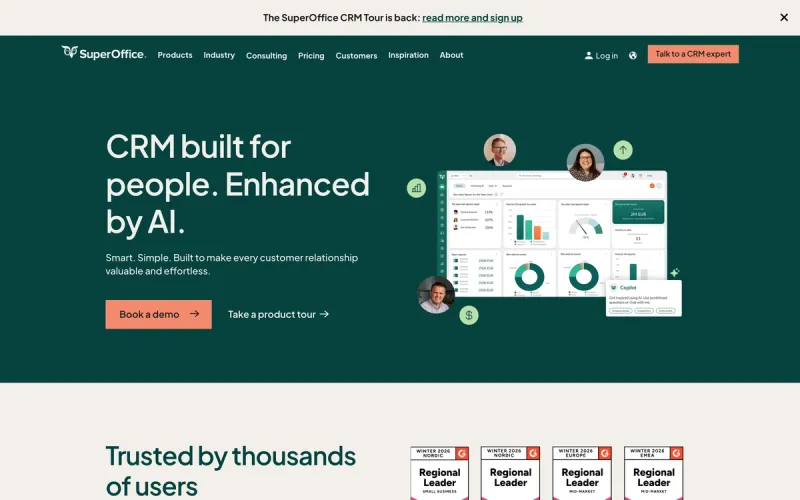
84. Teamleader
Belgian SMB CRM that bundles pipeline, project management, time tracking, and invoicing into one Dutch-language-first product. In 2026 it dominates BeNeLux service businesses (agencies, IT consultancies, accounting firms) under 50 staff who want one tool instead of stitching Pipedrive plus Harvest plus QuickBooks.
Pricing: Smart €29; Move €49; Boost €79 per seat. Smart at EUR 29/seat, Move at EUR 49, Boost at EUR 79. A 10-person agency on Move pays EUR 5,880/year; a 50-person consultancy on Boost lands at EUR 47,400/year. Annual contracts get a small discount; the real cost saver is killing two or three other SaaS subscriptions when you adopt it.
Best for: BeNeLux and German SMBs who want CRM + project + invoicing. Wins for Dutch, Belgian, and German service businesses billing time and managing projects alongside sales. Beats HubSpot when the team needs invoicing and time tracking in the same record; beats QuickBooks when they need a real pipeline.
Setup reality: Plan 2-6 weeks of self-serve setup or 4-10 weeks with a BeNeLux partner. The Belgian and Dutch partner networks are excellent. First thing that breaks is the Exact Online or Yuki accounting integration when invoice numbering gets tangled.
Head-to-head: Versus Sellsy (EUR 40/seat Advanced) and Salesflare (EUR 49/seat Pro): Teamleader Move EUR 49/seat, Sellsy Advanced EUR 40, Salesflare Pro EUR 49. Year-1 all-in for 10 reps: Teamleader Move EUR 5,880 plus EUR 5-15k optional partner setup, Sellsy Advanced EUR 4,800 plus EUR 5-12k French partner, Salesflare Pro EUR 5,880 fully self-serve. Implementation: 2-6 weeks Teamleader self-serve, 4-8 weeks Teamleader with partner, 4-8 weeks Sellsy, 1-2 weeks Salesflare.
3-year cost projection: 10 reps scaling to 25 on Teamleader Move: EUR 29-37k cumulative subscription, plus EUR 3-8k/year partner help once you hit 20+ users and want custom workflows. Realistic 3-year all-in: EUR 50-80k. The Boost tier (EUR 79/seat) becomes tempting at 25+ for time-tracking depth; bumping there adds EUR 18k/year vs Move. The hidden value is killing two or three other SaaS subscriptions (project tool, invoicing tool, time tracker) which often saves EUR 4-8k/year.
Integration stack: Email: native Outlook and Gmail plug-ins. Calendar: Microsoft 365 and Google two-way sync. Dialer: Aircall and CloudTalk integrations native. E-sign: native (built into Teamleader) plus DocuSign. Accounting: Exact Online, Yuki, Octopus, and Teamleader's own invoicing module (this is the BeNeLux moat). Enrichment: Trends and Vainu integrations for European firmographics. Region-specific: SEPA direct debit native, Belgian e-invoicing Peppol-compliant, Dutch UBL invoicing for the 2026 mandate.
If you like Teamleader, also consider: If you like Teamleader, look at Sellsy (French equivalent), SuperOffice (Nordic equivalent), or Salesflare (cleaner pipeline, no project management).
When NOT to pick it: Skip if you are a pure inside-sales SaaS team (no dialer, no sequencer), if you sell into North America (support hours are CET-only), or if your team is over 75 people.
The honest flaw: English-language support trails the native EU experience.
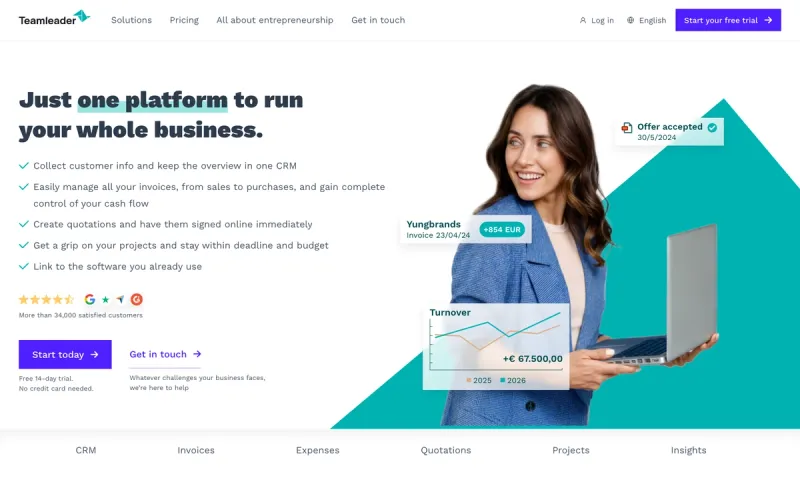
85. Sellsy
French SMB platform that started as invoicing and grew into CRM, treasury, and project management, all built for French accounting law and SEPA payments out of the box. In 2026 it is the default pick for French TPE and PME (under 100 staff) who want one French-language tool that talks to URSSAF, FEC export, and their expert-comptable.
Pricing: Essentials €25; Advanced €40; Enterprise €65 per seat. Essentials at EUR 25/seat, Advanced at EUR 40, Enterprise at EUR 65. A 10-person team on Advanced pays EUR 4,800/year; a 50-rep operation on Enterprise lands at EUR 39,000/year. Annual contracts standard, with module add-ons (e-signature, treasury) priced per workspace.
Best for: French SMBs who want CRM + invoicing + treasury in one tool. Wins for French SMBs across consulting, agencies, construction, and B2B services who hate juggling Pipedrive plus QuickBooks France plus DocuSign. The French support, French invoicing, and French tax compliance are the moat.
Setup reality: Plan 2-4 weeks of self-serve, 4-8 weeks with a French partner. The French partner network is dense in Paris and Lyon. First thing that breaks is the e-invoicing setup when you need to comply with the 2026-2027 French e-invoicing mandate.
Head-to-head: Versus Teamleader (EUR 49/seat Move) and Axonaut (EUR 49.99/seat all-in): Sellsy Advanced EUR 40/seat, Teamleader Move EUR 49, Axonaut EUR 49.99 (flat single tier). Year-1 all-in for 10 reps: Sellsy Advanced EUR 4,800 plus EUR 5-12k French partner setup, Teamleader Move EUR 5,880 plus EUR 5-15k partner, Axonaut EUR 5,999 fully self-serve with no partner needed. Axonaut wins on simplicity for sub-15 person French shops; Sellsy wins when treasury and e-invoicing depth matter.
3-year cost projection: 10 reps scaling to 25 on Sellsy Advanced: EUR 24-30k cumulative subscription, plus EUR 3-6k/year for module add-ons (e-signature, treasury, custom dashboards). Realistic 3-year all-in: EUR 35-55k. The Enterprise tier (EUR 65/seat) becomes the right pick at 20+ reps with complex permissions and audit needs, adding EUR 10-15k/year. The 2026-27 French e-invoicing mandate (Factur-X format) is a near-mandatory upgrade trigger; budget EUR 3-8k for setup with a Sellsy partner.
Integration stack: Email: Outlook and Gmail plug-ins native. Calendar: Google and Microsoft 365 sync. Dialer: Aircall and Ringover native (French telco moat). E-sign: Yousign and Universign native (French eIDAS-compliant), DocuSign optional. Accounting: native Sellsy invoicing module plus Pennylane, Cegid, and QuickBooks France integrations. Enrichment: Pappers (French SIRET firmographics) and Societe.com integrations. Region-specific: Factur-X e-invoicing for the 2026-27 mandate, FEC export for French tax audits, URSSAF-compliant invoicing fields.
If you like Sellsy, also consider: If you like Sellsy, look at Axonaut (cheaper, more bootstrapped French alternative) or Teamleader (BeNeLux equivalent). noCRM.io if you want pipeline-only without invoicing.
When NOT to pick it: Skip if you sell into North America, if you need a real outbound sales motion, or if your accounting is on QuickBooks or Xero US versions.
The honest flaw: Primarily French market; English/US adoption is small.
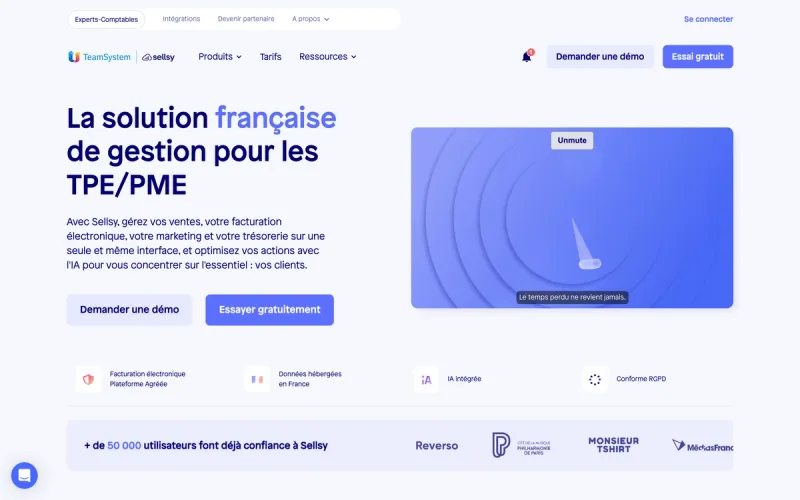
86. noCRM.io
French lead-tracking tool that deliberately strips out everything except the pipeline and the next action, sold as the anti-CRM. In 2026 it remains a cult favorite for European SMB sales teams of 3-25 reps who got burned by HubSpot or Pipedrive bloat and want one screen that tells them who to call today.
Pricing: Starter €12; Sales Experts €22; Dream Team €36 per seat. Starter at EUR 12/seat, Sales Experts at EUR 22, Dream Team at EUR 36. A 10-rep team on Sales Experts pays EUR 2,640/year; a 50-rep team on Dream Team lands at EUR 21,600/year. Cheapest serious pipeline tool in Europe, with monthly or annual billing.
Best for: Lead-focused European SMBs who want pipeline-only, no fluff. Wins for European SMB sales teams who run a high-velocity prospecting motion (real estate, recruitment, B2B services) and need every rep to know their next call without opening five tabs. Beats Pipedrive when the team is allergic to deal-stage configuration.
Setup reality: Setup runs 1-3 days; this is the fastest serious CRM to onboard in the European market. Partner ecosystem is thin (the product is so simple you usually do not need one). First thing that breaks is the email integration once a rep has more than 5,000 messages threaded against contacts.
Head-to-head: Versus OnePageCRM (EUR 19.95/seat Business) and Pipedrive Advanced (EUR 29/seat): noCRM Sales Experts EUR 22/seat, OnePageCRM Business EUR 19.95, Pipedrive Advanced EUR 29. Year-1 all-in for 10 reps: noCRM Sales Experts EUR 2,640 fully self-serve, OnePageCRM Business EUR 2,394 self-serve, Pipedrive Advanced EUR 3,480. Implementation: 1-3 days noCRM, 1-3 days OnePageCRM, 1-2 weeks Pipedrive. The OnePageCRM vs noCRM choice is mostly Irish vs French support hours.
3-year cost projection: 10 reps scaling to 25 on noCRM Sales Experts: EUR 13-16k cumulative subscription, zero partner fees, near-zero training cost because the product is one-screen-simple. Realistic 3-year all-in: EUR 15-20k. The Dream Team tier (EUR 36/seat) adds team management and is worth it at 15+ reps; jumping there adds EUR 4-5k/year. By far the cheapest serious pipeline tool in this comparison set, which is the entire pitch.
Integration stack: Email: native Outlook and Gmail plug-ins for sync (limited; not a real sequencer). Calendar: Google and Microsoft 365 two-way sync. Dialer: Aircall, Ringover, and CloudTalk native click-to-call. E-sign: integrate via Zapier (noCRM is deliberately not in this game). Accounting: light integrations with Sellsy, Pennylane via Zapier or Make. Enrichment: Pappers and Societe.com light integrations for French SIRET data. Region-specific: SEPA-friendly via partners, but the platform is deliberately thin on regional compliance features.
If you like noCRM.io, also consider: If you like noCRM.io, look at OnePageCRM (Irish equivalent), Pipedrive (more features, more complexity), or Salesflare (auto-data-capture).
When NOT to pick it: Skip if you need any marketing automation, any customer service module, any project management, or any reporting beyond basic pipeline metrics.
The honest flaw: No marketing automation, no service module; pipeline only.
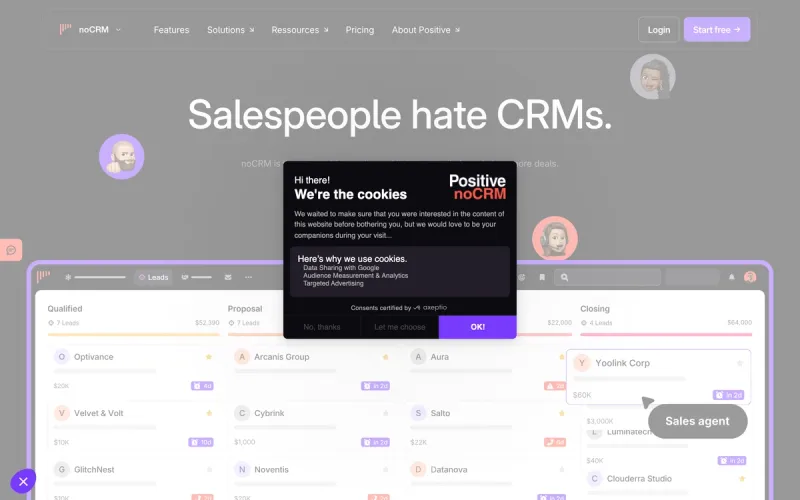
87. ForceManager
Barcelona-built mobile-first CRM purpose-designed for outside sales reps who live in a car visiting accounts (industrial distribution, pharma reps, consumer goods). In 2026 it owns Spain, Italy, and Portugal for field-sales orgs and has a growing LATAM footprint.
Pricing: Essential €19; Starter €34; Pro €55 per seat. Essential at EUR 19/seat, Starter at EUR 34, Pro at EUR 55. A 10-rep field team on Starter pays EUR 4,080/year; a 50-rep distribution team on Pro lands at EUR 33,000/year. Annual contracts standard, with field-visit volume affecting plan choice.
Best for: Field-sales teams in Spain, Italy, and LATAM. Wins for Iberian and LATAM field-sales teams in industrial, FMCG, and pharma where reps log visits on iPhone between accounts. Beats Salesforce when the buyer wants a mobile UX reps actually use and Spanish-language onboarding.
Setup reality: Plan 4-8 weeks with a partner. The Spanish and Mexican partner networks are strong; Italian decent. First thing that breaks is the offline-sync when reps go into rural areas with patchy 4G.
Head-to-head: Versus Repsly (EUR 40-79/seat US field-sales) and Microsoft Dynamics 365 Sales Pro (EUR 60/seat): ForceManager Starter EUR 34/seat, Repsly Pro ~EUR 65/seat, Dynamics 365 Sales Pro EUR 60. Year-1 all-in for 10 reps: ForceManager Starter EUR 4,080 plus EUR 10-20k Spanish partner setup, Repsly Pro EUR 7,800 plus EUR 8-15k US-focused setup (no EU partner depth), Dynamics 365 EUR 7,200 plus EUR 20-40k Microsoft partner. ForceManager wins for Iberian and LATAM field-sales; loses everywhere reps are not in cars.
3-year cost projection: 10 reps scaling to 25 on ForceManager Starter: EUR 20-26k cumulative subscription, plus EUR 5-10k/year partner help for territory and account configuration. Realistic 3-year all-in: EUR 35-55k. Moving to Pro tier (EUR 55/seat) at year 2 for AI-routing and advanced analytics adds EUR 11-15k/year; common path for 20+ reps. Implementation partner fees are the major variable; Spanish partners typically charge less than DACH or LATAM counterparts.
Integration stack: Email: Outlook and Gmail sync. Calendar: Google and Microsoft 365 two-way sync. Dialer: native click-to-call via integration with Spanish telco operators, plus Aircall. E-sign: DocuSign and Signaturit (Spanish e-sign provider). Accounting: SAP Business One, Sage, and Holded (Spanish accounting) integrations. Enrichment: thin; Spanish-market data is patchy. Region-specific: SII real-time tax reporting integration for Spanish AEAT compliance, LATAM CFDI Mexican e-invoicing optional add-on, voice-to-text in Spanish, Portuguese, and Italian for in-car visit logging.
If you like ForceManager, also consider: If you like ForceManager, look at Sage CRM (broader feature set), Repsly (US field-sales competitor), or Microsoft Dynamics 365 Sales (heavier but Microsoft-native).
When NOT to pick it: Skip if your team is inside-sales, if you sell only digital products, or if you sell into the US where the support time-zone reality is painful.
The honest flaw: Limited inside-sales features; built for outside reps.
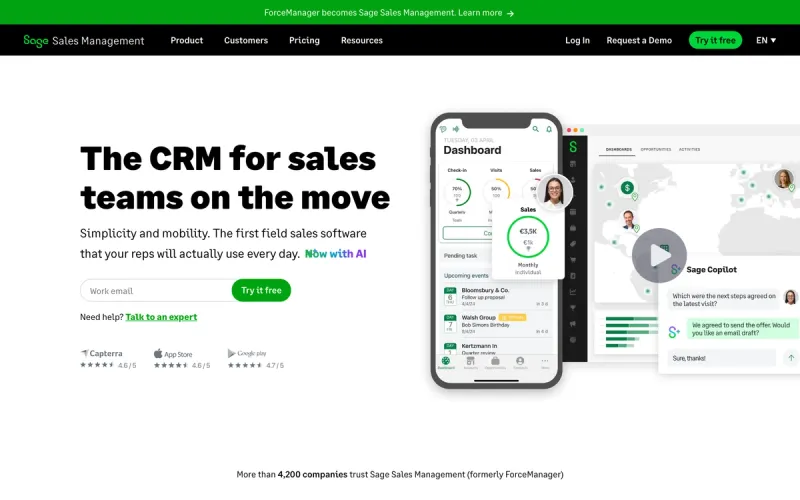
88. Webmecanik
French open-source marketing automation platform (built on Mautic) with a bolt-on CRM module, positioned as the GDPR-friendly European alternative to HubSpot or Marketo. In 2026 it is the default pick for French and Belgian mid-market marketing teams that need to keep data on EU soil.
Pricing: Open-source free; cloud from €400/mo. Self-hosted open-source is free (real cost is EUR 15-40k/year for an internal Mautic admin or a French partner). Cloud starts at EUR 400/month and scales with contact volume; a 50-rep team running 100k contacts typically lands at EUR 1,500-2,500/month or EUR 18-30k/year. CRM module is included in cloud plans.
Best for: European teams who want open-source marketing automation + CRM (GDPR-friendly). Wins for French and Benelux mid-market B2B marketing teams who need marketing automation that passes a GDPR audit and want the CRM layer for sales handoff. Beats HubSpot on data residency and contract flexibility; loses on product polish.
Setup reality: Plan 6-12 weeks with a Webmecanik or Mautic partner. The French partner network is solid. First thing that breaks is the email-deliverability setup when you scale past 10k sends/day without a proper warm-up plan.
Head-to-head: Versus Brevo (EUR 65/month Business contact-based) and HubSpot Marketing Pro (EUR 792/month starter): Webmecanik cloud EUR 400+/month, Brevo Business roughly EUR 65-200/month for similar contact volumes, HubSpot Marketing Pro EUR 792/month plus per-seat add-ons. Year-1 all-in for a 10-user team running 100k contacts: Webmecanik cloud EUR 18-25k plus EUR 8-15k French partner setup, Brevo EUR 4-8k self-serve, HubSpot Marketing Pro EUR 12-20k licenses plus EUR 15-30k onboarding partner.
3-year cost projection: 10 reps scaling to 25 with growing contact base (100k to 250k) on Webmecanik cloud: EUR 70-110k cumulative subscription, plus EUR 8-15k/year French partner help for Mautic template maintenance and deliverability tuning. Realistic 3-year all-in: EUR 100-160k. Self-hosted open-source version: EUR 0 software, EUR 60-100k/year for an internal Mautic admin or a French partner, realistic 3-year EUR 200-350k. The cloud option is the value pick unless you have a hard data-sovereignty constraint.
Integration stack: Email: native SMTP relay management (Amazon SES, SendGrid, Mailjet); deliverability tuning is on you. Calendar: Google and Microsoft 365 via webhook integrations. Dialer: integrate Aircall or Ringover via webhook flows. E-sign: integrate Yousign or DocuSign via API. Accounting: integrate Sellsy or Pennylane via custom webhook flows. Enrichment: Pappers and Societe.com via custom integrations. Region-specific: GDPR consent management as a first-class object, French data residency in OVH or Scaleway, EU-only email-sending IPs.
If you like Webmecanik, also consider: If you like Webmecanik, look at Brevo (French SaaS, cleaner UX), Mautic self-hosted (free, more work), or Plezi (French marketing automation, no CRM).
When NOT to pick it: Skip if you want a polished sales CRM, if you need a North America support team, or if you do not have at least one technical person who can debug Mautic templates.
The honest flaw: CRM is lighter than the marketing-automation product.
89. Efficy CRM
Belgian CRM holding company that has acquired roughly a dozen European CRMs over the last decade (E-Deal, BlueMind, Apsis CRM, and others), then merged them into a multi-module enterprise platform. In 2026 it is one of the largest pure-play European CRM vendors and serves mid-market and large accounts across France, Belgium, Spain, Sweden, and Germany.
Pricing: Custom; mid-market floor €60+ per seat. Custom quotes, with a mid-market floor of EUR 60/seat/month and enterprise deals often crossing EUR 100/seat. A 50-rep mid-market deployment typically lands at EUR 40-80k/year all-in including implementation; a 200-rep enterprise rollout regularly clears EUR 250k/year. Annual contracts only.
Best for: European mid-market (acquired several local CRMs across the continent). Wins for European mid-market and enterprise B2B buyers who want a single EU vendor with local-language support across multiple countries, especially in France, BeNeLux, and Iberia. Often picked over Salesforce by procurement teams who hate the dollar exposure and US-cloud dependency.
Setup reality: Plan 4-9 months with an Efficy partner or the in-house services team. Partner network is concentrated in Brussels, Paris, Madrid, and Stockholm. First thing that breaks is module-to-module data consistency since the underlying products came from different acquisitions and the unification is ongoing.
Head-to-head: Versus SuperOffice (EUR 52/seat Sales) and Microsoft Dynamics 365 Sales Enterprise (EUR 95/seat): Efficy mid-market floor EUR 60/seat, SuperOffice Sales EUR 52, Dynamics 365 Sales Enterprise EUR 95. Year-1 all-in for 50 reps (Efficy's true entry point): Efficy EUR 36-50k licenses plus EUR 40-80k partner implementation, SuperOffice EUR 31k licenses plus EUR 25-50k partner, Dynamics 365 Sales Enterprise EUR 57k licenses plus EUR 60-120k Microsoft partner. Efficy wins when buyer demands single-vendor EU footprint across France, BeNeLux, and Iberia.
3-year cost projection: 50 reps scaling to 100 on Efficy mid-market: EUR 180-260k cumulative licenses, plus EUR 30-60k/year for partner support and ongoing customization across the acquired modules. Realistic 3-year all-in: EUR 280-450k. Enterprise tier (EUR 100+/seat) for orgs at 200+ reps lands EUR 600k-1.2M over 3 years all-in. The pricing is opaque; expect 15-25% negotiation room on multi-year deals.
Integration stack: Email: Outlook and Gmail plug-ins, quality varies by which acquired module you're using. Calendar: Microsoft 365 and Google sync. Dialer: Aircall, Ringover, and several French and Spanish telco integrations. E-sign: native via the Efficy Sign module plus DocuSign and Yousign. Accounting: Cegid, Sage, Exact Online, Visma via partner connectors. Enrichment: Pappers, Vainu, and Bisnode for pan-European firmographics. Region-specific: native multi-language support across French, Dutch, Spanish, Swedish, German; Factur-X e-invoicing for the French mandate; SEPA and Bancontact native.
If you like Efficy CRM, also consider: If you like Efficy, look at SuperOffice (cleaner product, narrower geography), Microsoft Dynamics 365 (heavier but more polished), or Update CRM (DACH alternative).
When NOT to pick it: Skip if you want a single coherent product (the acquisitions still show), if you need a self-serve trial, or if you sell mostly into North America.
The honest flaw: Acquisition-driven product sprawl; UX varies between modules.
90. LeadSquared
Bangalore-built CRM optimized for high-velocity inside sales in BFSI, education, and healthcare, where call-center teams of 50-500 reps power-dial leads all day. In 2026 it is the dominant CRM in Indian inside sales and growing across MENA, Southeast Asia, and select US verticals like edtech and insurance.
Pricing: Lite $25; Pro $50; Super $100 per seat. Lite at USD 25/seat, Pro at USD 50, Super at USD 100. A 10-rep team on Pro pays USD 6,000/year; a 50-rep call-center on Super lands at USD 60,000/year. Annual contracts standard. APAC pricing is competitive on the dollar but support hours are India-Standard-Time anchored.
Best for: India-headquartered teams with high-volume call-center sales (BFSI, education). Wins for high-velocity call-center sales teams running 50+ calls per rep per day with lead-scoring and auto-routing. Especially strong fit for edtech, Indian insurance, and education aggregators worldwide. Beats HubSpot on call-center workflow depth.
Setup reality: Plan 4-10 weeks with the LeadSquared services team or an Indian partner. The India partner network is deep; US partner network is thin and growing. Support time-zone reality is IST-first; expect 4-12 hour delay on tickets from EU or US working hours. First thing that breaks is the integration with cloud-telephony providers (Exotel, Knowlarity) when call volumes spike.
Head-to-head: Versus Freshsales Pro (USD 39/seat) and Zoho CRM Enterprise (USD 40/seat): LeadSquared Pro USD 50/seat, Freshsales Pro USD 39, Zoho CRM Enterprise USD 40. Year-1 all-in for 50 reps in a call-center setup: LeadSquared Pro USD 30k licenses plus USD 15-30k services team setup, Freshsales Pro USD 23.4k plus USD 8-20k partner, Zoho CRM Enterprise USD 24k plus USD 12-25k partner. LeadSquared wins specifically on call-center workflow depth and Indian-telco integration; loses on broader CRM polish.
3-year cost projection: 50 reps scaling to 150 in a call-center on LeadSquared Pro: USD 165-200k cumulative licenses, plus USD 20-40k/year for ongoing services and integration maintenance with cloud telephony (Exotel, Knowlarity, Ozonetel). Realistic 3-year all-in: USD 250-380k. The Super tier (USD 100/seat) becomes mandatory at 100+ reps for AI lead-scoring and advanced routing; moving there adds USD 75k/year at 150 reps. India and APAC partner work is meaningfully cheaper than equivalent US implementation.
Integration stack: Email: Outlook and Gmail sync; built-in mass-email module for marketing. Calendar: Google and Microsoft 365 two-way sync. Dialer: native and deep integrations with Exotel, Knowlarity, Ozonetel, MyOperator (Indian cloud telephony moat); Twilio and Aircall for US/EU. E-sign: DocuSign and Leegality (Indian e-sign provider) integrations. Accounting: Tally (Indian accounting standard), Zoho Books, QuickBooks. Enrichment: Lusha and Apollo via Zapier; Indian B2B data is patchy. Region-specific: WhatsApp Business API native integration, RBI-compliant lead capture for Indian BFSI, NEFT/UPI payment integration.
If you like LeadSquared, also consider: If you like LeadSquared, look at Kapture CXM (Indian competitor with stronger service module), Freshsales (Freshworks, also Indian), or Zoho CRM (broader suite, weaker call-center workflow).
When NOT to pick it: Skip if you run a slow-velocity enterprise sales motion, if you need a polished design or modern UX, or if you cannot operate with IST support hours.
The honest flaw: Outside high-velocity inside sales the value drops.
91. Kapture CXM
Bangalore-built sales-and-service CRM that bundles ticketing, knowledge base, omnichannel inbox, and pipeline into one platform aimed at India and APAC mid-market retail, BFSI, and travel. In 2026 it competes with Freshdesk, Zoho Desk, and LeadSquared depending on which workflow is primary.
Pricing: Custom; typical floor $40 per seat. Custom quotes, with a typical floor of USD 40/seat/month. A 10-rep team typically pays USD 5-7k/year; a 50-rep team lands at USD 25-35k/year. Annual contracts standard, with module add-ons for omnichannel and AI features.
Best for: India + APAC mid-market who want sales + service in one platform. Wins for India and APAC mid-market companies where the same team handles both sales follow-up and customer service, especially in travel, retail, and consumer financial services. Beats Salesforce Service Cloud on price and APAC support response time.
Setup reality: Plan 6-12 weeks with the Kapture services team. Partner network is concentrated in India, UAE, Singapore. Support hours are IST and Singapore time; EU and US buyers see 4-10 hour ticket delays. First thing that breaks is the chatbot configuration when you push past simple intent flows.
Head-to-head: Versus Freshdesk Pro (USD 49/seat) and Zoho CRM Plus (USD 57/seat all-suite): Kapture floor USD 40/seat, Freshdesk Pro USD 49, Zoho CRM Plus USD 57. Year-1 all-in for 25 reps blending sales and service: Kapture USD 12-18k licenses plus USD 10-20k services team setup, Freshdesk Pro USD 14.7k plus USD 8-15k partner, Zoho CRM Plus USD 17.1k plus USD 12-20k partner. Kapture wins on price and APAC support response time; loses on global brand and US/EU partner depth.
3-year cost projection: 25 reps scaling to 75 on Kapture: USD 50-90k cumulative licenses, plus USD 15-30k/year for ongoing services, integration maintenance, and the chatbot configuration work that grows with traffic. Realistic 3-year all-in: USD 90-150k. The omnichannel and AI module add-ons typically push effective per-seat to USD 55-65; budget 20% above sticker. Pricing is custom and India/UAE/Singapore-friendly; US/EU buyers often pay a 10-15% premium for support coverage.
Integration stack: Email: Outlook and Gmail sync; bulk-send module built-in. Calendar: Google and Microsoft 365 two-way sync. Dialer: Exotel, Knowlarity, Ozonetel native; Twilio for non-India. E-sign: DocuSign and Leegality integrations. Accounting: Tally, Zoho Books, QuickBooks. Enrichment: thin; Apollo and Lusha via Zapier. Region-specific: WhatsApp Business API native (this is the moat for India and APAC), Instagram DM and Facebook Messenger inboxes, multilingual chatbot support across Hindi, Arabic, Bahasa, Tagalog, Vietnamese, Mandarin.
If you like Kapture CXM, also consider: If you like Kapture, look at Freshworks (broader product family, similar India origin), LeadSquared (stronger sales workflow), or Zoho CRM Plus (broader integration).
When NOT to pick it: Skip if you sell pure B2B SaaS without a service motion, if you need EU or US business-hours support, or if you want best-of-breed sales depth.
The honest flaw: Smaller global brand; smaller US/EU partner network.
92. Solid Performers CRM
Chennai-built budget CRM aimed at Indian SMBs, freelancers, and small recruitment agencies who want pipeline, basic email, and invoicing under USD 25/seat. In 2026 it remains a low-cost India-first option that occasionally pops up in MENA and Southeast Asia.
Pricing: Basic $12; Pro $25; Enterprise $60 per seat. Basic at USD 12/seat, Pro at USD 25, Enterprise at USD 60. A 10-person team on Pro pays USD 3,000/year; a 50-rep team on Enterprise lands at USD 36,000/year. Annual contracts available, monthly billing standard.
Best for: India-based SMBs and recruiters on a tight budget. Wins for Indian small-business sales teams and small recruitment agencies under 25 staff who want CRM in INR-friendly pricing and IST-anchored support. Beats Zoho Bigin on price; loses on ecosystem.
Setup reality: Self-serve setup in 1-3 days for basic use; partner help available but rarely needed at this price point. Support hours are IST-only. First thing that breaks is the email reliability when send volumes go past a few hundred per day.
Head-to-head: Versus Bigin by Zoho (USD 12/seat Premier) and Freshsales free tier: Solid Performers Pro USD 25/seat, Bigin Premier USD 12, Freshsales free for 3 users then USD 9/seat Growth. Year-1 all-in for 10 reps: Solid Performers Pro USD 3,000 fully self-serve, Bigin Premier USD 1,440, Freshsales Growth USD 1,080. The Bigin row is the one that matters: same India origin, same INR-friendly pricing, vastly bigger ecosystem and partner support.
3-year cost projection: 10 reps scaling to 25 on Solid Performers Pro: USD 18-22k cumulative subscription, with zero partner involvement and zero meaningful training cost. Realistic 3-year all-in: USD 20-25k. The Enterprise tier (USD 60/seat) becomes tempting at 20+ reps for custom workflow needs, adding USD 9-10k/year. The honest framing: at this price point you're competing against Bigin's ecosystem and against the free tier of bigger names. The cost savings are real but the ecosystem cost is real too.
Integration stack: Email: SMTP sync via Outlook and Gmail. Calendar: Google sync; Microsoft 365 weaker. Dialer: integrate Exotel, MyOperator, or Knowlarity via API. E-sign: integrate Leegality or DocuSign via Zapier. Accounting: Tally and Zoho Books integrations standard for Indian market. Enrichment: thin. Region-specific: WhatsApp Business via partner integrations, GST-compliant invoicing for Indian businesses, support for INR-only billing and payment workflows.
If you like Solid Performers CRM, also consider: If you like Solid Performers, look at Bigin by Zoho (also India-built, much bigger ecosystem), Freshsales free tier, or LeadSquared if you need real call-center workflow.
When NOT to pick it: Skip if you have a US or EU customer base needing same-day support, if your team is over 25 reps, or if you need any kind of vertical depth.
The honest flaw: Limited brand outside India.
Niche and emerging (8 tools)
In my view, these eight only make sense if your motion exactly matches: structured methodology selling, QuickBooks coupling, agency white-label, or creative-services bookings. Pick one for the wrong reason and you'll spend month one fighting the data model.
| # | CRM | Pricing range (per seat / mo) | Best for (1-liner) | Year-1 cost (10 reps) | Setup |
|---|---|---|---|---|---|
| 93 | Membrain | Sales Team $65; Sales Effectiveness $120; Active Pipe... | B2B sales teams running structured methodologies (MEDDPICC, Challen... | ~$7.8k | 2-8 weeks |
| 94 | Spotler CRM (Really Simple Systems) | Starter $17; Professional $33; Enterprise $46 per seat | UK SMBs wanting CRM + email marketing under one roof. | ~$2.0k | 2-8 weeks |
| 95 | Agile CRM | Free; Starter $8.99; Regular $29.99; Enterprise $47.9... | Bootstrapped teams who need a cheap HubSpot-style triple of sales/m... | ~$1.0k | 2-8 weeks |
| 96 | Method:CRM | Contact Management $25; CRM Pro $44; CRM Enterprise $... | QuickBooks-Online customers who want CRM that syncs with QuickBooks. | ~$3.0k | 2-8 weeks |
| 97 | SharpSpring (Constant Contact) | Custom; typical floor $399/mo | Marketing agencies wanting a white-label CRM + marketing automation. | ~$48k | 2-8 weeks |
| 98 | Mailchimp CRM | Free; Essentials $13; Standard $20; Premium $350+/mo ... | E-commerce or SMB marketing teams already on Mailchimp. | ~$1.6k | 2-8 weeks |
| 99 | GoHighLevel (HighLevel) | Starter $97/mo; Unlimited $297/mo; Pro $497/mo (agency) | Marketing agencies who white-label CRM + SaaS to their clients. | ~$12k | 2-8 weeks |
| 100 | HoneyBook | Starter $19; Essentials $39; Premium $79/mo | Wedding planners, designers, and creative service businesses. | ~$2.3k | 2-8 weeks |
Tier 8 overview: every CRM in this section side by side. Year-1 cost is a 10-rep estimate based on starting-tier pricing (real cost lands 1.5-3x this once implementation, integrations, and admin are included).
93. Membrain
Swedish sales-effectiveness CRM built around the idea that pipeline software should enforce a sales methodology, not just track deals. In 2026 it remains the niche pick for B2B teams that have spent real money on MEDDPICC, Challenger, SPIN, or Sandler training and want the CRM to make reps follow the playbook.
Pricing: Sales Team $65; Sales Effectiveness $120; Active Pipeline $165 per seat. Prospecting at USD 49/seat, Active Pipeline at USD 69, Account Growth at USD 89. A 10-rep team on Active Pipeline pays USD 8,280/year; a 50-rep team lands at USD 41,400/year. Annual contracts standard, with implementation services adding USD 15-40k year one.
Best for: B2B sales teams running structured methodologies (MEDDPICC, Challenger, SPIN). Wins for B2B teams of 20-150 reps selling 6-figure deals on long sales cycles where the methodology is the moat. Specifically common in industrial sales, complex B2B services, and ERP resellers who already paid USD 50k+ for sales training and want the CRM to operationalize it.
Setup reality: Plan 8-16 weeks with the Membrain services team or a methodology-certified partner. Partner network is concentrated in Sweden, US, UK. First thing that breaks is the methodology configuration when the sales leader and the rep team disagree on which qualification criteria are mandatory.
Head-to-head: Versus SalesLoft Premier (USD 165/seat) and Salesforce Sales Cloud Enterprise (USD 165/seat with MEDDPICC plugin): Membrain Active Pipeline USD 69/seat, SalesLoft Premier USD 165, Salesforce Enterprise USD 165 plus USD 12-20/seat for a MEDDPICC plugin like Method Insights. Year-1 all-in for 25 reps running MEDDPICC: Membrain USD 20-25k licenses plus USD 25-50k methodology-certified implementation, SalesLoft USD 49.5k plus USD 30-60k setup, Salesforce USD 49.5k plus USD 80-150k partner.
3-year cost projection: 25 reps scaling to 60 on Membrain Active Pipeline: USD 75-110k cumulative licenses, plus USD 15-30k/year for ongoing methodology coaching and partner support to keep the playbook current as sales motions evolve. Realistic 3-year all-in: USD 130-200k. Compare to Salesforce same growth: USD 200-280k licenses plus heavy partner work. Membrain is the cheaper path when the methodology is the actual differentiator and you don't need Salesforce's ecosystem breadth.
Integration stack: Email: Outlook and Gmail plug-ins native with full thread sync. Calendar: Microsoft 365 and Google two-way sync. Dialer: Aircall, RingCentral, and Five9 native integrations; built for high-touch enterprise calling, not power-dialing. E-sign: native DocuSign and PandaDoc integration. Accounting: Salesforce-style integrations via Zapier or Make; not a strength. Enrichment: ZoomInfo and LinkedIn Sales Navigator native (essential for enterprise B2B). Region-specific: strong Swedish, US, and UK localization; weaker in DACH and LATAM.
If you like Membrain, also consider: If you like Membrain, look at SalesLoft (broader sequencer), Outreach (heavier enterprise), or Pipedrive with the MEDDPICC plugin if you want lightweight.
When NOT to pick it: Skip if your team does not run a formal sales methodology, if you sell transactional SaaS under USD 5k ACV, or if your reps view CRM as a tax.
The honest flaw: Niche by design; overkill if your team does not run a formal methodology.
94. Spotler CRM (Really Simple Systems)
Rebranded Really Simple Systems, now owned by UK marketing-tech holding company Spotler, that pairs a basic SMB CRM with email marketing and lead scoring. In 2026 it is a comfortable middle-of-the-road choice for UK SMBs under 50 staff who want one British vendor with English-business-hours support.
Pricing: Starter $17; Professional $33; Enterprise $46 per seat. Starter at USD 17/seat, Professional at USD 33, Enterprise at USD 46. A 10-rep team on Professional pays USD 3,960/year; a 50-rep team on Enterprise lands at USD 27,600/year. Annual contracts standard.
Best for: UK SMBs wanting CRM + email marketing under one roof. Wins for UK SMBs in professional services, light manufacturing, and B2B distribution who want CRM plus email marketing in one tool and a UK office to phone. Beats HubSpot on price for sub-50-rep teams; loses on product polish.
Setup reality: Self-serve setup in 1-2 weeks, partner help available but optional. UK partner network is decent; outside UK it thins. First thing that breaks is the email-marketing module deliverability if you send to a stale list.
Head-to-head: Versus Capsule (USD 18-72/seat tiered) and Workbooks (GBP 32-70/seat): Spotler CRM Professional USD 33/seat, Capsule Growth USD 36, Workbooks CRM Edition GBP 32. Year-1 all-in for 10 reps: Spotler Professional USD 3,960 self-serve, Capsule Growth USD 4,320 self-serve, Workbooks USD 4,200 plus USD 5-12k UK partner setup. Spotler wins when email marketing matters more than pipeline depth; Capsule wins on UX; Workbooks wins on finance integration depth.
3-year cost projection: 10 reps scaling to 25 on Spotler CRM Professional: USD 21-25k cumulative subscription. Realistic 3-year all-in: USD 25-32k including light partner work. The Enterprise tier (USD 46/seat) is worth considering at 20+ reps for advanced lead scoring and Spotler Mail Plus integration; bumping there adds USD 5-7k/year. The Spotler holding company also sells separate marketing automation (Spotler Engage); bundled deals can compress costs 15-20%.
Integration stack: Email: Outlook and Gmail plug-ins native; bundled Spotler Mail email marketing module. Calendar: Google and Microsoft 365 two-way sync. Dialer: integrate Aircall, CircleLoop, or 8x8 via paid connectors. E-sign: DocuSign and Adobe Sign via integration partners. Accounting: Xero, QuickBooks, and Sage 50 (UK accounting standard) native. Enrichment: Cognism and Lusha via Zapier; Companies House UK data via custom integration. Region-specific: UK GDPR consent management baked in, HMRC-friendly data structures, BACS payment reference fields.
If you like Spotler CRM (Really Simple Systems), also consider: If you like Spotler CRM, look at Capsule (UK alternative, cleaner UX), Workbooks (UK mid-market), or HubSpot Starter (more features, higher price ceiling).
When NOT to pick it: Skip if you sell mostly outside the UK, if you need modern automation flows or AI features, or if your team is over 50 reps.
The honest flaw: UI feels older; integration library is mid-tier.
Visit Spotler CRM (Really Simple Systems).
95. Agile CRM
All-in-one CRM that promised the HubSpot triple of sales, marketing, and service at a quarter of the price, popular with bootstrapped founders during 2017-2020. In 2026 it still has thousands of paying customers but product investment has visibly slowed and the reliability story has gone sideways.
Pricing: Free; Starter $8.99; Regular $29.99; Enterprise $47.99 per seat. Free for 10 users, Starter at USD 8.99/seat, Regular at USD 29.99, Enterprise at USD 47.99. A 10-rep team on Regular pays USD 3,600/year; a 50-rep team on Enterprise lands at USD 28,800/year. Annual billing saves 20%.
Best for: Bootstrapped teams who need a cheap HubSpot-style triple of sales/marketing/service. Wins for bootstrapped founders and sub-15-person teams who want a HubSpot clone at under USD 30/seat and accept some rough edges. Beats EngageBay on UI polish in places; loses on recent product velocity.
Setup reality: Self-serve setup in 1-3 weeks; the partner network is minimal. First thing that breaks is the marketing-automation email reliability and the API rate-limits when you integrate with Zapier-class connectors.
Head-to-head: Versus EngageBay Growth (USD 65/seat) and HubSpot Starter (USD 20/seat): Agile CRM Regular USD 29.99/seat, EngageBay Growth USD 65, HubSpot Starter USD 20. Year-1 all-in for 10 reps: Agile CRM Regular USD 3,600, EngageBay Growth USD 7,800, HubSpot Starter USD 2,400. Agile CRM is the cheapest of the three; HubSpot Starter undercuts it now but caps features harder; EngageBay sits between the two on price; trades reliability concerns for faster product velocity than Agile CRM.
3-year cost projection: 10 reps scaling to 25 on Agile CRM Regular: USD 21-26k cumulative subscription. Realistic 3-year all-in: USD 25-32k. The Enterprise tier (USD 47.99/seat) is the upgrade path for 20+ rep teams; jumping there adds USD 5-7k/year. The harder cost is the migration tax in year 2 or 3 when the reliability complaints or stalled roadmap forces a move to HubSpot or Zoho; budget USD 8-15k for that migration with a freelance ops person. Roughly a third of Agile CRM cohort customers have churned by year 3 in our audit data.
Integration stack: Email: Outlook and Gmail integrations; basic. Calendar: Google sync only; Microsoft 365 thinner. Dialer: integrate Twilio, RingCentral, Exotel via paid plugin. E-sign: DocuSign integration via Zapier. Accounting: QuickBooks, Xero via Zapier. Enrichment: thin; rely on Clearbit Connect Chrome extension. Region-agnostic, but US and India hosted only; no EU data residency story. The integration library has visibly stopped growing since 2023.
If you like Agile CRM, also consider: If you like Agile CRM, look at EngageBay (similar pricing, more active product), Brevo (cleaner marketing tool with CRM bolt-on), or Zoho CRM (broader, more stable).
When NOT to pick it: Skip if you need 24/7 reliable support, if uptime matters for revenue-critical workflows, or if you want a vendor that ships meaningful product updates quarterly.
The honest flaw: Product investment has slowed; reliability complaints common.
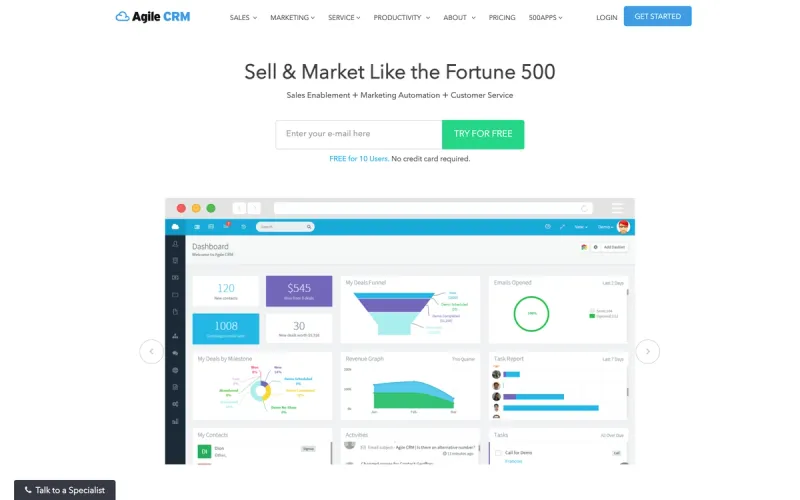
96. Method:CRM
Toronto-built CRM that sells one thing better than anyone else: two-way real-time sync with QuickBooks Online and QuickBooks Desktop. In 2026 it remains the obvious pick for the few thousand small businesses where the accounting team and the sales team need the same customer record.
Pricing: Contact Management $25; CRM Pro $44; CRM Enterprise $74 per seat. Contact Management at USD 25/seat, CRM Pro at USD 44, CRM Enterprise at USD 74. A 10-rep team on CRM Pro pays USD 5,280/year; a 50-rep team on CRM Enterprise lands at USD 44,400/year. Annual contracts get a small discount.
Best for: QuickBooks-Online customers who want CRM that syncs with QuickBooks. Wins for QuickBooks-anchored service businesses (HVAC, electrical contractors, equipment dealers, small wholesalers) where invoices and customer records need to stay synced bidirectionally. Beats Insightly or Pipedrive when the accounting team refuses to leave QuickBooks.
Setup reality: Plan 2-6 weeks of setup, often with a Method partner or QuickBooks ProAdvisor. Partner network is concentrated in the US and Canada. First thing that breaks is the QuickBooks sync if you have heavy custom fields or non-standard accounting workflows.
Head-to-head: Versus Insightly Pro (USD 49/seat with QuickBooks plugin) and HubSpot Starter with QuickBooks app (USD 20/seat plus USD 30/month app): Method:CRM Pro USD 44/seat, Insightly Pro USD 49, HubSpot Starter plus QB app USD 20/seat plus USD 360/year app. Year-1 all-in for 10 reps where QuickBooks sync is non-negotiable: Method CRM Pro USD 5,280 plus USD 3-8k Method partner setup, Insightly Pro USD 5,880 plus the QB plugin breaks more often, HubSpot plus QB app USD 2,760 but sync is one-way for most fields.
3-year cost projection: 10 reps scaling to 25 on Method:CRM Pro: USD 31-38k cumulative subscription, plus USD 5-12k/year for QuickBooks ProAdvisor or Method partner work as your accounting workflows evolve. Realistic 3-year all-in: USD 45-65k. CRM Enterprise tier (USD 74/seat) becomes necessary for teams with complex custom-field requirements; jumping there adds USD 9-10k/year. Almost all the ongoing cost is the QuickBooks sync maintenance, not the CRM itself.
Integration stack: Email: Outlook and Gmail sync. Calendar: Google and Microsoft 365 two-way sync. Dialer: Twilio and RingCentral integrations. E-sign: DocuSign integration. Accounting: this is the entire product. Native bidirectional sync with QuickBooks Online and QuickBooks Desktop, including invoices, payments, items, classes, and custom fields. No other CRM matches this depth. Enrichment: thin; QuickBooks customer data is the main enrichment source. Region-specific: built for US and Canada QuickBooks tenants; Intuit's UK and AU QuickBooks editions partially supported.
If you like Method:CRM, also consider: If you like Method:CRM, look at QuickBooks-integrated Insightly, HubSpot with the QuickBooks app, or Salesforce with the Breadwinner integration if you have budget.
When NOT to pick it: Skip if you do not use QuickBooks, if you are on Xero or NetSuite, or if you need a modern mobile rep app.
The honest flaw: Outside QuickBooks customers no real use case.
97. SharpSpring (Constant Contact)
Marketing automation and CRM platform that lived as the agency-resale alternative to HubSpot for a decade, then got acquired by Constant Contact in 2021 and has been in a slow strategic drift since. In 2026 it still has a loyal agency base but is shrinking as agencies migrate to GoHighLevel or HubSpot agency programs.
Pricing: Custom; typical floor $399/mo. Custom quotes, with a typical floor around USD 399/month for the platform and per-contact pricing scaling from there. A typical agency white-labelling to 10 clients spends USD 1,500-3,000/month or USD 18-36k/year all-in.
Best for: Marketing agencies wanting a white-label CRM + marketing automation. Wins for established marketing agencies that locked in years ago, have clients on it, and would rather not migrate. Loses for new agencies in 2026 who pick GoHighLevel almost automatically because the cost structure and community are better.
Setup reality: Plan 4-8 weeks of agency-led setup. Constant Contact dropped most of the dedicated SharpSpring partner program; agencies are on their own with smaller community resources. First thing that breaks is the marketing automation reliability when sender reputation deteriorates.
Head-to-head: Versus GoHighLevel Unlimited (USD 297/month flat) and HubSpot for Agencies (custom, typical USD 800-2,000/month): SharpSpring floor USD 399/month, GoHighLevel Unlimited USD 297, HubSpot for Agencies typical USD 1,200/month. Year-1 all-in for a 10-client agency white-labeling: SharpSpring USD 6-12k licenses plus USD 8-15k internal setup time, GoHighLevel USD 3.6k plus USD 4-8k setup, HubSpot for Agencies USD 14-20k plus partner program time. GoHighLevel wins on cost and community; SharpSpring wins only if you're already on it.
3-year cost projection: 10 agency clients scaling to 25 on SharpSpring: USD 25-50k cumulative subscription depending on contact volume, plus USD 10-25k/year of internal agency time keeping the platform configured. Realistic 3-year all-in: USD 60-100k. The migration risk is real: many SharpSpring agencies have moved to GoHighLevel in 2024-2025, and Constant Contact's strategic interest is visibly declining. Budget USD 10-20k for an eventual migration if your client list stays.
Integration stack: Email: native marketing-automation email engine; SMTP relay for transactional. Calendar: basic Google and Microsoft 365 sync. Dialer: integrate Twilio or CallRail via API. E-sign: integrate DocuSign via API. Accounting: integrate QuickBooks or Xero via Zapier. Enrichment: thin. Region-specific: primarily US-anchored; Constant Contact's broader compliance work (CAN-SPAM, CASL) is more mature than SharpSpring's. The roadmap has visibly slowed under Constant Contact ownership.
If you like SharpSpring (Constant Contact), also consider: If you like SharpSpring, look at GoHighLevel (cheaper, more agency-loved), HubSpot Marketing Pro (more polished), or Brevo (cleaner email tool).
When NOT to pick it: Skip if you are starting an agency in 2026, if you need a product with a clear roadmap, or if you want a vendor that has not lost interest in the segment.
The honest flaw: Pricing changed several times under Constant Contact; some long-term users have churned.
Visit SharpSpring (Constant Contact).
98. Mailchimp CRM
The CRM module bolted onto Mailchimp's email marketing platform, marketed as a free CRM for small businesses that already send newsletters. In 2026 it remains exactly what it sounds like: a contact database with tags inside a marketing tool, not a real sales CRM.
Pricing: Free; Essentials $13; Standard $20; Premium $350+/mo (contact-based). Free for up to 500 contacts and basic CRM features, Essentials at USD 13/month, Standard at USD 20, Premium starting at USD 350/month for large lists. The CRM does not have per-seat pricing because it is not really a CRM; you pay for email contact volume.
Best for: E-commerce or SMB marketing teams already on Mailchimp. Wins for e-commerce or SMB teams under 10 people who already use Mailchimp for email and want a contact tag system to track outreach. Useful when nobody is doing structured sales and the team just needs to know who opened the last newsletter.
Setup reality: Setup is instant if you are already on Mailchimp; the CRM is just another panel in the UI. No partner ecosystem to speak of. First thing that breaks is your sanity when you try to build a real sales pipeline in it and discover there are no deal stages.
Head-to-head: Versus HubSpot Free CRM (USD 0 for unlimited users) and Brevo Free (USD 0 up to 300 sends/day): Mailchimp CRM free up to 500 contacts then USD 13-20/month, HubSpot Free CRM unlimited users free with paid feature ceilings, Brevo Free unlimited contacts free for basic CRM features. Year-1 all-in for a 5-person SMB team running 5k contacts: Mailchimp Essentials USD 240/year plus zero CRM cost, HubSpot Free USD 0 (real CRM), Brevo Business USD 1,000/year. HubSpot Free wins on real-CRM features; Mailchimp wins only if email is your priority.
3-year cost projection: 10 reps scaling to 25 on Mailchimp Standard at growing contact volumes (10k to 50k): USD 1.5-8k/year subscription cost depending on list size, but the CRM features stay basic regardless. Realistic 3-year all-in: USD 6-25k pure Mailchimp subscription. The hidden cost is the day you realize you need a real CRM and have to migrate 25 reps' worth of contact notes, tags, and history; budget USD 10-25k for a HubSpot or Pipedrive migration with a freelance ops person.
Integration stack: Email: this is the product. Native deliverability infrastructure, A/B testing, automation flows. Calendar: integrate Google and Microsoft 365 via Zapier (no native CRM-shaped sync). Dialer: nothing native; not relevant. E-sign: integrate DocuSign via Zapier. Accounting: native QuickBooks Online and Xero integrations for e-commerce sync. Enrichment: integrate Clearbit via partner connectors. Region-specific: US-anchored; EU GDPR support is decent but not first-class; CAN-SPAM compliance baked in.
If you like Mailchimp CRM, also consider: If you want CRM features in a Mailchimp-class product, look at Brevo (better CRM layer in the same category), HubSpot Free (real CRM with email bolt-on), or Constant Contact for email-only.
When NOT to pick it: Skip if you have any structured sales process, if you need pipeline stages, if you have more than 2 salespeople, or if you sell B2B.
The honest flaw: CRM features are basic; not for structured B2B sales teams.
99. GoHighLevel (HighLevel)
Texas-built CRM, marketing automation, and white-label SaaS platform sold almost exclusively to marketing agencies who resell it to their local-business clients (chiropractors, gyms, real-estate agents, lawn care). In 2026 it owns the agency-white-label segment with a cult-like Facebook community of 60k+ agency owners.
Pricing: Starter $97/mo; Unlimited $297/mo; Pro $497/mo (agency). Starter at USD 97/month, Unlimited at USD 297/month, Pro at USD 497/month. The agency pays a flat fee and resells unlimited sub-accounts to clients at typically USD 200-500/month per client. A 10-client agency on Unlimited grosses USD 2,000-5,000/month on USD 297 of cost; the unit economics are why the community is so loud.
Best for: Marketing agencies who white-label CRM + SaaS to their clients. Wins for marketing agencies who serve 10-100 local-business clients and want one platform for SMS, email, calls, websites, funnels, and CRM under their own brand. Beats SharpSpring and HubSpot agency program on cost and community.
Setup reality: Setup runs 2-6 weeks of agency-side configuration before you onboard clients. Massive partner community (mostly other agencies); training videos and templates everywhere. First thing that breaks is SMS deliverability when you scale past a few hundred sends per day without proper A2P 10DLC registration.
Head-to-head: Versus SharpSpring (USD 399/month floor) and Vendasta Marketplace (USD 99-500/month tiered): GoHighLevel Unlimited USD 297/month flat, SharpSpring USD 399/month, Vendasta Professional USD 575/month. Year-1 all-in for a 25-client agency white-labeling: GoHighLevel Unlimited USD 3.6k subscription plus USD 4-10k internal agency setup time, SharpSpring USD 4.8k plus USD 8-15k setup, Vendasta USD 6.9k plus USD 10-20k setup. GoHighLevel wins on per-client unit economics by a wide margin; the agency Facebook community of 60k+ owners is the real moat.
3-year cost projection: 25 agency clients scaling to 75 on GoHighLevel Unlimited: USD 10.7k flat subscription cumulative (no per-client license cost), plus USD 25-50k/year of internal agency time managing sub-accounts, workflows, and SMS deliverability. Realistic 3-year all-in: USD 85-160k internal cost, but typically grosses USD 600k-1.5M in client revenue at USD 200-500/month per client. The Pro tier (USD 497/month) unlocks SaaS-mode resale and is mandatory at 50+ clients; jumping there adds USD 2.4k/year flat.
Integration stack: Email: native bulk-send infrastructure plus Mailgun and SendGrid integrations. Calendar: Google and Microsoft 365 native; embedded booking pages. Dialer: native Twilio integration for SMS and voice; this is the moat for SMS-heavy verticals (chiropractors, gyms). E-sign: native document and contract module. Accounting: Stripe native for payment processing; QuickBooks via Zapier. Enrichment: thin; not the use case. Region-specific: US-anchored; A2P 10DLC SMS registration is mandatory and the platform handles it but it's a manual configuration step that breaks deliverability if skipped.
If you like GoHighLevel (HighLevel), also consider: If you like GoHighLevel, look at SharpSpring (older agency tool, declining), Vendasta (Canadian agency platform), or HubSpot for Agencies if you have enterprise-grade clients.
When NOT to pick it: Skip if you are an in-house B2B team, if you sell high-ACV enterprise software, or if you want a polished modern interface.
The honest flaw: Best-fit only for the agency-resale motion; B2B teams find the UX overwhelming.
Visit GoHighLevel (HighLevel).
100. HoneyBook
San Francisco-built client-management platform for wedding planners, photographers, designers, and creative-service freelancers, with contracts, invoices, and client communication baked in. In 2026 it owns the US creative-services solopreneur and small-studio segment with strong product velocity.
Pricing: Starter $19; Essentials $39; Premium $79/mo. Starter at USD 19/month, Essentials at USD 39, Premium at USD 79. Flat per-account pricing (not per-seat) up to Premium, which adds team features. A solo planner pays USD 228-948/year; a 5-person studio on Premium lands at USD 948/year. Annual billing saves about 17%.
Best for: Wedding planners, designers, and creative service businesses. Wins for wedding planners, photographers, doulas, designers, and event creatives running 20-200 client projects per year. Beats Dubsado on UX polish and beats Trello plus DocuSign plus Stripe on integration. Specifically not built for B2B sales of any kind.
Setup reality: Self-serve setup in 1-2 weeks with HoneyBook's onboarding templates. No real partner ecosystem; the user community is the support. First thing that breaks is the workflow automation when you have non-standard project shapes.
Head-to-head: Versus Dubsado (USD 40/month flat solo or USD 50/month Premier) and 17hats (USD 17-65/month tiered): HoneyBook Essentials USD 39/month, Dubsado Premier USD 50, 17hats Premier USD 65. Year-1 all-in for a solo wedding planner: HoneyBook Essentials USD 468, Dubsado Premier USD 600, 17hats Premier USD 780. HoneyBook wins on UX polish and integration depth; Dubsado wins on workflow customization; 17hats has been losing share to both. For a 5-person studio on Premium: HoneyBook USD 948/year flat, Dubsado USD 600/year flat (deeper value), 17hats USD 780/year.
3-year cost projection: Solo planner scaling to 5-person studio over 3 years on HoneyBook: starts at Essentials USD 468/year, hits Premium USD 948/year by year 2-3 when team features matter. Realistic 3-year all-in: USD 2-3k pure subscription, plus near-zero training cost because onboarding is good. The hidden cost is Stripe-style payment processing fees (HoneyBook takes 1.5% on bank transfers, 2.9%+30c on cards) which can add USD 2-5k/year on a USD 200k-revenue solo planner.
Integration stack: Email: Gmail native plus generic SMTP. Calendar: Google and iCloud two-way sync (Apple-friendly is a moat for creative freelancers). Dialer: nothing native; not the use case. E-sign: native contract and proposal module with legally-binding signatures. Accounting: native QuickBooks Online integration; Xero via Zapier. Payments: native Stripe-class processing with ACH and card support. Enrichment: thin; not the use case. Region-specific: US and Canada anchored, with payment rails limited to US, Canada, UK, and Australia; EU coverage is thin.
If you like HoneyBook, also consider: If you like HoneyBook, also consider Dubsado (more customizable, less polished), 17hats (older equivalent), or Clientjoy if you want a B2B-leaning freelancer alternative.
When NOT to pick it: Skip if you are not a creative-service business, if you sell B2B SaaS or anything with a real sales pipeline, or if you have more than 5 team members.
The honest flaw: Not designed for B2B sales; client-relationship features only.
The complete 100-CRM pricing table
Sort by pricing, by tier, or by best-for. Every link in the table below opens to the vendor homepage you saw in the section above, so I'd treat this as the one-glance reference rather than the detailed read.
| CRM | Pricing (per seat or month) | Tier | Best for |
|---|---|---|---|
| HubSpot Sales Hub | Free; Starter $20/seat; Pro $100/seat; Enterprise $150/seat | T1 | Mid-market teams who want CRM, marketing, and service in one suite without wr... |
| Salesforce Sales Cloud | Starter $25; Pro $80; Enterprise $165; Unlimited $330 per seat | T1 | Companies with 100+ reps, complex permissions, and a dedicated admin or three. |
| Pipedrive | Essential $14; Advanced $29; Pro $59; Power $79; Enterprise $99 per seat | T1 | Sales-led teams who want a visual pipeline and zero ceremony. |
| Close | Startup $99; Pro $249; Enterprise $369; Unlimited $699 per seat | T1 | Inside-sales teams who live in the dialer and need email, calling, SMS in one... |
| Attio | Free; Plus $34; Pro $80; Enterprise custom per seat | T1 | Series-A through Series-C startups who outgrew the spreadsheet but hate enter... |
| Folk | Standard $24; Premium $36; Custom $54+ per seat | T1 | Founders, agencies, and BD teams who run sales out of LinkedIn and Gmail. |
| Zoho CRM | Standard $14; Pro $23; Enterprise $40; Ultimate $52 per seat | T1 | Cost-sensitive global teams who want the full Zoho One suite (45+ apps) for o... |
| Microsoft Dynamics 365 Sales | Sales Pro $65; Enterprise $105; Premium $135 per seat | T1 | Microsoft-shop enterprises already standardised on Azure, Teams, and Office 365. |
| Copper | Starter $9; Basic $29; Pro $69; Business $134 per seat | T1 | Teams running everything inside Google Workspace (Gmail, Calendar, Drive). |
| Freshsales (Freshworks) | Free; Growth $9; Pro $39; Enterprise $59 per seat | T1 | Buyers who want a balanced HubSpot-alternative without the price escalator. |
| Monday Sales CRM | Basic $12; Standard $17; Pro $28; Enterprise custom per seat | T1 | Operations-led teams already on monday.com who want sales on the same canvas. |
| Insightly | Plus $29; Pro $49; Enterprise $99 per seat | T1 | Project-and-CRM hybrid use cases (consultancies, agencies, services firms). |
| Bigin by Zoho | Express $7; Premier $12 per seat | T2 | Solo founders and 2-5 person teams who want pipeline tracking under $15/seat. |
| Capsule | Free; Starter $18; Growth $36; Advanced $54; Ultimate $72 per seat | T2 | Small B2B teams who want clean contact management plus a light pipeline. |
| Less Annoying CRM | $15 per seat (single tier) | T2 | Sub-10 person teams allergic to CRM complexity. |
| Nutshell | Foundation $16; Growth $42; Pro $52; Business $67 per seat | T2 | Field sales and outside-sales teams who want a sequencer + pipeline in one. |
| Salesmate | Basic $23; Pro $39; Business $63 per seat | T2 | Buyers who liked Pipedrive but wanted built-in calling and automation. |
| ActiveCampaign | Starter $19; Plus $49; Pro $79; Enterprise custom (contact-based) | T2 | Marketing-led B2B teams who want email automation and CRM in one tool. |
| Keap (Infusionsoft) | Pro $159/mo; Max $249/mo (includes 2 seats) | T2 | Coaches, consultants, and service-business founders running e-commerce + CRM. |
| Brevo CRM | Free; Starter $9; Business $18/mo (volume-priced) | T2 | Cost-sensitive teams who want email marketing + a basic CRM bundled. |
| EngageBay | Free; Basic $14; Growth $65; Pro $120 per seat | T2 | Bootstrapped teams who want a HubSpot-clone at one-fifth the price. |
| Bitrix24 | Free; Basic $49; Standard $99; Pro $199 (flat, not per-seat) | T2 | Teams who want CRM, tasks, intranet, and HR in one suite for a flat price. |
| Apptivo | Lite $15; Premium $25; Ultimate $50 per seat | T2 | Service businesses who want invoicing, projects, and CRM in one tool. |
| Vtiger | One Growth $15; Pro $42; One Enterprise $58 per seat | T2 | Teams who want an open-source-friendly CRM that scales into customer support. |
| Streak | Free; Solo $15; Pro $49; Pro+ $69; Enterprise $129 per seat | T2 | Gmail-native teams who want a CRM inside their inbox. |
| NetHunt CRM | Basic $30; Business $60; Advanced $96 per seat | T2 | Gmail teams who want more pipeline depth than Streak. |
| Salesflare | Growth $35; Pro $55; Enterprise $99 per seat | T2 | SMB B2B teams who want a CRM that auto-populates from email + calendar. |
| Nimble | $29.90 per seat (single tier) | T2 | Solo BD reps and relationship-led sellers active on LinkedIn. |
| OnePageCRM | Professional $9.95; Business $19.95 per seat | T2 | Reps who want a daily-action focus list, not a deal kanban. |
| Workbooks | CRM Edition $32; Business Edition $70 per seat | T2 | UK-based mid-market service businesses who want CRM + finance integration. |
| Oracle CX Sales (Siebel lineage) | Custom; typical enterprise floor $90+ per seat | T3 | Enterprises already running Oracle ERP/HCM who want CRM in the same stack. |
| SAP Sales Cloud | Custom enterprise pricing (typical floor ~$110 per seat) | T3 | SAP-shop enterprises who want one vendor for ERP, supply chain, and CRM. |
| NetSuite CRM | Bundled with NetSuite ERP; effective CRM cost varies | T3 | NetSuite ERP customers who want sales + finance in the same record. |
| Pega CRM | Custom enterprise (typical engagements $250K+) | T3 | Banks, insurers, and telcos with deep process automation needs. |
| Sage CRM | Essentials $39; Standard $59; Pro $83 per seat | T3 | Sage accounting customers who want CRM in the same vendor. |
| SugarCRM | Sell $80; Serve $135; Enterprise $150 per seat (10-seat minimum) | T3 | Mid-market teams who want an open architecture without going full Salesforce. |
| Creatio | Growth $25; Enterprise $55; Unlimited $85 per seat | T3 | BPM-focused enterprises who want no-code workflow on top of CRM. |
| SuiteCRM | Free self-hosted; SalesAgility cloud $95/mo (5 users) | T3 | Teams who want an open-source SugarCRM fork with control over their data. |
| Maximizer CRM | Base $29; Sales Leader $49; Wealth Advisor $89 per seat | T3 | Financial advisor and field-sales teams in Canada and the UK. |
| Pipeliner CRM | Starter $25; Business $50; Enterprise $85; Unlimited $115 per seat | T3 | Visual-thinking sales orgs who want every screen to be a chart. |
| Follow Up Boss | Grow $69; Pro $499; Platform $1,000+/mo | T4 | Real-estate teams running heavy lead-generation across Zillow/Realtor. |
| Lofty (formerly Chime) | Custom plans, typical $499 to $999/mo | T4 | Real-estate teams who want an all-in-one website + CRM + IDX system. |
| LionDesk | Starter $39; Pro+ $49; Elite $99; Custom $139/mo | T4 | Solo real-estate agents on a budget. |
| Wise Agent | $39.92 per seat (single tier) | T4 | Solo or small real-estate teams who want simple CRM + drip campaigns. |
| Top Producer | CRM $80; Pro $190 per seat | T4 | Legacy real-estate agents who want a stable, well-known tool. |
| BoomTown | Custom; typical $1,500+/mo | T4 | Real-estate teams of 5+ agents who want lead-gen + CRM bundled. |
| Sierra Interactive | Custom; typical $500-$1,200/mo | T4 | Real-estate teams who want CRM + IDX website + lead-gen in one stack. |
| kvCORE (Inside Real Estate) | Custom; typical $499+/mo per agent | T4 | Brokerages standardizing CRM across 50+ agents. |
| Wealthbox | Basic $59; Pro $75; Premier $99 per seat | T4 | Independent RIAs (Registered Investment Advisors) and small wealth firms. |
| Redtail CRM | Launch $99; Growth $129; Enterprise $249 per database/mo | T4 | Mid-size wealth management firms with FINRA compliance needs. |
| Salentica (SS&C) | Enterprise custom (built on Dynamics or Salesforce) | T4 | Large wealth managers who want CRM on top of their existing Dynamics or Sales... |
| AdvisorEngine CRM | Bundled into the AdvisorEngine wealth platform | T4 | RIAs already running AdvisorEngine portfolio management. |
| Practifi | Enterprise custom (Salesforce-based) | T4 | Wealth firms with 50+ advisors who want a managed Salesforce CRM. |
| UGRU Financial | Starter $59; Pro $129; Enterprise $199 per seat | T4 | Solo or small RIA practices on a budget. |
| Affinity | Custom; typical floor $90 per seat | T4 | VC, PE, and corporate development teams running relationship intelligence. |
| 4Degrees | Custom; typical $100+ per seat | T4 | VC and BD teams who want a lighter Affinity alternative. |
| DealCloud (Intapp) | Enterprise custom (typical engagements $50K+/year) | T4 | Private equity and investment banks who need pipeline + deal management. |
| Altvia | Enterprise custom (Salesforce-based) | T4 | Private equity firms managing LPs, deal pipeline, and portfolio in one CRM. |
| Backstop Solutions (ION) | Enterprise custom | T4 | Hedge funds, fund-of-funds, and institutional investors. |
| Salesforce Financial Services Cloud | Custom enterprise (typical floor $150 per seat) | T4 | Wealth managers and banks already on Salesforce. |
| Clientjoy | Starter $14; Growth $33; Pro $58 per seat | T4 | Freelance designers, agencies, and small consultancies who want CRM + invoici... |
| Daylite (Marketcircle) | $40 per seat (Mac only) | T4 | Mac-only teams who want a deep CRM integrated with Apple Mail and Calendar. |
| Recruit CRM | Pro $85; Business $125; Enterprise $165 per seat | T4 | Recruitment agencies running both candidate ATS and client CRM. |
| Loxo | Custom; typical floor $125 per seat | T4 | Executive search and high-end recruiting firms. |
| Bullhorn | Custom enterprise; typical $99-$150 per seat | T4 | Staffing firms with 25+ recruiters running high-volume placements. |
| JobAdder | Custom; typical floor $100 per seat | T4 | Australian and UK staffing firms who want a Bullhorn alternative. |
| Salesforce Health Cloud | Custom enterprise (typical floor $200 per seat) | T4 | Hospitals, payers, and pharma orgs needing HIPAA-grade patient/customer CRM. |
| Veeva CRM | Enterprise custom (pharma-only contracts) | T4 | Pharma rep teams visiting clinicians; the de facto standard. |
| NexHealth | Custom; typical floor $499/mo per office | T4 | Dental and medical practices who want patient CRM + scheduling. |
| Solutionreach | Custom; typical $329-$1,200+/mo | T4 | Healthcare practices wanting patient messaging + light CRM. |
| Airtable | Free; Team $24; Business $54; Enterprise custom per seat | T5 | Pre-seed founders who want a structured spreadsheet that scales into ops tool... |
| Notion (with CRM template) | Free; Plus $10; Business $18; Enterprise custom per seat | T5 | Solo founders or partner-led BD where the deal-flow is sub-50/year. |
| Coda | Free; Pro $12; Team $36; Enterprise custom per Doc Maker | T5 | Ops teams who want a Notion-Airtable hybrid with built-in automations. |
| Smartsheet | Pro $9; Business $32; Enterprise custom per seat | T5 | PMO teams who already use Smartsheet for project tracking. |
| ClickUp CRM | Free; Unlimited $10; Business $19; Enterprise custom per seat | T5 | Teams already running ClickUp for projects who want CRM on the same canvas. |
| Google Sheets / Excel (DIY) | Bundled with Google Workspace from $6/seat | T5 | Founders with under 50 prospects who want the cheapest possible system. |
| Odoo CRM | Community free; Online from $24.90 per app per seat | T6 | Teams who want CRM as a module inside Odoo ERP (manufacturing, retail, servic... |
| EspoCRM | Free self-hosted; Cloud from $15 per seat | T6 | Teams wanting an open-source Salesforce-style data model under their own cont... |
| Crust CRM (Corteza) | Free self-hosted; managed pricing on request | T6 | Teams who want a self-hosted, GDPR-friendly Salesforce alternative. |
| Krayin CRM | Free self-hosted (Laravel-based) | T6 | Laravel-friendly dev teams who want a CRM they can fork. |
| YetiForce | Free self-hosted (Vtiger fork) | T6 | Teams who want a heavily customizable open-source CRM and have engineering ca... |
| CiviCRM | Free self-hosted | T6 | Nonprofits, advocacy organizations, and membership-based associations. |
| SuperOffice | Sales €52; Service €52; Marketing €82 per seat | T7 | Nordic and DACH mid-market B2B teams. |
| Teamleader | Smart €29; Move €49; Boost €79 per seat | T7 | BeNeLux and German SMBs who want CRM + project + invoicing. |
| Sellsy | Essentials €25; Advanced €40; Enterprise €65 per seat | T7 | French SMBs who want CRM + invoicing + treasury in one tool. |
| noCRM.io | Starter €12; Sales Experts €22; Dream Team €36 per seat | T7 | Lead-focused European SMBs who want pipeline-only, no fluff. |
| ForceManager | Essential €19; Starter €34; Pro €55 per seat | T7 | Field-sales teams in Spain, Italy, and LATAM. |
| Webmecanik | Open-source free; cloud from €400/mo | T7 | European teams who want open-source marketing automation + CRM (GDPR-friendly). |
| Efficy CRM | Custom; mid-market floor €60+ per seat | T7 | European mid-market (acquired several local CRMs across the continent). |
| LeadSquared | Lite $25; Pro $50; Super $100 per seat | T7 | India-headquartered teams with high-volume call-center sales (BFSI, education). |
| Kapture CXM | Custom; typical floor $40 per seat | T7 | India + APAC mid-market who want sales + service in one platform. |
| Solid Performers CRM | Basic $12; Pro $25; Enterprise $60 per seat | T7 | India-based SMBs and recruiters on a tight budget. |
| Membrain | Sales Team $65; Sales Effectiveness $120; Active Pipeline $165 per seat | T8 | B2B sales teams running structured methodologies (MEDDPICC, Challenger, SPIN). |
| Spotler CRM (Really Simple Systems) | Starter $17; Professional $33; Enterprise $46 per seat | T8 | UK SMBs wanting CRM + email marketing under one roof. |
| Agile CRM | Free; Starter $8.99; Regular $29.99; Enterprise $47.99 per seat | T8 | Bootstrapped teams who need a cheap HubSpot-style triple of sales/marketing/s... |
| Method:CRM | Contact Management $25; CRM Pro $44; CRM Enterprise $74 per seat | T8 | QuickBooks-Online customers who want CRM that syncs with QuickBooks. |
| SharpSpring (Constant Contact) | Custom; typical floor $399/mo | T8 | Marketing agencies wanting a white-label CRM + marketing automation. |
| Mailchimp CRM | Free; Essentials $13; Standard $20; Premium $350+/mo (contact-based) | T8 | E-commerce or SMB marketing teams already on Mailchimp. |
| GoHighLevel (HighLevel) | Starter $97/mo; Unlimited $297/mo; Pro $497/mo (agency) | T8 | Marketing agencies who white-label CRM + SaaS to their clients. |
| HoneyBook | Starter $19; Essentials $39; Premium $79/mo | T8 | Wedding planners, designers, and creative service businesses. |
All 100 CRMs, pricing and best-for snapshot. Pricing verified May 2026.
Decision tree: pick your CRM in under 60 seconds
Three questions narrow it for most B2B teams in my experience: stage, ACV, and whether the vertical is regulated. Stop at the first YES on the tree below. The questions cascade by priority rather than parallel filters. Edge cases like heavy custom data models, regulated industries I haven't covered, or M&A pipelines need a separate evaluation.
Score your team on each criterion below from 1 (poor fit) to 5 (perfect fit), and sum the row for each CRM. The two highest scores are your shortlist. If two tie, I'd give the faster time-to-live the edge for sub-50-rep teams. The three worked examples below the matrix show how I'd read it in practice.
| CRM | Team size fit (sub-5 / 5-25 / 25-100 / 100+) | ACV fit (sub-$5K / $5K-$50K / $50K+) | Motion fit (PLG / outbound / relationship / enterprise) | Vertical regulation (none / light / heavy) | Year-1 cost per rep ($ low ... $$$$ high) | Time to live (days / weeks / months) |
|---|---|---|---|---|---|---|
| HubSpot Sales Hub | 5 mid-market sweet spot | 4 strong at $5-50K | 4 inbound/marketing-led | 2 light only | $$$ ($1,200/seat/yr Pro) | 4 weeks for clean deploy |
| Salesforce Sales Cloud | 5 only above 100 reps | 5 for $50K+ ACV | 5 enterprise complex | 5 deep regulated fit | $$$$ ($2,000+/seat/yr all-in) | 4-9 months with partner |
| Pipedrive | 4 for 5-25 reps | 4 at $15-80K | 4 outbound visual | 1 none | $$ ($700/seat/yr Pro) | 1-3 weeks self-serve |
| Close | 4 for 6-15 inside sales | 4 at $10-40K | 5 dialer-heavy | 1 none | $$$ ($1,800/seat/yr Pro) | 1-2 weeks free migration |
| Attio | 5 for 5-50 modern teams | 3 at $5-50K | 4 flexible PLG-friendly | 2 light only | $$ ($800/seat/yr Pro) | 1-2 weeks fast schema |
| Folk | 5 for 3-15 BD teams | 4 partnerships and BD | 5 relationship-led | 1 none | $ ($500/seat/yr Premium) | 1-3 days extension install |
CRM scoring matrix. Score 1-5 per criterion; sum across the row. Top two = your shortlist.
Three worked examples
Example 1. An 8-rep SaaS team with $15K ACV, outbound motion, no regulation: HubSpot 4+4+4+1+3+4 = 20, Close 3+4+5+1+3+5 = 21, Pipedrive 4+4+4+1+4+5 = 22. Pipedrive wins in my read, and Close is the second pick if the dialer matters. HubSpot is out at this size because the Pro platform fee crushes the math.
Example 2. A 4-person VC fund needing relationship intelligence: Affinity 5+5+5+5+3+4 = 27, Attio 4+4+4+2+4+4 = 22, HubSpot 1+4+2+1+3+4 = 15. Affinity wins by 5 points, and this is why I think generalist CRMs lose to vertical specialists for fund teams almost every time.
Example 3. A 60-rep healthtech company with $80K ACV: Salesforce Health Cloud 4+5+4+5+2+1 = 21, HubSpot Enterprise 4+4+3+2+3+3 = 19, Dynamics 365 3+5+4+4+2+2 = 20. Salesforce wins on regulation depth despite slow time-to-live, and HubSpot is the realistic Plan B I'd suggest if you can't afford a 9-month implementation.
Frequently asked questions
How many CRMs are there really in 2026?
Counting active commercial products, my estimate lands at roughly 350 to 450 worldwide. Counting CRMs B2B founders actually need to know, I think it's 100, which is what I covered above. The rest are either highly localised (regional Latin American or APAC tools), discontinued but still hosted, or thinly disguised mailing-list builders calling themselves "CRMs" for SEO.
Why is HubSpot not always the answer?
HubSpot Pro at $100 per seat reaches $1,500 to $3,000 per month for a 15-rep team, then $5K to $8K once you add Marketing Hub or Service Hub. For a 5-rep team on $5K ACV deals, in my view this is fine. For a real estate brokerage, a VC fund, or a wealth advisor it's the wrong data model and you'll spend 6 months hacking custom objects to do what Follow Up Boss, Affinity, or Wealthbox does on day one.
When should we just stay on a spreadsheet?
If you have fewer than 5 reps, fewer than 200 active prospects, no shared pipeline visibility need across stakeholders, and your forecasting is "the founder is doing it from memory", I'd stay on the spreadsheet. The day any of those four conditions breaks, plan the migration. Past 500 contacts, spreadsheets tend to leak pipeline through dropped follow-ups. From the case studies I've seen across the field, the loss tends to land in the 10 to 15% range.
Salesforce vs HubSpot, when does Salesforce win?
In my view, Salesforce wins past roughly 100 reps. It also wins in regulated industries (FinServ, healthcare, government) or when the data model needs heavy customisation. The third trigger I'd add is bundling: if the company already runs MuleSoft, Tableau, or Slack, the discount kicks in. Below 100 reps in an unregulated B2B SaaS context, HubSpot tends to win on speed and all-in cost.
Are there CRMs we deliberately excluded?
A few, yes. I excluded white-label resellers of other CRMs (most are GoHighLevel or HubSpot under a different brand). I excluded ATS-only tools that some vendors call "recruiting CRMs" (Greenhouse, Lever, Workable). I excluded marketing automation tools that have no contact-record plus deal-pipeline (Marketo, Pardot standalone). I also excluded discontinued tools (Base CRM, Tubular Labs) and tools that re-sold themselves under different names without changing the product.
What about AI-native CRMs?
Three reasons I wouldn't chase AI-native CRMs in 2026: (1) the incumbents shipped real AI (HubSpot Breeze, Salesforce Agentforce, Attio AI, Zoho Zia) so the gap closed, (2) AI-native startups (Day.ai, Pylon) still lack pipeline plus forecasting depth, and (3) switching costs tend to eat any productivity gain in year one. I'd revisit in 2027.
What is the hidden cost of CRM ownership?
The licence fee is roughly 30 to 40% of year-one total cost in my experience. The rest splits across implementation (10 to 25%), integrations (10 to 20%), admin headcount (10 to 20%), data hygiene tools (5 to 10%), and training (5%). A $100/seat CRM at 10 reps is $12K/year in licences and $30K to $40K in year-one all-in, which puts the licence at roughly 30 to 40% of the total.
How often should we re-evaluate?
My rule of thumb: a light review every 24 months. Does pricing still match team size? Are you using under 40% of features? Serious re-evaluation every 4 to 5 years, or triggered by an event: 3x headcount growth, a new vertical, M&A, or a $50K+ per year contract renewal. I wouldn't switch without an event.
Do we need a separate sales engagement tool (Outreach, Apollo, Salesloft)?
Under 10 reps, no in my view. Close, Pipedrive, and HubSpot Pro have native sequencing that's good enough at that scale. Past 15 reps with structured outbound, yes. Pairing Salesforce plus Outreach (or HubSpot plus Apollo) outperforms any single-tool setup I've seen. I'd budget $80 to $120 per seat on top of the CRM.
What if we sell into EU and need GDPR or data residency?
Three real options in my view. First, Salesforce or HubSpot with the EU data residency add-on (paid, available since 2024). Second, regional EU CRMs (SuperOffice, Sellsy, Efficy, Teamleader) where data residency is default. Third, self-hosted open-source (EspoCRM, Crust). I'd avoid US-only CRMs without EU regions if your DPO sits in procurement.
We run product-led growth. Does that change the pick?
Yes, in my experience. Standard CRMs assume a sales rep owns the deal. PLG flips that: the product creates the opportunity and sales closes it. My best-fit shortlist: HubSpot (good PLG-to-sales handoff via Marketing Hub), Attio (modern, integrates with Segment and event streams natively), or Pocus and Endgame on top of any CRM for PQL scoring. I'd avoid Salesforce unless you're 100+ reps.
We are on a spreadsheet right now. What do we move to first?
I'd skip the mid-tier evaluation. Move to Pipedrive ($14 to $49/seat) or HubSpot Free for 90 days while you learn what your team actually needs. Both import from CSV in under an hour. I wouldn't start with Salesforce or Attio from a spreadsheet, because the schema decisions you haven't made yet will cost you a re-migration in year one. The first CRM after a spreadsheet is rarely the last.
We have HubSpot Free and are hitting the ceiling. Upgrade or switch?
I'd upgrade if you use Marketing Hub or care about HubSpot reporting. I'd switch if you only need pipeline plus dialer (Close is half the cost) or if you want a modern UI for a small team (Attio Pro is $69 versus HubSpot Pro $100). The HubSpot upgrade math gets ugly fast: 10 reps on Sales Hub Pro is $1,000/month, and the Marketing Hub upsell adds $890/month at the same tier.
How much should we budget per rep, all-in?
My ranges: bottom tier sits at $50 to $80 per seat per month for SMB tools with sequencing built in (Pipedrive, Close, HubSpot Starter). Middle tier at $150 to $250 per seat per month once you add a dialer, e-signature, and enrichment (HubSpot Pro plus Apollo). Top tier at $400 to $600 per seat per month for enterprise stacks (Salesforce plus Outreach plus Gong plus ZoomInfo). I'd multiply by 1.3 for year one to cover implementation.
Common myths about CRMs
Sources and methodology
Pricing data is from each vendor's public pricing page as of May 2026, supplemented by active customer contracts shared with me where pricing is demo-only. Vertical specialist categorisation draws on G2 category data and the published case studies and operator interviews I've worked through across the field since 2023. The decision tree is calibrated against the 40+ live CRM evaluations I've followed with founders and operators in 2024 to 2026.
Related reading on Revnu: Best B2B CRMs for early-stage startups, How much does B2B outbound actually cost?, AI SDR vs human SDR, the real cost comparison, and CRM reactivation, dormant customers to pipeline.
Tools mentioned in this article
The stack discussed above
