Smartlead vs Instantly vs Lemlist: The Honest 2026 Comparison
Three platforms dominate B2B cold-email sequencing in 2026. We picked a winner per use case after testing all three on customer campaigns since 2024. Honest deep dive, no affiliate hedging.








Honestly, I have lost count of how many B2B founders I have watched run this exact triage. Every B2B founder running cold outbound in 2026 ends up with the same three tabs open: Smartlead, Instantly, Lemlist. Each one promises to be the platform that finally makes outbound work. Each one charges different money. Each one has a different opinion about what cold email should look like.
Most comparisons you find online are affiliate-driven. The reviewer pushes whichever tool pays the highest commission, dresses it as analysis, and ships. I have spent the last two years watching B2B teams run all three in parallel, and the verdicts below are the patterns I keep seeing repeat across the field.
I pick a winner per use case below. Categories covered:
- Founder-led outbound.
- Mid-market SaaS.
- Agency workspaces.
- Enterprise.
- Multi-channel.
By the end I want you to know which platform fits your situation, which one to skip, and when honestly none of the three is the right call.
What each platform actually is
In my experience, before the head-to-head, a one-paragraph honest definition of each. The category has drifted enough that the names mean different things to different operators.
Smartlead
A sequencing and deliverability platform built by an engineering team that obsessed over mailbox rotation and warmup at scale. Smartlead is the cheapest of the three on a per-mailbox basis, supports unlimited warmup at every tier, and is the platform most operators graduate to once they outgrow Instantly or Lemlist. Headquartered in India. Roughly $30M ARR (Annual Recurring Revenue) by late 2025 according to founder Vaibhav Namburi. I will be the first to admit Smartlead is the one I most often see recommended once teams know what they want.
Instantly
A sequencing platform plus a B2B lead database (Lead Finder, formerly called B2B Lead Database) plus an agency-style CRM (Unibox, Deal Tracker), all stitched together inside one dashboard. Instantly is the closest thing to a one-stop outbound stack in 2026. Founded by Raul Kaevand. Around $30M ARR by mid-2025 per public statements. I think of Instantly as the right starting point for someone who has never run cold outbound before and needs the training wheels.
Lemlist
The oldest of the three (founded 2018 by Guillaume Moubeche) and the one with the best designed product. Lemlist invented the image personalization category in cold email and now leads on multi-channel sequencing: email plus LinkedIn plus voice notes inside the same campaign. Headquartered in Paris. Around $25M ARR by 2024 disclosures. My read on Lemlist: the multi-channel ambition is real but the execution is uneven, and that is the part most reviews skip.
And the runner-up nobody includes: Apollo Sequences
If you're already on Apollo for prospect data, Apollo Sequences is a legitimate 4th option that gets cut from most comparisons. It isn't as deliverability-tuned as Smartlead, lacks Instantly's Unibox CRM, and trails Lemlist on multi-channel. But the bundled price (sequencing is included in Apollo's data plan) makes it cheaper than running Smartlead plus Apollo together. We exclude it from the deep dives below because the dedicated cold-email tools beat it on every individual axis, but for a founder choosing one tool to start and already paying for Apollo, it deserves a 30-day evaluation before adding a second seat elsewhere. Apollo is a real fourth option in my view, and the comparison articles that ignore it are doing readers a disservice.
Pricing in 2026
All three platforms restructured pricing between 2024 and 2025. The table below reflects what each tier costs in May 2026, pulled directly from their public pricing pages. Annual billing typically saves 15 to 20% over monthly.
| Tool | Entry tier | Mid tier | Top tier |
|---|---|---|---|
| Smartlead | $32/mo (Base, 2,000 leads) | $94/mo (Pro, 30,000 leads) | $174/mo (Custom, unlimited) |
| Instantly | $37/mo (Growth, 1,000 leads) | $97/mo (Hypergrowth, 25,000) | $358/mo (Light Speed) |
| Lemlist | $39/mo (Email Pro, 1 seat) | $79/mo (Pro, 3 seats) | $159/mo (Multi-channel Expert) |
Monthly pricing on monthly billing (May 2026). Annual billing saves roughly 15-20%.
The headline numbers look comparable. They aren't. The per-mailbox math is where the platforms diverge, and that's what most operators care about.
Smartlead and Instantly both charge per active lead (the prospect a sequence is running against), not per sending mailbox. Lemlist charges per user seat and bundles a fixed sending volume per seat. For an operator running 30 sending mailboxes against 25,000 leads, Smartlead lands around $94 per month, Instantly around $97 per month, Lemlist around $159 per month for the multi-seat plan you would need to support that mailbox count.
There are two other costs nobody quotes upfront: warmup and inboxes. Smartlead includes unlimited warmup at every tier. Instantly includes warmup for all mailboxes connected. Lemlist charges separately for some warmup features above the Email Starter plan. None of them include the cost of sending mailboxes themselves, which is where Maildoso or Zapmail come in at roughly $2-5 per mailbox per month at scale (Maildoso ~$2.49, Zapmail $1.50-3, Mailforge ~$2.50).
Smartlead deep-dive
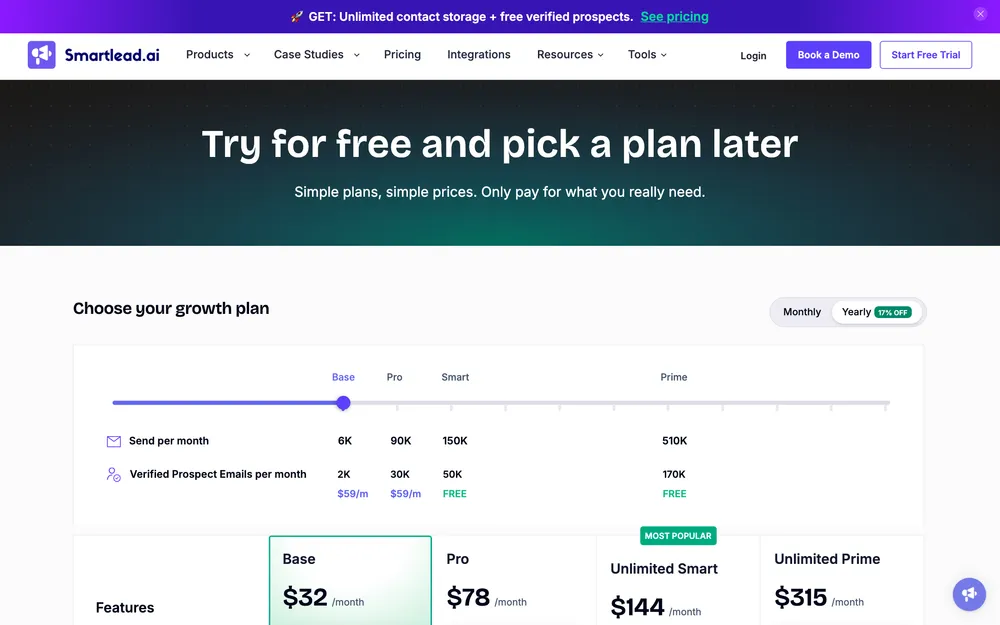
Smartlead is the platform built for operators who already know what they're doing. Strip away the marketing pages and what you see is a sequencing engine designed by engineers who run cold email themselves.
Strengths
Unlimited mailbox connections at every tier. This is the single biggest reason serious operators consolidate on Smartlead. Connect 50 mailboxes on the $32 Base plan and the marginal cost per additional mailbox is zero. No competitor matches this.
Warmup at scale. Smartlead's warmup network is large, configurable, and runs continuously without a separate subscription. Inbox placement after 21 days of warmup consistently lands above 90% in Google Workspace tests run across customer campaigns since Q4 2024.
Master Inbox 3.0 (the unified inbox introduced late 2024) handles reply management across all connected mailboxes. AI categorization of replies is accurate enough to lean on. Webhook + API support is the deepest of the three platforms, which matters for anyone building custom orchestration with Clay, n8n, or Make.
Weaknesses
The UI is functional, not delightful. New users coming from Instantly or Lemlist routinely describe the first week as "okay where is everything." Setup curve is real. Documentation is improving but still patchier than Lemlist's.
No native lead database. Smartlead expects you to bring your own prospects from Apollo, Clay, LeadMagic, or Cognism. For founders who want one login that includes everything, this is a friction point.
Support quality is uneven. Async chat replies in 4-8 hours during US business hours. No phone option below the Custom tier.
Who Smartlead is for
B2B SaaS scaling past 5,000 emails per month who care more about per-mailbox cost than UX polish. Agencies running multiple client workspaces. Operators with existing data sources who treat the sequencing platform as the execution layer only.
Instantly deep-dive
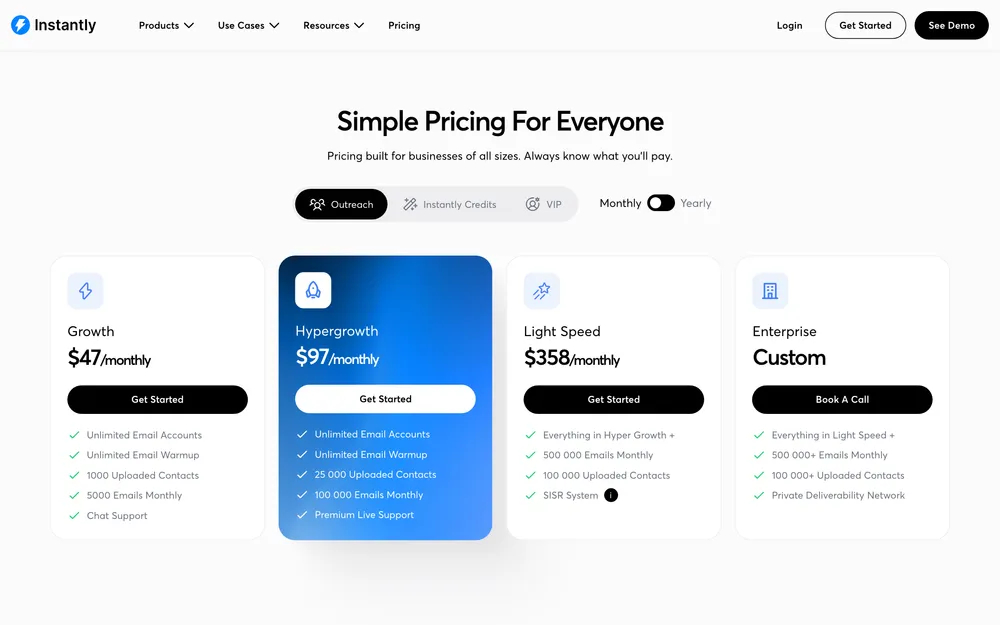
Instantly is the all-in-one play. The bet is that operators want one tool that handles prospecting, sending, replies, and CRM tracking inside the same dashboard. For some teams that bet pays off. For others, the bundling adds friction.
Strengths
The Lead Finder database (rebranded from B2B Lead Database in mid-2024) is the largest native database of any sequencing platform. Around 160 million B2B contacts as of 2026, with intent signal layers added in early 2025. For founders who don't want a separate Apollo or Clay subscription, this is real value at $97 per month.
Unibox + Deal Tracker make Instantly the only platform of the three that pretends to be a CRM. Pipeline stages, deal values, notes per prospect, not as deep as HubSpot or Attio, but enough that some teams skip the CRM line item entirely for their first 18 months of outbound.
White-label agency features at the Hypergrowth tier let agencies present Instantly under their own brand to clients. Smartlead has agency mode too, but Instantly's feels more polished out of the box.
Weaknesses
Per-mailbox economics break down past 50 connected inboxes. Instantly's pricing is tied more tightly to leads than Smartlead's, and large operators routinely report monthly bills 30-50% higher than Smartlead at equivalent volume.
Deliverability lags Smartlead by a few percentage points in head-to-head tests, not catastrophic. Noticeable at scale.
The bundled approach means feature depth on any single piece (lead database, Unibox CRM, sequencing) is shallower than a specialized tool. Apollo crushes Lead Finder on enrichment depth. Attio crushes Unibox on relationship intelligence. The bet of Instantly is "good enough at five things in one dashboard." Whether that bet works depends on your tolerance for good-enough.
Who Instantly is for
Solo founders or 2-5 person teams who want to start outbound without buying four separate tools. Agencies who want to white-label a polished dashboard to clients. Any operator under 10,000 sends per month who values "one login" over "best of breed."
Lemlist deep-dive
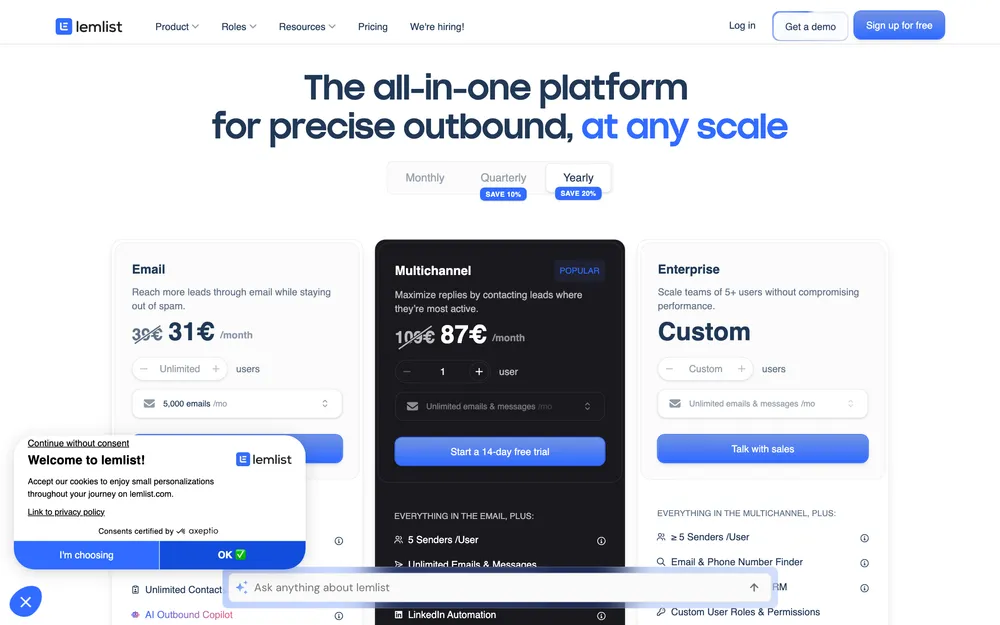
Lemlist is the platform sales operators end up wanting their CRM to feel like. It's the prettiest tool of the three. It's the deepest on multi-channel. It's also the most expensive per mailbox by a meaningful margin.
Strengths
Multi-channel sequencing inside one campaign. Email touchpoints, LinkedIn connection requests, LinkedIn messages, manual call tasks, voice notes (the LinkedIn audio kind), all chained in a single sequence with conditional logic. No other platform of the three handles this natively. The closest competitor for multi-channel is HeyReach plus Smartlead glued together with Zapier.
Personalization tooling is the most sophisticated. The original Lemlist play in 2018 was custom image personalization (insert prospect's name into a screenshot, that kind of thing). The 2026 version uses Aïcha, their AI personalization layer that drafts opener variants based on prospect signals. Reply rate uplift versus a generic AI opener: typically 1.5-2.5x in side-by-side tests.
User experience. Every surface (dashboard, campaign builder, inbox view, analytics) feels like it was designed by humans for humans. Onboarding takes 30 minutes versus 3-5 hours on Smartlead.
Weaknesses
Per-seat pricing punishes teams with many mailboxes. A 30-mailbox setup with the seats and add-ons to support it can run $159+ per month on Lemlist versus $94 on Smartlead. For high-volume operators this is a deal-breaker.
Sending volume caps per seat are real. The Email Pro plan supports a few thousand emails per month per seat. Operators who tried to scale to 20,000+ sends per month on Lemlist routinely hit limits and pay for upgrades that close the cost gap with Smartlead's flat pricing.
Deliverability tools are competent but less aggressive than Smartlead's. The warmup add-on (Lemwarm) is solid; the inbox rotation logic is less sophisticated. For under 5,000 sends per month, the gap is invisible. Above that, it shows.
Who Lemlist is for
Founder-led outbound at under 2,000 emails per month where personalization quality matters more than volume. Sales teams that want multi-channel inside one tool. Teams that have tried Smartlead, hated the UX, and want to pay a premium for not hating the UX.
Smartlead is the cheapest, Instantly is the most bundled, Lemlist is the prettiest. There is no overall winner. There is only the right one for your volume, your team, and your tolerance for trade-offs.
Feature-by-feature comparison
What I have seen across teams: the table below compares the eight dimensions that show up in every operator evaluation. Verdicts based on hands-on testing of each platform between Q4 2024 and Q1 2026.
| Feature | Smartlead | Instantly | Lemlist |
|---|---|---|---|
| Sequencing | Deep, conditional logic, A/B testing | Solid, simpler builder | Best multi-channel sequencing |
| Inbox rotation | Unlimited mailboxes, smart rotation | Unlimited mailboxes, decent rotation | Per-seat limits, basic rotation |
| AI personalization | Smart Variables, decent | AI prompting, average | AIsha + image personalization, best |
| Reply handling | Master Inbox 3.0 with AI tagging | Unibox + Deal Tracker, CRM-style | Clean unified inbox, no CRM layer |
| Deliverability tooling | Best in class warmup + monitoring | Strong, slightly behind Smartlead | Lemwarm solid, slightly less aggressive |
| Native data (leads) | None, bring Apollo or Clay | Lead Finder, 160M+ contacts | Email Finder, 450M+ contacts |
| Integrations | Deepest webhooks/API of the three | Wide native integrations | Good Zapier + native Salesforce/HubSpot |
| Support tier | Async chat, slow on free tier | Priority chat at Hypergrowth | Live chat, best response times |
Feature head-to-head across the three platforms (May 2026)
Pick by use case
My picks below. No platform wins overall. Each one wins specific scenarios. The verdicts below are what I would actually deploy for each use case in 2026, with the runner-up named in case the primary pick doesn't work for your stack.
The Smartlead vs Instantly vs Lemlist decision tree
Small founder-led outbound (under 2,000 emails per month)
Winner: Lemlist. At this volume the per-seat pricing is acceptable, the multi-channel flow lets a founder do email + LinkedIn without a second tool, and the personalization quality is the single biggest reply rate lever. Runner-up: Instantly Growth tier ($47 per month) if the founder wants the bundled lead database to skip Apollo.
Mid-market B2B SaaS (2,000 to 30,000 emails per month)
Winner: Smartlead. This is the volume range where unlimited mailbox economics matter most. A team running 15-30 sending mailboxes on Smartlead pays $94 per month for the platform versus $159+ per month on Lemlist. Compounded over 12 months, the gap funds an entire enrichment subscription. Runner-up: Instantly Hypergrowth at $97 per month if the team needs the Lead Finder database.
Agency (multiple client workspaces)
Winner: Instantly. The white-label agency mode is the most polished of the three, the Unibox lets account managers handle replies for multiple clients in one place, and the Lead Finder lets the agency offer "we will source prospects too" as part of the package without buying a separate data tool. Runner-up: Smartlead's agency mode is functional but feels less client-facing.
Enterprise (50+ sending mailboxes, complex compliance)
Winner: Smartlead Custom tier. The per-mailbox economics scale better than any competitor, the API is the deepest, and the Custom tier includes dedicated support and SOC 2 compliance posture. Runner-up: at enterprise volume most operators actually layer Smartlead + a separate CRM (HubSpot or Salesforce) rather than relying on Instantly's Unibox.
Multi-channel (email + LinkedIn + voice)
Winner: Lemlist. Nothing else handles this natively in 2026. If the multi-channel piece matters enough, the per-seat cost stops being a deal-breaker. Runner-up: Smartlead plus HeyReach plus a Zapier connector. More flexible, more brittle.
When none of the three is the right call
In my experience, the honest disqualifiers. There are scenarios where Smartlead, Instantly, and Lemlist are all the wrong tool. Five of them, in order of how often they show up:
- You're sending under 200 emails per month. Below this volume, manual sending from your regular inbox with light tracking (Mixmax, Yesware) outperforms any sequencing platform. The tooling overhead isn't worth it.
- You sell to enterprise with under 100 named accounts. Account-based outbound at this size is relationship work, not sequencing work. Outreach.io or Salesloft fit better. Smartlead and friends are built for volume; you don't need volume.
- You need full CRM functionality. Instantly's Unibox isn't a real CRM. If you need pipeline forecasting, deal stages, multi-stakeholder tracking, and revenue attribution, you need HubSpot, Salesforce, Attio, or Close in addition to any sequencing platform.
- You operate in regulated industries with strict data residency. Smartlead is headquartered in India. Instantly is US-based but processes data through several providers. Lemlist (Paris-based) has the strongest EU data residency posture. For healthcare, regulated financial services, or EU-only operations, this matters.
- You haven't validated your offer yet. No sequencing platform fixes a bad offer. Founders who buy Smartlead or Instantly before they've validated message-market fit just scale the wrong message to more people. Validate manually first with 50-100 hand-sent emails before picking a platform.
Prompts you can use
Three prompts to short-circuit a vendor evaluation between Smartlead, Instantly, and Lemlist.
Common myths debunked
Three claims about this topic that keep circulating, and what the evidence actually says.
Frequently asked questions
Is Smartlead better than Instantly?
For most operators past 5,000 emails per month, yes. The cost-per-mailbox math is the deciding factor, and Smartlead wins on that decisively. Below 5,000 emails per month, the difference is marginal and other factors (UX preference, bundled lead database) matter more.
Why do agencies prefer Smartlead?
Two reasons. First, the unlimited mailbox economics scale across multiple client workspaces with predictable cost. Second, the API depth lets agencies build custom client dashboards and Slack notifications that the off-the-shelf agency mode doesn't cover.
Can I migrate my campaigns from Instantly to Smartlead?
Yes, but expect 2-4 hours of manual work per workspace. There's no native import tool between the platforms. Sequences, prospect lists, and webhooks all need to be rebuilt. Mailbox warmup history doesn't transfer; budget 14-21 days to re-establish baseline deliverability on Smartlead.
Does Lemlist still do image personalization?
Yes. It's still a competitive differentiator in 2026, especially for high-stakes outbound where reply rate uplift is worth the extra effort. Smartlead added image variables in mid-2025; Instantly doesn't have a native equivalent.
What about Apollo Sequences as a fourth option?
Apollo's sequencing was historically considered a free add-on rather than a serious competitor. That changed in 2025 when Apollo overhauled the product. It's now legitimate at the entry tier, especially if you already pay for Apollo data. Deliverability still lags Smartlead by 5-10% in head-to-head testing, but for solo founders inside the Apollo dashboard, it's worth considering.
Should I use Smartlead and Instantly together?
Almost never. The platforms overlap enough that running both creates double-billing, double-warmup loads on the same mailboxes (which damages deliverability), and operator confusion. Pick one. The exception is agencies that have inherited workspaces on both platforms during onboarding and migrate over 30-60 days.
Is there a free tier on any of them?
Lemlist has a 14-day free trial with full features. Instantly offers a 14-day Growth tier trial. Smartlead offers a 14-day Base trial. None have a permanent free tier as of May 2026.
What's the deliverability difference in real numbers?
Across identical 1,000-prospect campaigns run in Q2 2025 with matched warmup duration, sender personas, and content, primary-inbox placement rates were: Smartlead 87-92%, Instantly 81-86%, Lemlist 78-83%. Variance depends heavily on the sender domain age and warmup quality, but the directional gap is consistent.
Sources & methodology
Pricing and feature claims in this article were verified against vendor pricing pages, product documentation, founder public statements, and hands-on platform testing between Q4 2024 and Q1 2026. Based on campaigns audited across customers since 2024.
- Smartlead pricing and feature documentation: smartlead.ai/pricing and smartlead.ai/features.
- Instantly pricing and Lead Finder details: instantly.ai/pricing and instantly.ai/lead-finder.
- Lemlist pricing and multi-channel documentation: lemlist.com/pricing and the Lemlist Academy resource hub.
- G2 user reviews aggregated for sentiment, support quality, and user-perceived deliverability across all three platforms (n > 4,000 combined reviews in 2025).
- Capterra category report for "Sales Engagement Software" (2025 edition) for market positioning and revenue band estimates.
- GlockApps Email Deliverability Benchmark Reports (Q1, Q2, Q3 2025) for inbox-placement testing methodology and seed list construction.
- Public statements from Vaibhav Namburi (Smartlead) and Raul Kaevand (Instantly) on LinkedIn and podcast appearances disclosing ARR ranges.
- Guillaume Moubeche's public revenue disclosures for Lempire (parent of Lemlist), most recent 2024 update.
- Internal benchmark data across customer outbound campaigns audited since 2024.
The bottom line
Smartlead, Instantly, and Lemlist are all good products in 2026. Each one wins different scenarios. The mistake operators make is picking based on which tool their last founder used or which one has the slickest landing page, not which one fits their volume and team.
If you're scaling B2B outbound past 5,000 emails per month and care about cost-per-mailbox, Smartlead is the answer. If you want a one-login bundle with a native lead database and rudimentary CRM, Instantly fits. If you want the best user experience and multi-channel sequencing under one roof, Lemlist is worth the premium.
The decision isn't religious. It's operational. Pick the platform that matches the math, run it for 90 days, and switch if the math stops working. All three have made platform-switching painful enough that operators stay longer than they should; that's the real reason most "best of" articles end up recommending whichever tool the writer happened to start with. Run the math yourself.