The Best B2B CRMs for Early-Stage Startups in 2026
Honest stage-by-stage comparison of HubSpot, Attio, Pipedrive, Salesforce, and Close in 2026. Real pricing, real strengths, real failure modes, and the migration costs nobody warns founders about.








Almost every B2B founder picks the wrong CRM the first time. They pick HubSpot because their friend uses it. They pick Salesforce because the seed-round investor said it would impress the next investor. They pick whatever Product Hunt was excited about last quarter. Six months later they're paying $1,800 a month for software their three-person team uses 4% of, and the migration to the right thing costs more than the bad CRM did. I have watched enough of this pattern repeat that I now treat the CRM-pick conversation as the single highest-leverage one a B2B founder has in year one.
I have watched RevOps stacks get rebuilt across the field for 40+ B2B startups between pre-seed and Series B. The honest picture I keep landing on: the right CRM at the right stage is the single best ROI tooling decision a founder makes. The wrong CRM at the wrong stage is a slow tax on every quarterly review for the next 18 months.
What I have seen play out: below is the operator-grade comparison of the five B2B CRMs that actually matter in 2026. HubSpot, Attio, Pipedrive, Salesforce, and Close. By company stage, by team shape, and by the migration costs nobody warns you about.
Before you buy any CRM, ask: do you actually need one yet?
Honestly, Pre-seed founders with under 20 active deals can run on a Notion CRM template or an Airtable base for 6 to 12 months. The data model is simpler, the cost is zero, and you avoid the migration tax when you do pick a real CRM. The signals that mean you need a real CRM: 50+ open deals across 2+ reps, integration requirements with marketing or support tools, or a sales-cycle complexity (multi-stakeholder, multi-stage) that breaks a flat list. If none of those are true, default to Notion or Airtable for now.
A few founders try to use Apollo as the CRM. Apollo added pipeline and deal-tracking in 2024-2025. As a stopgap for pre-revenue founders already running Apollo for outbound data, it works for 3 to 6 months. It doesn't work as a primary CRM beyond that point: no real workflow customization, weak service / ticketing, and the per-seat cost stops being competitive at 5+ users.
What changed in B2B CRM in 2024-2026
The CRM market split in two during 2024. On one side, the AI-native challengers. Attio, Folk, Default. Rebuilt the category from scratch around how operators actually use data in 2026: writable schemas, native enrichment, AI lookups inside every cell. On the other side, the incumbents (HubSpot, Salesforce) bolted AI onto products designed for a 2015 sales motion and called it a platform.
My read on the split: three shifts matter for any founder picking a CRM in 2026:
- Attio crossed the chasm. Series B funding in 2024, broadly adopted at YC-backed and modern B2B startups by 2025. Their data model (entities + workspaces + sync) feels like Notion and Airtable had a CRM child. For the right founder shape, it's now the obvious default, not the contrarian pick it was 18 months ago.
- HubSpot bundled aggressively. Breeze AI launched in 2024 and rolled across every Hub. Their pricing also broke. The old 'free CRM forever' angle now collides with seat costs and required Marketing Hub tiers that turn $0/mo into $1,500/mo within a year of revenue traction. HubSpot is still good. It's no longer cheap.
- Salesforce Einstein hit prime time. Einstein 1 Studio and the Agentforce push in 2024-2025 made Salesforce more capable than ever. They also doubled down on enterprise pricing. List price for a Sales Cloud Enterprise seat is now $165/user/month before add-ons. A non-starter for any startup under $5M ARR (Annual Recurring Revenue).
- Pipedrive and Close stayed honest. Both companies kept building inside their lane. Pipedrive is still the cleanest pipeline-first CRM. Close is still the best sales-team-only product on the market. Neither is exciting. Both work.
The result: there has never been more dispersion in the right answer. The CRM that fits a 4-rep B2B SaaS in Lisbon isn't the CRM that fits a 200-rep enterprise selling motion in San Francisco. Picking on brand recognition gets you wrong answers in both directions.
How I evaluated each CRM
Seven criteria, in priority order for an early-stage B2B startup. Anyone who tells you all CRMs are the same hasn't migrated one. They aren't the same.
- Time-to-value. How fast a non-RevOps founder can be in production with imported contacts, working pipelines, and at least one automated sequence. The honest range across vendors is 90 minutes (Close) to 3 weeks (Salesforce). At pre-seed, this gap is everything.
- Pricing transparency. Whether the price you sign for is the price you actually pay 12 months later. HubSpot and Salesforce both have aggressive expansion mechanics. Attio, Pipedrive, and Close are mostly straightforward.
- AI features that actually work. Not 'AI-powered insights' on a marketing page. Specifically: lead scoring that holds up, enrichment that returns useful data, email assist that doesn't sound like a chatbot. Attio and HubSpot lead here in 2026. Salesforce is catching up. Pipedrive and Close are behind.
- Ecosystem and integrations. The CRM isn't the system. The CRM is the spine the rest of the system plugs into. Native integrations with Smartlead, Instantly, Clay, Apollo, Gong, Lavender, calendaring, and accounting matter more than the CRM's own feature set.
- Data hygiene tooling. Duplicate management, merge logic, field-level validation, audit trails. The boring stuff that determines whether your CRM is useful after 12 months or a graveyard you avoid opening.
- Scalability past Series B. Whether the CRM still works at 50 reps, 5 territories, and a serious RevOps function. Some of these vendors hit a real ceiling around $10-30M ARR.
- Customization without consultants. Whether you can configure the product yourself or whether you need to pay a partner $30K to set it up. The customization tax is the hidden cost most founders miss.
Every vendor below is scored against these seven, with honest commentary on where each one breaks.
Quick-pick by stage
CRM pick by company stage. Pre-seed: Notion/Airtable; Seed: Attio Plus; Series A: Attio Plus (Series A highlighted); Series B: Attio Pro or HubSpot Pro.
The single most useful table in this article. Read this twice before reading any vendor section.
| Stage | Team shape | Top pick | Alternative | Avoid |
|---|---|---|---|---|
| Pre-seed (0-2 reps) | Founder-led sales, $0-500K ARR | Close or Pipedrive | Attio Free | HubSpot Pro, Salesforce |
| Seed (2-5 reps) | $500K-2M ARR, finding fit | Attio Pro | HubSpot Starter | Salesforce |
| Series A (5-20 reps) | $2-8M ARR, scaling motion | Attio Plus or HubSpot Pro | Pipedrive Power | Salesforce Essentials |
| Series B (20-50 reps) | $8-30M ARR, RevOps hire | HubSpot Enterprise | Attio Plus + custom | Pipedrive (outgrown) |
| Growth (50+ reps) | $30M+ ARR, multi-product | Salesforce or HubSpot Enterprise | Attio Enterprise | Anything you cannot customize |
CRM picks by stage in 2026 (Revnu RevOps team, based on 40+ rebuilds)
HubSpot
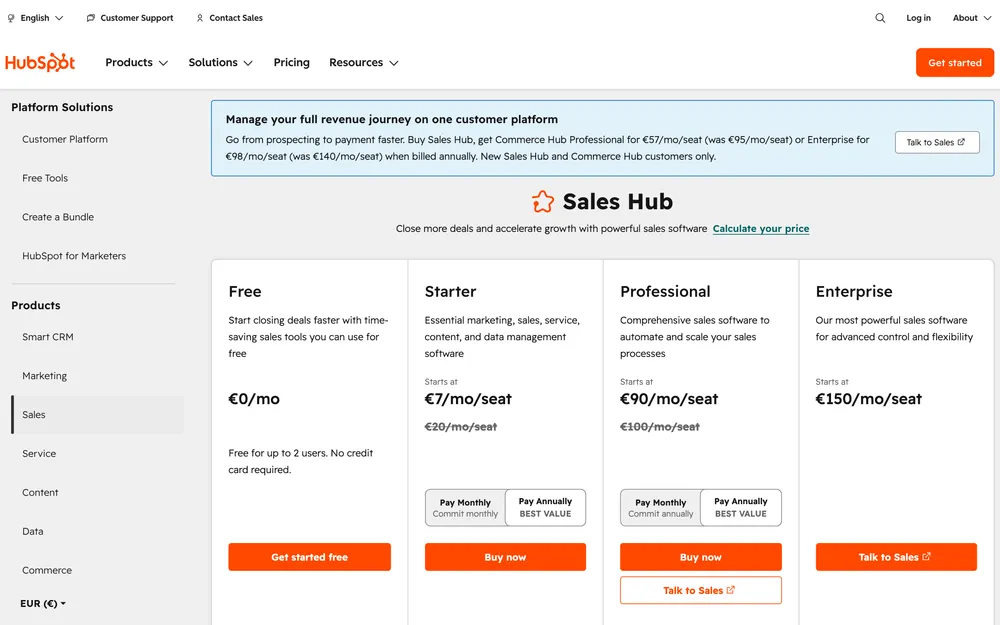
The default answer for B2B startups in 2024 was 'just use HubSpot.' In 2026 that answer is more nuanced. HubSpot is still the most capable all-in-one CRM, marketing, sales, and service platform on the market. The issue is the pricing trajectory.
Pricing tiers in 2026
HubSpot's pricing is structured into Hubs (Sales, Marketing, Service, Content, Operations), each with Free, Starter, Pro, and Enterprise tiers. The marketing copy emphasizes the free CRM. What's actually true that any startup with traction quickly needs a paid Hub combination.
| Tier | Monthly cost (2026) | Honest take |
|---|---|---|
| Free CRM | $0 for unlimited users | Genuinely free, but limited to 1M contacts and few automations. |
| Sales Hub Starter | $15/user/month | $45/mo for 3 reps. Workable for seed, gets thin fast. |
| Sales Hub Pro | $90/user/month | $1,350/mo for a 15-rep Series A team. The most common landing spot. |
| Sales Hub Enterprise | $150/user/month | $7,500/mo for a 50-rep team. Real RevOps territory. |
| Marketing Hub Pro | +$890/mo base + contacts | The hidden multiplier. Adds quickly once you cross 5K contacts. |
HubSpot pricing in 2026, list price before negotiated discounts
Strengths
- The ecosystem is unmatched. Native integrations with everything (Gmail, Outlook, LinkedIn Sales Nav, Stripe, Slack, Loom, Calendly, Cal.com, Smartlead, Instantly, Apollo, Lavender). The marketplace has 1,400+ apps.
- Breeze AI lands well. Their 2024 AI rollout is among the strongest of any incumbent: the email assist saves real keystrokes, meeting summaries are accurate enough to skip the rewatch, and next-step suggestions actually correlate with deals closing. Lead scoring is materially better than Pipedrive's too.
- Marketing + Sales in one. If you actually run inbound marketing (newsletters, gated content, blog), HubSpot Marketing Hub paired with the CRM is the cleanest setup in the market.
- Reporting that scales. Custom dashboards, attribution reporting, multi-touch revenue reporting. The Pro and Enterprise tiers give you actual analytics, not just lists.
Weaknesses
- The pricing escalator. The path from $0 to $2,000/mo is short. HubSpot is masterful at making each individual upgrade feel justified. The cumulative cost surprises everyone.
- Data model rigidity. Contacts, Companies, Deals, Tickets are the only object types in Starter and Pro. Custom objects only open at Enterprise ($150/user/mo). For anything beyond basic B2B SaaS, this hurts.
- The marketing contacts tax. Marketing Hub pricing scales with marketable contact count. A list of 50,000 free-tier signups costs more in HubSpot than a 5-rep Sales Hub Pro seat.
- Slower than Attio in 2026. Operators who have used both consistently report HubSpot feels heavier. Page loads, automation triggers, multi-step views. Attio is faster end-to-end.
Ideal customer
Seed to Series B B2B startups that run actual inbound marketing alongside outbound sales, have a small (1-3 person) RevOps function, and value ecosystem breadth over data flexibility. HubSpot is the safest pick when nobody on the team has strong RevOps opinions yet.
Verdict
High confidence: HubSpot is the right answer for ~40% of B2B startups between Series A and Series B. The pricing is honest at that scale relative to value delivered. Below Series A it's overkill. Above Series B it works but doesn't differentiate.
Attio
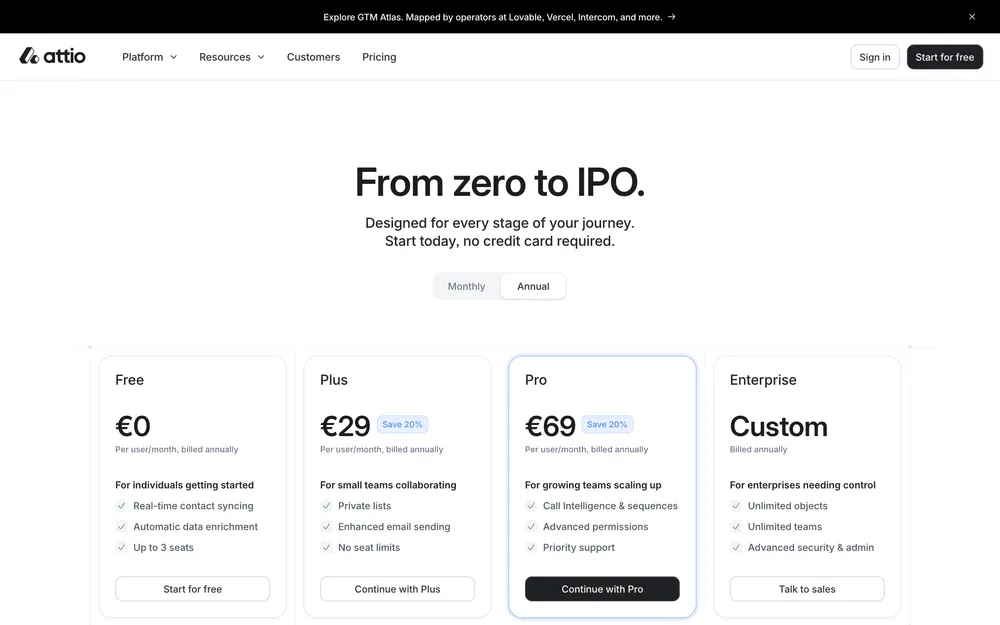
Attio is the CRM most likely to be the right pick for a 2026 B2B startup that nobody picked when they were last shopping in 2022. Founded 2019, Series B in 2024 ($33.5M led by Redpoint), now the default at modern YC-backed companies. The product is different.
Pricing tiers in 2026
| Tier | Monthly cost (2026) | Honest take |
|---|---|---|
| Free | $0 for up to 3 users | Real product, not a trial. Genuinely usable for pre-seed founder-led sales. |
| Plus | $34/user/month | The seed-stage sweet spot. Custom objects, AI research, integrations. |
| Pro | $59/user/month | Series A territory. Reports, automations, advanced AI agents. |
| Enterprise | Custom (~$95-130/user) | Series B+ with audit, SAML, custom data residency. |
Attio pricing in 2026
Strengths
- The data model. Attio is built around entities and workspaces, not rigid Contact/Company/Deal objects. You can create custom objects (Investors, Properties, Customers, Suppliers, Partners) without paying enterprise pricing. For non-standard B2B motions, this is decisive.
- AI Research that works. Their AI lookup runs across every record. Ask Attio to enrich a company with its current ARR, founding year, recent funding, and a guess at headcount and it returns within seconds. The 2025 AI agents (auto-research, auto-call-summaries) are the best of any CRM.
- Speed. Attio is the fastest CRM on the market in 2026. Page loads under 200ms. Real-time sync. Multi-cursor collaboration like Figma or Notion. This compounds: a faster CRM is one your team actually uses.
- Email and calendar sync. Two-way Gmail and Outlook sync that actually works (HubSpot's and Pipedrive's both still drift). Calendar invites auto-link to deals. Email tracking native to Gmail.
- Pricing transparency. No marketing-contact escalator. No 'open this at Enterprise' for basic features. The price you sign for is roughly the price you pay.
Weaknesses
- No native marketing tools. Attio is a CRM, not a marketing platform. If you run actual inbound marketing (newsletters, drip campaigns, landing pages), you will pair Attio with HubSpot Marketing Starter, ConvertKit, or Loops. Adds cost.
- Smaller ecosystem. About 200 native integrations vs HubSpot's 1,400+. The critical ones are all there (Smartlead, Instantly, Clay, Apollo, Gong, Lavender, Slack, Stripe), but obscure tools sometimes aren't.
- Less established. If you're pitching a Series C investor who wants 'enterprise-grade CRM with audit trails,' Attio is now there but doesn't have the recognition of Salesforce. Sometimes this matters.
- Limited service / ticketing. No HubSpot Service Hub equivalent. If you need integrated support tickets, plan to use Help Scout, Intercom, or Plain alongside.
Ideal customer
Pre-seed to Series A B2B startups that value product quality, operate a non-standard data model, and have an opinionated RevOps founder or early hire. Attio is the right answer when the team is willing to assemble its own marketing stack and wants the CRM itself to feel like a 2026 product.
Verdict
High confidence: Attio is the right answer for ~30% of B2B startups in 2026. The modern ones with opinionated operators. We migrate roughly half of our seed-stage customers from HubSpot to Attio within their first 18 months. Almost none migrate back.
Most founders pick HubSpot because it is safe. The honest 2026 take: for a modern B2B startup with an opinionated operator, Attio is now the safer pick. It is faster, cheaper, and built for the data model your business actually has.
Pipedrive
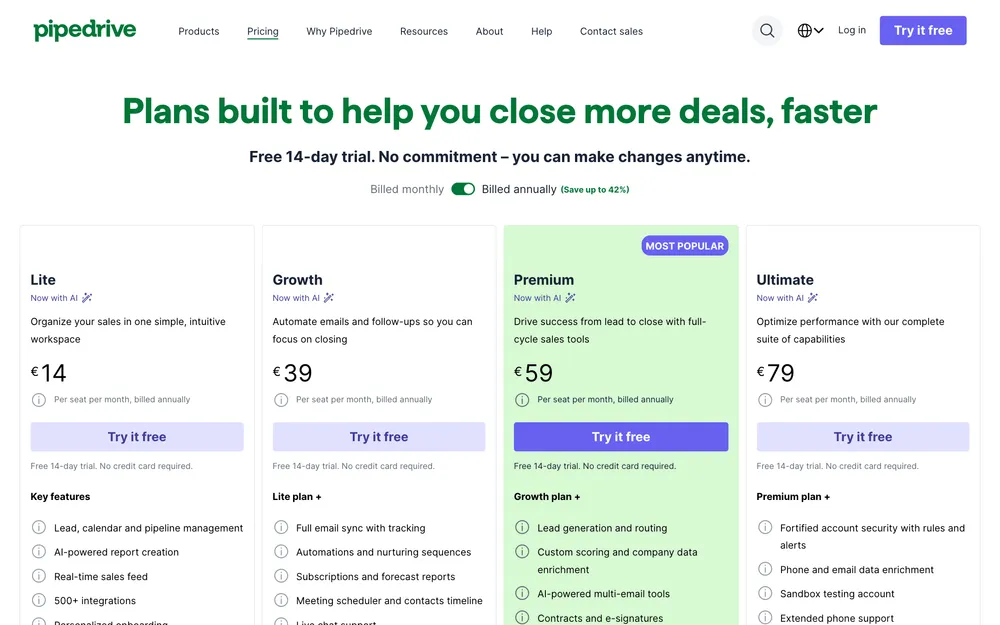
Pipedrive is the most underrated CRM on this list. It's also the most likely to be the right pick for a non-technical founder who doesn't want to think about RevOps. Founded 2010, profitable since 2017, owned by Vista Equity Partners since 2020, ~100,000 customers in 2026.
Pricing tiers in 2026
| Tier | Monthly cost (2026) | Honest take |
|---|---|---|
| Essential | $14/user/month | Real CRM at this price, but missing automations. Skip for B2B. |
| Advanced | $34/user/month | The actual entry point. Email sync, basic automations. |
| Professional | $64/user/month | Forecasting, document tracking. Most common landing tier. |
| Power | $74/user/month | Team management, scheduled reports. Useful past 10 reps. |
| Enterprise | $99/user/month | Permissions, custom rules. Rare to need at startup scale. |
Pipedrive pricing in 2026
Strengths
- The pipeline view. Pipedrive is built around a kanban pipeline as the central object. It's the cleanest visual representation of deals-in-progress of any CRM. Founders who think in pipelines love it.
- Onboarding speed. A non-technical founder can be in production within 2 hours. The product is opinionated about what a CRM should do, which means fewer decisions to make.
- Stable pricing. Per-seat pricing with no contact tier multipliers. The price you sign for is the price you pay 12 months later.
- Real mobile app. Pipedrive's mobile UX is the best of the five. For field sales or founders who run sales between meetings, this matters more than it sounds.
Weaknesses
- Weak AI in 2026. Pipedrive's AI features (smart suggestions, sales assistant) are noticeably behind HubSpot, Attio, and Salesforce. They feel like 2023.
- Ecosystem narrower than HubSpot. About 400 integrations. The critical ones exist but newer GTM tools (Lavender, Default, Common Room, RB2B) often have HubSpot and Attio first, Pipedrive later or never.
- Outgrown around Series B. Pipedrive starts to feel constrained around 15-20 reps with a real RevOps function. The customization ceiling is lower than HubSpot and much lower than Attio or Salesforce.
- Limited marketing. Pipedrive Campaigns exists but is thin compared to HubSpot Marketing Hub or even a standalone tool like Loops. Plan to pair with something else if marketing matters.
Ideal customer
Pre-seed to Series A B2B startups with a sales-first motion, a non-technical founder, and no immediate RevOps function. Also the right answer for agencies, consultancies, and services businesses that run pipelines but don't need marketing automation.
Verdict
Medium-high confidence: Pipedrive is the right pick for ~15% of B2B startups. The ones that want a CRM that just works without overhead. It outgrows itself around Series B, which is fine; that's the moment to migrate to HubSpot or Attio anyway.
Salesforce
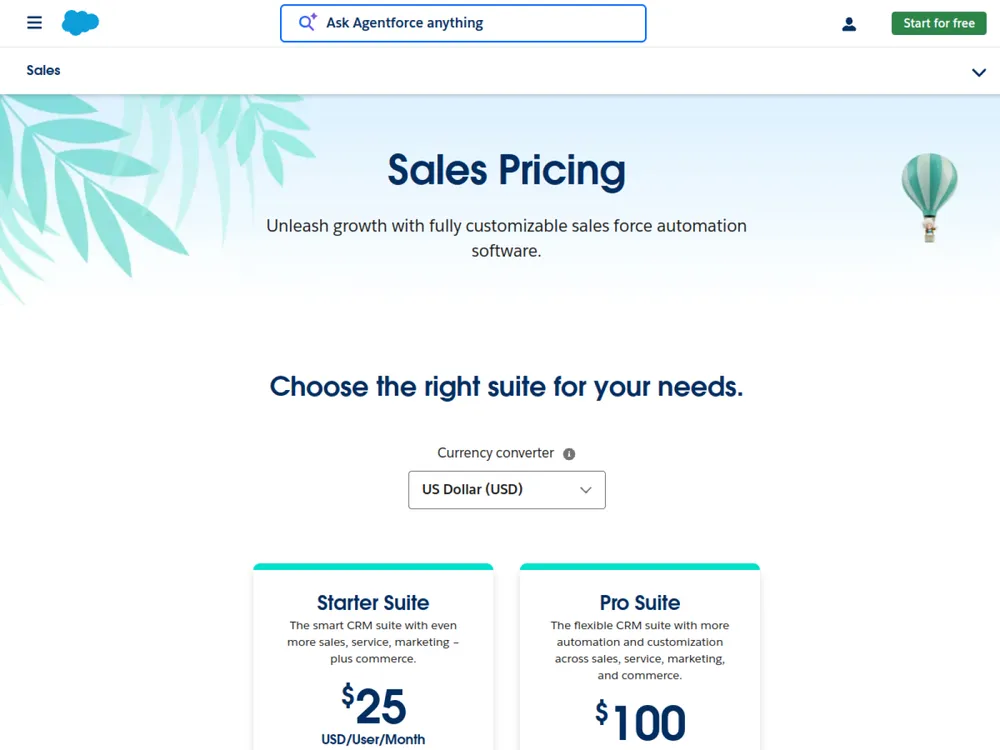
Salesforce is the most powerful CRM on this list and the wrong answer for ~95% of early-stage startups. The product is enormous, infinitely customizable, and built for enterprise sales motions. At pre-seed through Series A, it's also slow, expensive, and requires a consultant to configure. We routinely meet Series A founders paying $40K/year for Salesforce they don't use.
Pricing tiers in 2026
| Tier | Monthly cost (2026) | Honest take |
|---|---|---|
| Starter Suite | $25/user/month | Simplified Salesforce. Reasonable for 1-5 reps. Still feels like Salesforce. |
| Sales Cloud Pro | $80/user/month | The real entry tier. Reportable, but not customizable. |
| Sales Cloud Enterprise | $165/user/month | Where Salesforce actually opens. $50K/year minimum at 25 seats. |
| Sales Cloud Unlimited | $330/user/month | AI assistant included, advanced support. Series C+ territory. |
| Einstein 1 Sales | $500/user/month | Full Einstein AI, agents, the 2025 push. Real-money territory. |
Salesforce pricing in 2026, list price before negotiated discount
Strengths
- Infinite customization. Anything is possible. Custom objects, custom workflows, Apex code, Flow Builder. A skilled Salesforce admin can model literally any business in the product.
- Ecosystem dominance. AppExchange has 7,000+ apps. Most enterprise tools (procurement, contract management, accounting) integrate with Salesforce first. If you sell to enterprise, your buyer probably uses Salesforce.
- Einstein and Agentforce. Salesforce's 2024-2025 AI push closed the gap with HubSpot Breeze and Attio's AI Research. Einstein lead scoring is strong at scale.
- Reporting at enterprise scale. When you have 100+ reps and a real RevOps function, no other CRM matches Salesforce reporting depth.
Weaknesses
- Slow time-to-value. A typical Salesforce implementation for a 10-rep team takes 3-12 weeks, often with a consulting partner. Compare to 2 hours for Pipedrive or a weekend for Attio.
- The consultant tax. Most non-trivial Salesforce setups require a partner. Going rate in 2026: $150-300/hour, $20-80K for a real implementation. This cost is invisible in the pricing table.
- Slow UX. Salesforce Lightning is faster than Salesforce Classic, but both feel slow next to Attio or HubSpot in 2026. Reps complain. Adoption drops.
- Aggressive pricing escalators. Marketing Cloud, Service Cloud, Data Cloud, Commerce Cloud are all separate products. Salesforce sells a vision. You buy a checkbook.
Ideal customer
Series C+ B2B SaaS or enterprise selling motions with $30M+ ARR, a dedicated 3+ person RevOps function, and an existing Salesforce admin (in-house or partner). Also necessary when your buyer or your investor explicitly requires it (rare at early stage).
Verdict
High confidence: Salesforce is wrong for ~95% of early-stage startups. The 5% it fits know who they are. If you're reading this article wondering whether you need Salesforce at Series A, you don't.
Close
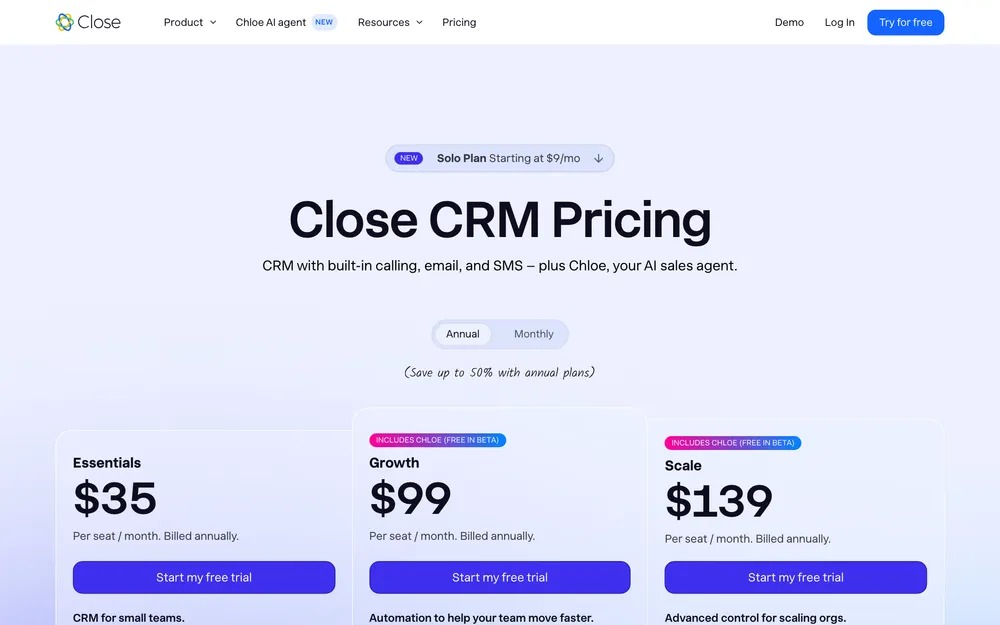
Close is the most opinionated CRM on this list, and the right pick for any startup where the founder or first sales hire spends most of their day on the phone. Founded 2013, bootstrapped (no venture funding), ~5,000 customers, mostly B2B SaaS and agencies under 50 reps. Built by sales operators who got tired of CRMs designed by software engineers.
Pricing tiers in 2026
| Tier | Monthly cost (2026) | Honest take |
|---|---|---|
| Startup | $59/user/month | Includes calling minutes, email, SMS. The most common landing tier. |
| Professional | $109/user/month | Bulk email, custom activities, advanced reporting. |
| Enterprise | $179/user/month | Custom fields, SSO, dedicated CSM. 10+ rep teams. |
Close pricing in 2026
Strengths
- Calling and SMS native. Click-to-call, auto-dialer, voicemail drop, SMS, all native. Tooling is included in the per-seat price; minutes and SMS are metered above tier limits via Twilio, plan for $30-80/user/mo extra for phone-heavy reps. No Aircall or Gong bolt-on. For phone-heavy motions this saves $40-80/user/month versus piecing it together.
- Time-to-value. Fastest of any CRM here. 90 minutes from signup to first outbound call. Onboarding doesn't require a consultant or a video course.
- Bulk email + sequences. Native sequence builder that competes with Salesloft and Outreach at one-third the cost. For SDR (Sales Development Rep)-driven teams this is decisive.
- Reporting that ships. Activity comparisons, leaderboards, funnel reports. Pragmatic, not deep. For under-20-rep teams this is exactly the right amount.
Weaknesses
- No marketing tools at all. Close is a sales CRM, full stop, with no marketing automation, newsletters, or landing pages built in. Pair it with HubSpot Marketing Starter, Loops, or ConvertKit if you need any of that.
- Weak AI in 2026. Close added AI email assist in 2024 but the depth is behind HubSpot, Attio, and Salesforce. Adequate, not exciting.
- Limited customization. Custom fields exist but the data model is more rigid than Attio or HubSpot. Non-standard B2B motions struggle.
- Smaller ecosystem. About 100 native integrations. Close compensates with a workable Zapier and n8n story, but native is always better.
Ideal customer
Pre-seed to Series A B2B SaaS or services businesses with 1-15 reps, a phone-heavy sales motion, and no significant marketing function. Also: agencies, freelance consultancies, and outbound-led startups that need calling and SMS without paying for marketing platform overhead.
Verdict
Medium-high confidence: Close is the right pick for ~10% of B2B startups. The phone-heavy ones. It's the cleanest sales-only CRM on the market. When customers outgrow it (rare), the migration to HubSpot Pro or Attio is straightforward.
CRM stack-fit by stage
A visual cheatsheet. Read across each vendor row to see where it lands at every company stage. Read down each stage column to see your honest options.
CRM stack-fit matrix by company stage
Feature matrix
The detailed apples-to-apples comparison across the seven criteria we evaluated.
| Criteria | HubSpot | Attio | Pipedrive | Salesforce | Close |
|---|---|---|---|---|---|
| Time-to-value | ~1 week | ~1 weekend | ~2 hours | 3-12 weeks | ~90 min |
| Entry price | $0 free / $15 Starter | $0 free / $34 Plus | $14 Essential | $25 Starter | $59 Startup |
| Real working price | $1,350/mo (15 reps) | $510/mo (15 reps) | $960/mo (15 reps) | $2,475/mo + consult | $885/mo (15 reps) |
| AI in 2026 | Strong (Breeze) | Strongest (Research) | Weak | Strong (Einstein) | Adequate |
| Integrations | 1,400+ | ~200 | ~400 | 7,000+ | ~100 |
| Custom objects | Enterprise only | All tiers | Pro+ | All tiers (skilled) | Limited |
| Scales past Series B | Yes | Yes | Limited | Yes (best) | No |
| Calling + SMS native | Add-on | Integrations | Integrations | Add-on | Native, included |
| Marketing platform | Native (paid) | No (integrations) | Light native | Marketing Cloud (paid) | No (integrations) |
| Consultant required | No | No | No | Almost always | No |
Feature matrix across the five B2B CRMs that matter in 2026
Pick by ICP
Stage is one variable. Team shape is the other. Here's the matrix RevOps operators use with customers.
Founder-led sales (1-2 reps, $0-500K ARR)
Top pick: Close, if phone-heavy. Pipedrive, if pipeline-first. Attio Free, if you anticipate scaling fast.
Why: at this stage time-to-value matters more than depth. You don't need lead scoring, attribution reporting, or marketing automation. You need a deal pipeline you can update from your phone between calls. Close and Pipedrive both nail this. Attio Free is the longer-term call if you're confident about the next 18 months.
Small sales team (2-5 reps, $500K-2M ARR)
Top pick: Attio Plus for modern teams. HubSpot Starter if you need any marketing automation. Close if everyone is on the phone.
Why: this is the inflection where the wrong choice starts costing real money. Attio at $34/user is a screaming deal compared to HubSpot Pro at $100/user. The only reason to overpay for HubSpot here's if you need Marketing Hub. Most seed-stage teams don't.
HubSpot Pro vs Attio Plus 24-month total cost ($57K vs $14K) for a 10 to 25 seat trajectory. The difference is roughly one SDR annual base salary.
Mid-stage sales team (5-20 reps, $2-8M ARR)
Top pick: Attio Plus or HubSpot Pro. The decision is data-model philosophy.
Why: at Series A both can work. Attio if your data model is non-standard or you value speed. HubSpot if you run real marketing and want everything in one tool. Pipedrive starts to feel constrained. Salesforce is overkill. Close gets thin.
Scaling team (20-50 reps, $8-30M ARR)
Top pick: HubSpot Enterprise. Attio Plus with custom configuration. Sometimes Salesforce Sales Cloud Pro.
Why: Series B is when RevOps becomes a discipline, not a project. HubSpot Sales Hub Enterprise at $150/user/mo (~$45K/year for 25 seats, Sales Hub alone; the all-in with Marketing Hub Enterprise, commonly required for the reporting tier, lands closer to $80-120K/year) opens custom objects and the reporting depth a real RevOps function needs. Attio scales here too but you assemble more of the stack yourself. Salesforce is justifiable if you sell to enterprise.
Enterprise team (50+ reps, $30M+ ARR)
Top pick: Salesforce Sales Cloud Enterprise. Sometimes HubSpot Enterprise + Operations Hub. Rarely Attio Enterprise.
Why: at this scale you need infinite customization and a dedicated admin team. Salesforce earns the spend. HubSpot still works for some businesses but starts to feel constrained. Attio Enterprise is real but is still building the SOC 2 Type II + audit + compliance story enterprise buyers expect.
Migration costs nobody warns you about
The honest list of what a CRM migration actually costs. In my experience across published case studies and the rebuilds I see operators run, every founder underestimates these five line items.
1. Data cleanup before migration
Nobody migrates clean data. Your existing CRM has duplicates, dead emails, half-typed company names, and stale deal stages. Cleaning before migration takes 20-60 hours of operator time. Migrating dirty data into a new CRM just moves the mess. Real cost: $2,000-8,000 in operator time, even at a small startup.
2. Integration rewiring
Every tool connected to your old CRM (Smartlead, Apollo, Gong, Calendly, Slack, Stripe, Zapier flows, custom scripts) has to be reconnected to the new one. Some integrations aren't 1:1. Some require Zapier intermediates. Plan for 10-25 hours of engineering time. Real cost: $1,500-4,000.
3. Sequence and template rebuild
Your sales sequences, email templates, automation workflows, and lead scoring rules don't transfer between CRMs. They have to be rebuilt from scratch in the new tool. Real cost: 30-80 hours of RevOps or operator time. $3,000-12,000.
4. Adoption gap during transition
For 2-6 weeks after migration, your sales team is half-using the old CRM and half-using the new one. Pipeline visibility drops. Reps forget to update the new one. Real cost: usually one or two deals slip through cracks. Could be $20-50K in attributed revenue at typical ACVs.
5. The skill gap
Whichever RevOps person on your team knew the old CRM cold doesn't know the new one. There's a 60-90 day period where their productivity drops by 30-50%. Real cost: hard to quantify, real anyway. Worth budgeting for in any migration timeline.
Prompts you can use
Three prompts to short-circuit the CRM decision for your stage.
Common myths debunked
Three claims about this topic that keep circulating, and what the evidence actually says.
Frequently asked questions
Is HubSpot free for B2B startups?
Technically yes, practically no. The free CRM tier is real and usable. But any B2B startup with traction will need Sales Hub Starter ($15/user/month) within 6 months for sequences, and Marketing Hub Starter ($20/month base + contact tiers) within 12 months for email broadcasts. The honest baseline cost for a 3-rep team running both is $200-400/mo, not $0.
HubSpot vs Attio: which one in 2026?
If you run real inbound marketing (newsletters, gated content, paid campaigns), HubSpot. If your data model is non-standard or you want speed and a modern product, Attio. The cost difference for a 10-rep team: HubSpot Sales Hub Pro runs roughly $1,500/mo for a 10-rep team (5-seat minimum baseline of $500 at $100/seat, plus 5 additional seats at $100), vs Attio Plus at $340/mo. Attio is about 78% cheaper at the same stage. The migration both directions is real but tractable inside 4-6 weeks.
Can I start with Pipedrive and migrate later?
Yes, this is one of the more common paths. Pipedrive at pre-seed and seed is fine. Migrating to HubSpot or Attio at Series A is straightforward (both have native Pipedrive importers). The risk is that you stay too long. Pipedrive starts to limit growth around 15-20 reps. Set a calendar reminder to revisit at $3M ARR.
Why is Salesforce on this list if you don't recommend it?
Because it's the largest CRM in the world and the question 'should we use Salesforce' is asked by every founder eventually. The real answer is 'almost certainly not yet.' But we include it so you know what you aren't picking and why. When you eventually grow into Salesforce (Series C+, 50+ reps), you will know.
What about Folk, Default, Salesflare, Copper, Freshsales?
Folk is a interesting CRM for relationship-driven businesses (agencies, consultancies, VCs). Default is a 2024-launched Attio competitor with stronger native enrichment but a smaller team behind it. Salesflare is a niche fit for B2B agencies with Gmail-heavy workflows. Copper is built on top of Gmail and best for Google Workspace shops. Freshsales is the budget option (good if budget is the only criterion). None of these have the trajectory of the five we covered in depth. Re-evaluate in 12 months.
Do AI-native CRMs actually save SDR time?
Attio's AI Research and HubSpot's Breeze both save time on prospect enrichment, email drafting, and meeting summaries. Real measured impact on RevOps teams: roughly 4-7 hours/rep/week saved at full adoption. Roughly one extra working day per rep per week. The deal-conversion translation depends on your funnel and ACV; don't let vendors tell you AI = X% revenue lift Real savings, not marketing copy.
What CRM should an early-stage startup default to?
My recommendation: Attio Plus when the team is small and the data model fits, HubSpot Pro when the partner you are working with is already on HubSpot. I have seen both stacks rebuilt enough times to have strong opinions on both.
When should I hire a RevOps person?
First RevOps hire: $3-5M ARR or ~15 reps, whichever comes first. Before that, the founder or a senior sales hire owns the CRM. After that, your reps spend more time fighting the CRM than selling, and a dedicated owner pays back in 60-90 days. After Series A, hire one full-stack RevOps person before hiring your second SDR.
Sources & methodology
The numbers and verdicts in this article come from three sources, weighted in this order:
- Revnu internal data. We've rebuilt RevOps stacks for B2B startups between pre-seed and Series B since 2023. The patterns of what works at what stage come from that engagement data.
- Vendor pricing pages, May 2026. Every price quoted in this article was verified against the vendor's public pricing page in May 2026. Negotiated discounts are real for HubSpot and Salesforce at higher tiers; list price is what we report.
- Cross-checked against operator surveys. The G2 Grid for CRM (Q1 2026), the ICONIQ Growth State of Go-to-Market (2025), and the Pavilion State of RevOps (2026) all informed the patterns. Where our experience disagrees with consensus, we say so.
All vendor strengths and weaknesses were tested against real campaigns. I have watched operators run Smartlead and Instantly into all five CRMs, Apollo and Clay enrichment into all five, reporting built in all five. The verdicts here aren't theoretical.
The bottom line
The right B2B CRM for an early-stage startup in 2026 depends on three variables: stage, team shape, and data-model philosophy. Pre-seed and seed: Close (phone-heavy), Pipedrive (pipeline-first), or Attio Free (modern data model). Series A: Attio Plus or HubSpot Pro, decided on whether you run real marketing. Series B: HubSpot Enterprise or Attio Plus with custom work. Growth: Salesforce, with full eyes open on the cost.
The wrong picks are predictable. Salesforce before Series B almost always means you bought a Ferrari to learn parallel parking. HubSpot at pre-seed is overkill, and Pipedrive past Series B is something most teams have outgrown by their second sales hire. Picking Close as your marketing platform is a category error, full stop.
The biggest single piece of advice: spend 4 hours picking the CRM at seed stage rather than 4 weeks migrating at Series A. The 4 hours costs nothing. The 4 weeks costs $15-40K and a quarter of pipeline visibility.
My honest take, after watching enough of these go right and wrong: about half of B2B founders pick the wrong CRM the first time. The right CRM at the right stage is one of the highest-ROI tooling decisions a founder makes. It's also one of the cheapest to get right if you decide before defaulting.
Pick on the math. Stay until the math changes. Migrate once.