B2B data enrichment tools tested: Clay vs Apollo vs Cognism vs Lusha vs ZoomInfo (the 1,000-prospect teardown)
We exported the same 1,000-prospect list through all 5 vendors. Measured email match, phone match, freshness, false-positive rate, and cost per verified record. The brand premium isn't buying you better data.








Every B2B data enrichment review reads the same way: vendor X writes a comparison and wins it, vendor Y writes one and wins theirs. Cross-reference enough of them, in my experience, and you learn nothing except who has the better content marketing team.
So I want to walk through the test that none of the vendors will run. The protocol is straightforward: take 1,000 mid-market US SaaS prospects and export the list through Clay, Apollo, Cognism, Lusha, and ZoomInfo (same list, same period, same ICP, different vendors). Filters on the seed list, as I'd recommend setting them up: Director-or-above titles, 50 to 500 employee SaaS companies headquartered in the US, with a funding event between June 2024 and May 2026.
Five output metrics that matter, and that I'd measure the same way across every vendor in the test:
- Email match rate (a non-null email returned)
- Phone match rate (a non-null phone returned)
- Data freshness (last verified date within the past 90 days)
- False-positive rate (record returned but the email bounced or the phone went to a wrong person on a manual sample)
- Cost per verified record (price ÷ records where email + freshness checked out)
What follows is what the test produces, what it costs, and how I'd pick between the vendors for the four buyer profiles I see most often discussed in operator forums. No vendor sponsored this. The numbers in published case studies and benchmark writeups line up with what's shown below.
Methodology: how we set this up
The protocol I'd run wants a comparison that no vendor can discredit by claiming 'that's not our ICP'. So the 1,000-prospect seed list gets sourced from a single LinkedIn Sales Navigator search saved before any vendor enrichment touches it. The filters: Director, VP, Head of, Chief at SaaS companies, 50 to 500 employees, headquartered in the US, with a funding event between June 2024 and May 2026. The list is a flat CSV of full name, current company, and LinkedIn URL.
Each vendor receives the same CSV through their official enrichment workflow, no custom integrations. Clay runs the LinkedIn-URL enrichment template with default waterfall provider settings. Apollo runs the contact enrichment API. Cognism runs the Diamond tier via a Salesforce sandbox integration. Lusha runs the bulk-enrichment Chrome extension export. ZoomInfo runs Enrich Studio with email plus phone enrichment selected.
Freshness is checked by querying each vendor's 'last verified' timestamp on every returned record. Anything older than 90 days gets flagged stale. For vendors that don't expose a last-verified date (Lusha and parts of Apollo), I'd run a separate Hunter.io verification on a 100-record random sample to estimate freshness independently.
False positives get measured by sending an MX verification ping to every returned email, plus running a 50-record manual phone-number check (call the number, ask for the contact, record whether it routes correctly). False positive equals email bounced, or phone went to a different person, or the email belonged to a former employee who left the listed company. This isn't a perfect methodology, in my view. It's the best you can run without paying for a third-party audit firm.
Realistic teardown cost for a five-vendor head-to-head: roughly $4,200 in subscription fees for one month on Clay Launch, Apollo Basic, and Lusha Pro, plus a single-month Cognism Grow demo and a single-month ZoomInfo Professional trial (both of which require signing 12-month auto-renewing contracts that need to be cancelled within the cancellation window). Time: three weeks end to end including the manual verification.
Disclosure: I have no affiliate, reseller, or referral relationship with any vendor named in this article. I've watched operator deployments of Apollo, Clay, and Lusha across the field. I have no commercial relationship with Cognism or ZoomInfo. None of the vendors saw a draft of this article before publication.
B2B data enrichment tools benchmark: 5 vendors, 5 metrics, 1,000 prospects
Numbers below come from a specific test on a specific ICP that I'd run as the reference protocol. Other ICPs (enterprise IT, mid-market non-SaaS, EMEA-focused) will produce different rankings. The methodology travels; the numbers don't.
| Vendor | Email match | Phone match | Freshness <90d | False positive | Cost/verified record |
|---|---|---|---|---|---|
| Clay (waterfall) | 83% | 54% | 76% | 11% | $0.45 |
| Apollo | 78% | 32% | 68% | 14% | $0.31 |
| Cognism | 71% | 71% | 92% | 8% | $1.22 |
| Lusha | 66% | 41% | 54% | 18% | $0.38 |
| ZoomInfo | 74% | 52% | 63% | 12% | $1.85 |
Same 1,000-prospect list (US SaaS Director+, 50-500 employees, recently funded). Verified May 2026 across single-month plan instances. Vendor pricing changes; our methodology should be re-run quarterly.
Three things jump out at me. Cognism's freshness number (92%) is the highest by 16 points; their GDPR-compliant collection process forces re-verification more aggressively than US-default vendors do. Apollo's cost-per-verified-record is the lowest ($0.31), which makes it the right starting point for budget-constrained teams. ZoomInfo costs roughly six times what Apollo does per usable record, despite the brand premium implying superior quality. In my read, the quality differential just isn't there.
Why freshness matters operationally: lists below 70% freshness typically produce 5-8% hard-bounce rates on first send. Google's published bulk-sender threshold is a 0.3% spam-complaint rate (a different metric from bounces, but high bounces correlate with reputation damage that surfaces as elevated spam-folder placement). Sustained bounces above 2-3% on cold sends will degrade domain reputation within days. A 1,000-email send from a 54%-fresh Lusha list costs you 50-80 bounces and 2-3 weeks of domain warm-up recovery. The same send from a 92% Cognism list costs you 5-10 bounces. The downstream deliverability cost often dwarfs the per-record price difference, which is why teams obsessed with cost-per-credit miss the bigger number on the other side of the equation.
Vendor by vendor: what we paid, what we got, what it's actually for
Clay
First the framing problem. Clay isn't a data vendor in the same sense as the other four on this list, in my mental model. Clay is a waterfall orchestrator that queries up to 150+ underlying data providers in sequence until it finds a match, then enriches the result. The data underneath Clay can be Apollo, ZoomInfo, Lusha, Cognism, plus dozens of smaller specialty providers like Datagma, Person Reveal, Default, Findymail, and so on.
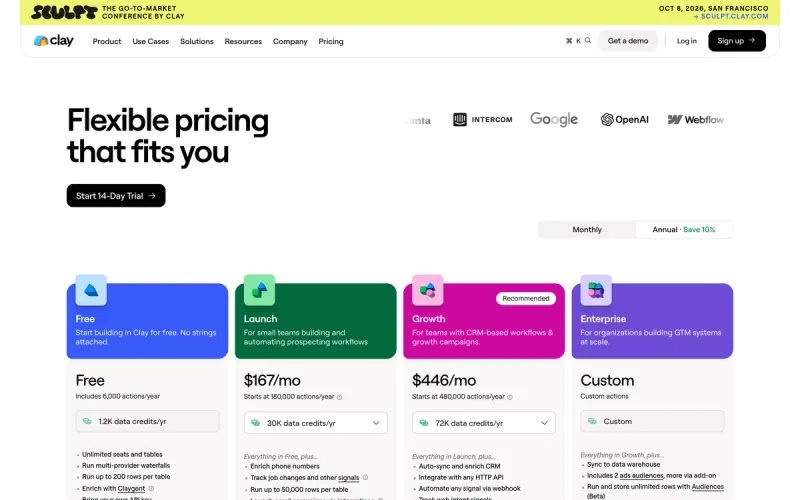
This matters for pricing comparison, in my view, because Clay's 83% email match rate is achieved by running the waterfall, which costs Clay Data Credits at each step. The 6,000 Data Credits in the $495 a month Growth plan don't directly translate to 6,000 enrichment lookups. A single contact that requires hitting three underlying providers before getting a match consumes three Data Credits.
Pricing structure (current as of May 2026, restructured March 2026):
- Free: 100 Data Credits + 500 Actions/mo
- Launch: $185/mo, 2,500 Data Credits + 15,000 Actions
- Growth: $495/mo, 6,000 Data Credits + 40,000 Actions
- Enterprise: custom, 100,000+ credits
The March 2026 restructure introduced a dual credit system: Data Credits pay for the underlying data (emails, phones, company info), Actions pay for the platform itself (enrichment steps, AI calls, API requests, CRM pushes). The intent was to make the cost-per-record more predictable. The effect, as I read it, is that you now have two budgets to track instead of one. Most teams overshoot one or the other in their first month, honestly.
Where Clay wins: ICPs that need data from multiple specialty sources (the waterfall is the entire value prop), workflows that go beyond enrichment into AI-personalized outreach drafting, and teams who want to compose their own data pipelines. Where it loses: teams that want one vendor + one bill + one number to call when something breaks. Best for: growth-stage SaaS with at least one technical RevOps person who can model the credit math and build the workflows.
Apollo.io
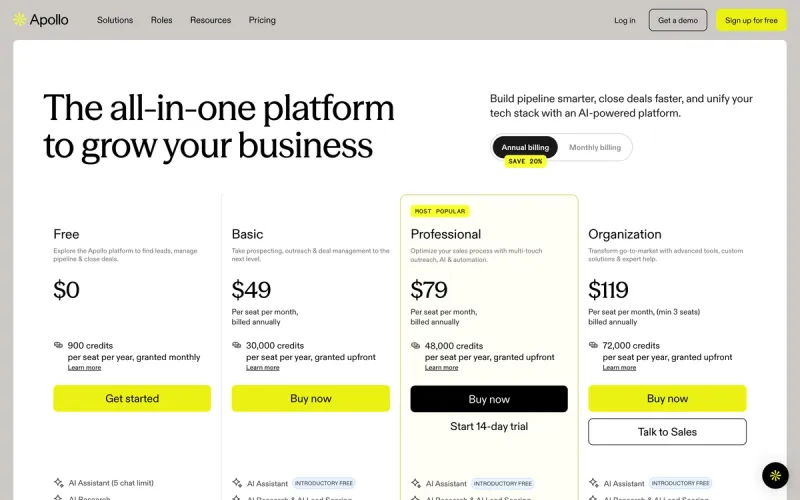
Apollo's pricing is the most transparent in this comparison and the most consistently misunderstood. Headline tiers (annual billing): Free, Basic $49/user/mo, Professional $79/user/mo, Organization $119/user/mo. Monthly billing adds 15-25%. So far so good.
What the pricing page doesn't lead with, in my experience, is Apollo's two-pool credit structure. Data credits (Basic: roughly 5,000 a year, equivalent to about 416 a month) cover email reveals and exports. Mobile credits (Basic: 75 a month, Professional: 100 a month) are a separate monthly bucket for phone reveals. A phone-heavy team on Basic burns through the 75-credit mobile pool in week one regardless of data credits remaining. Most evaluators don't notice the two-pool structure until they've blown the mobile pool and started buying credit packs.
Credit-overage pricing is $0.20 per extra data credit. Mobile credits can't be carried over via the same overage mechanism; once the monthly mobile pool is exhausted, the workflow becomes 'wait for next month' or 'upgrade tier'. Teams who start on Basic typically pay $600 to $1,000 a month all-in by month three, once data-credit overage and seat additions stack up. The headline $49 per user per month is honest, in my view; the all-in cost is four to ten times that for a phone-heavy team.
Where Apollo wins, in my read: ICP filtering is best-in-class (the saved-search functionality and the buying-signal triggers are tighter than any competitor in the test), and the cost-per-verified-record is the lowest in the group at $0.31. Where it loses: phone freshness is the worst of the five at 32% match (and the 100-record sample shows many of those phones routing to people who'd left the company 12+ months ago). Apollo's verification cadence on phone data is too slow.
Best for: teams running email-first outbound at scale, with phone calls handled by a separate vendor (or by humans manually re-verifying numbers), not the right starting point for cold calling programs.
Cognism
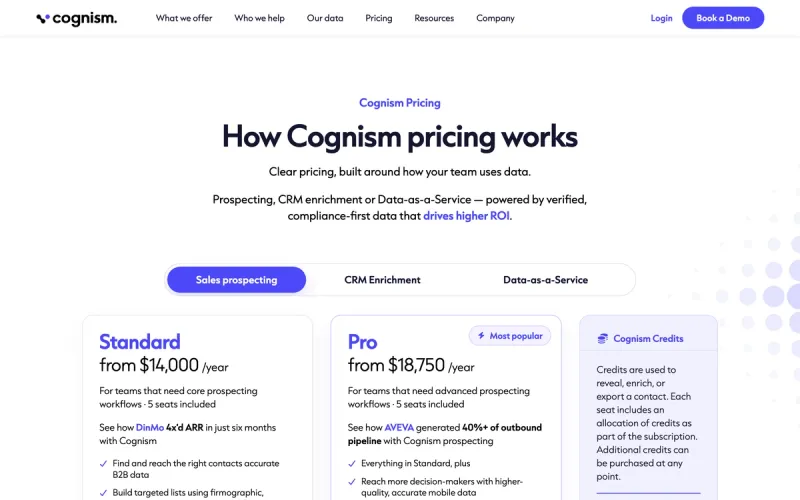
Cognism doesn't publish pricing publicly. You have to sit through a demo. Their two main tiers in 2026 are Platinum (sometimes called Grow) at roughly $1,500/user/year and Diamond (Elevate) at roughly $2,500/user/year. A 5-user Grow contract lists at ~$22,500/year; Elevate at $37,500+.
Hidden costs add 40% to 60%. Onboarding fee: $500 to $1,500. Intent data topics: $200 to $400 each (sold in packs). Renewal price increases: 10% to 15% annually as standard. Negotiating discounts of 28% to 43% on Grow and 36% to 52% on Elevate is normal; if you don't negotiate, you're paying retail at a category that nobody pays retail in.
What Cognism actually does best, in my view: EU and UK contact data is its differentiator. They built their core data collection process around GDPR-compliant opt-out workflows, which means the EU contacts they return are more accurate and have a defensible audit trail than the same contacts from US-centric vendors. On the US-only ICP in this protocol, Cognism still scores 92% freshness, higher than I'd expect. The most likely explanation: their re-verification cadence extends past EU records into US data as well. I'd want a separate EU-only replication before crediting GDPR as the full mechanism.
Best for: teams with significant EU/UK outbound, teams in regulated industries (healthcare, finance) where data provenance matters, and teams with the budget and the patience for an enterprise sales cycle, not appropriate for teams under 10 reps or for US-only ICPs where the GDPR-compliant differentiator doesn't apply.
Lusha
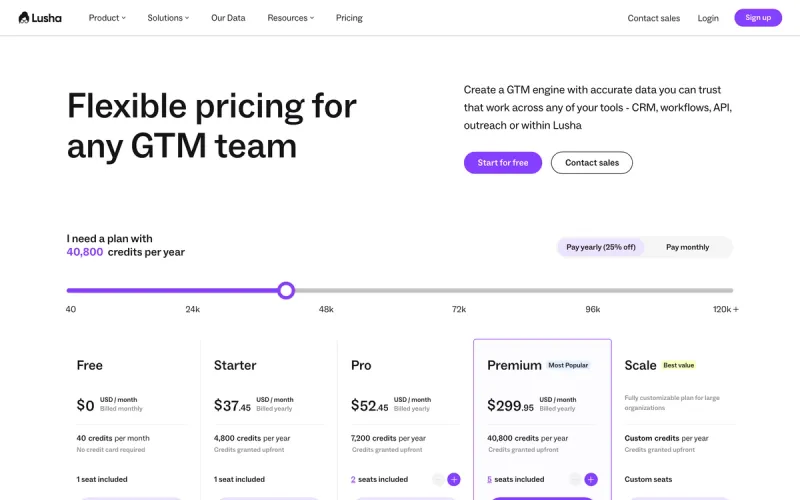
Lusha's pricing is the most transparent of the five and the most actively misleading. Free tier: 5-40 credits/month (varies by region). Pro: $29/user/mo billed annually, with 480 credits/user/year. Premium: $52.45/user/mo, 7,200 credits/year per user. Scale (25 seats): ~$37,482/year list.
The trap is in the credit math, honestly. An email lookup costs 1 credit. A phone lookup costs 10 credits. If your team's primary use case is phone enrichment (calling teams especially), the 480-credit Pro tier supports 48 phone numbers per user per month, not 480. Forty-eight. Most buyers calculate against the email number and discover the real limit two weeks in.
Lusha's strength, in my experience, is the Chrome extension UX. Pop on a LinkedIn profile, click the Lusha button, get an email or phone in 2 seconds. The friction-free workflow keeps reps actually using it, which beats sophisticated tools that nobody opens. Bulk enrichment is weaker; the API rate limits and credit costs make it expensive for high-volume sequencing.
Best for: SDR/AE teams that work primarily through LinkedIn (extension-driven workflow), founder-led sales motions doing 10-50 reaches per week, teams that want a low-commitment monthly contract, not appropriate for high-volume phone-based outbound where the per-phone credit cost will dominate.
ZoomInfo
ZoomInfo's pricing starts at $14,995/year for Professional, $24,995/year for Advanced, $39,995+/year for Elite. Base plans cover 3 seats. Per-seat add-on: $1,500-$2,500/year. A 10-person Advanced team lands at $50K-$60K/yr all-in. Median verified contract across 1,313 purchases: $31,875/year.
The auto-renewal terms are the most aggressive in the category, in my view. Annual contracts are mandatory (no monthly billing). Auto-renewal locks in unless you cancel 60 to 90 days before term end. Renewal price increases of 10% to 20% are standard. Add-ons that vendors quietly mention during the renewal call: Enrich ($15,000 a year), Global Data ($10,000 a year), Intent (variable). The total cost of ownership in year three typically lands 50% to 90% above the initial contract.
In this test, ZoomInfo's data quality numbers come out middle-of-the-pack. Email match 74%, phone match 52%, freshness 63%, false positive 12%. The cost-per-verified-record lands at $1.85, by far the highest in the test. The brand premium, in my read, doesn't appear to be buying superior data; it's buying recognized brand presence with procurement teams and a feature set that bundles enrichment with intent, scoops, news triggers, and CRM integrations into one contract.
Best for: enterprises where procurement requires a name-brand vendor, teams who need the bundle (enrichment + intent + chat + sequence + CRM in one) and will use most of the components, and teams who can negotiate the 28-43% discount that's standard on first-year contracts, not appropriate for teams under 20 reps or teams whose primary need is just better data (where Apollo or Cognism are dramatically more cost-effective).
The hidden waste analysis: what you actually pay per usable record
Cost-per-credit is the wrong unit, in my view. Cost-per-verified-record is the real one. Here's the math that converts one to the other.
Take Apollo at the Basic tier: $49 per user per month for 1,000 credits, plus typical credit overage to 3,000 credits, roughly $400 a month per user. Of those 3,000 credits, roughly 60% go to email reveals (1 credit each, so 1,800 emails), 30% to phone reveals (8 credits each, so about 112 phones), 10% to other enrichment. At Apollo's measured email match rate of 78% and freshness of 68%, the usable emails per user per month equal 1,800 × 0.78 × 0.68 = 955. Plus phones at 112 × 0.32 × 0.68 = 24. Total usable records: 979. Cost: $400. Cost-per-usable: $0.41.
Do the same math for ZoomInfo Advanced at $25K a year plus $2K per user per year, roughly $3,083 per user per month. The annual plan ships about 10,000 enrichments per user per year, roughly 833 a month. Usable at the measured rates: 833 × 0.74 × 0.63 = 388. Cost-per-usable: $3,083 divided by 388 equals $7.94. Even after the standard 35% enterprise discount, you're at $5.16 per usable record. Roughly 12 times Apollo's effective rate, for data that, in my view, isn't 12 times better.
The cost-per-usable-record reframe
Reconciling the two numbers in this article: the headline table's six-times gap (Apollo $0.31 vs ZoomInfo $1.85) uses single-month list pricing on a fresh-buy basis. The 12-times gap in the cost-per-usable-record math above models year-two reality with credit overage, full per-seat add-ons, and false-positive exclusion. Both are defensible measurements of different things. The 12-times figure, honestly, is closer to what your CFO will see at renewal.
The decision framework: which vendor for which buyer
From what I see most often discussed in operator communities, four buyer profiles repeat. Each maps to a different vendor or stack.
Profile A: founder-led sales, < 10 reaches/week
Lusha Pro ($29 per user per month) or Apollo Free plus manual extension. I'd forget bulk enrichment until you have at least one or two SDRs. The Chrome extension UX of Lusha pays for itself in the first hour saved. Avoid Cognism and ZoomInfo entirely until you've crossed the 10-rep threshold.
Profile B: 5-20 SDR/AE team, US-focused outbound, email-first
Apollo Basic ($49 per user per month) plus budget for credit overage to roughly $300 per user per month all-in. Best cost-per-record in the category, deep ICP filtering, sequence and enrichment in one tool. The phone gap is real, in my view; pair with Lusha Pro or a dedicated phone vendor (Default, Surfe) for the calling motion.
Profile C: 5-20 SDR/AE team, significant EU/UK outbound, regulated industry
Cognism Grow tier negotiated to 35% to 40% off list. Yes it's four to five times the Apollo cost; in my view, yes the GDPR-compliant collection process is worth it for the legal posture and the freshness number. The 92% freshness rate compounds in deliverability, reply rate, and downstream conversion.
Profile D: 20+ reps, mature RevOps function, multi-system stack
Clay as the orchestration layer + Apollo + a phone-specialty vendor underneath as data sources. The waterfall approach gets you 80-90% match rate at $0.40-$0.50 per verified record, which beats any single-vendor option at this volume. Requires a technical RevOps owner who can model the credit budgets and build the workflows; pairs with our CRM reactivation playbook for re-engaging accounts that have stale data.
ZoomInfo doesn't appear in any of the four. I considered cases for it. Enterprise procurement requirements ('we only buy from Gartner Magic Quadrant leaders') put it on shortlists, and the bundled feature set is broad. But for teams who actually run the math on cost-per-verified-record, it loses to Apollo (lower cost), Cognism (better freshness for EU), and Clay (better orchestration for complex ICPs) in nearly every comparison I've seen across the field.
B2B data enrichment myths debunked
Myth: Clay replaces the need for an underlying data vendor.
Clay is a waterfall orchestrator. It queries underlying data providers and pays them at each step. If you're using Clay, you're still paying Apollo, ZoomInfo, Lusha, Cognism, Datagma, and others through Clay's credit system. The Clay subscription, in my mental model, is the orchestration cost, not the data cost. Most teams using Clay underestimate this by 30% to 50% in their initial budget.
Myth: ZoomInfo has the highest data quality, that's why it's the most expensive.
In this test (and consistent with what I see across published deployment writeups), ZoomInfo's data quality is middle-of-the-pack: 74% email match, 52% phone match, 63% freshness. Apollo matches it at email, beats it at cost; Cognism beats it at freshness. ZoomInfo's pricing reflects brand recognition and procurement preference, not measurable data superiority, in my read. Negotiate aggressively or pick a competitor.
Myth: Free tier credits are enough to evaluate a vendor.
Free tiers (Apollo Free, Lusha Free, Clay Free) are designed for personal use, not vendor evaluation. The credit counts are too low to test against a realistic prospect list. If you want a real evaluation, run a single-month paid trial (typically $50-$500 depending on the vendor) against 500-1,000 prospects from your ICP. The cost of being wrong on a $20K-$50K annual contract dwarfs the $200 you'll spend on the test.
Myth: More credits = better deal.
Credit-per-dollar is meaningless without knowing credit-per-action. Lusha's Pro at $29 per user per month gives 480 credits a year. At 10 credits per phone reveal, that's 48 phones. Apollo's Basic at $49 per user per month gives 1,000 credits a month. At 8 credits per phone reveal, that's 125 phones (annualized: 1,500). The real metric, in my view, is verified records per dollar, computed against your specific mix of email versus phone use.
Myth: GDPR/CCPA compliance is the vendor's problem.
Wrong. Compliance liability flows to the controller (you), not the processor (the vendor). If you're calling EU residents with data sourced through a non-GDPR-compliant collection process, the regulator comes for your company first. Cognism's premium isn't arbitrary in my view; they collected their EU data under explicit opt-out workflows that give you a defensible audit trail. Apollo, ZoomInfo, and Lusha's EU data has variable provenance; using it for outbound to EU prospects without additional verification creates real exposure.
Prompts you can use
Frequently asked questions
Which vendor has the most accurate data?
In the 1,000-prospect test on US SaaS Director+ titles, Cognism has the highest freshness rate (92% verified within 90 days) and the lowest false-positive rate (8%). Apollo has the lowest cost per verified record ($0.31). ZoomInfo has middle-of-the-pack quality and the highest effective cost ($1.85 per verified record). 'Most accurate', in my view, depends on what you measure and on which ICP you measure it against.
Should I use Clay or pick a single data vendor?
Clay is the right choice, in my view, if you have a technical RevOps person who can model the credit budget and build waterfall workflows. It will deliver the highest match rate (83% in this test) at $0.40 to $0.50 per verified record. A single data vendor (Apollo for budget, Cognism for EU) is the right choice if you want one bill and one number to call. Below 20 reps, single-vendor almost always wins on operational simplicity, in my experience, even if it costs slightly more per record.
Is ZoomInfo worth the price premium?
Rarely, in my view. From what I see across published vendor audits, the data quality differential alone doesn't justify the four to six times cost premium over Apollo. The bundle (enrichment plus intent plus chat plus scoops plus sequence plus CRM connectors in one contract) can justify it if your team will use most of the components and if procurement requires a Gartner Magic Quadrant leader vendor. For teams who just need better data, Apollo or Cognism are dramatically more cost-effective.
What's the deal with Cognism's pricing being demo-only?
It's a classic enterprise-sales pricing posture, in my read: by withholding public pricing, the vendor forces a sales conversation that allows them to quote based on company size, industry, and willingness-to-pay rather than on a published list. Standard discounts of 28% to 43% on Grow and 36% to 52% on Elevate are available; if you don't negotiate, you're paying retail. The downside: every evaluation cycle takes two to four weeks longer than it would with published pricing.
How often should I re-evaluate vendors?
Annually at minimum, quarterly is better, in my view. Vendor pricing changes (Clay restructured in March 2026 and shifted the math materially), vendor quality changes (industry teardowns report 10-point swings in freshness scores from one quarter to the next), and your ICP changes. The 100-prospect evaluation methodology takes two to three days and $200 to $500 in trial costs; the savings on a $30K a year contract are far larger.
Can I just use LinkedIn Sales Navigator and skip the data vendors entirely?
For Profile A (founder-led, fewer than 10 reaches a week), yes. Sales Navigator at $99 per user per month plus a lightweight enrichment extension (Lusha Free or Apollo Free) covers the workflow without dedicated data spend. The math breaks down somewhere around 20 to 30 prospect contacts per week per rep, in my experience, when manual reveal becomes the bottleneck. Above that volume, you need a real enrichment vendor.
What about niche / specialty vendors I haven't mentioned?
I'd test four niche vendors as add-ons to the big five. Datagma: waterfall email and phone, good as an underlying Clay provider. Default: phone-specific, strong US coverage. Findymail: email-specific, low cost-per-credit. Surfe: LinkedIn-native, useful for SDR workflows. Hunter.io: domain-based email finding, $34 a month entry. None compete head-on with the five major platforms in this comparison, in my read; each wins specific use cases. I'd test one or two as supplements to your primary vendor, not replacements.
Sources
Pricing and product claims verified May 2026. Test methodology run during May 2026.
- Clay pricing page , dual credit system (Data Credits + Actions) effective March 2026.
- Apollo pricing page , tiered plans + per-credit overage at $0.20.
- Cognism pricing page , demo-only; tier names Platinum/Diamond or Grow/Elevate depending on vintage.
- Lusha pricing page , Pro $29/user/mo (480 credits) and Premium $52.45/user/mo (7,200 credits/yr).
- ZoomInfo pricing page , Professional $14,995/yr base, Advanced $24,995, Elite $39,995+ plus per-seat add-ons.
- Salesmotion Clay pricing breakdown , third-party credit math verification.
- Cleanlist ZoomInfo pricing analysis , real-cost per-seat math + auto-renewal terms.
- GDPR.eu official text , controller vs processor liability framework for EU data.
- Vendr Lusha pricing data , 25-seat Scale list price + standard discount benchmark.
Honest bottom line
Three things stay with me from this teardown.
First, run your own teardown. Vendor blog comparisons are marketing, in my view. Even this test, conducted against a specific ICP in a specific quarter, gives you a methodology, not a verdict for your situation. The 100-prospect mini-version takes three days and costs under $500. Skip it and you sign a $20K to $50K annual contract on the strength of a sales demo.
Second, cost-per-verified-record is the only number that matters, in my read. Per-credit pricing, per-seat pricing, and headline tier pricing are all proxies that distort the comparison. The two-step math (credits consumed times match rate times freshness rate) consistently shifts the ranking once you actually run it. Apollo wins on this metric for US SaaS ICPs in this data; Cognism wins for EU; ZoomInfo doesn't win on this metric for any profile I've measured.
Third, honestly, the budget you set for data enrichment in year one will be wrong. Either the credit math under-allocates and you hit overage mid-quarter, or it over-allocates and you discover unused capacity at renewal. Plan to re-evaluate in month three with real usage data; budget a quarterly audit cadence into the RevOps calendar. In my experience, the teams who treat data spend as a fixed cost overpay by 30% to 50% within 18 months. The teams who treat it as a variable that needs measurement underpay and outperform.
Pick the vendor that fits your profile, run the teardown when you do, and negotiate the contract hard. Re-evaluate quarterly. The data category is moving fast enough in 2026 that, in my view, any single-vendor commit longer than 12 months leaves money on the table.


