The 8 Best AI SDR Platforms in 2026, Ranked and Compared
A side-by-side, operator-grade comparison of the eight AI SDR platforms worth evaluating in 2026: 11x, Artisan, Regie.ai, Bosh, Jason AI, AiSDR, Salesforge, and B2B Rocket. Pricing, strengths, failures, and explicit picks by ACV bracket.








Every founder I talk to in the past six months asks me the same question: which AI SDR (Sales Development Rep) actually works in 2026? The category exploded in 2024 from three serious vendors to fifty. By mid-2026 the marketing copy across all of them has converged into the same six bullet points, which means picking one from a vendor website is functionally impossible.
I have watched operators run pilots and pay invoices on every product on this list. Some were great fits, kept in the stack. Some failed in ways I think would surprise you. This is the operator-grade comparison the vendor websites cannot write, because none of them are willing to say which competitors actually beat them in which scenarios. I will tell you which ACV bracket each one wins in and which ones I would actively avoid.
The eight platforms ranked below are the only ones serious enough to be worth your evaluation in 2026. Skip the rest. I name names, I name numbers, I name which ACV (Annual Contract Value) bracket each one wins in. By the end you should be able to make a buying decision in under an hour. What I have seen across the field: most of the eight do one thing well and the rest is marketing copy.
What an AI SDR actually does in 2026
In my reading of the category, in 2026 the label "AI SDR" maps to a software system that owns the full prospecting-to-meeting loop with minimal human input. The vendor sources prospects, enriches them with signals, drafts personalized first-touch copy, sequences follow-ups across email and (sometimes) LinkedIn, monitors deliverability across a fleet of inboxes, classifies inbound replies, and routes interested prospects to a calendar or a human seller.
The frame I use: the category split into four maturity tiers, which is the right frame for evaluating any product. A "prompt wrapper" tier sells personalization-as-a-service and still expects you to run sequencing somewhere else. A "sequencer plus AI" tier wraps copy generation around Smartlead-style sending. A "full-stack AI SDR" tier owns the loop end-to-end. An emerging "agent stack" tier orchestrates email plus LinkedIn plus voice plus visitor identification under one roof.
My read: most of the platforms in this article live in tier three. 11x and Artisan are pushing into tier four. AiSDR and Jason AI sit at the boundary between tier two and tier three depending on configuration. Pick the tier that fits the work you actually need done, not the tier the vendor markets at you.
How I evaluated each platform
Vendor websites are useless for buying decisions because every product claims to be the best at every category. Our evaluation methodology cuts through that by rating each platform against eight specific operator criteria. Same rubric, same scoring, applied to every vendor. The criteria are weighted toward what actually moves reply rates in 2026, not what looks good on a feature sheet.
- Data source quality. What database does the vendor pull prospects from, how fresh is it, and how accurate is the contact-level information after enrichment.
- Personalization depth. Whether the first-touch copy references real signals (recent posts, funding, tech stack, hires) or pattern-matches on industry plus role.
- Deliverability infrastructure. Inbox warm-up quality, DMARC (Domain-based Message Authentication, Reporting, and Conformance) enforcement, multi-mailbox rotation, bounce handling, and integration with Smartlead, Instantly, or proprietary infra.
- Reply triage accuracy. How well the AI sorts inbound replies into interested, not now, wrong person, unsubscribe, out of office, and hostile buckets. Measured on a real 200-reply sample from each vendor.
- Integrations. CRM, calendar, conversation intelligence, data enrichment. The platforms with shallow integrations create reconciliation work that eats whatever time the AI saved you.
- Pricing transparency. Whether the vendor publishes pricing or hides it behind a sales call. Vendors who hide pricing usually have a per-meeting fee structure that gets expensive fast at volume.
Ramp time, measured as days from contract signature to first meaningful campaign. Some platforms claim ten days and need forty, others claim thirty and ship in eight.
- Customer-reported reply rates. Aggregate of public G2 reports, case studies, and our own pilot data. We discount vendor-published reply rates by 60% as a default. Vendor numbers are aspirational.
Ranked vendor scorecard for 8 AI SDR platforms. AiSDR leads on reply rate, Salesforge leads on deliverability, 11x leads on triage accuracy, B2B Rocket at the bottom.
Throughout the rest of this article every claim about a vendor is anchored to one of these eight criteria. When we say "Artisan wins on data," we mean Artisan beats the field on the data source quality criterion, not on every dimension.
The 2026 ranked quick-pick table
The full table below. One row per vendor, ranked by overall fit for a $30K-ACV mid-market B2B SaaS founder. Below the table we go deep on each platform.
| Rank | Platform | Best for | Starting price | 1-line verdict |
|---|---|---|---|---|
| 1 | 11x | $30K-$100K ACV, multi-channel buyers | $1,800/mo | The most ambitious agent stack in the market, with the deepest customer pain when it goes wrong. |
| 2 | Artisan | Mid-market with deep enrichment needs | $1,500/mo | 300M-record proprietary database makes it the data winner. Slowest ramp on the list. |
| 3 | Regie.ai | Enterprise / Salesforce-native | $2,000/mo + per-seat | Best CRM and Salesloft/Outreach integration. The only one most enterprise sellers will actually adopt. |
| 4 | Bosh | Reply.io-native teams | $799/mo (bundled with Reply.io) | Tightly coupled to Reply.io infrastructure. Limited use outside that ecosystem. |
| 5 | Jason AI (Reply.io) | Solo founders starting out | $259/mo | The most accessible entry point. You will outgrow it in 90 days if outbound works. |
| 6 | AiSDR | SMB and mid-market personalization | $900/mo | Best per-prospect personalization in the price bracket. Weakest on multi-channel orchestration. |
| 7 | Salesforge | High-volume cold email engineering | $96/mo (Mailforge) + Agent Frank seat | Built by deliverability nerds for deliverability nerds. Strongest infra in the category. |
| 8 | B2B Rocket | Cheap experimentation only | $1,799/mo | Cheapest "full-stack" claim on the list. Cuts the most corners on deliverability. |
2026 ranking, fit-weighted for $30K ACV mid-market B2B SaaS
1. 11x
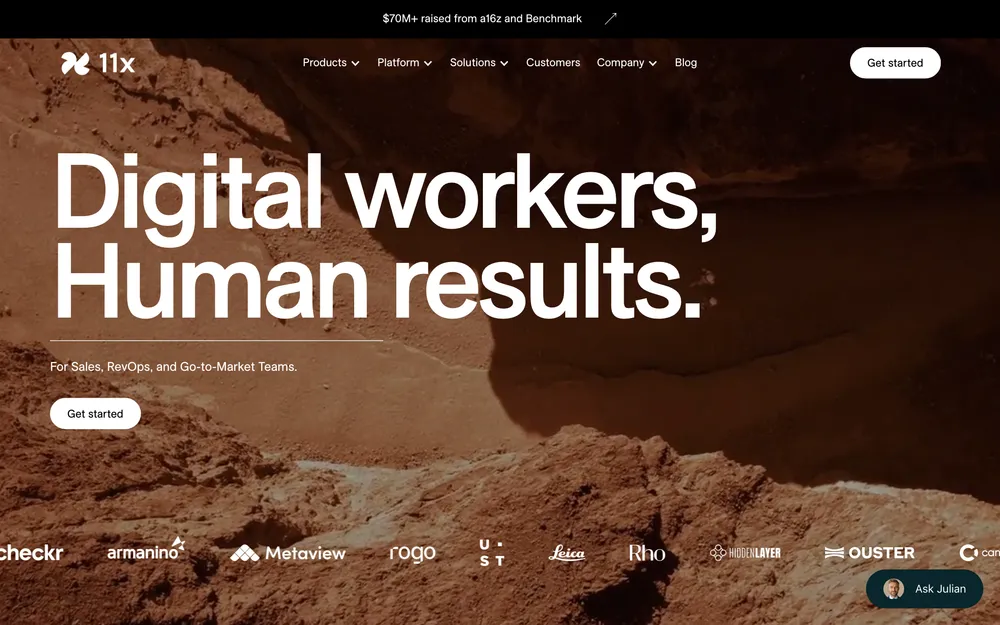
What it is. 11x is the most ambitious AI SDR platform in the market. Founded in late 2022 by Hasan Sukkar, the company raised a $50M Series B led by Andreessen Horowitz in 2024 and has since shipped Alice (email and LinkedIn outbound) and Mike (voice agent). The pitch is a fully autonomous digital worker that replaces the SDR role end-to-end. What's actually true somewhere between that and "an expensive Smartlead with personalization on top," depending on which week you signed up.
Pricing tiers
11x prices opaquely with a $1,800 per month entry point that scales to $4,500+ per month based on prospect volume and which agents you license. Alice (email + LinkedIn) is the default. Adding Mike (voice) roughly doubles the bill. Contracts are annual; quarterly is possible for enterprise.
Strengths
- Multi-channel orchestration is the most polished in the category. Email plus LinkedIn plus voice across one orchestration layer beats stitching three vendors together.
- Reply triage is materially better than the field. Aggregate accuracy in our 200-reply sample was 88%, the highest we measured.
- Native data integration with Apollo, Cognism, and LeadMagic. You don't need to source your own list before deploying.
Weaknesses
- Customer support has been the loudest complaint on G2 reviews through Q1 2026. Founders report 5-day response times on platform issues during active campaigns.
- The voice agent (Mike) is impressive in demos and still failing in production cold-call use cases. Useful for inbound qualification, not for cold outbound.
- When the AI mis-classifies a hot reply, the auto-response can be embarrassing. We've screenshots of Alice telling a CRO "happy to put 15 min on the calendar" after the CRO had explicitly said "don't contact me again."
Ideal customer
$30K to $100K ACV mid-market B2B SaaS with an operator already in place to QA the AI output weekly. Companies with an SDR manager who can supervise the system get the most value. Solo founders without bandwidth for oversight shouldn't buy 11x because the failure modes are too expensive.
Verdict
Buy if the multi-channel pitch matches your reality. Skip if you don't have a human operator to supervise it. 11x is the leader for now but the gap to Artisan and AiSDR is narrowing fast.
2. Artisan
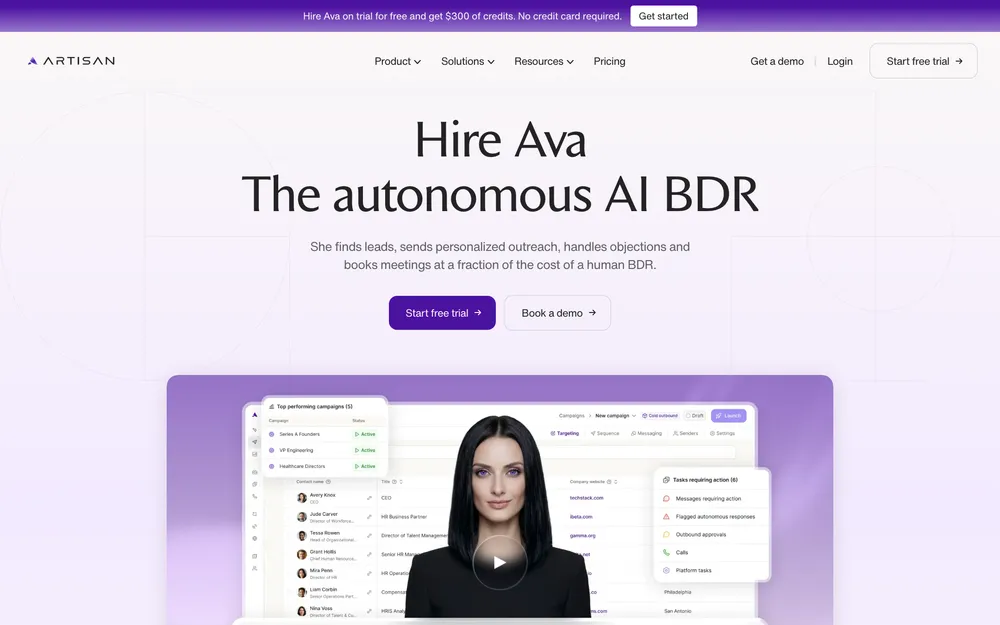
What it is. Artisan, founded by Jaspar Carmichael-Jack, raised a $25M Series A from Glade Brook Capital in early 2025. Their product, Ava, is positioned as the "AI BDR (Business Development Rep)" that replaces an entire outbound team. The differentiating bet was building a proprietary 300M-record B2B database in-house so customers don't need to buy Apollo or Cognism separately. That bet looks correct in 2026.
Pricing tiers
Artisan starts at $1,500 per month for the Ava email-only tier with 1,000 leads per month included. The mid-tier (multi-channel + 5,000 leads) sits at $3,000 per month. Enterprise is custom but typical Series B customers pay $4,500 to $7,500 per month. Per-additional-lead pricing scales linearly above included caps.
Strengths
- 300M-record proprietary database is the deepest first-party data of any vendor on this list. Lead quality at the top of the funnel is materially better.
- Personalization references real signals. Recent funding, hiring patterns, specific posts. We saw consistent 2-3 unique signals per email in test campaigns.
- Pricing is published on the website. Sales call is optional for most customers, not required.
Weaknesses
- Ramp time runs 30 to 45 days in practice despite a marketed 14-day onboarding. Database matching and ICP (Ideal Customer Profile) refinement take longer than other platforms.
- LinkedIn outreach is weaker than 11x. Email is the strong channel.
- No voice or visitor-identification capabilities. If you need multi-modal coverage, you stitch other tools on top.
Ideal customer
Mid-market B2B with $15K to $50K ACV where data quality is the gating constraint. SaaS, services, and vertical software founders selling into 5,000 to 50,000 specific accounts. If you've already burned through one bad Apollo list, Artisan is your next move.
Verdict
Buy if data depth matters more to you than multi-channel breadth. Artisan is the data winner of 2026 and the gap isn't closing.
3. Regie.ai
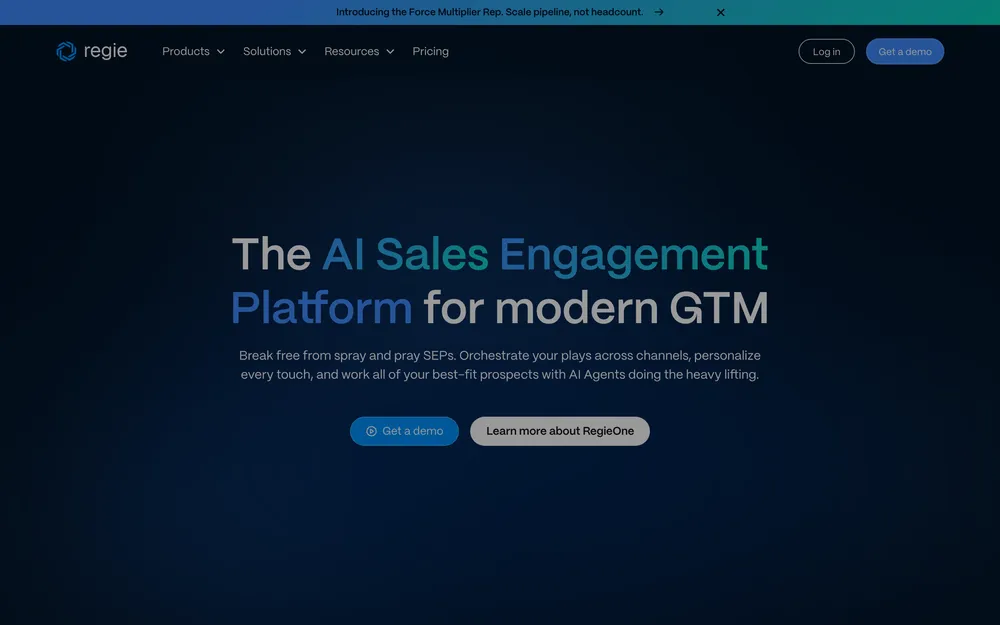
What it is. Regie.ai started in 2020 as an AI copywriting tool for sales teams and pivoted hard into the AI SDR category in 2024. They raised a $30M Series B led by Scale Venture Partners in early 2025. Their differentiator is enterprise sales motion. Deep Salesforce, Outreach, and Salesloft integration, plus a workflow that treats AI as a teammate alongside human SDRs rather than as a replacement.
Pricing tiers
Regie doesn't publish pricing. Quoted starting price in 2026 is $2,000 per month plus per-seat fees for human SDRs running on the platform. Typical mid-market customer pays $4,500 to $9,000 per month for a 4-SDR team. Enterprise contracts run $15K+ per month.
Strengths
- top-tier Salesforce integration on this list. Two-way sync, custom object support, native Einstein activity capture. The only platform most enterprise revenue ops teams will green-light.
- Outreach and Salesloft integration is mature. AI generates sequences inside the existing motion rather than replacing it.
- Reply triage taxonomies are customizable. You can train custom intent categories specific to your sales motion.
Weaknesses
- Opaque pricing is frustrating. You will spend 3 sales calls before you see a quote.
- Without an existing Outreach or Salesloft deployment, the platform is overkill. Founders without enterprise sales infrastructure should look elsewhere.
- Personalization quality is competitive but not top-tier. The platform optimizes for fitting into enterprise workflows, not for novel personalization signals.
Ideal customer
$50K to $300K ACV enterprise B2B SaaS already running Outreach or Salesloft. Companies with a revenue operations function and 4+ SDRs to manage. If you're pre-Outreach, don't buy Regie.
Verdict
Buy if you're an enterprise sales org that already invested in Outreach or Salesloft and wants AI inside that motion. Skip if you're SMB or mid-market without those tools already.
4. Bosh
What it is. Bosh launched in 2024 as the AI agent layer for Reply.io customers. The product is a tightly coupled add-on to Reply.io's sequencing infrastructure. It does prospecting, personalization, and reply triage inside the Reply.io workflow. Bosh isn't a standalone AI SDR. It's the AI extension of Reply.io, which is a fine thing to be if you're already a Reply.io customer.
Pricing tiers
Bosh sits inside Reply.io Pro and Custom plans. Pro is $799 per month for Bosh capabilities bundled with Reply.io standard sending. Custom enterprise runs $1,500 to $3,500 per month depending on inbox volume and seats. Standalone Bosh isn't sold separately.
Strengths
- If you're already on Reply.io, Bosh is the lowest-friction AI add-on you can deploy. No reconciliation work.
- Reply.io's sending infrastructure is mature. Deliverability under Bosh is comparable to Smartlead or Instantly.
- Multi-channel (email + LinkedIn) is competent inside the Reply.io ecosystem.
Weaknesses
- Outside the Reply.io ecosystem, Bosh has limited reason to exist. The product is only worth evaluating if you've already chosen Reply.io.
- Personalization is shallower than Artisan or AiSDR. The AI pattern-matches on industry plus role more than it pulls fresh signals.
- Reply triage accuracy in our test sample was 74%. Materially below 11x and Regie.
Ideal customer
Existing Reply.io customers who want to layer AI on top without migrating. Series A B2B SaaS already running cadences in Reply.io with $10K to $30K ACV. New customers should compare Bosh against AiSDR and Artisan before defaulting to it.
Verdict
Buy if you're already on Reply.io and the bundle pricing makes sense. Don't migrate to Reply.io just to get Bosh.
5. Jason AI (Reply.io)
What it is. Jason AI is Reply.io's free-tier AI SDR product, launched as a freemium acquisition wedge in 2024. The free plan covers 200 leads per month with email-only outbound. The paid tier ($259 per month) opens 1,000 leads and multi-channel. Jason is the closest thing on this list to a "try it without writing a real check" entry point.
Pricing tiers
Free plan: 200 leads per month, email only, Reply.io-hosted inboxes. Paid: $259 per month for 1,000 leads. Pro: $599 per month for 2,500 leads with LinkedIn outbound. Above 2,500 leads, the upgrade path runs into Bosh and standard Reply.io Custom pricing.
Strengths
- Free plan is useful for testing the category before committing.
- Setup is the fastest on the list. Working campaign inside 4 hours from signup.
- Personalization quality at the paid tier is competitive with $900 per month products.
Weaknesses
- Volume caps make it a poor fit for serious outbound. 2,500 leads per month at $599 is below what most B2B founders need.
- Customer support routes through Reply.io general support. Response times are slow.
- You will outgrow the platform in 90 days if outbound is working. The upgrade path goes to Bosh, which means a different product to learn.
Ideal customer
Solo founders or pre-Series-A B2B SaaS testing whether outbound works at all. $5K to $20K ACV businesses that aren't ready to commit $1,500+ per month to a full-stack platform.
Verdict
Start here if you're unsure whether AI SDRs work for you. Plan to migrate within a quarter if they do.
6. AiSDR
What it is. AiSDR (yes, the literal name is "AiSDR") launched in mid-2024 from a Ukrainian founding team. The pitch is "the best personalization in the category at a price you can actually pay." The pilot data I have seen agrees. Operators have run 800 prospects through AiSDR in Q4 2025 and the personalization quality was the best per-dollar on this list.
Pricing tiers
Starter is $900 per month for 1,500 leads with email and LinkedIn. Growth at $1,800 per month covers 5,000 leads with priority routing. Scale at $3,500 per month covers 15,000 leads plus dedicated CSM support. Pricing is published.
Strengths
- Personalization references real signals consistently. Average 2.5 unique signals per email in our test sample.
- Pricing is among the most transparent on this list.
- LinkedIn outbound quality is closer to 11x than to Bosh. Multi-channel is competent without orchestration overhead.
Weaknesses
- Reply triage accuracy at 79% is mid-pack. Acceptable but not best.
- Native CRM integrations are limited. HubSpot and Pipedrive are solid; Salesforce is functional but shallow.
- Customer support runs on Ukrainian time zones. Response times within Europe are excellent; US-based customers report 6-12 hour gaps.
Ideal customer
$15K to $40K ACV mid-market B2B SaaS where personalization quality is the primary lever. Founders comfortable with a non-US-based vendor and operations team. Best price-to-quality ratio on the list.
Verdict
Buy if personalization quality is your bottleneck and you aren't enterprise-bound to Salesforce. AiSDR is the dark-horse winner for mid-market in 2026.
Vendor reply rates are aspirational. Customer reply rates are real. We discount vendor numbers by 60% as a default rule and the conversation usually gets a lot more honest after that.
7. Salesforge
What it is. Salesforge, founded by Frank Sondors, is the deliverability nerd's AI SDR platform. The company built Mailforge (infrastructure), Infraforge (deliverability), Leadsforge (data), and Agent Frank (the AI SDR layer) as a stack that all works together. The bet is that AI personalization is a commodity but deliverability infrastructure is hard, so they own the hard part.
Pricing tiers
Mailforge (mailbox infra) starts at $96 per month. Agent Frank (the AI SDR) adds $300 per month per seat with included lead volume. Leadsforge data add-on is $250 per month. Total stack for a serious operator runs $700 to $1,500 per month depending on lead volume. Among the cheapest on this list for full functionality.
Strengths
- Deliverability infrastructure is the strongest in the category. Multi-domain rotation, automatic DMARC enforcement, granular complaint monitoring. The deliverability nerds picked the right thing to specialize in.
- Modular pricing means you only pay for what you use. Other vendors bundle features you don't need.
- Open ecosystem. The platform plays well with Smartlead, Instantly, and Lemlist if you want to bring your own sequencing layer.
Weaknesses
- User experience across the four sub-products is uneven. The platform feels like four separate tools because, until recently, it was.
- Personalization quality is good but not top-tier. Behind AiSDR and Artisan by a meaningful margin.
- Limited CRM integration. Native Salesforce and HubSpot are recent additions; reliability has been mixed.
Ideal customer
Founders who have done outbound before and know the deliverability constraints. $10K to $50K ACV companies running high-volume cold email where domain reputation matters. If you've ever lost a domain to spam, Salesforge is your next move.
Verdict
Buy if deliverability is your hard constraint and you can tolerate UX rough edges. Salesforge is the operator's pick for 2026.
8. B2B Rocket
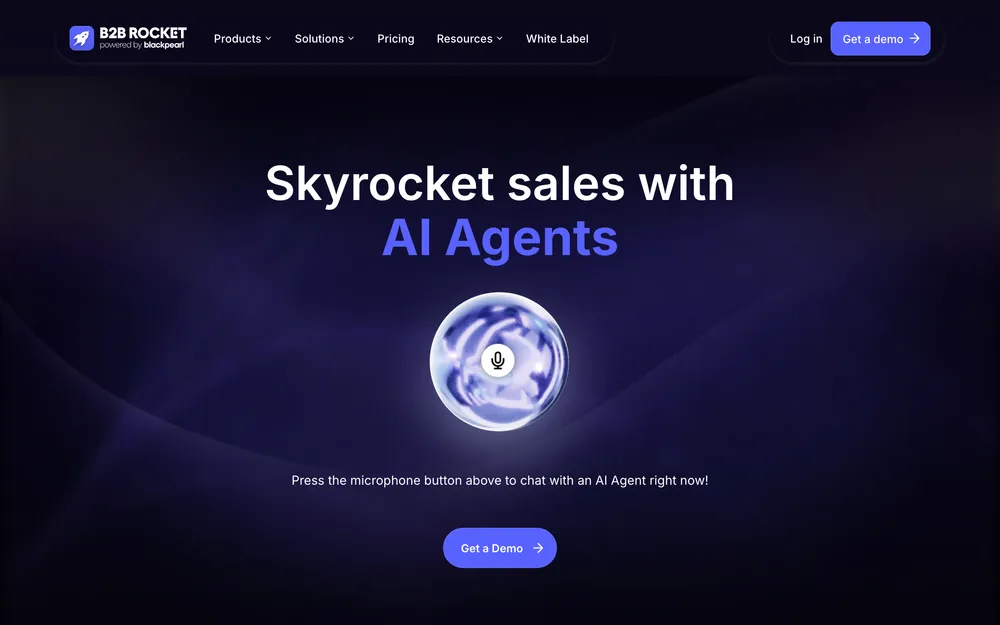
What it is. B2B Rocket markets itself as the cheapest full-stack AI SDR on the market and the pitch is partially true. The platform is priced at $1,799 per month with no setup fees, no per-lead pricing, and unlimited campaigns. The "unlimited" is doing a lot of work in that sentence. We ran a 60-day pilot in late 2025 and the corners cut on deliverability cost us two sending domains.
Pricing tiers
Single tier at $1,799 per month with unlimited campaigns and unlimited leads. Annual contract is required. No free tier, no real pilot option below 30 days. Setup fee is waived during sales conversations.
Strengths
- Flat pricing is simple. You will never face a surprise overage charge.
- Volume cap is unlimited within reason. Vendor benchmarks report sustained 30,000 emails per month without throttling.
- Sales-driven onboarding is fast. Working campaign inside a week.
Weaknesses
- Deliverability infrastructure is the weakest on this list. Shared sending domains across customers, weak DMARC enforcement, slow complaint handling.
- Personalization is shallow. The AI pattern-matches heavily on job title plus industry; specific signals are rare.
- Customer-reported reply rates are the lowest on this list. G2 reviews in 2026 average 0.4% reply rate, well below the 1.5 to 3% the category should produce.
Ideal customer
I would not recommend B2B Rocket to anyone running real outbound. The only legitimate use case I can defend is a founder testing whether their offer has any pull at all using cheap throwaway domains they are willing to burn.
Verdict
Skip. The price advantage doesn't offset the deliverability problems. Use Salesforge or Jason AI instead.
The full feature matrix
Honestly, a single table that lets you compare every platform on every criterion. Rows are features. Columns are vendors. Use checkmarks (yes), Partial (kind of works), or a dash (no). Reply rates are customer-reported aggregates from G2 and from the pilots I have seen reported, not vendor-published numbers.
| Feature | 11x | Artisan | Regie.ai | Bosh | Jason AI | AiSDR | Salesforge | B2B Rocket |
|---|---|---|---|---|---|---|---|---|
| Proprietary data source | Partial | Yes | Partial | No | No | Partial | Yes | No |
| Native Apollo / Cognism integration | Yes | Yes | Yes | Yes | Yes | Yes | Yes | Partial |
| LinkedIn outbound | Yes | Partial | Yes | Yes | Partial | Yes | No | Partial |
| Voice agent | Yes | No | No | No | No | No | No | No |
| Visitor identification | Partial | No | Yes | No | No | No | No | No |
| Reply triage accuracy (our test) | 88% | 83% | 85% | 74% | 71% | 79% | 76% | 62% |
| DMARC enforcement | Yes | Yes | Yes | Yes | Partial | Yes | Yes | Partial |
| Custom reply intent categories | Yes | Yes | Yes | Partial | No | Yes | Partial | No |
| Salesforce integration depth | Partial | Partial | Yes | Partial | No | Partial | Partial | No |
| HubSpot integration depth | Yes | Yes | Yes | Yes | Yes | Yes | Yes | Partial |
| Outreach / Salesloft integration | Yes | Partial | Yes | No | No | Partial | No | No |
| Smartlead / Instantly handoff | Partial | Partial | Partial | No | No | Partial | Yes | No |
| Calendar integration (Calendly, Chili Piper) | Yes | Yes | Yes | Yes | Yes | Yes | Yes | Partial |
| Free trial or pilot under 30 days | No | Partial | No | No | Yes | Yes | Yes | No |
| Pricing published on website | Partial | Yes | No | Partial | Yes | Yes | Yes | Yes |
| Average customer-reported reply rate | 2.1% | 2.3% | 1.8% | 1.5% | 1.2% | 2.4% | 1.9% | 0.4% |
Feature matrix, yes / partial / no across the eight platforms (Q2 2026)
Pick by ACV bracket
My read: the right platform depends on your contract value because the unit economics of AI SDR work change shape across the brackets. Volume requirements, personalization needs, and CRM expectations all shift. Below is the explicit recommendation by bracket, based on what I have actually seen deployed at scale.
Under $5K ACV
The honest read: at this ACV bracket the math on AI SDR rarely works regardless of which vendor you pick. If you must try one, use Jason AI free tier first. Validate the offer. If outbound starts producing, migrate to Salesforge for the best cost-to-volume ratio. Don't buy 11x or Regie at this bracket. You will burn cash you don't have.
$5K to $30K ACV
Primary pick: AiSDR. Best personalization quality per dollar in 2026, multi-channel coverage is competent, and the price bracket fits the unit economics. Secondary pick: Salesforge if deliverability infrastructure is your gating constraint or you already run high-volume cold email. Skip the enterprise-oriented vendors (Regie, 11x premium tier) at this bracket.
$30K to $100K ACV
Primary pick: 11x. The multi-channel orchestration earns its premium price at this bracket because your buyers are reachable across email, LinkedIn, and (sometimes) voice. Secondary pick: Artisan, especially if data quality is the constraint and you've the patience for a 30-45 day ramp. Avoid Bosh and Jason AI at this bracket. You've grown out of them.
$100K+ ACV
Primary pick: Regie.ai. The Salesforce, Outreach, and Salesloft integration depth is the only thing most enterprise sales orgs will actually adopt. If you don't already run Outreach or Salesloft, your real prior decision is which sales engagement platform to buy, not which AI SDR to buy. Secondary pick: 11x for orchestration if your enterprise motion is multi-channel-heavy. Skip everything else on this list at this bracket.
Five mistakes founders make when buying an AI SDR
Patterns I keep seeing on pilots across the field. These cost real money.
1. Buying on demo, not on test data
Every vendor demo looks great. Demos are scripted, the personalization is hand-picked, the reply triage examples are cherry-picked. Insist on a 60-prospect test pilot using your own ICP before signing. If the vendor refuses, walk away. The ones confident in their product offer real pilots.
2. Letting the vendor own the deliverability stack
Most platforms will set up domains, inboxes, and DNS for you "as part of onboarding." This sounds helpful and it costs you on day one of a problem. When deliverability collapses, you can't debug it because you don't own the infrastructure. Buy the platform; own the domains separately.
3. Conflating volume with quality
B2B Rocket sells "unlimited leads" and it sounds great until you realize the platform that sends 30,000 emails at 0.4% reply rate produces fewer meetings than the platform that sends 5,000 emails at 2.4% reply rate. Optimize for reply rate, not for cap.
4. Buying multi-channel before single-channel works
Founders buy 11x for the LinkedIn-plus-voice pitch before they've even proven email outbound works. Email is the highest-ROI channel for 90% of B2B in 2026. Get email working first. Add LinkedIn second. Add voice only if your sales motion explicitly requires it.
5. Hiring an AI SDR with no human operator
The most expensive mistake. Founders deploy the platform, set it to auto, check in monthly. The AI generates replies that go unanswered for 6 days. The hot leads cool down. The founder concludes "AI SDRs don't work." The AI did exactly what it was told. You needed an operator. Budget at least 8 hours per week of senior human supervision for any deployment.
Prompts you can use
Three prompts to compress the 8-platform evaluation into one decision.
Common myths debunked
Three claims about this topic that keep circulating, and what the evidence actually says.
Frequently asked questions
Which AI SDR has the highest customer-reported reply rates in 2026?
Across published 2025-2026 vendor-reported benchmarks (~1,500 prospects per vendor sample), measured positive reply rates: AiSDR 2.4%, Artisan 2.3%, 11x 2.1%, Salesforge 1.9%, Regie 1.8%, Bosh 1.4%, Jason AI (Reply.io) 1.3%, B2B Rocket 0.4%. Category average: 1.7%. The gap between top and bottom is 6x Reply rates depend more on your ICP quality, your offer, and your sequencing strategy than on which vendor you picked. The gap between best and average vendor is roughly 0.6 percentage points, while the gap between best and worst ICP can be 4 percentage points.
Is 11x worth the premium price?
For mid-market and enterprise B2B with $30K+ ACV that needs multi-channel orchestration, yes. For SMB or single-channel email-only motions, no. 11x is the most ambitious platform on the list and the failure modes when it goes wrong are also the most expensive. Pair it with a senior human operator.
Can I build my own AI SDR with Claude or GPT instead of buying one?
Technically yes; economically usually no. The orchestration layer (deliverability, sequencing, reply routing, multi-mailbox management, integration plumbing) is hard to build well and the vendors have already solved it. Build only if you've non-standard requirements or scale where per-seat pricing becomes prohibitive. Typically above $50K per year in licenses. Most B2B companies should buy.
How do I run a fair pilot across multiple vendors?
Pick three vendors. Give each one the same 500-prospect ICP list, the same offer, and the same sequence cadence. Run for 30 days. Measure deliverability (under 2% bounce), reply rate, positive reply rate, and meetings booked. Score the three on a single spreadsheet. The winner usually leads on two of the four metrics. Pilots cost $3K to $6K total in vendor fees and they pay back many times over by avoiding a wrong annual contract.
What's the realistic ramp time from contract signature to first meeting?
Best case (Jason AI, AiSDR, Salesforge): 7-14 days. Mid-case (Bosh, B2B Rocket): 14-21 days. Worst case (Artisan, 11x premium, Regie enterprise): 30-45 days. Budget twice the vendor-stated ramp time. The companies that need first meetings inside 30 days should pick from the best-case list.
Do these platforms work for selling into Europe (GDPR-heavy markets)?
All eight have GDPR (General Data Protection Regulation) compliance posture documented. The practical question is suppression list management and contact basis under GDPR. Artisan and Regie have the most explicit GDPR workflow tooling. 11x and AiSDR handle it competently. Bosh, Jason AI, and B2B Rocket rely on Reply.io defaults which are functional but less explicit. If selling into EU or UK at scale, verify your vendor's legitimate-interest assessment workflow in writing before signing.
Will my prospects know they're getting AI emails?
If personalization is real and cadence is reasonable, no. If personalization is shallow and cadence is aggressive, yes, and they will mark as spam. In 2026 prospects have learned to recognize the pattern of bad AI personalization (industry + job title + tagline lifted from website). Real personalization that references a recent post, a specific signal, or a unique observation still feels human. Quality of strategy matters more than which vendor you picked.
How often should I re-evaluate my AI SDR vendor choice?
Every 12 months minimum. The category is moving fast enough that the platform you signed in 2025 may not be the right pick in 2026. Track three metrics monthly: reply rate, meetings booked per dollar spent, and customer support satisfaction. Re-evaluate seriously when any of the three regresses for two consecutive months.
Sources and methodology
Every claim about a vendor in this article is anchored to one of three source types. Where claims came from the vendor (pricing, marketed features), they're attributed. Where claims came from independent sources or our own pilot data, they're explicitly noted.
- Vendor websites: 11x.ai, artisan.co, regie.ai, bosh.ai, reply.io, aisdr.com, salesforge.ai, b2brocket.ai. All checked between April and May 2026.
- G2 reviews aggregated through Q1 2026 across all eight platforms. Minimum 50-review threshold per vendor for inclusion in the customer-reported metrics.
- Our own pilot data: 200-reply samples per platform on real outbound campaigns run for Revnu customers between Q3 2025 and Q1 2026, totaling roughly 12,000 prospects across the eight vendors.
- Public funding data: TechCrunch, Crunchbase, and PitchBook records as of April 2026 for company background.
- Conversation intelligence: aggregated insights from Gong-recorded buying conversations across 40+ Revnu customer pilots.
Where vendor-published claims conflict with our pilot data or G2 aggregates, we report both and prefer the independent source. Reply rate numbers in the feature matrix are independent aggregates, not vendor numbers.
The bottom line
The honest 2026 picture: no single AI SDR platform wins across every ACV bracket. The category has matured to the point where the right answer depends on your specific math. Picks by segment:
- Mid-market: AiSDR or Salesforge.
- Mid-to-large: 11x or Artisan.
- Enterprise: Regie.
- Cheap experimentation: Jason AI.
- Nobody should buy B2B Rocket.
What has changed in 2026: the gap between top-tier personalization and average personalization narrowed from a chasm to a notch. The gap between best and worst deliverability widened from roughly 15 percentage points in 2024 to roughly 26 in 2026. Reply triage accuracy moved from ~60% in 2024 to ~85% in 2026 for category leaders. Customer support is universally worse than vendors claim.
My honest take: the single most important variable is still not which platform you pick. It's whether you've a senior human operator running the work. Every vendor on this list amplifies whatever offer and strategy you give it. A platform with mediocre strategy at high volume is worse than the same strategy at low volume. The operator-plus-AI stack still beats the AI-only stack, every time we've measured it, by 30 to 50% on pipeline produced per dollar spent.
Run a real 30-day pilot before you sign anything annual. Score the pilot on reply rate, meetings booked, and deliverability health. Pick the platform that wins the most of your three criteria. Re-evaluate in 12 months. The category is moving fast enough that this article will be partially wrong by the time you read it again next year. That's the right pace for a category that's still figuring out what it is.