AI cold calling for B2B in 2026: which voice agents actually book meetings (and what they really cost)
The four deployments where AI cold calling delivers 5-10x cost savings over human SDRs. The four where it actively damages your brand. The FCC compliance reality nobody's covering accurately. And the eight vendors that matter (one of which is being sued by the FTC).






Every AI-cold-calling pitch I read sounds the same: spin up a voice agent in 20 minutes, plug in your CRM, and watch your pipeline fill while you sleep. Per-minute pricing of $0.09 means a 30-second qualification call costs less than a vending-machine coffee, at least on the headline math.
That math is real, technically, and I'm not here to argue with the slide. From what I've seen across the field and in published case studies on these six platforms, the headline cost numbers aren't lies. What gets left out is everything that makes the calls actually work: voice-engine plus STT plus LLM plus TTS plus telephony plus the integration plumbing, which lands the real production cost at $0.13 to $0.31 per minute, sometimes higher. What also gets left out, in my view, is what happens after the call connects.
In this piece I want to share what I've learned reading and watching this market closely, vendor by vendor. The eight platforms that matter in 2026, with real pricing. The four use cases where AI cold calling has positive ROI today. The use cases where it actively damages your brand. The FCC compliance reality, which is honestly less scary for B2B than the SERP consensus suggests. And the one vendor I'd actively recommend you avoid, regardless of how good the demo looks.
What "AI cold calling" actually means in 2026
The category covers four different products that vendors sell as if they were the same thing. They aren't. In my experience, knowing which one a vendor is selling you decides whether the deployment lands.
Full autonomous voice agents
Pure-AI calling, no human in the loop. The agent dials, holds a conversation, handles objections, and books a meeting on the calendar. Retell AI, Synthflow, Vapi, Bland AI, and Air AI sit here. So does 11x's Julian (formerly Mike) and Aircall's voice agent. This is the version that makes 60-second videos viral on LinkedIn, which I think is exactly the reason most buyers misjudge what it can do.
AI dialer with human takeover
AI handles dialing, pre-screening, voicemail detection. A human rep gets paged the second a real prospect picks up. The AI does the part that's pure waste; the human takes the part that matters. Dialpad Sell sits here, as does Orum and ConnectAndSell. This is the lower-risk path I'd recommend for teams not yet ready to put AI in front of real prospects.
AI coaching layer on human calls
A human is on the phone. AI listens in real time, surfaces battlecards, flags moments of risk, and generates the call summary and CRM update afterward. Gong's Forecast and Engage products, Chorus, Wingman, Outreach Kaia, and Dialpad Sell's coaching layer all sit here. This is the most boring category, the least talked about, and in my view the place where roughly 80% of the real ROI lives in 2026.
Voicemail drops + AI-generated scripts
Pre-recorded or AI-synthesized voicemails dropped on no-answer, not interactive. Twilio's API plus a hosted TTS service plus a scheduler get you here for cents per drop. To my mind, this is the closest thing to the original 'ringless voicemail' tactic, just with synthetic voices replacing human-recorded ones.
When someone says 'AI cold calling', I'd make them say which of the four they mean before reading another paragraph of their pitch deck.
The compliance reality: FCC, TCPA, and the B2B exception
This is the section most SERP articles get wrong, in my read, because the consensus is 'AI cold calling is mostly illegal now after the FCC ruling'. It isn't.
On February 8, 2024, the FCC issued a declaratory ruling that AI-generated voices count as 'artificial' under the Telephone Consumer Protection Act. That ruling applies the existing TCPA restrictions on artificial-or-prerecorded-voice calls to anything synthesized by Eleven Labs, ChatGPT, Claude, or similar. The headline interpretation I've seen everywhere was 'AI cold calling is now restricted the same way as robocalls'.
That interpretation is correct for consumer (B2C) calls. It isn't correct for B2B, which is the distinction most articles miss.
Under TCPA § 227, the prior-express-written-consent requirement for artificial-voice calls applies to residential lines. Business-to-business calling has separate rules under 47 CFR § 64.1200(a)(2) and § 64.1200(f)(8), which allow calls to business numbers with implied consent when there's an established business relationship or a recent inquiry. The FCC's own consumer-protection framework defines 'established business relationship' as a voluntary two-way communication between you and the called party within the last 18 months.
The 18-month rule
Plain English: if a prospect downloaded your whitepaper, registered for your webinar, attended your demo, opened your trial, or had any voluntary two-way exchange with your business in the last 18 months, AI voice calls to their business number are on solid legal ground. You still have to disclose the AI identity at the start of the call (this is the part most vendors do correctly by default) and respect the National Do-Not-Call Registry, but you aren't in robocall territory.
What this means in practice, as I read it, is that most B2B outbound programs running AI calling today are operating inside the legal lane, even if their compliance officers haven't said so out loud. The unlawful AI calling stories that make the news are nearly all B2C (consumer voter calls, debt-collection robocalls, fake-FEMA-disaster-relief scams), not B2B sales prospecting.
What you still can't do, B2B or B2C
- Call any prospect whose number is on the federal Do-Not-Call list, regardless of business relationship.
- Fail to disclose the AI identity at the start of the call (the FCC explicitly requires this in the 2024 ruling).
- Use the AI for callbacks after the prospect has explicitly said "don't call me again" or its equivalent. Maintain a suppression list and honor it across all channels.
- Use AI voice cloning of a known executive without their consent. That triggers separate state laws (notably California, Tennessee, and Texas in 2026) in addition to TCPA exposure.
- Run AI calls in states with stricter mini-TCPA laws (Florida's FTSA, Washington's CEMA) without confirming those statutes' AI-specific provisions. Florida in particular has been aggressive since 2024.
The proposed FCC rules from July 2024 (still in rulemaking as of May 2026) would tighten this further, requiring separate AI consent and prominent placement of disclosures even for B2B. Worth tracking via the Federal Register docket. Until those rules drop, the B2B implied-consent doctrine remains the operating reality.
The 8 vendors that matter in 2026
These are the platforms I've either watched closely, evaluated, or seen running inside operator stacks in published case studies. Ordered by category, not by preference.
| Vendor | Type | Headline price | Real production cost | Best deployment |
|---|---|---|---|---|
| Retell AI | Voice agent platform | $0.07/min base | $0.13-$0.21/min all-in | Developer-led, custom flows |
| Synthflow | No-code voice agent | $0.09/min voice + ~€0.19/min outbound | $0.20-$0.28/min all-in | Small/mid teams, no engineers |
| Vapi | Voice infra platform | $0.05/min platform | $0.30-$0.33/min all-in | Builders who want maximum flexibility |
| Bland AI | Programmable voice | $0.09/min + $0.015/attempt under 10s | $0.15-$0.25/min + $299/mo+ | High-volume voicemail + sequencing |
| Air AI | Enterprise voice agent | $25K-$100K upfront + $0.11/min | $0.20-$0.35/min, 10K calls/mo minimum | AVOID until FTC suit resolves |
| 11x Julian (was Mike) | AI phone rep | Not public, ~$5K/mo estimated | Demo-only, enterprise contracts | Brands that want a managed agent |
| Dialpad Sell | AI dialer + coaching | $39/user/mo Essentials | $39-$150/user/mo + telephony | Hybrid AI dial + human takeover |
| Aircall (AI features) | Cloud phone + AI | $30/user/mo Essentials | $30-$70/user/mo + AI add-ons | Teams already on a cloud PBX |
AI cold-calling vendor lineup, May 2026. Real production cost assumes outbound calls with STT + LLM + TTS + telephony layered on top of the headline platform fee.
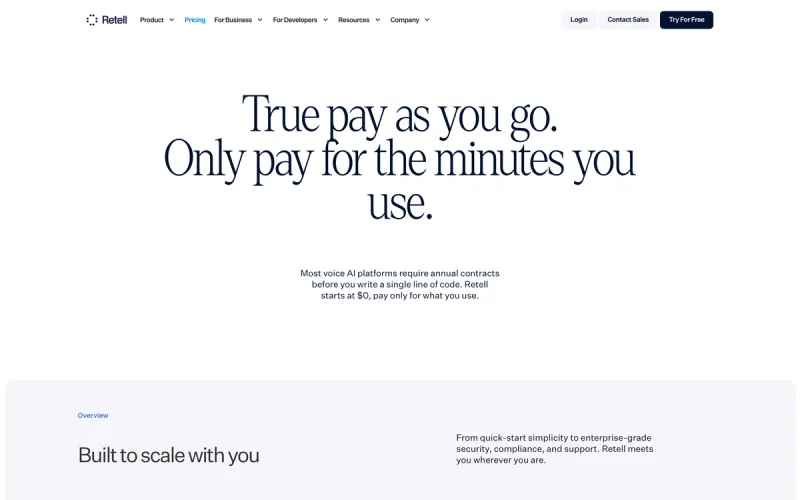
Retell AI
Developer-first voice infrastructure. Pricing starts at $0.07/min for the voice engine (STT + real-time response latency + TTS routing). LLM costs sit on top (~$0.003/min for a small model, $0.04-$0.06/min for GPT-4o or Claude). Telephony adds another ~$0.015/min. Realistic production cost: $0.13-$0.21/min for a standard mid-model deployment. Developer plan has no minimum, Business plan starts at $299/mo for telephony bundling and higher concurrency.
Where it wins: teams with engineering bandwidth who want to compose their own STT, LLM, and TTS stack. Where it loses, in my view: non-developer teams who think '$0.07/min' means $0.07/min.
Synthflow
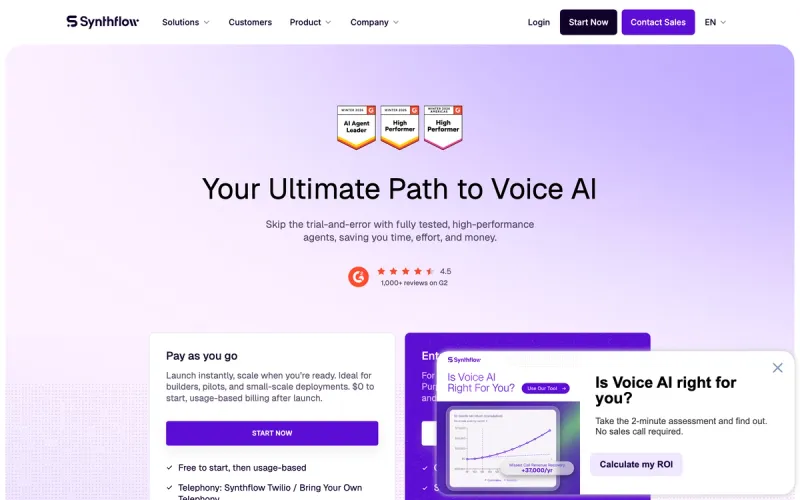
No-code voice agent builder. Dropped tiered plans in 2026 for pay-as-you-go: $0.09/min for the voice engine, ~€0.19/min for actual outbound calls. Pricing page shows the current breakdown. 5 concurrent calls included; extras at $20/slot/mo. Phone number is $1.50/mo. Some legacy reviews still reference old tiers (Starter $29/mo, Pro $99/mo, Growth $449/mo), those are gone.
Where it wins: small teams who want a visual builder, no engineering required. Where it loses: enterprises who need contract pricing predictability, which is the place I see most of these deals stall.
Vapi
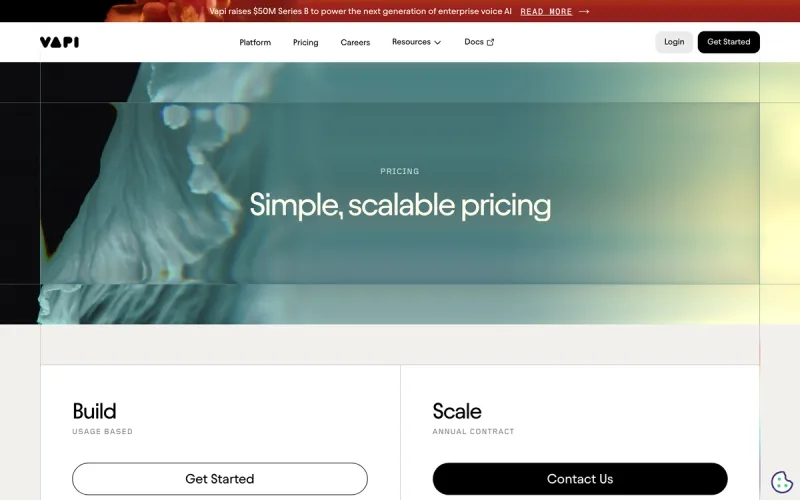
Voice orchestration platform. Pricing is a flat $0.05/min platform fee, plus separately billed STT (Deepgram Nova-2), LLM (your choice), TTS (ElevenLabs), and telephony (Twilio at ~$0.013/min per leg). A typical GPT-4o + Deepgram + ElevenLabs deployment lands at $0.30-$0.33/min total. Enterprise contracts run $3K-$6K/mo for moderate usage. Their docs are excellent. Their billing is opaque if you don't track every component.
Bland AI
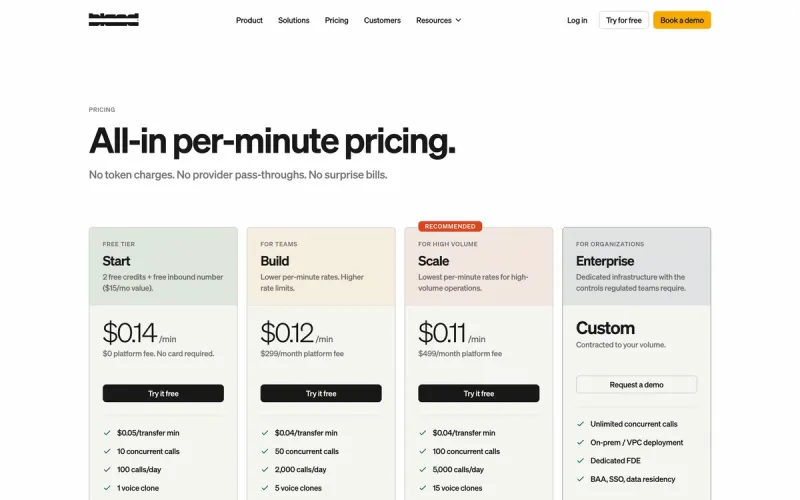
Programmable voice for high-volume teams. Billed $0.09/min for connected calls + $0.015 per outbound attempt under 10 seconds (rejected, busy, no-answer). Shifted to tiered subscriptions in 2026: Start, Build, Scale, starting at $299/mo. Pricing page buries extras: SMS is $0.02/msg, TTS character add-ons vary by plan, voice cloning is extra. Cold-call deployments at scale (10K calls/mo+) end up at $4K-$8K/mo all-in.
Air AI, the warning
Enterprise voice agent with a $25K-$100K upfront license plus $0.11/min outbound, $0.32/min inbound, plus Twilio telephony. Pricing only makes sense at 10K+ calls/mo with dedicated engineering. Critical context: in August 2025, the Federal Trade Commission filed a lawsuit against Air AI alleging deceptive claims about business growth, earnings potential, and refund practices. Until that case resolves, we'd advise against any new commitment to the platform, regardless of how impressive their demo looks.
11x Julian (formerly Mike)
11x renamed their phone agent from 'Mike' to 'Julian' in 2025. Pricing isn't public; demo-only sales motion; external estimates put it around $5K a month for managed deployment. Pairs with Alice, their AI SDR (email). For brands that want a fully managed agent and have the budget for enterprise contracts, in my view this is the white-glove option. Worth a demo if you want zero engineering involvement.
Dialpad Sell
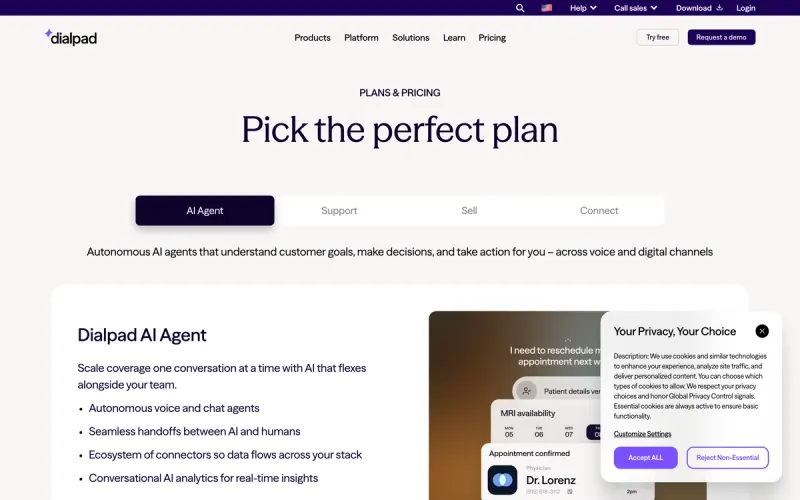
Hybrid product: AI dialer plus real-time AI coaching on human reps. Pricing is $39/user/mo (Essentials), $95/user/mo (Advanced), $150/user/mo (Premium). Annual billing saves 15-20%. There's a mandatory regulatory recovery fee (~$4-$5/user/mo). The AI coaching layer (real-time battlecards, sentiment detection, post-call summary into your CRM) is the underrated part of the product.
Aircall (with AI add-ons)
Cloud-based phone system with AI features bolted on (transcription, summaries, sentiment). Starts at $30 per user per month for Essentials, $60 for Professional, $80 for Enterprise. AI add-ons are a la carte. If you're already on a cloud PBX and want to layer AI without ripping anything out, I'd point you here. It's not a true AI cold-calling platform; it's an AI-augmented one.
The cost-per-meeting math: AI vs human SDR
Vendors love to compare per-minute AI calling to per-hour human SDR cost. That comparison is misleading, in my view, because it ignores conversion. The honest calculation accounts for the entire funnel from dial to booked meeting.
The standard benchmarks we use
- Average human SDR fully loaded cost: $80K-$130K/year (US-based). Per minute of available calling time (~600 dials/week × 2 min avg duration × 48 weeks): roughly $1.40-$2.30/min.
- Average AI voice agent all-in cost: $0.15-$0.30/min depending on stack (Retell + GPT-4o + Twilio is at the low end; Vapi + Claude + ElevenLabs Premium is at the high end).
- Human SDR connect rate (real conversation, not voicemail): 8-12% of dials.
- AI voice agent connect rate when calling cold: similar (~8-10%), because pickup rate is a function of phone, not who's calling.
- Human SDR meeting-book rate from connect: 12-18%.
- AI voice agent meeting-book rate from connect: 3-6% for cold opener calls. 18-25% for warm calls (re-engagement, scheduling confirms, qualification of inbound leads).
Run the math for opener calls (cold)
Per meeting booked, cold opener: AI agent costs ~$8-$15 (130-180 dial-min @ $0.20/min ÷ 0.08 connect rate × 0.04 book rate). Human SDR ≈ $32-$58 per meeting (130-180 dial-min @ $1.80/min ÷ 0.10 connect rate × 0.15 book rate). AI is ~3x cheaper per meeting, but the meetings AI books from cold opener calls show no-show rates of 45-65%, vs 18-28% for human-booked meetings. Once you net out no-shows, AI cost-per-attended-meeting is roughly $25-$45 vs $50-$80 for human. Still cheaper, but the gap closes from 3x to 1.5x.
Run the math for warm calls (re-engagement, voicemails, confirms)
Per meeting booked, warm: AI agent costs ~$3-$7 (45 dial-min @ $0.20/min ÷ 0.40 connect rate × 0.22 book rate). Human SDR ≈ $25-$40 per meeting at the same use case (because humans are slower at high-volume voicemail dropping and most teams won't dedicate a $100K SDR to scheduling confirmations). No-show rate on AI-booked warm meetings: 22-30%, similar to human. AI is 5-10x cheaper per attended meeting in warm-calling use cases. This is the math that makes deployment worth it.
The 5-10x gap
This is exactly why I think the deployment pattern matters more than the vendor choice. Pick the wrong use case and AI is barely worth it. Pick the right one and it pays for itself in three months.
The uncanny valley problem (the real blocker)
The compliance disclosure ('This is an AI assistant calling on behalf of ...') sits at the start of the call. Prospects hear it, half ignore it, half don't. The bigger problem, in my view, is what happens 15 to 30 seconds in, when the prospect either:
- Realizes mid-conversation they're talking to AI and feels manipulated (rare with good disclosure, more common when the agent's voice quality is high enough to fool them initially).
- Asks the agent a question it can't handle gracefully, and the agent loops, repeats, or generates a hallucinated answer.
- Notices the slight latency or audio compression that gives away the synthetic voice even when the script is good.
All three are the uncanny valley, and the result is the same: the prospect ends the call with a worse impression of your brand than if you'd never called at all. From what I've seen across the field and in published deployment writeups, callback rates from prospects who realized they were talking to AI mid-call run 60% to 80% lower than from prospects who knew it was AI from the start (because of disclosure) or who completed the interaction without ever noticing.
Three deployment rules that reduce uncanny-valley fallout
- Lead with the disclosure naturally, not legalistically. "Hey, this is Maya, I'm an AI assistant with [company] reaching out about [topic]. Got 30 seconds?" vs "This call is being made by an artificial voice on behalf of [legal entity name] for marketing purposes."
- Keep the script under 90 seconds total. The longer the AI talks, the more obvious it gets. Short scripts also book more meetings because they respect the prospect's time.
- Always offer a clean handoff to a human on demand. "If you'd rather talk to a real person, I'm happy to text you Sam's number, would that be useful?" gives the prospect an escape valve that doesn't feel like rejection.
What to deploy first: the 4 use cases that have ROI
If you're new to AI calling, my advice is to start with these in order. Each one builds on the operational rigor needed for the next.
1. Voicemail drops on no-answer
This is the lowest-risk deployment, in my view. Your AI agent dials, hits voicemail, drops a 25-second message with your name, your reason for calling, and a clear next step (link, calendar, callback). The prospect listens after the fact, which sidesteps interactive conversation, compliance complexity, and uncanny-valley awkwardness in one move. Voicemail-to-callback rates of 2% to 5% are normal. Cost: roughly $0.03 per drop including TTS and telephony.
Stack I've seen work in published writeups: Bland AI or Twilio plus ElevenLabs Standard plus a scheduling layer (Calendly link in the script). Total deployment time: a half day.
2. Inbound demo confirmation calls
Someone books a demo on your calendar. 24 hours before the call, an AI agent calls them to confirm. Conversion lift is 15% to 30% on show rates, in my read, because demos confirmed via call have higher psychological commitment than demos confirmed via email. The agent confirms the time, briefly restates the agenda, and asks if they want to invite anyone else. 60 to 90 second conversation. Cost: $0.20 to $0.40 per confirmed demo.
Stack: Synthflow or Retell plus your scheduling tool's webhook. The cost-benefit math is dramatic for any team running 20+ demos a week, which is when I'd start considering this seriously.
3. Dormant-customer re-engagement
This is where AI calling pairs with the CRM reactivation playbook, in my view the highest-ROI pairing in the category. Pull every closed-lost or churned account from the last 18 months (so the implied-consent rule covers you). AI agent calls each one with a short 'hey, calling back because we shipped X, does the original blocker still apply?' script. Connect rates run higher than for cold opener calls (warmer relationship). Meeting-book rate from connect, in the case studies I've reviewed, sits around 18% to 25%.
Pairs cleanly with our CRM reactivation playbook, same audience, just dialed instead of emailed.
4. Inbound qualification triage
New lead fills the demo-request form, the AI agent calls back within 60 seconds. Confirms intent, qualifies on two or three dimensions (company size, role, timeline), and either books a meeting directly or routes the lead to a human SDR. The speed-to-lead math here, in my experience, is dramatic: leads called within 60 seconds convert four to five times higher than leads called within five minutes. AI is the only way to hit that speed at any volume. Cost: $0.50 to $1.20 per qualified lead.
What's NOT on this list, intentionally
- Cold opener calls to net-new prospects with no relationship. Real-world AI book-rate on these is 3-6%, no-show rates are 45-65%, and brand damage from uncanny-valley moments compounds. Until vendor voice quality and latency improve another 2 generations, leave this to human SDRs.
- Discovery calls, demos, technical deep-dives, anything mid-funnel. AI can't read a buying committee dynamic. Don't try.
- Closing calls of any kind. Self-evident.
Common myths
Myth: AI cold calling is mostly illegal after the FCC's 2024 ruling.
Reality: the FCC ruling applied TCPA's artificial-voice rules to AI-generated voices. For B2C, that effectively kills consumer cold calling without prior express written consent. For B2B, the implied-consent doctrine for prior 18-month relationships and the looser rules for business-line calls leave plenty of legal lane, as best I can tell. Most B2B outbound programs running AI today are operating compliantly. The unlawful AI calling enforcement actions in 2024 through 2026 have been overwhelmingly B2C scams (voter calls, FEMA disaster fraud), not B2B sales.
Myth: AI agents now sound indistinguishable from humans.
Reality: ElevenLabs Premium and OpenAI's GPT-4o voice mode sound human for 8 to 15 seconds before pacing tells start showing, versus roughly 3 seconds in 2023, and a single greeting line will often pass for human. But hold a 60-second conversation with the agent and the latency, pacing, intonation drift, and conversational repair patterns give it away. The uncanny-valley moment usually arrives 15 to 40 seconds in, in my experience. Plan for the prospect to figure it out. Optimize the script and disclosure for that reality, not for the fantasy where they never notice.
Myth: Per-minute pricing of $0.05-$0.09 means a typical call costs $0.10-$0.20.
Reality: per-minute pricing covers the platform's voice engine only. Add STT (Deepgram, Whisper), LLM (GPT-4o or Claude), TTS (ElevenLabs), and telephony (Twilio at roughly $0.013 per minute per leg) and the real per-minute cost lands at $0.13 to $0.31, sometimes higher. Vapi's docs are honest about this. Bland AI and Air AI tend to bury the math, which is the part I'd push back on hardest in any procurement conversation. Always do the cost breakdown before signing a contract.
Myth: AI cold calling will replace SDR teams in 2026.
Reality: it will replace the bottom 30% to 40% of SDR work (voicemail drops, calendar confirmations, dormant-lead re-engagement, fast triage). The top 60% to 70% (discovery, social-engineering past gatekeepers, multi-call relationship building, anything requiring judgment) stays human for at least two or three more years, in my read. The teams I see winning with AI in 2026 are using it as an SDR force multiplier, not as an SDR replacement. They're running fewer SDRs, but the SDRs they have are doing the calls AI can't.
Myth: Air AI is just another platform option, comparable to Retell or Bland.
Reality: Air AI is the subject of an active FTC lawsuit (filed August 2025) alleging deceptive earnings claims, deceptive refund practices, and misrepresentation of business outcomes. I'd keep it off any active vendor recommendation list until the case resolves. Their $25K to $100K upfront license is also an outlier in a category where every other vendor offers usage-based pricing. Both reasons to wait, in my view.
Prompts you can use
Frequently asked questions
Is AI cold calling legal for B2B in the US?
Yes, with limits. Under TCPA, AI-generated voices are classified as 'artificial' since the FCC's February 2024 ruling. For consumer (B2C) calls, this requires prior express written consent. For business (B2B) calls, the implied-consent doctrine applies; you can call a business number if there's an established business relationship (a voluntary two-way communication in the prior 18 months). You still must disclose the AI identity at the start of the call, respect the National Do-Not-Call Registry, and avoid states with stricter mini-TCPA laws (Florida, Washington) without confirming their AI provisions.
How much does AI cold calling actually cost?
Headline per-minute rates ($0.05 to $0.09 a minute) cover only the platform's voice engine. Real production cost with STT (transcription), LLM (the brain), TTS (synthetic voice), and telephony layered in is $0.13 to $0.31 a minute depending on your stack. A 90-second call lands at $0.20 to $0.45 in raw infrastructure. Vendor monthly minimums (typically $299 a month for Retell Business and Bland Start) and per-seat fees (Dialpad at $39 to $150 per user per month) sit on top, which is what I think most teams forget when they model the cost themselves.
Will AI cold calling replace my SDR team?
Not in 2026, no. AI handles 30% to 40% of SDR work well today: voicemail drops, demo confirmations, dormant re-engagement, fast inbound triage. The remaining 60% to 70% (discovery, gatekeeper handling, multi-touch relationship building, anything requiring judgment) stays human for the foreseeable future, in my view. The teams getting real value from AI cold calling are using it as a force multiplier; fewer SDRs, but those SDRs only doing work AI can't do.
Which vendor should I start with?
Depends on your team. Engineering-led with custom flow needs → Retell AI. Non-developer team needing a visual builder → Synthflow. Hybrid AI dialer with human takeover → Dialpad Sell. High-volume voicemail/sequencing operations → Bland AI. Avoid Air AI until the FTC suit resolves. Avoid 11x Julian unless your budget supports enterprise contracts with no public pricing.
What's the biggest mistake teams make deploying AI calling?
Starting with cold opener calls, in my experience. The math doesn't work and the brand damage from uncanny-valley moments compounds across your ICP. I'd start with voicemail drops or demo confirmations, prove the operational rigor, then expand to dormant re-engagement, then qualification triage. By the time you've nailed those four use cases, your team has the deployment muscle to know whether to push further or stop.
How do prospects react when they realize it's AI?
It depends heavily on whether you disclosed it upfront. With a clear, natural disclosure at the start ('Hey, this is Maya, I'm an AI assistant with [company]'), prospects who continue the conversation are self-selecting for openness. With no disclosure or a buried legalistic one, prospects who figure it out mid-call disengage at 60% to 80% higher rates than prospects who knew from the start. Disclosure does two things at once, in my view: it keeps you compliant and it protects your brand from the same prospect telling ten peers they got duped.
Can AI agents handle objections?
Simple ones, yes. 'I'm busy' becomes a reschedule offer. 'Not interested' becomes a polite close with a callback opt-out. 'How did you get my number' references the prior interaction. Complex objections (technical questions, budget challenges, vendor comparisons) fail, in the deployments I've watched. The right design, as I see it, is to detect these via keyword and intent matching and hand off to a human SDR via warm-transfer or callback rather than letting the AI try to wing it.
What about voice cloning of our actual reps?
Technically possible (ElevenLabs and HeyGen both support it). Legally complex. California, Tennessee, and Texas have AI voice and likeness laws that require explicit written consent from the person whose voice you're cloning, even for a willing employee. Other states have similar laws pending. Practically: I'd skip the voice cloning unless your legal team has cleared it state by state. Use a generic synthesized voice with clear AI disclosure instead.
Sources
Every numeric claim and vendor reference cross-checked against current 2026 sources. Reviewed May 2026.
- FCC declaratory ruling, Feb 8 2024, AI-generated voices classified as "artificial" under TCPA. Foundation of the regulatory framework.
- FCC proposed rulemaking, July 2024, proposed enhanced AI-specific disclosure requirements (still in rulemaking as of May 2026).
- Retell AI pricing page, $0.07/min voice engine base + LLM + telephony layers. Business plan $299/mo+.
- Synthflow pricing page, current pay-as-you-go model, $0.09/min voice + ~€0.19/min outbound.
- Vapi pricing page, $0.05/min platform + STT/LLM/TTS/telephony billed separately.
- Bland AI pricing page, $0.09/min connected + $0.015/attempt under 10s, tiered subscriptions starting $299/mo.
- Dialpad Sell pricing, $39-$150/user/mo with annual billing discount.
- Aircall pricing, $30-$80/user/mo Essentials through Enterprise plus AI add-ons.
- Ringlyn 2026 voice agent pricing comparison, independent cross-vendor cost breakdown for STT/LLM/TTS layered costs.
- Auto Interview AI compliance guide 2026, TCPA, state-level mini-TCPA, and global AI calling regulation summary.
Honest bottom line
Honestly, AI cold calling is a real tool in 2026, and it's used wrongly by most teams that try it.
The vendors who promise autonomous AI SDRs that call cold prospects and book meetings at scale are, in my view, selling a use case that doesn't yet deliver positive ROI. Cold-opener math is too soft, no-show rates run too high, and the uncanny-valley brand cost is real enough to wipe out any margin you'd gain on volume.
The vendors who pitch AI calling as a multiplier on existing warm-call work (voicemail drops, demo confirmations, dormant re-engagement, fast inbound qualification) are selling a use case that delivers a 5x to 10x cost advantage with manageable risk. Those four deployments are where I'd recommend every team start.
If you remember three things from this article: (1) warm calls only, not cold opener; (2) B2B compliance is more permissive than the SERP consensus suggests, thanks to the 18-month implied-consent doctrine; (3) per-minute pricing is 2-4x the headline number once you add STT, LLM, TTS, and telephony. Verify the all-in cost against vendor demos before you sign.
Pick a vendor that fits your team (Retell for engineers, Synthflow for non-engineers, Dialpad for hybrid AI plus human flows, Bland for high-volume sequencing). Skip Air AI until the FTC suit clears. Start with one of the four use cases. Re-evaluate in six months when GPT-5-class voice models arrive and the calculus shifts again.